

Quick answer
Drishti is the South Indian name for the evil eye, the trouble believed to follow an admiring or envious look. Families answer it with an ash gourd at the door, a fierce painted face on a new building, a camphor aarti and red turmeric-and-lime water circled after an event. The red colour is ordinary chemistry, not a sign.
What is drishti?
Drishti is the South Indian word for the evil eye, the belief that a look full of admiration or envy can leave a mark on a person, a child, a house, a shop or a vehicle. The Sanskrit word simply means sight, and in Tamil, Telugu, Kannada and Malayalam homes it has come to mean the trouble that sight can bring: a baby off its feed after a crowded naming day, a bride exhausted after the reception, a new shop that goes quiet after a week of compliments.
It is the same idea North Indian families call nazar, with its own set of answers. Nazar and drishti removal covers the work Master Vijay Ram does when the household rites have not settled things; this page is about the rites themselves.
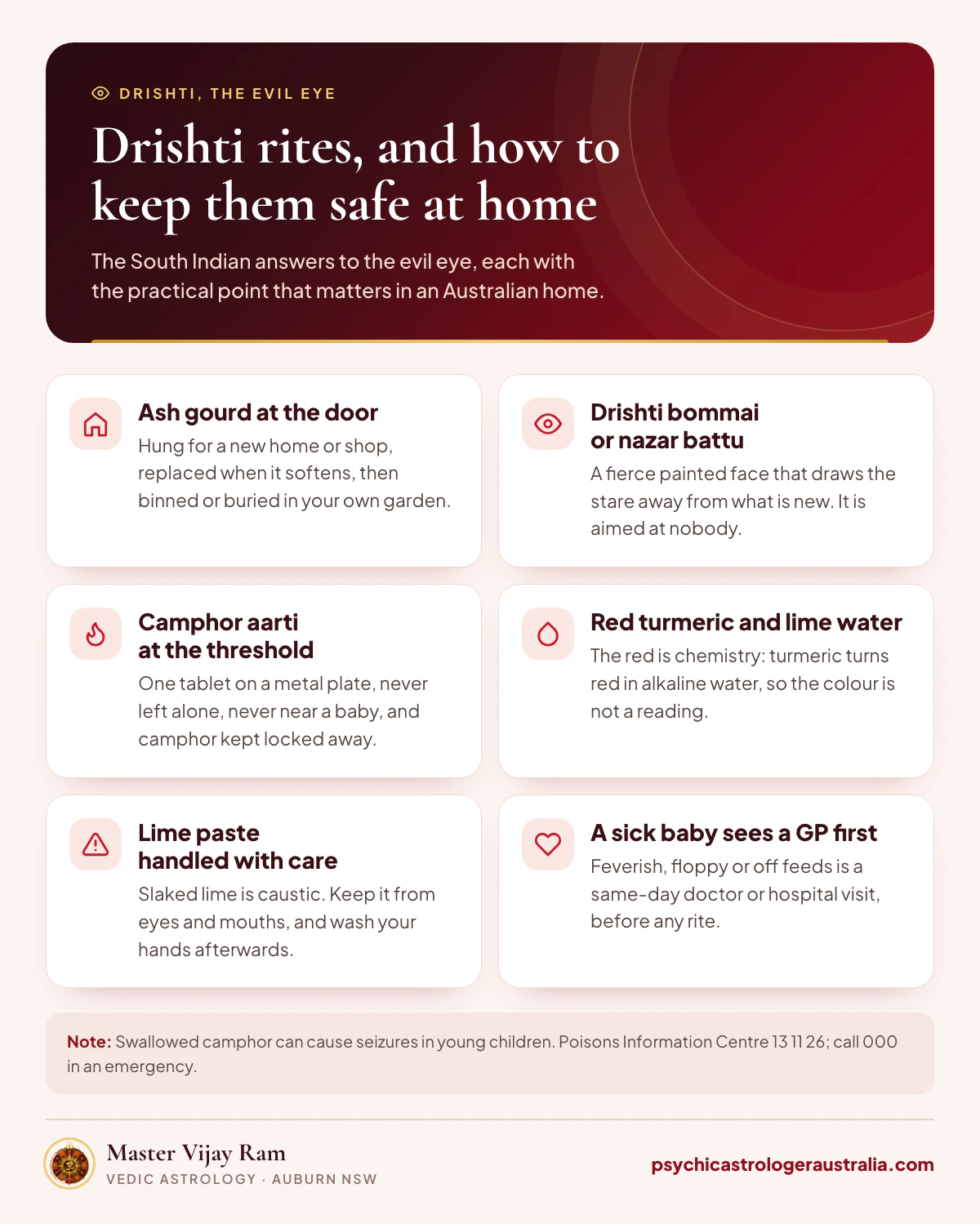
Drishti, dishti, kan drishti: are they the same thing?
Yes, with regional accents. Tamil families say drishti or kan drishti, from kan, the eye, and Telugu families usually say dishti; Kannada and Malayalam speakers have their own forms of the same word. All of them mean harm by a look, with no ritual and often no intention behind it.
That matters, because drishti is the lightest of the fears families bring. It is not seivinai, banamati or any deliberate harm worked through ritual, and keeping the two apart stops a household from turning a tired baby into a family accusation. Seivinai and suniyam in Tamil families explains the heavier words.
Why is an ash gourd hung at a new house or shop?
The ash gourd is the wax gourd, Benincasa hispida, a large pale-green vegetable with a white powdery bloom, known in Tamil as poosanikai and in Hindi as petha, the same vegetable that becomes Agra’s famous sweet. In Sanskrit it is kushmanda, and some temples offer it in place of an animal sacrifice, a rite known as kushmanda bali. Its size, its pale skin and its watery flesh have made it the classic absorber of drishti.
An ash gourd at the door is hung from a rope above the entrance of a house under construction, a new home after the griha pravesh, or a shop on its opening day, often painted with a fierce face or marked with kumkum and turmeric. When it begins to rot it is said to have done its work, and it is replaced or taken down.
Many families also break one: on Ayudha Puja during Navratri, after a house-warming, or before a new vehicle is first driven, the gourd is circled and then smashed on the ground, sometimes with kumkum pressed into a cut so that it looks like an offering. A griha pravesh for a new house can include the gourd if it belongs to your family’s custom.
What are drishti bommai and nazar battu faces?
A drishti bommai is a fierce painted face, bulging eyes, fangs and a lolling tongue, hung on a building site, a new house, a truck or a shop to catch the eye before the eye catches anything else. Telugu families call it a dishti bomma, and many Hyderabadi and Deccani homes say nazar battu; the face is the same idea under different names.
The logic is distraction, not aggression. A passer-by who stares at the grotesque face is not staring at the beautiful new house, and the face echoes the kirtimukha, the fierce face carved over temple doorways. It is aimed at no one, and that is why it is one of the gentlest protections in the tradition.
What happens in the camphor aarti after an event?
When someone returns from a wedding, a long journey, a hospital stay or their own birthday party, an elder of the family meets them at the door with a plate. On it there may be a lit camphor tablet, red water in a bowl, or both, and the plate is circled in front of the person, usually three times, before the water is poured out into the street or the drain and the camphor allowed to burn out.
Newlyweds are met this way, and so are babies coming home from the hospital and children after a school prize night. The rite says the day is over, the eyes of the crowd are left outside, and the person is home.
Why does turmeric and lime water turn red?
Because of chemistry, plainly and completely. Curcumin, the pigment that makes turmeric yellow, stays yellow in neutral or acidic water and turns red when the water becomes alkaline, and slaked lime, the white paste called chunnam or sunnambu, is strongly alkaline. Stir a pinch of turmeric and a dab of the paste into water and it turns deep red in seconds, every time, whoever mixes it.
The same reaction is why a turmeric stain on a kitchen bench goes reddish when it is scrubbed with soap. The red water is a beautiful custom, and it has been used for generations because the colour is striking, but the colour says nothing about how much drishti a person was carrying. Anyone who claims to read your trouble from how red the water turns is misreading a reaction any school laboratory could reproduce.
It is also the chemistry behind the bleeding lemon some fake healers produce at a session. The bleeding lemon and other tricks explains what to do if that happens to you.
Which lime: the fruit or the paste?
The English word causes confusion, because the drishti rites use two different limes. One is the citrus fruit, cut and circled over a person and thrown away outside, or set under the wheels of a new car. The other is slaked lime, calcium hydroxide, the paste sold at Indian grocers for paan and used in the red water.
The paste needs care. It is caustic, it can burn the eyes, and it does not belong anywhere near a child’s mouth, so use a tiny amount, keep the tin closed and high, and wash your hands afterwards; if any reaches an eye, rinse with running water and call the Poisons Information Centre on 13 11 26.
Is it safe to use camphor for drishti at home?
Only with real care. Swallowed camphor can cause seizures in young children, sometimes within minutes, and the Victorian Poisons Information Centre advises not keeping camphor blocks or camphorated oil in the house at all. If you keep any, lock it away, never put it on a child’s skin, and call 13 11 26 at once if a child may have swallowed some, or 000 if they are unwell.
Burn a single tablet on a metal plate, away from curtains, never left alone, and never cover or disable a smoke alarm for an aarti. For a baby, leave out the flame altogether: the red water circled at arm’s length, or a quiet prayer at the door, keeps the custom without smoke or heat near the child.
The rites at a glance
The table sets the main drishti rites beside the practical point that matters in an Australian home. Traditions differ from family to family, and none of these is required.
| Rite | When families use it | What it is said to do | Practical note |
|---|---|---|---|
| Ash gourd hung at the door | Building works, a new home, a shop opening | Absorbs the looks a new place attracts | Replace it when it softens; keep it off footpaths and common property |
| Ash gourd broken | Ayudha Puja, after a house-warming, a new vehicle | Takes the drishti and is let go | On your own concrete or driveway, swept up at once, never on a road |
| Drishti bommai or nazar battu | A house being built, a truck, a new shop | Draws the stare away from what is new | Fix it securely; strata or a landlord may need to agree |
| Camphor aarti | Return from a wedding, a trip or hospital | Closes the day at the threshold | One tablet, metal plate, never near a baby, camphor locked away |
| Red turmeric and lime water | Newlyweds, a newborn’s homecoming, a prize night | Lifts the eyes of the crowd | The red is chemistry; lime paste is caustic, so keep it from eyes and mouths |
| A lime cut and circled | After praise, a crowded event | Carries the drishti outside | Wrap and bin it; never leave it on a neighbour’s step |
The North Indian equivalents, salt circled over a person and a lemon with chillies at the door, are covered in nazar utarna with salt and chillies.
Where do you find an ash gourd in Australia, and what happens to it afterwards?
Indian grocers stock ash gourds, especially before Navratri and Pongal, and Asian grocers sell the same vegetable as winter melon, though often cut into pieces for soup. For hanging you want a whole one with its white bloom intact, and it will last longer in a southern winter than in a northern wet season.
When it is finished, it goes out with the household rubbish, wrapped, or into a hole in your own garden; a broken gourd is swept up straight away and dealt with the same way. Never put it in a creek, the sea or bushland, where it counts as littering, and never leave it on someone else’s footpath, where it frightens people who read it as something done against them.
Coconuts follow similar rules, with one difference worth knowing: an offered coconut is eaten, while an ash gourd used for drishti never is. Why a coconut is circled and broken explains that distinction.
When is it more than drishti?
A baby who is feeding poorly, feverish, unusually sleepy or floppy goes to a GP or a hospital that day, before any aarti. An adult who has been flat for weeks after a wedding season may be exhausted, anaemic or low, and a GP visit comes first there too.
The rites are meant for once, after an event. If a household finds itself repeating them weekly, if the heaviness lands again almost as soon as the water is poured away, or if more than one person at home is struggling, that calls for drishti removal by someone who reads the pattern rather than another round of the custom.
What if Hindi is not your family’s language?
Consultations with Master Vijay Ram are in English, Hindi or Punjabi. For Tamil-, Telugu-, Kannada- or Malayalam-speaking elders, a son, daughter or grandchild on the same call can interpret, and the words drishti and dishti need no translation in a reading. Consultations in Hindi and Punjabi explains how calls run when more than one language is at the table.
The consultation costs $50, whether by phone, video or WhatsApp. Where a nazar shanti is warranted, it starts from $250, the figure is agreed before he begins, and he performs it himself at his Auburn place of practice; pujas performed personally in Auburn describes how the family joins.
Drishti customs in Darwin, Cairns and Townsville
The tropical north is hard on ash gourds: in the wet season a gourd hung at a Nightcliff or Edge Hill doorway softens in days, so families there replace it more often or keep a painted face instead. Darwin’s Tamil and Sri Lankan families have had the Sri Sithy Vinayakar Temple at Malak for more than four decades, and an archanai there sits comfortably beside any home rite.
Families in Cairns, Townsville, the Central Coast, Sydney and Melbourne consult the same way as readings for Darwin clients do, by phone, video or WhatsApp. Darwin never changes its clocks, so mention your local time when booking, and note that face-to-face appointments happen only at Auburn.
What drishti rites cannot do
They cannot treat a fever, mend a business with no customers, or tell you who looked at you with envy. The colour of the water, the speed at which a gourd rots and the shape a camphor flame makes are not diagnoses, and nobody should be charged for reading them.
What the rites can do is mark the end of a big day, give a worried grandmother something gentle to do with her love, and send the family to bed settled. All of it is faith and custom, offered with no guarantee, and none of it stands in for medical, legal or financial advice.
Read next
- Evil Eye Removal in Melbourne: Nazar Utarna for Victorian FamiliesEvil eye removal in Melbourne: the signs Victorian families describe, nazar utarna at home, and how Master Vijay Ram …
- Nazar on a New Car, a New Phone or a New Job: The Modern Evil EyeNazar on a new car, phone or job: what the evil eye tradition says about new things, what to rule out first, and the …
- Taweez & Kavach for Protection: Real Ones vs FakesHow to tell a genuine taweez or kavach from a fake: what belongs inside one, what never should, which option suits yo…
Frequently asked questions
What is drishti in Tamil and Telugu families?
Drishti, or kan drishti in Tamil and dishti in Telugu, is the evil eye: trouble believed to follow an admiring or envious look at a person, a baby, a house, a shop or a vehicle. It involves no ritual and usually no intention, which makes it lighter than seivinai or banamati. Families answer it with simple home rites such as an ash gourd, a camphor aarti or red water.
Why do people hang an ash gourd in front of a house?
The ash gourd is believed to absorb the looks a new house or shop attracts, so it is hung above the entrance during building works, after a griha pravesh or on a shop’s opening day, often painted with a fierce face. When it softens or rots it is said to have done its work and is replaced. Once it is finished, Australian families wrap it for the rubbish bin or dig it into their own garden.
Why does turmeric water turn red with lime?
Curcumin, the pigment in turmeric, is yellow in neutral or acidic water and turns red in alkaline water. Slaked lime, the chunnam or sunnambu paste sold for paan, is strongly alkaline, so the mixture turns deep red within seconds every time. The colour is chemistry, not a measure of drishti, and anyone reading meaning into how red it turns is misreading a simple reaction.
What is a drishti bommai?
A drishti bommai is a fierce painted face with bulging eyes, fangs and a long tongue, hung on a building site, a new house, a shop or a truck. Telugu families call it a dishti bomma and many Hyderabadi homes say nazar battu. The idea is distraction: the grotesque face catches the stare before the new building does. It is aimed at nobody and harms nobody.
Is camphor safe to use for drishti at home?
Used carefully by adults, a single tablet burnt on a metal plate is the traditional way, but camphor is dangerous to children. Swallowed camphor can cause seizures in young children within minutes, and the Victorian Poisons Information Centre advises not keeping camphor blocks in the house. Lock any camphor away, never use it near a baby, and call 13 11 26 if a child may have swallowed some.
Where can I buy an ash gourd in Australia?
Indian grocers stock ash gourds, particularly before Navratri and Pongal, and Asian grocers sell the same vegetable as winter melon, though often cut into pieces. For hanging at a door you need a whole gourd with its white powdery bloom intact. In the tropical north a hung gourd softens quickly in the wet season, so families there replace it often or use a painted face instead.
What do I do with the ash gourd afterwards?
Wrap it and send it out with the household rubbish, or dig it into a corner of your own garden. A gourd broken for a vehicle or a house-warming is swept up at once and treated the same way. It never goes into a creek, the sea or bushland, where it counts as littering, and it is never left on anyone else’s footpath, where it can frighten people.
Can I consult Master Vijay Ram if my parents speak only Tamil or Telugu?
Yes. The consultation itself runs in English, Hindi or Punjabi, so a son, daughter or grandchild joins the call to translate for elders who speak Tamil, Telugu, Kannada or Malayalam, and words such as drishti and dishti need no translation in a reading. It costs $50 by phone, video or WhatsApp, and any shanti that follows starts from $250 and is agreed first.
When should drishti be treated as something medical?
Whenever a baby is feeding poorly, feverish, unusually sleepy or floppy, or an adult has been unwell or low for weeks. Those go to a GP or a hospital first, the same day for a baby, and any aarti waits. Drishti rites are meant to be done once after an event, and heaviness that keeps returning is a reason to look harder, not to repeat the rite.
People also ask
How do you remove drishti at home?
Families usually do one gentle rite once: red turmeric-and-lime water or a lit camphor tablet circled before the person at the door, a lime cut and circled then thrown away outside, or an ash gourd hung or broken for a new house. Keep camphor away from children and babies, keep lime paste out of eyes, and see a GP first if anyone is actually unwell.
What is the difference between drishti and nazar?
They are the same belief in different languages: drishti is the South Indian word, from the Sanskrit for sight, and nazar is the Hindi and Urdu one. The answers differ by region. South Indian families reach for the ash gourd, the drishti face, camphor and red water, while North Indian families tend to circle salt or chillies and hang a lemon with chillies.
Why is a pumpkin broken on Ayudha Puja?
The vegetable usually broken is the ash gourd, often called a white pumpkin. On Ayudha Puja during Navratri families circle it before their vehicles, tools and shops and then smash it, sometimes with kumkum pressed into a cut, to let go of the drishti gathered over the year. In Australia, break it on your own driveway and sweep it up at once, never on a road.
Is the red aarti water a sign of evil eye?
No. Turmeric turns red in alkaline water, and the slaked lime used in aarti water is strongly alkaline, so the water turns red every time, for everyone. The custom is lovely and old, but the depth of the colour reflects how much turmeric and lime went in, not how much drishti a person was carrying.
References & further reading
Serving clients across Australia
Confidential consultations by phone, video & WhatsApp — including: