

Quick answer
A coconut, or shriphal, is used in Hindu worship because its hard shell is read as the ego and its white kernel as the pure self. In nariyal utarna it is circled over a person and discarded unopened or broken outside; at a temple or a new venture it is broken and shared. An utarna coconut is never eaten.
Why does the coconut appear in so many Hindu rites?
The shriphal is the coconut used in worship, and its name means the fruit of Shri, the goddess of auspiciousness. It sits on top of the kalash at a griha pravesh, it is broken before a new shop opens, it is offered at almost every temple, and in many households it is circled over a person to lift nazar. Few objects travel so easily between the sacred and the everyday, and that is part of the reason it is trusted.
It is also practical. A coconut keeps for weeks, carries its own clean water, and needs no knife to offer whole, which made it the natural gift to bring to a shrine in any season. Evil eye and nazar removal draws on the same household customs when a family’s own practice has not settled things, and this page explains the coconut’s part in them.
What do the three eyes, the shell and the water stand for?
Look at the end where the fibres meet and you will find three dark marks, the germination pores, and many families say they recall the three eyes of Shiva. The usual teaching takes the rest of the fruit apart in the same way: the rough husk and the hard shell are the ego, the white kernel is the pure inner self, and the water is the devotion stored inside.
Breaking a coconut before a deity therefore means breaking pride and offering what is left. That reading explains the coconut puja meaning better than any claim of special power: the act is a small surrender made with the hands, and the person who breaks it is as much the offering as the fruit.
Not every family uses the same words for it, and some simply say the coconut is the purest fruit because nothing has touched its insides. Traditions differ, and none of them requires a particular explanation before the offering counts.
What is nariyal utarna, and how do families do it?
Nariyal utarna is a folk practice of taking off nazar with a whole coconut. A family elder holds the coconut, husk and all, and circles it over the person from head to feet, usually seven times, while saying a prayer or the person’s name, and the coconut is then taken out of the house. In India it often ends at a crossroads, a fire or a river, depending on the family.
It is used after a child has been praised too loudly, after a wedding or a crowded party, or when someone comes home from hospital, and it is done once. Like the salt, lemon and chilli methods in nazar utarna with salt, lemon and chillies, it is a household reset rather than a cure, and repeating it night after night turns a custom into a worry.
The thinking behind the coconut for nazar is the same as behind every utarna: something passes over the person, takes the heaviness, and leaves the house with it. That is why the coconut is never eaten, kept or offered at the altar afterwards.
Why is a coconut broken at a temple or a new venture?
A breaking coconut ritual marks a beginning. Families break one at the temple before a journey, an exam or a wedding, in front of a new shop on the morning it opens, and in front of a new car before its first drive; Tamil families know the forceful version, in which the coconut is thrown down hard on stone before Ganesha so that it shatters, as sidharu thengai. The sound and the split are the point: something closed is opened, and a start is declared.
For a car the coconut usually comes with lemons under the tyres and a tilak on the bonnet, a sequence already set out in nazar on a new car, phone or job. For a business, the coconut is broken at the threshold after a Ganesha prayer, and the pieces are shared with whoever is there to open the doors.
What is the coconut on the kalash?
A kalash is a pot of water, usually brass or copper, with mango leaves fanned around its mouth and a coconut set on top, tuft upward, often wrapped in red cloth and tied with kalava. Together they make the purna kumbha, the full pot, and the coconut is treated as the head of the deity invited into it. It is the coconut most families meet at a griha pravesh, a wedding or Navratri.
What happens to it afterwards differs between families. Some break it at the end of the puja and share it as prasad, some keep it at the altar until the next festival, and some let it dry and then return it to the earth; your family priest or the griha pravesh home blessing you booked will follow your custom.
What happens to the coconut afterwards?
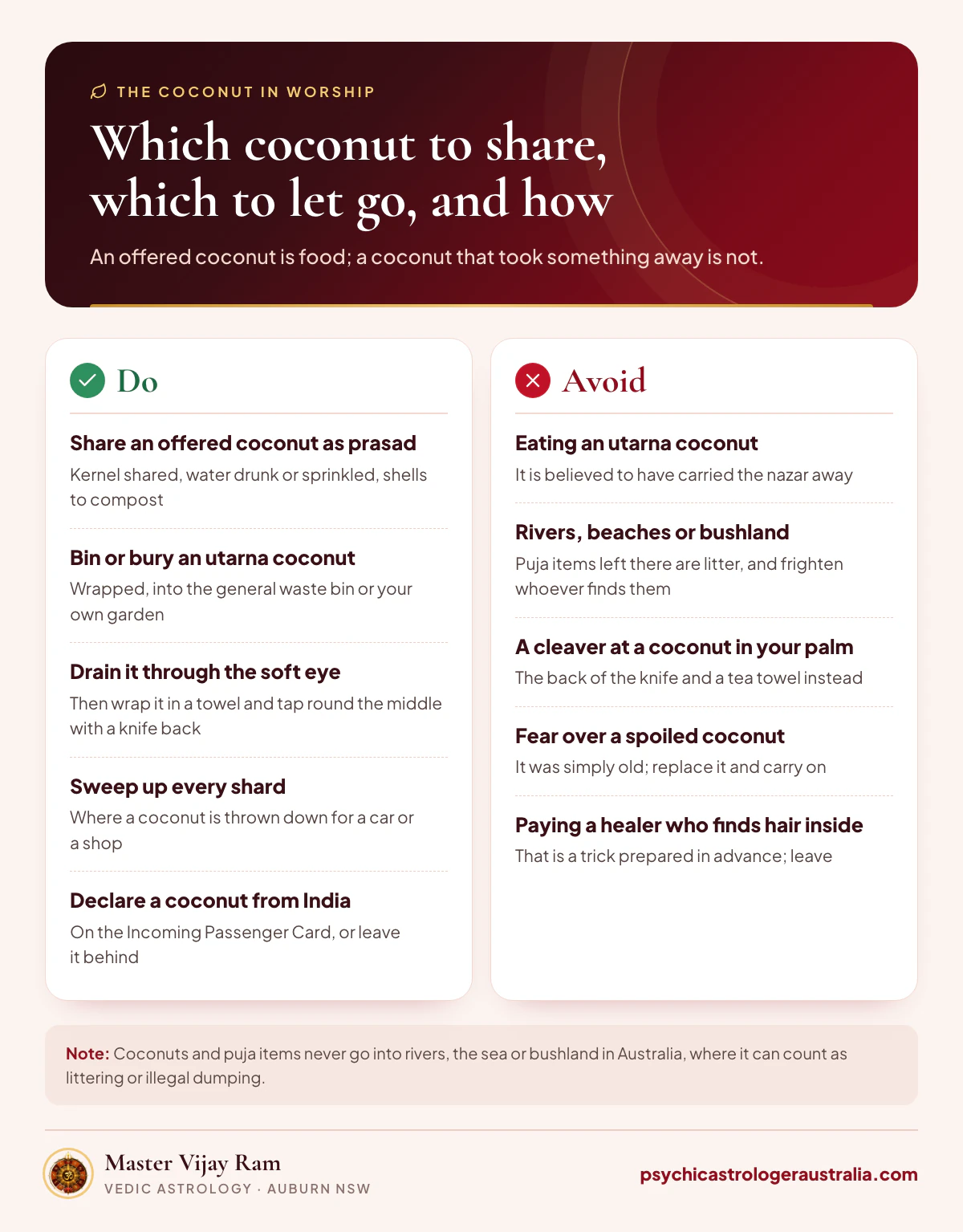
The rule of thumb is simple: a coconut that was offered is food, and a coconut that took something away is not. The table sorts the usual cases.
| Coconut | Eaten? | What families do with it | Never |
|---|---|---|---|
| Broken at the temple or at the altar | Yes, as prasad | Share the kernel; drink or sprinkle the water; shells to compost or the green bin | Thrown away uneaten as if it were rubbish |
| On a kalash | Depends on the family | Shared at the end, kept till the next festival, or dried and buried in the garden | Floated in a river or left on a beach |
| Used in nariyal utarna | No | Wrapped and put in the general waste bin, or buried in your own garden | Eaten, kept indoors, or left at a crossroads |
| Broken for a new car or shop | Yes, usually | Pieces shared with the people present; every shard swept up | Left in a car park for others to step on |
| Found at your door or gate | No | Gloves or paper, wrapped, into the outside bin; the step washed | Kept, eaten or returned to anyone’s property |
Coconuts, flowers and other puja items never go into rivers, the sea or bushland in Australia, where it can count as littering or illegal dumping. Disposing of flowers and puja items covers the rest of the altar.
How do you break a coconut safely?
At home, drain it first: one of the three eyes is soft, and a skewer pushed through it lets the water run into a cup. Then wrap the coconut in a tea towel, hold it over a bowl, and tap firmly round its middle with the back of a heavy knife or a hammer, turning it after each strike until a crack runs all the way round and it opens in two.
Never use the sharp edge of a cleaver on a coconut held in your palm; that is how fingers are cut at kitchen benches every festival season. Where a coconut is thrown down to shatter, do it on concrete or a temple stone, away from bare feet and children, and pick up every piece of shell afterwards.
Puja coconuts with the tuft left on are sold at Indian grocers, and supermarket brown coconuts serve just as well for an offering. A coconut that opens grey, dry or sour inside was simply old, and replacing it and carrying on is the sensible response.
Does a spoiled coconut mean something bad?
Families read it in different ways. Some say a rotten coconut at a puja is a poor omen, others that it has absorbed a trouble that would otherwise have landed, and many simply buy another. A coconut is a fruit that ages in storage and transit, and an Australian summer does it no favours.
No rite needs to be repeated or paid for because a coconut was spoiled. If a healer breaks a coconut and finds hair, a nail or red liquid inside, that is a trick prepared in advance, and the right response is to leave.
Can you bring a temple coconut back from India?
Fresh and dried fruit is among the things Australian biosecurity treats as a possible risk, so a coconut prasad in a suitcase needs to be declared on the Incoming Passenger Card or left behind. Declared items that pose no risk are handed back; others are taken.
Most families find it simpler to eat the prasad in India and offer a fresh coconut at their own temple here. The blessing is in the offering, not the particular fruit.
When does a coconut ritual stop being enough?
When the same heaviness returns within days every time, when several people in the house are affected, or when a coconut has been circled over someone weekly for months. At that point repeating it feeds the worry it was meant to settle, and a reading of the pattern makes more sense than another coconut.
A child who is unwell, off food, feverish or unusually sleepy sees a GP that day, before any utarna. Folk practice sits beside medical care, never in place of it.
What does Master Vijay Ram do, and what does it cost?
He does not sell coconuts or perform utarna by post. For $50 he will talk it through with you on the phone, on video or over WhatsApp, in English, Hindi or Punjabi, and look at whether the trouble follows a pattern in the chart or simply a hard few weeks.
Where a nazar shanti or a puja is warranted, he performs it himself at Auburn on a chosen muhurat, and the price, from $250, is settled before anything begins. A puja performed in Auburn explains how families join by video, and the ash gourd and drishti rites cover the South Indian customs that sit beside the coconut.
Coconut customs from Canberra to the Sunshine Coast
The waterways rule matters most in the places families love. A coconut floated on Lake Burley Griffin, left on the bank of the Derwent in Hobart, dropped into Corio Bay at Geelong or set on the sand at Mooloolaba is rubbish to everyone who finds it, and a frightening sight to anyone who reads it as a curse.
Callers from Newcastle, Wollongong and the Sunshine Coast are looked after exactly like readings for Canberra clients, over the phone, on video or through WhatsApp, and anyone wanting to meet in person comes to Auburn by appointment.
What a coconut cannot do
It cannot cure an illness, lift a curse by itself, fix a business or prove that anyone wished you harm. It cannot be guaranteed, and nobody should charge a family for the coconut or for the reading of what it looked like inside.
Used simply, a coconut marks a beginning, expresses a surrender, and gives a household a gentle way to close a hard day. This is faith-based guidance, not medical, legal or financial advice, and the coconut is at its best used simply and then let go.
Read next
- Energy Cleansing for a Car, a Shop and a Rental PropertyEnergy cleansing for a new car, a shop and a rental property: what the customs do, what a tenant may and may not do, …
- Winter Heaviness & Low Energy: A Seasonal Cleansing GuideWinter heaviness and low energy in Australia: how to tell a flat, dark season from something spiritual, what to chang…
- Broken Mirrors, Cracked Glass and Things That Keep Breaking at HomeA broken mirror or a run of breakages at home: the physical causes first, what Hindu folk belief and vastu say, safe …
Frequently asked questions
Why is a coconut circled over a person?
In nariyal utarna a family elder circles a whole coconut over a person from head to feet, usually seven times, to take off nazar after praise, a crowded event or an illness. The coconut is believed to take the heaviness with it, so it is carried out of the house and never eaten. It is a household custom done once, not a cure, and an unwell child sees a doctor first.
Can you eat a coconut used for nazar utarna?
No. A coconut used to take off nazar is treated as having carried something away, so it is not eaten, kept indoors or offered at the altar. In Australia it is wrapped and put in the general waste bin or buried in your own garden. A coconut broken at a temple or an altar is different: that one is prasad, and it is shared and eaten.
What does breaking a coconut mean in Hinduism?
It is usually explained as breaking the ego: the hard shell is pride, the white kernel the pure self and the water the devotion inside, so cracking it before a deity offers what lies under the shell. Practically it marks a beginning, which is why coconuts are broken before journeys, at temples, at shop openings and before a new car is first driven.
What is done with the coconut on a kalash after the puja?
Customs differ. Some families break it at the end of the puja and share it as prasad, some keep it on the altar until the next festival, and some let it dry and then bury it in the garden. All of these are respectful. What it should never do is float down a river or be left on a beach, where it counts as litter.
Where do I throw a coconut after a puja in Australia?
Shells from an offered coconut go to compost or the council green bin once the kernel has been shared. A coconut used for nazar utarna is wrapped and put in the general waste bin or buried in your own garden. Rivers, the sea, bushland and crossroads are never the answer here: dumping puja items can be littering or illegal dumping, and it frightens people who find them.
How do I break a coconut without hurting myself?
Push a skewer through the soft eye and drain the water first. Wrap the coconut in a tea towel, hold it over a bowl and tap firmly round the middle with the back of a heavy knife or a hammer, turning it after each strike until it splits. Never swing the sharp edge of a cleaver at a coconut held in your palm, and keep children well back.
Is it a bad sign if the coconut is rotten inside?
Families read it differently: some see a poor omen, others say the coconut absorbed a trouble that would otherwise have landed, and many simply fetch another. A coconut ages in storage and transit, especially in an Australian summer, so a spoiled one usually means an old one. Nothing needs to be repeated or paid for because of it.
Can I bring a coconut prasad back from an Indian temple?
Fresh and dried fruit is treated as a possible biosecurity risk, so a coconut in your luggage must be declared on the Incoming Passenger Card or left behind. Declared items that pose no risk are handed back. Many families eat the prasad in India and offer a fresh coconut at their temple in Australia, which keeps the custom without the queue at the airport.
Does Master Vijay Ram use coconuts in his work?
Coconuts appear in the pujas he performs, as they do in most Hindu rites, but he sells no coconuts and does not perform utarna by post. A $50 consultation looks at whether a family’s trouble follows a pattern or a hard season. Where a nazar shanti or puja is warranted, he performs it himself in Auburn, from $250, with the figure agreed before it begins.
People also ask
Does coconut remove negative energy?
In folk practice a whole coconut circled over a person is believed to take nazar and heaviness away with it, and many families use it after praise, a wedding or an illness. It is a household custom rather than a proven remedy, done once and then discarded outside. If the heaviness keeps returning, a reading of the pattern makes more sense than repeating it.
Why is coconut called shriphal?
Shriphal means the fruit of Shri, the goddess of auspiciousness and plenty, and the name reflects the coconut’s place in nearly every Hindu rite: on the kalash, at the temple, at weddings and at new beginnings. Many families also point to its three eyes, which they connect with Shiva, and to its untouched insides, which make it a pure offering.
What is nariyal utarna?
Nariyal utarna is a folk way of taking off nazar with a coconut. The coconut is circled over the person from head to feet, usually seven times, with a prayer or the person’s name, and then taken out of the house and disposed of. It is never eaten. In Australia it goes in the general waste bin or is buried in your own garden.
Why do Indians break a coconut before a new car?
Breaking a coconut declares a beginning and offers the first act of the car’s life to the deity, usually Ganesha. It comes with other customs, such as lemons placed under the tyres and a tilak on the bonnet, and a slow first drive. Break it on concrete away from people, sweep up every piece of shell, and share the kernel as prasad.
References & further reading
Serving clients across Australia
Confidential consultations by phone, video & WhatsApp — including: