

Quick answer
Phitkari is potassium alum, the crystal barbers use on shaving cuts and villages use to settle muddy water. Many families circle a lump over a person and drop it on coals to lift nazar, or keep a piece in the bathroom. It is a harmless custom used carefully, but the melted shape is only melting, and it names nobody.
What is phitkari, and why do families use it against nazar?
Phitkari is the Hindi name for potassium alum, a colourless mineral salt that forms clear, glassy crystals, and it has sat in Indian households for generations as both a practical tool and a folk protection. Grandmothers reach for it after a crowded wedding, shopkeepers keep a lump near the till, and many bathrooms hold a piece in a small bowl. Its reputation as a cleanser of the unseen grew out of what it visibly does to water, skin and smells.
Families who use phitkari for negative energy are usually doing one of three things: circling it over a person and burning it, keeping it in a room, or adding it to bath water. Each has a practical side and a limit, and nazar and evil eye removal is where Master Vijay Ram comes in once a household custom has run out of road.
What is alum actually used for?
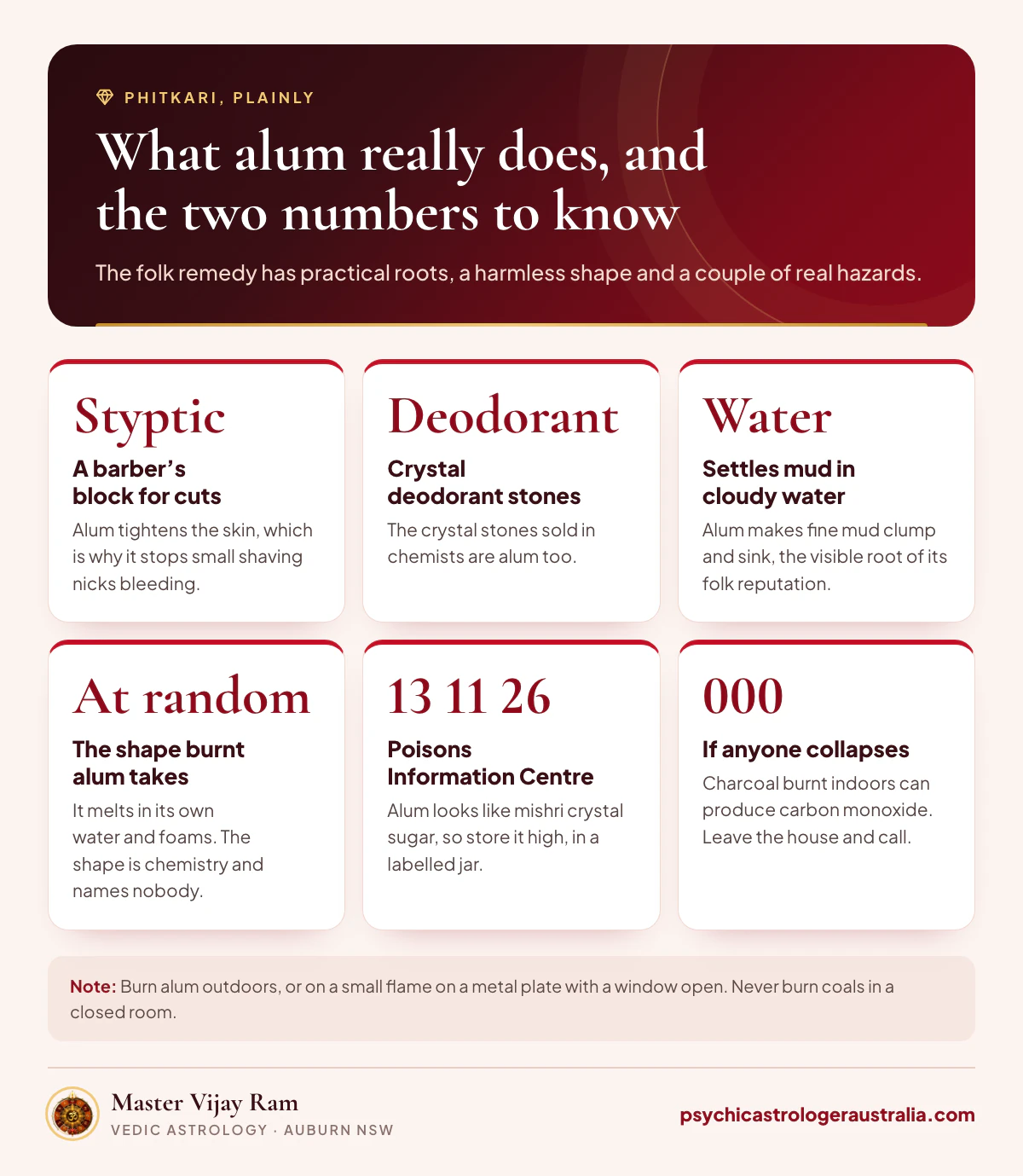
Three ordinary jobs explain most of its reputation. Barbers rub an alum block over shaving nicks because it is a styptic, tightening the skin so small cuts stop bleeding; the crystal deodorant stones sold in chemists are alum too; and alum has long been used in water treatment, because it makes fine mud clump together and sink.
That last use is the root of the folk idea. Swirl a lump of phitkari in a bucket of cloudy village water and within an hour the mud has dropped to the bottom and the water above is clear, so it is easy to see how alum became the mineral that clears what is murky. The tradition took a real, visible effect and extended it to the invisible.
How is phitkari used in nazar utarna?
In phitkari nazar utarna, an elder passes a lump of alum around the person seven times in most families, from the crown of the head down to the feet, and then drops it onto glowing coals or into a flame. The alum hisses, bubbles and swells into a white, crusty shape, which many families then study before the remains are thrown away outside. Some add mustard seeds or a dried chilli to the coals at the same moment.
It is done once, after an event: a wedding, a child’s first birthday, a promotion everyone heard about. The salt, lemon and chilli versions of the same rite are set out in nazar utarna with salt and lemon, and the alum form follows the same logic as every utarna: the material carries off the weight of the day and is then destroyed.
What does the melted shape really show?
It shows melting. Potassium alum crystals hold a great deal of water inside them, so when a lump is heated it first melts in that water, then boils it off, foaming and puffing up into a light white mass that sets in whatever form the heat, the bubbles and the shape of the coal happened to give it. Two lumps from the same packet, burnt side by side, come out differently every time.
People then see faces, figures and animals in the result, just as they see faces in clouds and in the front of a car; psychologists call that pareidolia. The result is no diagnosis, and the custom becomes harmful the moment a family looks at a lump that resembles a woman with long hair and decides it is an aunt, a sister-in-law or a neighbour.
Master Vijay Ram is firm about this. No reading of alum, wax, eggs or lemons names anyone, and a household that starts to suspect a relative from a burnt crystal has turned a gentle custom into a family rift.
Is it safe to burn alum indoors?
The alum is the smaller risk; the coals are the bigger one. Burning charcoal indoors produces carbon monoxide, which is colourless and odourless and causes headaches, dizziness and nausea, and a closed room with a coal pot is exactly where it builds up. If anyone collapses, leave the house and call 000.
Heated alum also spits hot droplets and gives off steam and acrid fumes that catch in the throat, so faces stay well back and anyone with asthma stays out of the room. If the family keeps the custom, do it outdoors on a still evening, on a metal tray, with children and pets well clear; indoors, a small flame on a metal plate with a window open is safer than coals, and a smoke alarm is never covered or switched off for it.
Why do people keep alum in the bathroom or by the door?
The custom of alum in the bathroom, which many vastu guides repeat, holds that a bowl of phitkari in the bathroom or a lump by the front door absorbs heaviness from the house, and the piece is replaced when it turns cloudy or crumbles. Some shopkeepers tie a lump in a black cloth above the entrance. These are folk practices, traditions differ, and nothing bad follows if you never keep one.
A lump in a bowl is harmless where children and pets cannot reach it. A bathroom that smells musty or feels heavy, though, usually needs a working exhaust fan and a look for mould behind the cabinet, which is a different job from a crystal; mould, damp and gas as real causes covers what to check first, and vastu for the home covers the layout questions families raise.
Should you add alum to bath water?
Some families add a pinch of phitkari to a bucket of bath water after a funeral, a hospital visit or a long journey, as a cleansing bath. Alum is an astringent and drying salt, so it can sting broken skin, irritate eczema and make eyes smart, and it is no help at all to dry winter skin in Canberra or Hobart.
If you keep the custom, use a very small amount, keep it out of your eyes, rinse with plain water afterwards, and stop if your skin reacts. Never put it in a baby’s or a young child’s bath.
Why must phitkari be stored away from children?
Because a lump of alum looks almost exactly like mishri, the crystal sugar many families keep for prasad and for guests. A child who mistakes one for the other gets a mouthful of something bitter and astringent that can upset the stomach, and a larger amount swallowed is a matter for the Poisons Information Centre on 13 11 26.
Keep alum in a labelled jar on a high shelf, away from the sugar and the spices, and keep the bathroom bowl out of a toddler’s reach. Dogs and cats should not be licking it either.
The folk uses beside the facts
The table puts each folk use beside what alum actually does and the practical note for an Australian home. It is not a ranking of which custom works; it is a guide to keeping each one harmless.
| Folk use | What families say | What alum actually does | Practical note |
|---|---|---|---|
| Circled and burnt on coals | It lifts nazar, and the shape shows its source | Melts in its own water, foams and sets at random | Outdoors or on a small flame; coals indoors risk carbon monoxide; the shape names nobody |
| A bowl in the bathroom | It absorbs heaviness from the house | Sits there; it is not an air freshener | Out of reach of children and pets; fix the fan and the mould first |
| A lump by the door or till | It keeps envy at the threshold | Nothing measurable | Harmless; replace it when it crumbles |
| A pinch in bath water | It washes off the day after a funeral or a journey | Astringent and drying on skin | Tiny amounts, rinse after, never for babies or eczema |
| Swirled in cloudy water | It purifies | Settles mud, a real water-treatment use | Not a way to make water safe to drink at home |
Alum belongs to the wider family of household totke, the small folk charms families pass down. Harmless and harmful folk charms draws the line between the habits worth keeping and the ones never to touch.
When is phitkari not enough?
When the custom has been done and the heaviness is back within days, when the alum is being burnt weekly, or when several members of the household are struggling. A phitkari remedy repeated on a loop stops being a reset and becomes a way of keeping fear alive, and the household learns nothing from the tenth lump that it did not learn from the first.
Any unwell child goes to a GP before alum is lit, and an adult who has been low or exhausted for weeks does the same. After that, a reading of the dates and the chart says whether there is a pattern worth addressing, and what salt, lemon and chillies mean explains how the other household customs fit beside alum.
Does Master Vijay Ram burn alum for clients?
No. He does not burn alum for clients or read melted shapes, and he sells no crystals. His part is a $50 consultation, held in English, Hindi or Punjabi over the phone, on video or on WhatsApp, and it looks at the household’s dates and chart rather than at the alum.
If a nazar shanti is warranted, he performs it in person at his place of practice in Auburn, and the price, from $250, is confirmed with you before it goes ahead; a nazar shanti performed in Auburn explains how the family can join by video.
Phitkari from Brisbane to Hobart
The questions are the same everywhere. A family in Logan might ask whether the lump that came out looking like a face means something; a renter in Perth might want to know whether the bathroom bowl breaks the lease (it does not, but a scorched benchtop might); a household on the Gold Coast might have burnt alum on the balcony after a big birthday.
Readings for Brisbane clients are by phone, video or WhatsApp, the same arrangement that serves Adelaide, Canberra, Hobart, Perth and the Gold Coast. Queensland stays on standard time all year, so state your local time when booking, and appointments in person are held at Auburn alone.
What alum cannot do
Alum will not cure an illness, purify drinking water at home, reveal who envied you, or protect a house that has a real problem with damp, gas or money. No result from it can be guaranteed, and paying someone to burn it and interpret the shape is money wasted.
What phitkari can do is give a family a familiar, inexpensive way to close a crowded day, provided it is burnt outdoors, kept away from children and never used to point at a person. This is faith and custom offered for what it is, not medical, legal or financial advice.
Read next
- Coconut in Cleansing: Why a Nariyal Is Circled and BrokenWhy a coconut is circled over a person, broken at temples and set on a kalash, which coconut may be eaten afterwards,…
- Neem in Home and Body Cleansing: The Tradition and Safe UseNeem in Hindu home and body cleansing: Ugadi neem and jaggery, the neem bath, leaves at the door, why neem smoke stay…
- Signs of Negative Energy in Your Home & How to Clear ItSigns of negative energy in a home, the ordinary causes to rule out first, and how nazar, heavier interference and me…
Frequently asked questions
Does phitkari remove negative energy?
In folk practice many families believe it does: a lump circled over a person and burnt is said to lift nazar, and a piece kept in the bathroom or by the door is said to absorb heaviness. Alum’s real powers are physical, as a styptic, a deodorant and a salt that settles mud in water. Treat it as a harmless custom done carefully, not as a proven remedy.
How do you do nazar utarna with alum?
An elder moves a lump of phitkari in circles around the person, crown to feet, seven times in most households, then drops it onto glowing coals or into a flame, where it foams and sets into a white shape that is then thrown away outside. Do it once, outdoors or on a small flame with a window open, keep faces back, and keep children, pets and anyone with asthma away.
What does the shape of burnt alum mean?
Nothing beyond chemistry. Alum crystals hold a lot of water, so a heated lump melts in that water, boils it off and puffs up into a shape set by the heat, the bubbles and the coal underneath. Seeing a face in it is pareidolia, the same habit that finds faces in clouds. The shape never identifies who gave the nazar, and nobody should be suspected because of it.
Is it safe to burn alum on charcoal inside the house?
No. Charcoal burnt indoors can produce carbon monoxide, which is colourless and odourless and causes headaches, dizziness and nausea; if anyone collapses, leave the house and call 000. Heated alum also spits and gives off fumes that catch in the throat. Keep the custom outdoors on a still evening, or use a small flame on a metal plate with a window open.
Why do people keep alum in the bathroom?
It is a folk vastu custom: a bowl of phitkari in the bathroom is said to absorb heaviness, and it is replaced when it turns cloudy or crumbles. It is harmless out of reach of children and pets, but it does not freshen the air. A bathroom that smells musty or feels heavy usually needs a working exhaust fan and a check for mould behind the cabinets.
Can I put phitkari in my bath water?
A tiny pinch is a custom some families keep after a funeral or a journey. Alum is astringent and drying, so it can sting broken skin, irritate eczema and make eyes smart. Use very little, keep it away from your eyes, rinse with plain water afterwards, and stop if your skin reacts. Never put it in a baby’s or a young child’s bath.
What if a child swallows a piece of alum?
A small piece usually causes a bitter taste and possibly an upset stomach, but call the Poisons Information Centre on 13 11 26 for advice straight away, and call 000 if the child is unwell or struggling to breathe. Because phitkari looks so much like mishri crystal sugar, keep it in a labelled jar on a high shelf, well away from the sugar and spices.
Does Master Vijay Ram use alum or read burnt shapes?
No. He does not burn alum for clients, read melted shapes or sell crystals, and he never names anyone. A $50 consultation reads the household’s dates and the chart of the person affected, by phone, video or WhatsApp. If the reading shows a nazar shanti would help, he carries it out in Auburn, from $250, with the price confirmed before it goes ahead.
People also ask
What is phitkari used for spiritually?
In many Indian homes phitkari is used for nazar utarna, circled over a person and burnt, and kept in the bathroom, by the door or near a shop’s till to absorb heaviness. These are folk customs that differ from family to family. Practically, alum is a styptic, a deodorant and a water-treatment salt, and its spiritual reputation grew from those visible effects.
Where should alum be kept at home for vastu?
Folk vastu advice usually puts a bowl of phitkari in the bathroom or a lump near the front door, replaced when it turns cloudy or crumbles. Wherever it goes, it should be out of reach of children and pets, because it looks like crystal sugar. Nothing bad follows from not keeping one, and a damp bathroom still needs its fan fixed.
Is alum safe to burn?
Burnt carefully outdoors, a small lump is what families have done for generations, but heated alum spits hot droplets and gives off fumes that irritate the throat, and the charcoal it is usually burnt on can produce carbon monoxide indoors. Keep faces back, keep children and anyone with asthma away, never burn coals in a closed room, and never cover a smoke alarm.
Why does alum turn into a shape when burnt?
Because potassium alum crystals contain a lot of water. Heated, a lump melts in that water, boils it off and foams into a light, white, crusty mass whose form depends on the heat, the bubbles and the surface underneath. The result looks different every time, which is why people see faces and figures in it. It is chemistry, not a message.
References & further reading
Serving clients across Australia
Confidential consultations by phone, video & WhatsApp — including: