
Quick answer
Nazar utarna at home usually means passing rock salt, or a lemon and seven chillies, over a person or doorway once, then destroying the material rather than keeping it. It is a small household reset, not a cure, and repeating it nightly is a sign to have the pattern assessed instead.
What nazar utarna actually means
Utarna means to take down, to lift off. Nazar utarna is the household act of lifting off the effect of a hard, envious or over-admiring look. It is less a scriptural rite than a kitchen practice, carried in families rather than in books, and versions of it live in Indian, Pakistani, Sri Lankan, Arab, Turkish, Greek and Italian homes alike. In Australia it is usually done quietly by a mother or a grandmother after dinner, with salt from the pantry and no ceremony at all.
Two things are worth saying before any method. It is a small reset, not a cure, and it was never meant to carry the weight people now put on it. And most of the tiredness, irritability and run of bad luck that arrives described as nazar turns out to have a very ordinary cause.
Why salt, chillies and lemon are the usual materials
Salt is used because it draws and holds, and because it can be dissolved and sent away completely, leaving nothing behind to sit in a bin. Rock salt is preferred over table salt simply because a fistful holds together. Lemon and chillies are used because they are sour and sharp, and are traditionally treated as things that will take on what is not wanted. Camphor is used because it burns clean and leaves almost no residue.
None of these materials is powerful in itself, and anyone who tells you their salt is special is selling something. What the tradition actually rests on is a sequence: something is passed over the person, something is taken away from them, and the thing that carried it is destroyed rather than kept. The same principle runs through Evil Eye Removal Service in Australia: Confidential Nazar Healing.
The rock salt method, step by step
Take a handful of coarse rock salt in your right hand and close it. Stand the person in a doorway or in the middle of a room rather than against a wall. Pass the closed fist around them in slow circles, from the crown of the head down to the feet, three times or seven times depending on what your family does. The number genuinely varies between households and no version is more correct than another.
Then dissolve the salt under running water and let it go down the drain. Wash your hands. Do it once, at dusk, without an audience and without commentary. Families who ask about negative energy and evil eye removal across Perth's northern corridor very often describe having done exactly this, faithfully, for years before they thought to ask anyone anything.
Lemon and chillies at the entrance
The common form is one lemon and seven green chillies threaded on cotton and hung above or beside the front door. It is changed weekly, and changed immediately once it dries, drops or breaks. Hang it high enough that children cannot reach it and nobody has to step over it on the way in.
One honest caution. Many families read meaning into how fast the lemon blackens. On a north-facing door in an Australian summer, a lemon will dry and darken within two days for entirely ordinary reasons, and a shrivelled nimbu mirchi is not evidence of anything at all. Reading the pattern in a household, rather than the state of the fruit, is the actual work in buri nazar.
Alum, camphor and mustard seeds
Alum, or phitkari, is passed over the person and then dropped into a flame. Some families read the shape it takes as it melts. Be careful with that. Alum foams and distorts unpredictably as it heats, and people see faces in it much as they see faces in clouds. The shape is not a diagnosis and should never be treated as one.
Camphor is lit briefly on a metal plate in a ventilated room and allowed to burn out on its own. Mustard seeds thrown on a small flame crack loudly, which is the whole point of them. Questions about which of these is strongest arrive most weeks in consultations for Sydney, and the honest answer is that none of them outranks the others.
The seven-day salt log
Repeating a remedy every night is the most common mistake in Australian households, and it quietly turns a small tradition into an anxiety habit. Master Vijay Ram suggests something plainer instead, which he calls the seven-day salt log.
Do the salt method once. Then, for seven nights, write three short lines before bed: how you slept, whether you ate normally, and what the first upset of the day was. Nothing else, no interpretation, no theories. On the eighth morning, read the week as a whole. If two of the three lines have shifted, stop there and leave it alone. If nothing has moved and more than one person in the house is affected, stop repeating and have the pattern looked at properly instead.
The log exists to end the loop rather than feed it. The wider signs worth noting down are described in 11 Signs of Negative Energy in Your Life (and How to Clear It).
Disposing of the materials afterwards
This part is skipped more often than any other, and it matters more than the ritual itself. Salt goes down the drain under running water. Lemon and chillies are wrapped and put in the outside bin, not the kitchen bin beside the door where the family walks past them for three days.
Do not throw the remains into a park, a creek or a neighbour's yard. Councils take a dim view of it, and native birds should not be eating chilli and cotton thread. Wash the plate separately from the dinner dishes, wash your hands, and do not photograph what is left for the family group chat. Households enquiring from Casula and Moorebank often mention that nobody ever told them this part of it.
Doing this safely at home
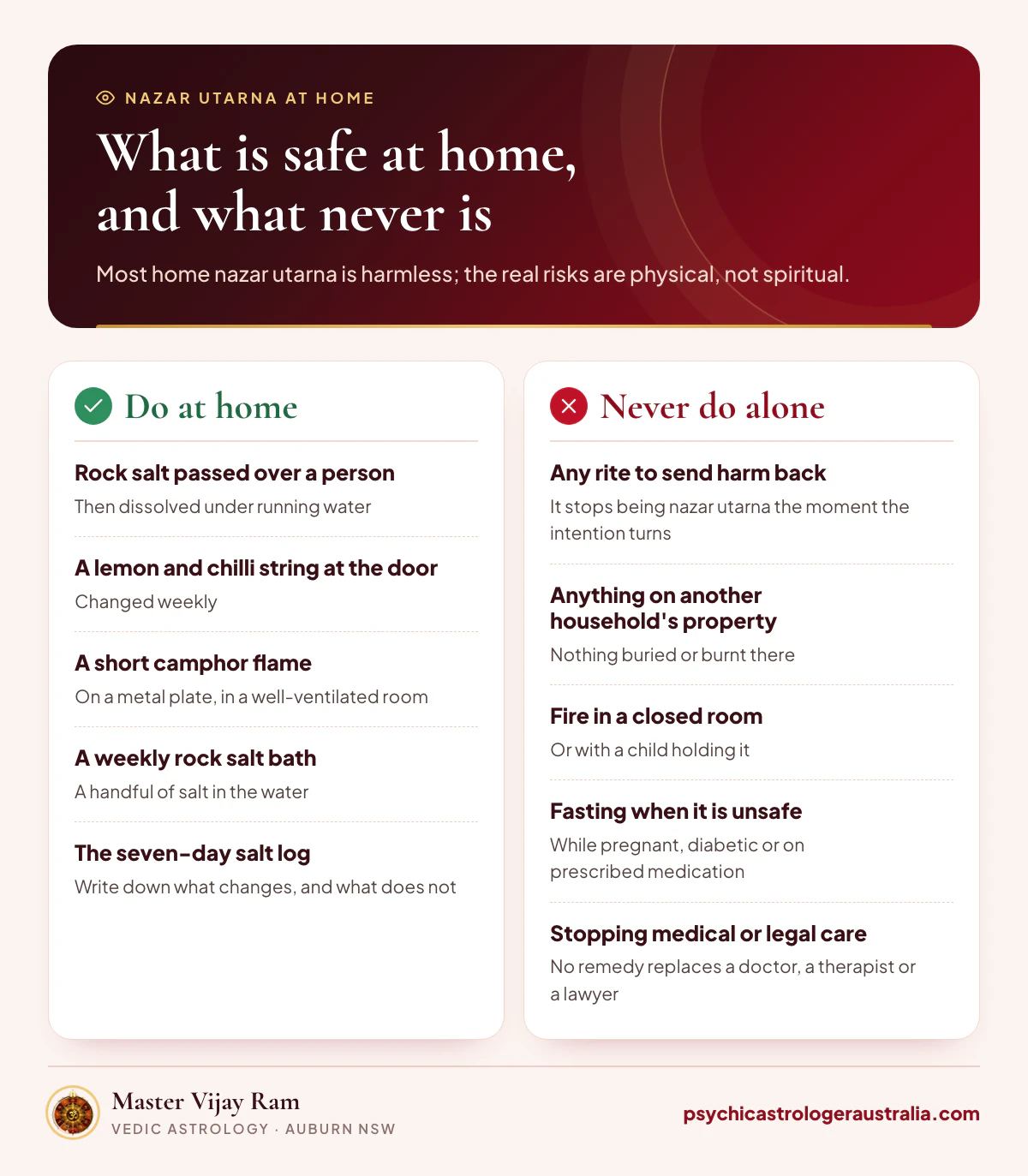
Most home nazar utarna is harmless. The risks that exist are physical rather than spiritual: open flame near curtains, camphor smoke in a closed room with an asthmatic child, hot alum spitting, threads left near a sleeping baby. Ventilate, use a metal plate, and never leave a flame unattended.
| Do at home | Do only with guidance | Never do alone |
|---|---|---|
| Rock salt passed over a person, then dissolved away | A whole-house clearing after a death or long illness | Any rite meant to send harm back at someone |
| A lemon and chilli string at the door, changed weekly | Repeating nimbu mirchi when trouble returns every few weeks | Burying or burning anything on another household's property |
| A short camphor flame on a metal plate, well ventilated | Any sustained fire ritual, or one for a named outcome | Fire work in a closed room, or with a child holding it |
| A weekly bath with a handful of rock salt | Fasting offered as part of a remedy | Fasting while pregnant, diabetic or on prescribed medication |
| Keeping the seven-day salt log | Deciding what to do when the log shows nothing | Stopping medication, therapy or legal advice for a remedy |
| Airing the room the trouble seems to sit in | Assessing a house where several people are affected | Paying urgently because someone says a deadline is closing |
Where a home remedy falls into the guidance column of that table, an assessment for heavy or negative energy is the sensible next step rather than another round at the kitchen bench.
The mistakes that make home nazar utarna useless
Four come up again and again. Doing it every single night, which converts a reset into a compulsion. Doing it as a test, to see whether something is there. Doing it at someone, which stops being nazar utarna the moment the intention turns. And announcing it to the whole extended family, which reliably creates more trouble than the original problem. Each of these makes a house tenser, not lighter.
There is a fifth that deserves its own mention. People reach for salt and chillies when what they actually want is a relationship repaired, which is a different question with a different answer, and it is the question behind most reunion enquiries from families in Mandurah. Salt will not bring anybody back, and pretending otherwise costs people months they cannot spare.
Nazar utarna for children and babies
The traditional versions for infants are gentle: a pinch of salt passed once around the baby and thrown away outside, and a small black dot behind the ear, never imported kajal and never near the eyes. Threads stay off a sleeping baby, and nothing goes in the cot. Vijay Ram ji is direct about the limits here, because the risks in this one area are real and physical rather than spiritual.
Never put salt, ash or ritual water into a baby's mouth. Never tie a thread around an infant's neck, and check ankle or wrist threads daily for tightness. Never burn camphor in a closed nursery. And never treat a baby who is not feeding, is unusually floppy, or has a fever as a spiritual case first. That is a doctor, that day, without debate.
A protective item such as a taweez or kavach for protection is something to ask about calmly, once the child is well.
Nazar on a person, nazar in a house
These are not the same thing, and the difference changes what you should do. When the trouble sits with a person, it travels with them: flat at work, flat at home, flat on a holiday in another state. When it sits in a house, it stops at the front door. Everyone inside is heavy, visitors say the place feels close, and the same family is fine within a day of going away.
Work out which one you are looking at before you hang anything or buy anything. A week of honest observation settles it more often than a remedy does. What to do once you know is set out under spiritual protection and cleansing.
When home remedies stop being enough
There is no dramatic threshold, and anyone who names one is guessing. What tends to matter is the shape of the pattern rather than its intensity. Watch for the same disruption returning within days of each clearing, three or more people in one household affected at the same time, a sudden and uncharacteristic aversion to a particular room or relative, or a person who becomes visibly distressed during something as simple as a salt pass.
None of that is proof, and none of it is cause for panic. It is a reason to have the situation assessed rather than repeated. It is also the point at which many people in Melbourne finally make a call they could have made a year earlier.
When this is not the answer
Most of what arrives described as nazar has an ordinary cause, and those causes are treatable. Persistent exhaustion is far more often iron deficiency, an underactive thyroid, sleep apnoea, perimenopause or undiagnosed diabetes. Low mood, irritability and a sense of heaviness are the ordinary presentation of depression, anxiety, postnatal depression or unprocessed grief. Agitation, hearing voices, or a marked change in personality can be a psychotic episode or a manic phase, and that needs a doctor urgently rather than a ritual.
Money trouble, a hostile workplace, a tenancy dispute or a family law matter belongs with a lawyer or a community legal centre. Coercive control and family violence belong with the police and a specialist service. If anyone is in immediate danger, call 000. Spiritual work sits alongside all of that. It does not replace any of it.
What an honest assessment involves
An assessment is mostly listening. Birth details where they are available, a plain timeline of when things changed, who else in the household is affected, and what has already been tried. No cameras, no theatrics, and no naming of the person you suspect. Vijay Ram ji does not name people, because a name in the wrong ear has broken families that were otherwise perfectly well.
Most enquiries end without a remedy at all. People are told plainly that nothing spiritual is running, and that what they are carrying is ordinary pressure that will answer to rest, to medical care, or to one difficult conversation they have been avoiding.
Where something genuinely does need clearing, cleansing the aura is usually the lighter first step rather than anything larger.
The daily practices worth keeping afterwards are set out in How to Remove Negative Energy From Yourself: Vedic Methods. The consultation is $50, and where a remedy is warranted it starts from $250, with the figure agreed before anything is performed.
Read next
- Evil Eye Removal in Sydney: Signs, Nazar Utarna and When to CallEvil eye removal in Sydney: the signs families describe, home nazar utarna practices, what Master Vijay Ram checks fi…
- How to Remove Evil Eye at Home: Safe Daily PracticesHow to remove evil eye at home safely: salt, lemon and daily habits, a seven-night ledger to track change, and the ho…
- Evil Eye Removal Service in Australia: Confidential Nazar HealingHow to tell nazar from black magic, jinn disturbance and ordinary medical causes, plus what confidential evil eye rem…
Frequently asked questions
Should I use rock salt or ordinary table salt for nazar utarna?
Coarse rock salt is the traditional choice because a fistful holds together and it dissolves cleanly under running water. Table salt works if that is all you have in the house. The material matters far less than doing the pass once, calmly, and destroying the salt afterwards rather than tipping it back into the jar for next time.
Three turns or seven turns, and does the number actually matter?
Families differ, and both counts are traditional. Some use three, some seven, some eleven. No version is more correct than another, and nobody should tell you your family's practice is wrong. What matters more is that the pass is unhurried and done once, rather than repeated anxiously until the number finally feels right to you.
What do I do with the salt afterwards if I live in an apartment with no garden?
Dissolve it under running water in the bathroom or kitchen sink and let it go. That is a complete disposal and it suits a flat perfectly well. Do not leave it sitting in a bowl on a windowsill, do not tip it into the kitchen bin, and do not carry it down to the building's garden beds.
The lemon at my front door turned black within a day. Does that mean something is there?
Almost certainly not. A cut or pierced lemon on a sunlit door in an Australian summer will dry, darken and shrivel within a day or two through heat alone. Reading that as evidence causes a great deal of unnecessary fear in a household. Change it, and judge the situation on the wider pattern instead.
Can nazar utarna be done for someone who is not in the room, such as a child at school?
Traditionally yes, using a photograph or simply holding the person in mind while the salt is passed. Many households do it for someone away at work or overseas. It is a gentle act either way. If the concern feels serious enough that distance seems like a real obstacle, that is a signal to have the situation assessed rather than improvised.
Is nazar utarna safe to do while pregnant?
The salt pass itself is harmless. Take care with anything involving smoke or open flame, since camphor and burning chilli irritate the airways and pregnancy makes that considerably worse. Skip any fasting attached to a remedy unless your doctor or midwife has agreed to it first. If you feel unwell during or afterwards, stop and ring your GP.
My mother-in-law wants to do this on my newborn. What should I not allow?
Nothing goes into the baby's mouth, meaning no salt, no ash and no water from a ritual. No thread around the neck at any age, and wrist or ankle threads checked daily for tightness. No camphor or smoke in a closed room with an infant. A pinch of salt passed once around the baby and a small black dot behind the ear, never imported kajal, are the traditional limits, and they are enough.
Can nazar utarna be done on a house rather than on a person?
Yes, and the method differs. For a home, salt is usually carried through each room and taken out the front door, and a lemon and chilli string is hung at the entrance. Work out first whether the heaviness follows the family when they travel. If it lifts the moment they leave for a weekend, the house is the right focus.
How often is too often to repeat a home remedy?
More than once a week is usually a sign of worry rather than need. Nightly repetition almost always means the person is soothing anxiety rather than clearing anything, and it tends to deepen the very fear it was meant to settle. Do it once, watch quietly for a week, then decide with a clearer head.
Does it matter who in the family performs it?
Traditionally an older woman of the household does it, and there is real value in that, because it is unhurried, familiar and needs nothing but time. But nobody is disqualified from doing it. What matters is that the person doing it is calm and genuinely wishes the other person well. Doing it while angry at someone turns it into something else entirely.
Is there any harm in doing nazar utarna when nothing is actually wrong?
Not in the act itself. The harm sits in what it can quietly displace. If salt and chillies become the reason a fever goes unchecked, a low mood goes untreated or a violent situation goes unreported, real damage follows and it follows quickly. Treat it as a small comfort alongside proper care, never as a substitute for it.
Is a nimbu mirchi at the door doing the same job as a thread worn on the wrist?
No. A lemon and chilli string is tied to a place and marks a boundary at the entrance, which is why it is changed weekly. A worn thread or amulet travels with the person and is treated as personal. Confusing the two leads people to hang something at the door when the trouble is clearly following them from room to room.
Someone told me to throw the chillies at a crossroads at midnight. Should I?
No. Anything that involves leaving material on a road, in a park or on someone else's property is a problem in Australia for practical reasons long before spiritual ones, and it also carries the idea of passing your trouble to a stranger who did nothing. Wrap the remains and use your own outside bin. Nothing is lost by doing it plainly.
What am I actually paying for if a home remedy is not enough?
You are paying for time and judgement: a proper look at the timeline, the household and the chart, and an honest opinion about whether anything spiritual is running at all. The consultation is $50, a great many people are told plainly that no remedy is needed, and in that case nothing further is charged. Where one is warranted, it starts from $250 and is agreed before anything is performed.
Can nazar utarna make a situation worse if it is done badly?
Not spiritually, in the sense most people fear. It can certainly make things worse in practical terms. Repeating it every night feeds anxiety. Announcing it to relatives invites gossip and accusation. Naming a suspect out loud has ended more family relationships than any curse ever did. Keep it quiet, keep it short, and keep it to yourself.
People also ask
Does nazar utarna still work if the person does not believe in it?
Belief is not treated as the active ingredient in the tradition, because the act is done for a person rather than by them. In practice, though, a sceptical adult dragged through it resentfully gets very little from it. If someone objects, do not force the issue. A quiet pass done with their agreement, or none at all, is better than an argument.
Why do families use seven chillies rather than some other number?
Seven is the most common count across Indian and Pakistani households, though five and eleven both appear and no source settles the matter. Odd numbers are generally preferred. It is worth saying plainly that the number is custom rather than doctrine, and that a string with six chillies on it is not a failed remedy in any meaningful sense.
Is nazar utarna a Hindu practice, or does it belong to other cultures too?
Versions of it appear far beyond South Asia. Greek, Turkish, Italian, Arab, Persian and North African households all have their own way of removing the effect of an envious look, using oil, water, blue glass or salt. The Indian salt, lemon and chilli method is one branch of a very old and very widespread family of practices.
Should nazar utarna be done in the morning or in the evening?
Most families do it at dusk or after the evening meal, largely because that is when everyone is home and the house has gone quiet. Some avoid Tuesdays and Saturdays, others pay no attention to the day at all. None of this is fixed. Choose a time when the household is settled and nobody is rushing through the room.
Can you do nazar utarna for yourself, with nobody else present?
Yes. Pass the salt around yourself from head to feet, dissolve it under running water, and leave it at that. Doing it alone is often better, because it avoids the audience and the commentary that turn a private act into a family discussion. What you should not do alone is anything involving sustained fire or fasting.
References & further reading
Serving clients across Australia
Confidential consultations by phone, video & WhatsApp — including: