

Quick answer
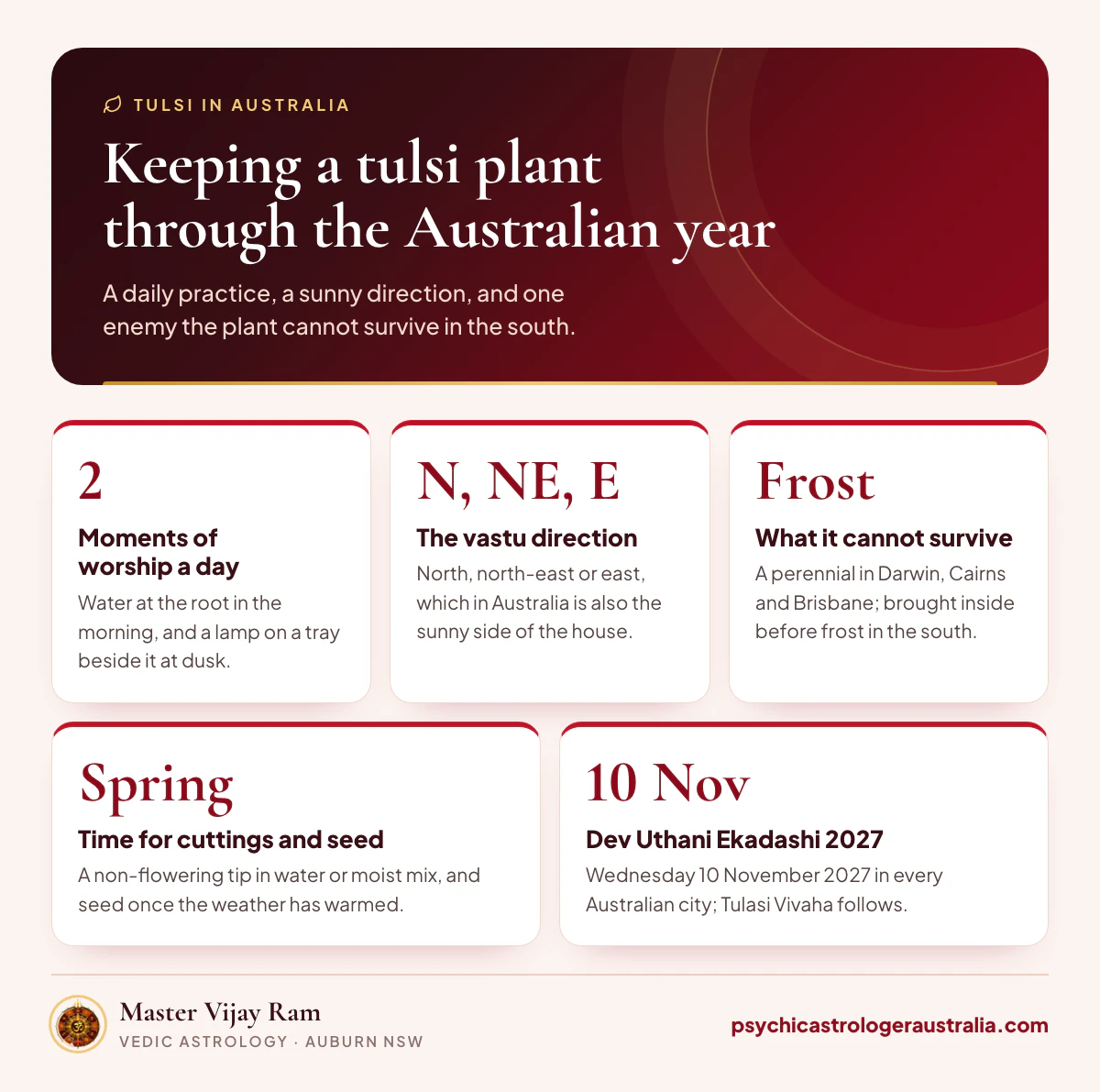
Tulsi, the holy basil Ocimum tenuiflorum, is kept for daily worship: water in the morning and a lamp at dusk, ideally in the north, north-east or east. It is frost-tender, so it grows year-round in Brisbane, Cairns and Darwin, but in Melbourne, Canberra and Hobart the pot comes inside for winter beside a sunny north-facing window.
What is tulsi, and why do Hindu homes keep one?
Tulsi is the holy basil, Ocimum tenuiflorum, a fragrant shrub that Hindu households keep as a living part of daily worship, sacred to Vishnu and to Krishna. Two kinds are common: Rama tulsi, with bright green leaves, and Krishna or Shyama tulsi, with purple-tinged leaves and stems, and families keep whichever their elders kept. In the tradition’s eyes, a home with a tulsi is a home where the day begins and ends with an offering.
In Australia the plant brings a second question with it, which is how to keep a tropical herb alive through a southern winter. This page covers both: the practice and the protection tradition first, then the climate, city by city. Where the question is where tulsi and everything else should sit in a particular home, a vastu reading of your floor plan answers it for your own layout.
What is the daily tulsi practice?
Water in the morning and a lamp in the evening. After the morning bath, a little water is offered at the root of the plant with a short prayer, and many families walk around it once or three times; at dusk a small ghee lamp is lit beside it on a tray, well clear of the leaves. In Indian courtyards the plant often stands in a raised planter called a tulsi vrindavan, and in Australia a large pot on the deck or balcony does the same work.
The practice takes two minutes at each end of the day, and that is its strength. A tulsi plant that is greeted every morning is also a plant that is checked every morning, which is why the families who pray to it are often the ones whose tulsi survives.
Why is tulsi linked with protection?
Because the tradition treats it as the presence of the goddess in the home and the beloved of Vishnu, and a house that keeps her well is said to be a guarded house. A tulsi beside the entrance or in the courtyard is one of the oldest household protections, which is why it appears alongside the toran and the threshold customs in the main door and the threshold. Tulsi leaves go into the charanamrit and onto the offering plate, and tulsi beads are worn as a mala by many Vaishnava families.
The protection the tradition describes is quiet and daily, not dramatic. Tulsi at home is not a charm against a named enemy or a substitute for locks, lights and good neighbours; it is a practice that keeps a household turning towards prayer twice a day.
Are there days when tulsi leaves are not picked?
Many families have folk rules about it, and they differ from household to household. Common ones are not picking leaves on Sundays, on Ekadashi or during an eclipse, not picking after sunset, and picking gently with the fingertips rather than tearing. Many traditions also keep tulsi off Ganesha’s offering plate while giving it freely to Vishnu and Krishna.
Some of these rules have a practical root, since a plant left alone on certain days gets a rest, and leaves picked by daylight are easier to choose well. None of them carries a threat, and a family that picks a leaf on the wrong day has done nothing that needs undoing.
Where should tulsi go: what is the vastu direction?
The preferred tulsi vastu direction is the north, the north-east or the east of the home, in front of the house or in the courtyard, with the south usually avoided. In Australia that preference lines up neatly with the sun, because south of the equator the sun tracks across the northern sky, and a north- or east-facing spot is also where tulsi gets the warmth and light it needs.
In an apartment, a north- or east-facing balcony is the natural home for the pot, kept out of hot afternoon wind. Indoors it needs the brightest window you have, never a dark corner beside the altar, and vastu remedies without demolition shows how plants fit into a house that cannot be rebuilt around them.
How does tulsi grow in the Australian climate?
Tulsi is frost-tender. In the warm, frost-free north it is a perennial shrub that can grow through the whole year, while in the cooler south it is a summer plant that needs shelter or a move indoors when the nights turn cold. The table gives the broad picture; your own garden’s frost pockets and wind will refine it.
| Where | How tulsi behaves | What to do in the cool months |
|---|---|---|
| Darwin, Cairns, Townsville | A perennial that grows all year | Little; in the wet season, a free-draining pot and no standing water |
| Brisbane, Sunshine Coast, Gold Coast | A perennial in most gardens | A sunny, sheltered spot; cover it or bring the pot in on a rare cold night |
| Sydney, Central Coast, Perth, Adelaide | Often survives a mild winter against a warm north wall, though it may sulk | A pot moved close to the house, or indoors on cold nights |
| Melbourne, Geelong, Canberra, Hobart | A summer plant outdoors; frost kills it | Inside before the first frost, beside a sunny north-facing window |
Wherever you are, tulsi wants free-draining soil, a pot with holes in the base, and more water in summer than in winter. Cold, wet roots are among the commonest reasons a tulsi fails.
How do you keep tulsi alive through a Melbourne or Canberra winter?
Grow it in a pot from the start, so that winter is a move rather than a rescue. Before the first frost, bring the pot inside and set it beside the sunniest north-facing window in the house, turning it every few days so it does not lean; water only when the top of the mix is dry, and keep it away from heater vents and split systems, whose hot, dry air scorches the leaves. This is the heart of tulsi winter care in the south, and it is the same in a Canberra house or a Hobart flat.
Pinch off the flower spikes, the manjari, as they form; many families offer them at the altar, and the plant puts its strength into leaves instead of seed. Families growing tulsi in Melbourne or Geelong move the pot back outside once the frosts are over in spring, a few hours a day at first, so the leaves do not burn in the stronger sun.
How do you start a new tulsi from cuttings or seed?
Spring is the time for both. Take a cutting from a healthy, non-flowering tip, strip the lower leaves and stand it in a glass of water or a pot of moist mix on a bright windowsill; it usually roots within a few weeks and can then be potted on. Seed is sown once the weather has warmed, barely covered, and kept moist until it sprouts.
Many garden centres sell tulsi seedlings, often labelled holy basil, which is the easiest start of all. Tulsi seeds carried from India are seeds to Australian biosecurity, so they are declared on arrival and the officers decide; bringing puja items from India covers this with the rest of the puja bag.
What does a dying tulsi mean?
Usually that it is winter, the roots are wet, or the plant has flowered itself out. Some families read a withering tulsi as a sign of trouble in the house, but in Australia the plainer explanations are strong and nearly always enough. Look at the soil, the pot and the season before anything else.
When a tulsi does die, the custom is to thank it, return it to the earth and plant a new one, ideally from a cutting taken earlier. Why plants keep dying in the house goes through light, water, pests and heating for every plant in the home, and the beliefs families attach to them.
When is Tulasi Vivaha in 2027?
Tulasi Vivaha, the ritual marriage of tulsi to Vishnu, follows Dev Uthani Ekadashi, the day Vishnu is said to wake from his four-month rest and the wedding season reopens. In 2027 Dev Uthani Ekadashi falls on Wednesday 10 November 2027 in every Australian city and in India; the Ekadashi runs from Tuesday 9 November at 1:05 pm to Wednesday 10 November at 2:42 pm AEDT.
| City | Date | Kartika Shukla Ekadashi (local time) | Rule applied |
|---|---|---|---|
| Sydney | Wed 10 Nov 2027 | Tue 09 Nov 2027, 1:05 PM AEDT – Wed 10 Nov 2027, 2:42 PM AEDT | tithi present at sunrise (udaya tithi) |
| Melbourne | Wed 10 Nov 2027 | Tue 09 Nov 2027, 1:05 PM AEDT – Wed 10 Nov 2027, 2:42 PM AEDT | tithi present at sunrise (udaya tithi) |
| Brisbane | Wed 10 Nov 2027 | Tue 09 Nov 2027, 12:05 PM AEST – Wed 10 Nov 2027, 1:42 PM AEST | tithi present at sunrise (udaya tithi) |
| Perth | Wed 10 Nov 2027 | Tue 09 Nov 2027, 10:05 AM AWST – Wed 10 Nov 2027, 11:42 AM AWST | tithi present at sunrise (udaya tithi) |
| Adelaide | Wed 10 Nov 2027 | Tue 09 Nov 2027, 12:35 PM ACDT – Wed 10 Nov 2027, 2:12 PM ACDT | tithi present at sunrise (udaya tithi) |
| Canberra | Wed 10 Nov 2027 | Tue 09 Nov 2027, 1:05 PM AEDT – Wed 10 Nov 2027, 2:42 PM AEDT | tithi present at sunrise (udaya tithi) |
| Hobart | Wed 10 Nov 2027 | Tue 09 Nov 2027, 1:05 PM AEDT – Wed 10 Nov 2027, 2:42 PM AEDT | tithi present at sunrise (udaya tithi) |
| Darwin | Wed 10 Nov 2027 | Tue 09 Nov 2027, 11:35 AM ACST – Wed 10 Nov 2027, 1:12 PM ACST | tithi present at sunrise (udaya tithi) |
| New Delhi (reference) | Wed 10 Nov 2027 | Tue 09 Nov 2027, 7:35 AM IST – Wed 10 Nov 2027, 9:12 AM IST | tithi present at sunrise (udaya tithi) |
The tithi is one moment everywhere; only the clock and the sunrise differ, which is why a city can fall a day apart from India. Computed with the Swiss Ephemeris (Lahiri ayanamsa for Vedic positions) and checked against US Naval Observatory data. Times are rounded to the minute.
Families differ on the day of the vivaha itself: some hold it on the Ekadashi, many on the following day, and some on any evening up to the next full moon, so the temple or family panchang decides. The plant is dressed like a bride, a shaligram or a Krishna murti stands as the groom, and the evening ends with prasad; for a family choosing a wedding date in the season it opens, choosing an auspicious date and hour is the place to start.
Does Master Vijay Ram suggest tulsi as a remedy?
He suggests it as a household practice rather than a remedy: a living plant in the north or east, watered and lit for, is something every family can keep. In a vastu consultation, which is $50 by phone, video or WhatsApp, he reads the floor plan and says where the plant will be happiest in your particular home. Families in Cairns and Townsville, where tulsi grows readily, and in Geelong, where it lives indoors half the year, all consult him by phone or video; readings for Geelong families explains how.
A household that wants a Vishnu puja or a shanti done on its behalf can have him perform it in person at Auburn, and watch by video from home if it likes; a puja performed on request starts from $250, and the amount is settled before the puja.
What can a tulsi plant not do?
It cannot protect a house that is not locked, heal an illness or settle a quarrel, and a dying tulsi is not a verdict on anyone. Tulsi leaves are eaten and brewed as tea in many homes as food and custom, not treatment; anyone pregnant or on medication asks the midwife or GP before taking any herbal remedy. Tulsi lore and vastu are traditions of faith, offered as such and never as medical, legal or financial advice.
Its gift is two small acts of devotion a day and a green, fragrant presence by the door. In most Australian gardens that is well within reach, with a pot and a sunny window for the cold months.
Read next
- Vastu for Bedrooms and Sleep: Restless Homes Made CalmVastu for bedrooms and sleep: bed direction, the corner for couples, mirrors and beams, what a GP checks first, and t…
- Lighting a Diya for Protection: Ghee or Oil, Direction and TimingLighting a diya for protection: ghee or oil, one or five wicks, which way the flame faces, dawn and dusk timing, the …
- How to Remove Negative Energy From Yourself: Vedic MethodsVedic ways to clear negative energy from yourself: what to rule out first, safe home practices, the four-gate reset, …
Frequently asked questions
Can tulsi grow in Australia?
Yes, very well in the warm north and in a pot almost anywhere. In Darwin, Cairns and Townsville it grows all year, and in Brisbane and on the Sunshine Coast it is a perennial in most gardens. In the cooler south it is frost-tender, so in Melbourne, Canberra and Hobart it lives outdoors in summer and comes inside for winter beside a sunny north-facing window.
How do I keep tulsi alive in winter in Melbourne?
Grow it in a pot and bring it inside before the first frost. Stand it beside the sunniest north-facing window, turn it every few days, water only when the top of the mix is dry, and keep it away from heater vents. Pinch off the flower spikes, and move it back outside gradually once the spring frosts are over, so the leaves do not burn.
Which direction should tulsi be placed at home?
The tradition prefers the north, north-east or east of the home, in front of the house or in a courtyard, and usually avoids the south. In Australia that suits the plant too, since the northern side gets the most sun, so a north- or east-facing balcony or garden bed gives tulsi the light and warmth it needs.
Can tulsi be kept indoors?
For the cold months, yes, beside the brightest north-facing window you have, away from heaters and split systems. Year-round indoor life is harder on it, because tulsi wants several hours of direct sun, so it does best outdoors in the warm months. A dark corner beside the altar is the one place it will not thrive.
Why is my tulsi plant dying?
In Australia the usual causes are cold, wet roots in winter, frost, a pot without drainage holes, hot dry air from a heater, or a plant that has flowered and set seed. Check the soil, the pot and the season first. Some families read a withering tulsi as a warning, but the plain causes are nearly always enough, and a cutting taken earlier gives you the next plant.
On which days should tulsi leaves not be plucked?
Folk custom differs by family. Many avoid picking on Sundays, on Ekadashi and during an eclipse, and some never pick after sunset; most pick gently with the fingertips rather than tearing. These are household customs, not rules with penalties, and a leaf picked on another day causes no harm. Follow your own family’s practice where you have one.
What is the difference between Rama tulsi and Krishna tulsi?
Both are Ocimum tenuiflorum, the holy basil. Rama tulsi has bright green leaves, while Krishna or Shyama tulsi has purple-tinged leaves and stems. They are cared for the same way and worshipped the same way, and families usually keep whichever kind their elders kept. Both are frost-tender in southern Australia.
When is Tulasi Vivaha in 2027?
Tulasi Vivaha follows Dev Uthani Ekadashi, which falls on Wednesday 10 November 2027 in every Australian city and in India. Families differ on the exact day of the vivaha: some hold it on the Ekadashi, many on the following day, and some on an evening up to the next full moon. Follow your temple or family panchang for the day itself.
What do I do with a dead tulsi plant?
Thank it and return it to the earth: dig it into the garden, lay it in a large pot of soil, or place it in the council green bin. It never goes into a creek, a river or the sea. Then plant a new tulsi, ideally from a cutting of the old one or a friend’s plant, and read the loss as a gardening lesson rather than a sign.
People also ask
Is holy basil the same as tulsi?
Yes. Tulsi is the holy basil, Ocimum tenuiflorum, and Australian garden centres often sell it under that name. It is a different plant from the sweet basil used in cooking, though the two are related. Look for holy basil or tulsi on the label, and choose a healthy, non-flowering seedling in spring.
Is tulsi a perennial in Australia?
In frost-free places, yes: in Darwin, Cairns and Townsville it grows year-round, and in Brisbane it is a perennial in most gardens. In frosty places it behaves as a summer plant unless it is brought indoors, which is why families in Melbourne, Canberra and Hobart keep it in a pot and move it inside for winter.
Can tulsi be kept on a balcony?
Yes, ideally a north- or east-facing balcony, which suits both the vastu direction and the plant’s need for sun. Use a pot with drainage holes, shelter it from hot afternoon wind, and in a cold climate bring it inside before frost. If a lamp is lit beside it at dusk, it stands on a tray well clear of the leaves.
Why do Hindus light a lamp near tulsi in the evening?
The evening lamp beside the tulsi marks the close of the day with an offering to the plant the tradition treats as sacred to Vishnu, just as the morning water opens it. Families light a small ghee lamp on a tray, well clear of the leaves, and many say a short prayer. Where a naked flame is not safe, an electric diya keeps the custom.
References & further reading
Serving clients across Australia
Confidential consultations by phone, video & WhatsApp — including: