
Quick answer
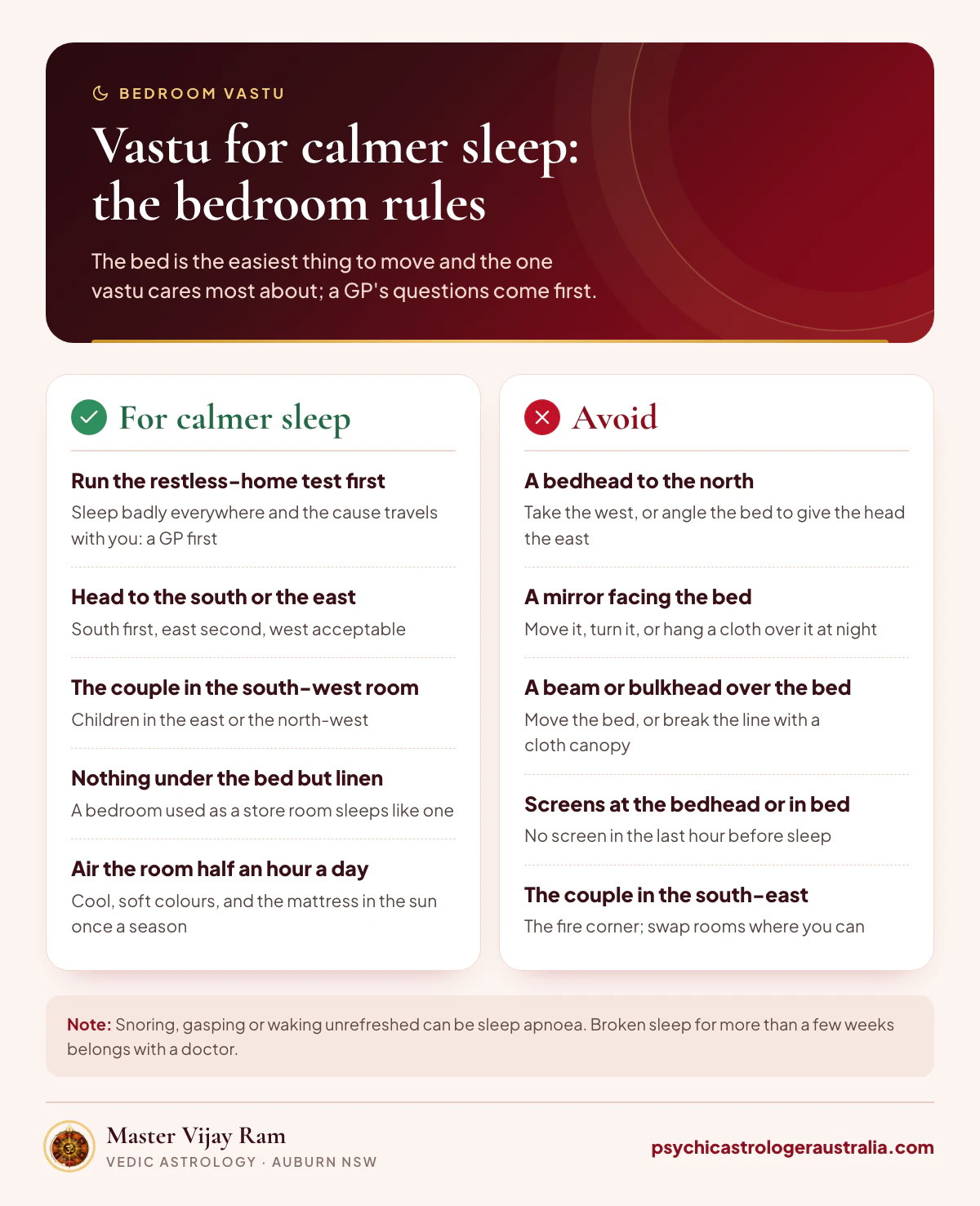
Vastu for sleep starts with the bed: head to the south or the east, the couple in the south-west room, no mirror facing the bed, nothing under it, no beam above it and no screen at the bedhead. Before any of that, a GP rules out apnoea, pain and shift-work exhaustion. A consultation is $50; a vastu shanti, where warranted, starts from $250.
What vastu for bedrooms claims, and what sleep medicine comes first for
Vastu for a bedroom is the set of rules in Vastu Shastra about where a person should sleep and which way the head should point, built on the belief that the body rests best in a particular relationship to the directions and to the rest of the house. Vastu for a bedroom is also the part of the tradition that most often meets a medical question head-on, because a family that is not sleeping has usually tried everything except a doctor, and a bed turned to the south does nothing for sleep apnoea.
Master Vijay Ram reads bedrooms from a plan and a compass sketch by phone or video, and his Vastu consultation covers the whole house. This page takes the bedroom on its own: the rules, the fixes, and the order in which a sensible family applies them.
The restless-home test: do you sleep better elsewhere?
Before a bed is moved, answer one question honestly. Do you sleep better at your parents' place, in a hotel, on holiday, on the couch? If the answer is yes, the bedroom is a reasonable suspect, and the rest of this page applies. If the answer is no, you sleep badly everywhere, and the cause travels with you: pain, a breathing problem, worry, a roster, a phone, caffeine after lunch. That is a GP's question, and vastu for sleep waits its turn behind it.
Families often find that one person in the house sleeps badly and the others sleep well, in the same house with the same directions. That too points at the person rather than the plan.
What a GP would ask before anyone turns a bed
| What you notice | Ordinary cause to test | Who first |
|---|---|---|
| Snoring, gasping, waking unrefreshed, a dry mouth | Sleep apnoea | A GP, then a sleep study |
| Falling asleep easily, waking at three and lying awake | Worry, alcohol, a late screen, depression | A GP; Healthdirect for what to try first |
| Cannot fall asleep for an hour or more | Caffeine after noon, a bright room, a phone in bed, no wind-down | Sleep hygiene for a fortnight before anything else |
| Waking with headaches or a stiff neck | The pillow, the mattress, a beam of cold air, grinding teeth | A new pillow; a dentist; a GP if headaches persist |
| Broken sleep on a roster | Shift work | Blackout curtains, a fixed routine, the GP for anything that lasts |
| A child who will not settle | Screens, a late dinner, fear, a noisy street | The child health nurse or GP |
| Everyone sleeps badly only in this house | Noise, heat, damp, a street light, the neighbour's air-conditioner | Curtains, a fan, the landlord; then the room's layout |
A reading that skips this table is not worth paying for, and Vijay Ram ji asks every question in it before he asks which way the bedhead points.
Bed direction: head to the south or the east
The best-known rule of bed direction vastu is to sleep with the head to the south, with the east as the second choice, the west acceptable, and the north avoided. The tradition's reason is that the body lies better in line with the earth than against it, and a head to the north is read as a head set against the pull of the pole. Whatever one makes of the physics, families who have turned a bed from north to south often report calmer sleep within a week, and the change costs a quiet half hour on a Sunday.
Where a room allows only a north bedhead, because of the door, the window or a built-in wardrobe, the west is taken instead, or the bed is set across the room on an angle that gives the head the east. A room is never rebuilt for this, and vastu for apartments covers the flats where the wall choice is smallest.
The corner for couples: the south-west room
Vastu for a couple's bedroom gives the couple the south-west, the heaviest and most stable corner of the house, and keeps the children in the east or the north-west. A couple in the south-east, the fire corner, is the arrangement the tradition likes least and the one most often found in project homes where the master suite was placed for the view; the fix is a swap of rooms, and where there is no other room, the head to the south, cool colours and no mirror. The tradition also prefers the bed set so that neither partner sleeps with their feet to the door, and a bedhead against a solid wall rather than a window.
None of this is about which partner sleeps on which side, whatever a glossy article says. It is about the room.
Mirrors, screens and the bedhead
A mirror facing the bed is the bedroom fault most families already suspect, and the tradition confirms them: the reflection of a sleeper is read as a second presence, and people who cover the mirror at night sleep better whatever the reason. Move it, turn it or hang a cloth over it. A television at the foot of the bed, a phone charging at the bedhead and a laptop on the doona belong to the same rule, and the GP's sleep advice agrees with the tradition precisely here: no screen in the last hour, and no screen in the bed.
The bedhead itself is kept solid, against a wall, away from the wall shared with a toilet where the plan allows, and clear of anything that hums.
Beams, bulkheads and what hangs over you
A beam or a bulkhead over the bed is read as pressure on the sleeper, and people under one often report headaches and broken sleep. Move the bed so the beam crosses the floor rather than the body; where the room will not allow it, a cloth canopy or a false panel breaks the line, and most landlords permit a canopy. Heavy shelves, a hanging light or a pot plant over the bedhead come down for the same reason, and the ceiling fan, which so many Australian bedrooms have directly over the bed, is left where it is and simply kept clean.
Under the bed, inside the wardrobe: the clutter rule
What is under a bed is under the sleeper all night, and the tradition wants nothing there but linen. Suitcases, shoes, paperwork, the children's old toys and the box from the move all come out, and the floor beneath is cleaned. The wardrobe follows: clothes nobody wears, bags of things waiting for the op shop, the broken iron. A bedroom that is a store room sleeps like one. This is the one bedroom vastu remedy that every family can apply this week and the one that most often changes the feel of the room on its own.
Colours, light and air for a bedroom
Cool, soft colours in the bedroom, warm ones in the kitchen; a tenant does it with bedding, curtains and a rug rather than paint. Light is kept soft at night and bright by day, with the curtains open in the morning so the room is aired and the bed is made in daylight. The lamp lit at dusk for the house stays in the living room, not by the bed, and incense is for the open window. Air is the part Australian bedrooms most often lack: a room shut for the air-conditioner all summer or the heater all winter is opened for half an hour a day, and the mattress goes into the sun once a season.
The room-by-room Vedic guide takes the bedroom through the same cleaning in the context of the whole house.
Children's rooms and the study-bed
A child sleeps in the east or the north-west with the head to the east or the south, the desk facing east or north, and the bed out of the line of the door. The screen rules are stricter for children than for adults, and the tradition and the child health nurse agree on them. A student in a share house or a studio, with the desk, the bed and the kettle in one room, keeps the desk away from the bed, the head to the south or east, and the laptop closed before the light goes off; it is the most that a small room allows, and it is enough.
Shift workers, apartments and the room you did not choose
A nurse at Westmead sleeping by day, a FIFO worker home for a week, a warehouse picker on nights in Truganina: the bedroom has to work against the clock, and the tradition's rules are applied where they can be and set aside where they cannot. Blackout curtains, a cool room and a fixed routine matter more than direction for a day sleeper, and a bed that can only face north in a rented flat is faced west instead and left alone. The Westmead page speaks to the health precinct's rosters directly, and the Sydney page covers the rest of the city.
Where a fault in the room cannot be moved, a beam over the only possible bed position, a toilet on the north-east wall of the bedroom, the traditional completion is a vastu shanti, performed once, which vastu remedies without demolition explains, and which Master Vijay Ram performs personally through the online puja and havan service with the family joining by video.
When the problem is not the room
Some sleep trouble is neither medical nor a matter of layout. Nightmares that recur after an event, waking at the same hour with a sense of presence, a child who will not enter a particular room: these are the questions families bring to the phone, and the guide to nightmares and sleep paralysis takes them seriously, with the GP and the sleep clinic first. Where a house has gone heavy rather than merely been arranged badly, the negative energy removal service is the right page, and where the restlessness travels with the person, aura cleansing addresses the person rather than the place.
Vastu for a bedroom is offered as guidance and a matter of faith, never as medical advice. Anyone whose sleep has been broken for more than a few weeks belongs with a doctor, and he says so before he reads a plan.
What does it cost?
A consultation is $50, and spell or prayer work, where it is warranted, starts from $250. The bedroom reading, from a plan and compass photos by phone or video, sits within the consultation along with every fix on this page; a vastu shanti is performed only where a fault in the room cannot be moved, at a figure agreed before anything is performed, and if no remedy is called for, nothing further is charged.
Hot bedrooms and visiting parents: sleep in an Australian house
Heat comes before direction. A bedroom with a west wall in Penrith or Blacktown, or in Mandurah or Joondalup, soaks up the afternoon sun and gives it back at midnight, and no bedhead turned to the south will fix that on its own. Close the blinds by noon, run a fan, swap the doona for a sheet, and the cool, soft room vastu asks for is half made already.
The other bedroom question Australian families bring is the spare room. Parents who come from India for months at a time arrive with their body clocks still set several hours behind Sydney, and sleep badly for the first fortnight whichever way the bed points, so give jet lag its due before anyone reads the corners. A ground-floor room spares older knees the stairs, and if a granny flat is the only choice, the same rules for the bedhead, the mirror and the clutter apply there.
The reading itself needs only a floor plan and compass photos, sent by phone, video or WhatsApp from any city; in person, the one place is Auburn, by appointment. Families in those suburbs can start from Penrith negative energy removal, negative energy removal for Blacktown or Mandurah negative energy removal, which describe how the wider work reaches them.
Read next
- Tulsi at Home in Australia: Winter Care and the Protection TraditionTulsi at home in Australia: the daily water and lamp, the vastu direction, winter care from Darwin to Melbourne, cutt…
- Feng Shui or Vastu for an Australian Home? An Honest ComparisonFeng shui or vastu for an Australian home: origins, maps and elements side by side, where they agree and clash, the s…
- Signs of Jinn Disturbance at Home and How Ruqyah HelpsJinn disturbance at home: which signs matter, which have ordinary causes, what ruqyah really is, and how a settled ho…
Frequently asked questions
Which direction should the head face while sleeping?
South first, east second, west acceptable, north avoided. The tradition reads a head to the north as set against the pull of the earth, and families who turn a bed from north to south often report calmer sleep within a week. Where the room allows only a north bedhead, take the west or set the bed on an angle that gives the head the east; the room is never rebuilt for it, and a GP's questions come before any of this.
Why do I sleep better at my parents' place than at home?
That is the restless-home test, and the answer makes the bedroom a reasonable suspect. Look at the obvious things first: noise, heat, a street light, a mattress, a screen in the bed, the neighbour's air-conditioner. Then the layout: a bedhead to the north, a mirror facing the bed, a beam above it, a store room's worth of things beneath it. Fix those in order, and if the difference remains, a reading of the plan is worth having.
Does a mirror facing the bed really matter?
The tradition reads the reflection of a sleeper as a second presence in the room, and most people who cover a mirror at night sleep better whatever the reason. Move it, turn it or hang a cloth over it, and treat a television at the foot of the bed and a phone at the bedhead as the same rule. The GP's sleep advice and the tradition agree exactly here: no screen in the last hour and none in the bed.
Our master bedroom is in the south-east. Is that why we argue?
Couples in the fire corner report short tempers and poor sleep more often than chance, but money, a roster and a hot room do most of the arguing. The fix is a swap: the couple takes the south-west room and the south-east becomes a study or a child's room; where there is no other room, the head goes to the south, the colours go cool and the mirror comes off the facing wall. If the arguments are about something, Relationships Australia helps more than a compass.
What should be kept under the bed?
Linen, and nothing else. Suitcases, shoes, paperwork, old toys and the box from the move all come out, the floor is cleaned, and the wardrobe gets the same treatment. The tradition reads what is under a bed as under the sleeper all night, and a bedroom used as a store sleeps like one. It is the single fix that most often changes the feel of a room on its own, and it needs no permission from anyone.
I work night shifts. Does bed direction still matter?
Less than blackout curtains, a cool room and a fixed routine, which are the first three things for anyone sleeping by day. Apply the direction rules where the room allows and set them aside where it does not; a bed that can only face north in a rented flat is faced west and left alone. If a roster has broken your sleep for weeks, a GP comes before any vastu change, and the tradition would say the same.
Can vastu help a child who will not sleep?
A child's room sits in the east or north-west with the head to the east or south, the desk facing east or north and the bed out of the door line, and screens leave the room at night. Before any of that, the child health nurse or GP rules out the ordinary reasons: a late dinner, fear, a noisy street, a screen under the pillow. A child who will not enter a particular room at all is a different question, and one he takes seriously.
Can the bedroom fixes be done in a rental?
All of them. Turning the bed, moving a mirror, hanging a cloth, a canopy under a beam, cool bedding and curtains, a cleared wardrobe and an aired room need no permission; painting and anything fixed to the wall need the agent's consent. A vastu shanti for a fault that cannot be moved is performed at Auburn with the family joining by video, so the lease is never involved.
Does Master Vijay Ram visit the house to read a bedroom?
No. A sketch of the compass directions, the floor plan and a few photos of the room are all the reading needs, by phone or video, and any vastu shanti is performed personally at his own place of practice in Auburn. No visit to a home is offered anywhere in Australia, and a consultant who insists on walking through your bedroom for a fee is selling the visit.
What does a bedroom vastu consultation cost?
A consultation is $50, and spell or prayer work, where it is warranted, starts from $250. The bedroom reading and every fix on this page sit within the consultation; a vastu shanti is performed only where a fault in the room cannot be moved, at a figure agreed before anything is performed, and if no remedy is called for, nothing further is charged.
People also ask
What is the best bed position according to vastu?
Head to the south or the east, the bedhead against a solid wall, the bed out of the line of the door, no mirror facing it, no beam above it and nothing beneath it but linen. A couple takes the south-west room and children the east or north-west. A bedhead to the north is avoided where the room gives any choice.
Which direction should you not sleep in?
With the head to the north, in the tradition's view, because the body is read as lying against the pull of the earth. Where a room allows only a north bedhead, the west is taken or the bed is angled to give the head the east. Nobody rebuilds a room for this, and a GP's questions about sleep come first.
Can vastu fix insomnia?
No. Insomnia, sleep apnoea, pain and shift-work exhaustion are medical questions and belong to a GP, a sleep study and a fortnight of sleep hygiene before any bed is turned. What vastu fixes is a room that works against a sleeper: a north bedhead, a mirror facing the bed, a beam above it, a store room beneath it, a screen at the bedhead and no air.
Is it bad to sleep under a beam?
The tradition reads a beam over a sleeper as pressure, and people under one often report headaches and broken sleep. Move the bed so the beam crosses the floor rather than the body; where that is impossible, a cloth canopy or a false panel breaks the line and most landlords allow it. Headaches that persist after the bed is moved are for a GP.
Should a mirror be in the bedroom?
It can be, as long as it does not face the bed. A mirror inside a wardrobe door, on a side wall or covered at night satisfies the tradition, which reads the reflection of a sleeper as a second presence. Most people who cover a facing mirror sleep better, and a television at the foot of the bed falls under the same rule.
References & further reading
Serving clients across Australia
Confidential consultations by phone, video & WhatsApp — including: