
Quick answer
When plants keep dying indoors the cause is nearly always practical: too little light (the midday sun is in the northern sky here), too much water, pests, or heat, frost and heater vents. Vastu adds advice on cactus, bonsai, the money plant and tulsi, and folk belief says a plant can absorb nazar. Fix the practical causes first; the custom that follows is gentle.
Why do plants keep dying in my house?
A houseplant that keeps dying is a plant that is short of light, drowning in water, under attack from pests or sitting in a draught, and the leaves usually say which. When three or four die in a row, families start to wonder about plants dying in the house as a sign of negative energy, nazar or a vastu fault. The tradition has things to say about all three, and they come after the watering can.
Master Vijay Ram is asked about dying plants more often than people expect, usually by someone whose tulsi or money plant has failed for the second time. His vastu consultations begin with the window, the pot and the heater vent, because a plant that is simply in the wrong place cannot be prayed back to health.
Is it the light?
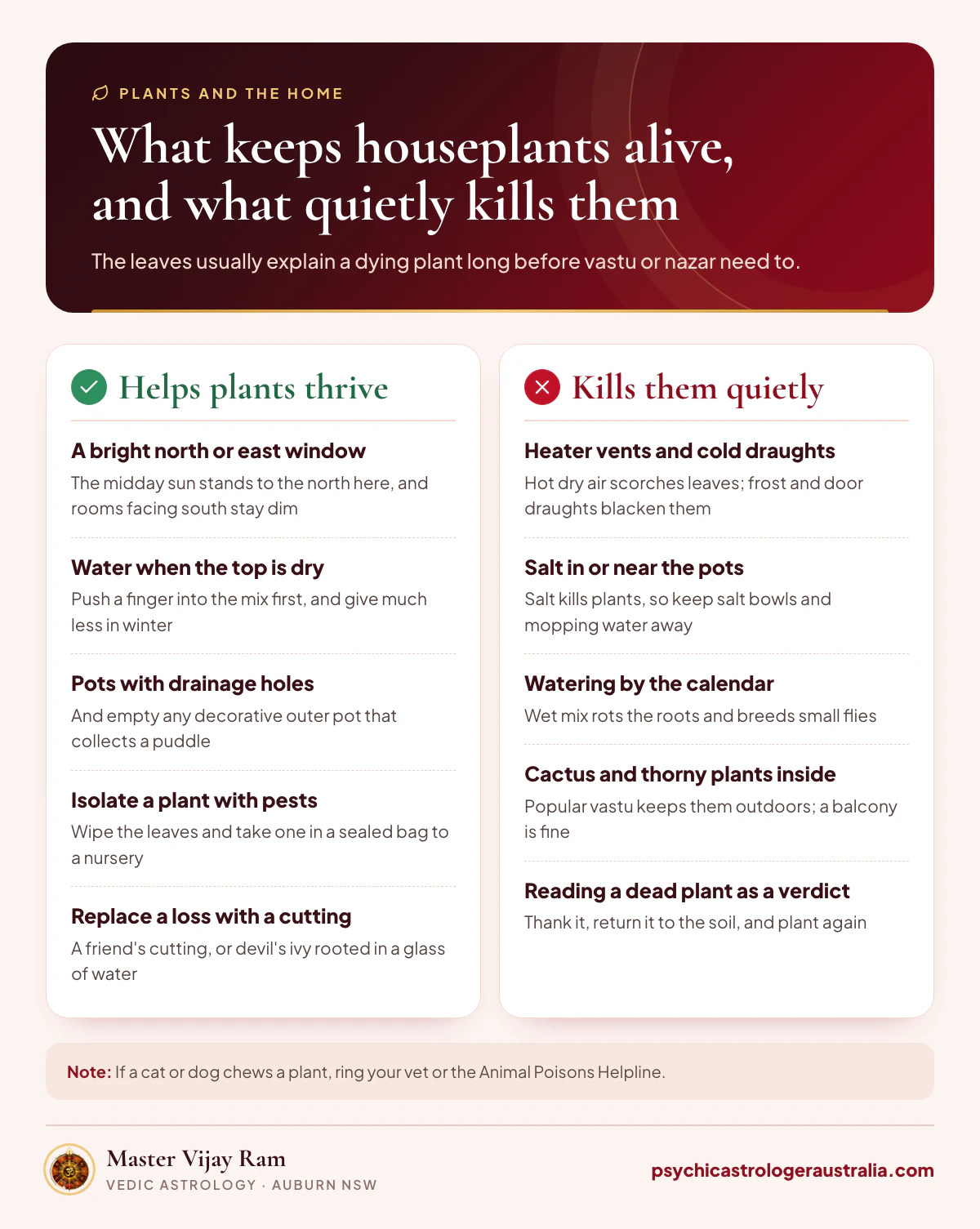
Often. The midday sun stands in the northern sky over Australia, so north-facing windows get the most light through the year, east windows give gentle morning sun, west windows bake in summer afternoons, and south-facing rooms stay dim. A plant guide written for India, Europe or North America assumes the opposite sky, which is why advice to put a sun-loving plant by a south window goes so wrong here.
Low light shows as long, leggy stems leaning towards the glass, pale new leaves and no new growth at all. Moving the plant within a metre or two of a bright north or east window fixes more why plants die indoors questions than anything else. The separate question of whether vastu’s directions should be read differently south of the equator is taken up in feng shui or vastu for an Australian home.
Too much water, or too little?
Overwatering is the classic indoor killer. Yellowing lower leaves, soft or blackened stems, soil that stays wet for days and tiny flies hovering over the pot all point to roots that are rotting for want of air. Pots without drainage holes, and decorative outer pots that quietly collect a puddle, make it worse.
Push a finger into the potting mix before you water; if the top few centimetres are still damp, wait. Most indoor plants want much less water in winter, when they grow slowly. Crispy brown edges and soil shrinking away from the side of the pot are the opposite problem, and a thorough soak until water runs from the base usually answers it.
Could it be pests?
Look under the leaves and where they join the stem. White cottony tufts are usually mealybug, small brown bumps are scale, fine webbing with speckled leaves is spider mite, which thrives in dry heated rooms, and leaves that feel sticky are being fed on by one of them. Fungus gnats breed in constantly wet potting mix.
Move the affected plant away from the others, wipe the leaves, and take a leaf in a sealed bag to a nursery, where staff can name the pest and the remedy. A plant that keeps dying in the same spot may simply be catching what the plant beside it carries.
What about heat, frost and indoor heating?
Heater vents, split systems and gas heaters blow hot, dry air that scorches leaves within days, and a plant against a west window in January can cook behind the glass. Cold does as much harm: a pot left outside on a frosty Geelong night, or beside a door that lets in winter draughts, turns black and limp by morning. Air-conditioning blowing straight onto foliage dries it in any climate.
Plants also sulk after a change. One bought from a supermarket shelf, repotted, or carried from the balcony to the lounge room often drops leaves for a few weeks before it settles. Some, such as grocery-store herbs, were never grown to last long indoors at all.
Which signs point to which cause?
The table reads the plant before anything else. Most dying plants show one of these signs clearly, and the fix in the last column costs little more than attention.
| What the plant shows | The usual cause | The first fix |
|---|---|---|
| Yellow lower leaves, wet soil, small flies | Overwatering and poor drainage | Let it dry out; a pot with drainage holes; empty the outer pot |
| Long, leaning stems and pale leaves | Too little light | Closer to a bright north or east window |
| Crispy brown edges, dry shrunken soil | Underwatering or dry heated air | Water deeply; move it away from heater vents |
| White cottony spots or sticky leaves | Mealybug or scale | Isolate it, wipe the leaves, ask a nursery |
| Fine webbing and speckled leaves | Spider mite in dry air | Rinse the leaves; keep it out of heater draughts |
| Black, limp leaves after a cold night | Frost or a cold draught | Bring it inside, away from doors |
| Sudden leaf drop after a move | Shock from repotting or a new position | Leave it in one place and wait a few weeks |
Constantly wet pots can also grow mould on the surface of the mix, which is worth avoiding in a house where anyone has asthma. If a cat or dog chews a plant, ring the vet or the Animal Poisons Helpline.
What does vastu say about plants in the home?
Living, healthy plants are welcome in vastu, especially in the north and east of a house, and dead or dying ones are to be removed promptly rather than left on the sill. Popular vastu advice keeps thorny plants, cactus and spiny succulents outside rather than in the living rooms, and some families keep plants with milky sap outdoors too. Bonsai is avoided by some because the clipped tree is read as stunted growth.
Traditions differ, and none of this makes a healthy cactus on a balcony dangerous. Read honestly, plants dying vastu questions usually come back to the same two points: a cared-for plant in good light belongs in the house, and a dead one does not.
What does it mean when a money plant dies?
The money plant of Indian homes is sold in Australian nurseries as devil’s ivy or pothos, and the folk belief is simple: a thriving money plant draws prosperity, so a money plant dying is read as a worry about money. Popular vastu places it in the south-east and asks that it climb upwards rather than trail across the floor. The Chinese money plant and the jade plant are different plants with their own customs.
The practical news is good. Devil’s ivy is one of the easiest indoor plants there is, so when it fails the cause is nearly always cold or waterlogged roots, and a healthy cutting set in a jar of water will usually put out roots and start again. A new plant from your own cutting carries the custom forward without any fear.
What does it mean when tulsi dies?
Tulsi worries families more than any other plant, since some households take its decline as an omen for the home. The plant itself offers simpler reasons: it is tender to frost, sulks in cold, soggy soil, and often fades once it has flowered and set seed, so a bush that was lush in February can collapse by July in Geelong. Tulsi at home in Australia sets out how to carry one through a southern winter.
A tulsi that has died is treated with respect rather than fear: many families say a word of thanks, lay it back into garden soil or the green-waste bin, and start a fresh plant, ideally from a cutting kept on the windowsill. Waterways are not the place for it, or for any material from a puja.
Do plants absorb nazar?
That is a folk belief many families hold: a healthy plant admired by visitors, or one kept near the entrance, is said to take the nazar meant for the people in the house and wilt in their place. Some households keep a plant by the front door for exactly that reason. It is the same protective logic that reads a cracked mirror as having taken a blow, explored in broken mirrors and things that keep breaking.
A plainer account notices that plants wilt after a busy week of guests because nobody watered them, the room was hot and crowded, or the pot was moved to make space. If nazar on a person is the real worry, evil eye and nazar removal describes how it is read. A plant that has taken a knock deserves water, light and a little patience.
What is a calm practice for the plants and the house?
Keep a two-week plant diary: when you watered, where each pot stands, whether the heater was on, and any new leaves. Choose fewer, hardier plants for the hard spots, and give the tulsi or money plant the brightest place you have. Never put salt in a pot or let salt water from mopping splash into the soil, because salt kills plants.
Then keep the custom lightly. Water the tulsi in the morning, set the evening lamp on a metal tray a safe distance from the foliage, say a short prayer, and replace any plant that dies with a cutting from a friend’s garden. A living gift from someone who loves you is a better answer to a dead plant than worry.
When is it worth asking about vastu or nazar?
When the plants are one part of a wider picture: the house heavy since a particular month, sleep breaking, quarrels, a run of illness, with the light, water and pests already checked. Then a vastu reading of the floor plan, and a look at the household’s charts against those months, has something real to work with; signs of negative energy in a home describes that wider pattern.
More often than not, Master Vijay Ram’s verdict is a south-facing room and a heavy hand with the watering can, and he gives it plainly.
What does a vastu reading cost, and what does it include?
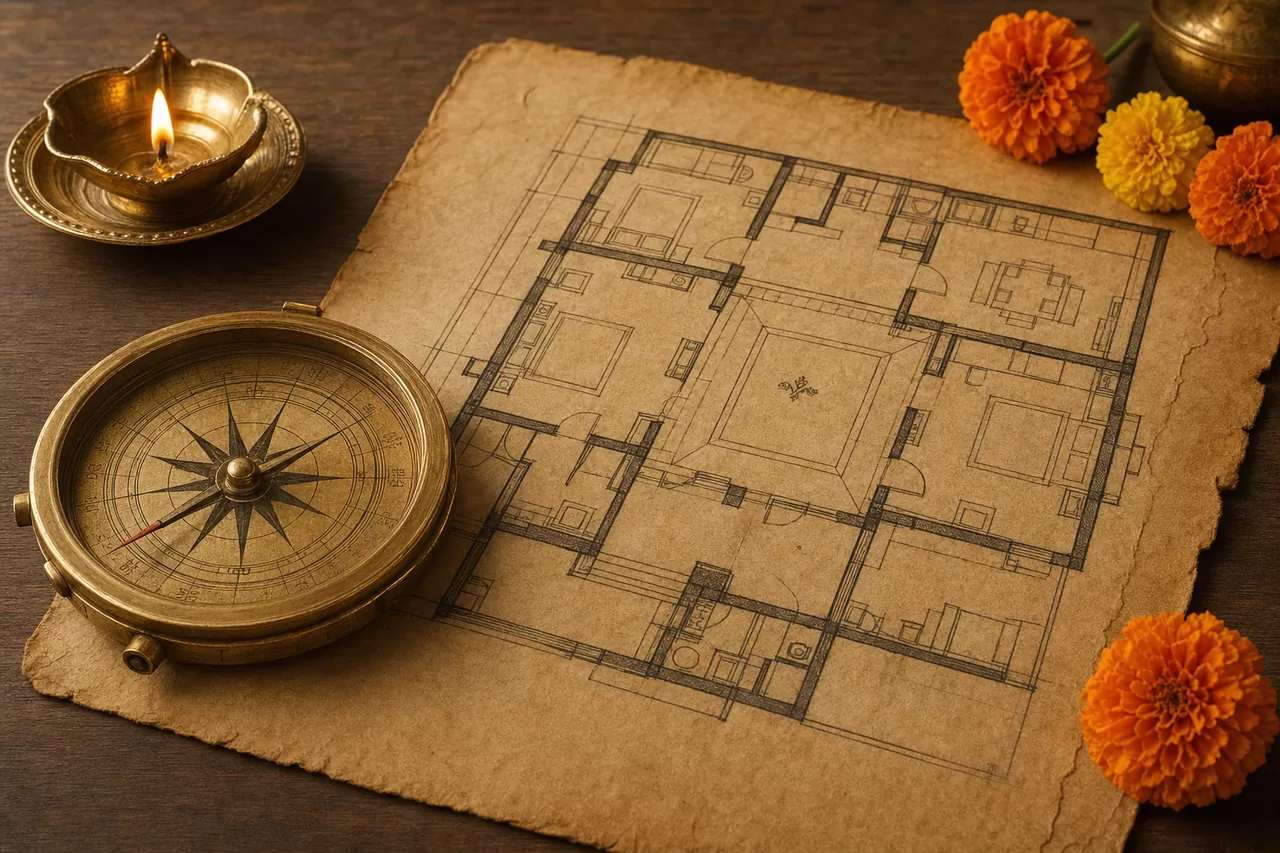
A vastu consultation costs $50 and runs by phone, video or WhatsApp; a floor plan with compass photos is enough for him to read the layout. Where a vastu shanti is warranted for a layout problem the house cannot shed, it starts from $250, a figure settled with you before he begins, and he performs it himself at Auburn, with the family welcome to follow by video. Online puja and havan sets out what the day includes.
No one should sell you a remedy for a fern that was watered every day.
Humid north, cold south: Cairns, Townsville and Geelong
Plants fail differently across the country. In Cairns and Townsville the wet season brings rot and fungus to pots that never dry, and plants that flourish on the verandah often sulk in a cold air-conditioned room; on the Sunshine Coast the same humidity favours the money plant. In Geelong, and in winter in Newcastle and Wollongong, heaters and cold draughts do the damage, and coastal wind carries salt onto balcony leaves.
For families in Victoria’s second city, readings for Geelong households are by phone or video, the same as for Far North Queensland and the Illawarra; the one place he meets clients face to face is Auburn.
What vastu cannot do for a plant
Vastu cannot water a fern, kill a mealybug or move the sun to the other side of the house. It cannot be guaranteed either, and vastu and folk belief are faith-based guidance, not horticultural, medical or legal advice. A nursery, a little reading on the plant’s needs and a fortnight of attention will save more plants than any remedy.
What the tradition offers is a way of living with plants that treats them as part of the household: the tulsi watered at dawn, the dead plant thanked and returned to the soil, and the house kept bright enough for living things.
Read next
- Broken Mirrors, Cracked Glass and Things That Keep Breaking at HomeA broken mirror or a run of breakages at home: the physical causes first, what Hindu folk belief and vastu say, safe …
- Phitkari (Alum) for Negative Energy: The Folk Remedy and Its LimitsPhitkari (alum) against nazar and negative energy: what alum really is, why its melted shape means nothing, safe use …
- Signs of Negative Energy in Your Home & How to Clear ItSigns of negative energy in a home, the ordinary causes to rule out first, and how nazar, heavier interference and me…
Frequently asked questions
Why do my plants keep dying even though I water them?
Often because they are watered too much. Yellow lower leaves, soft stems, soil that stays wet and small flies over the pot all point to roots rotting for lack of air, especially in pots without drainage holes or with a decorative outer pot holding water. Water only when the top few centimetres of mix are dry, use less in winter, and move the plant nearer a bright north or east window.
Do dying plants mean negative energy in the house?
Rarely on their own. Light, water, pests, heater vents and cold draughts explain most dying plants, and the leaves usually show which. Some families do read a run of dying plants, alongside broken sleep, quarrels and illness that began in the same month, as heaviness in the house. That wider pattern, with the practical causes checked, is what a reading looks at.
What does vastu say about cactus and thorny plants inside?
Popular vastu advice keeps cactus, spiny succulents and other thorny plants outside rather than in the living rooms, and some families also keep plants with milky sap outdoors. Bonsai is avoided by some because the clipped tree is read as stunted growth. Traditions differ, and none of it makes a healthy cactus on a balcony harmful; dead plants, though, should be removed promptly.
What does it mean if my money plant is dying?
Folk belief links a thriving money plant with prosperity, so a dying one is read as a money worry. Practically, the money plant is devil’s ivy or pothos, one of the easiest indoor plants, and it usually fails from cold or waterlogged roots. Take a healthy cutting, stand it in water until roots appear and start again; popular vastu places it in the south-east, climbing upwards.
Is a dying tulsi plant a bad sign?
It is taken as an omen in some homes, though the everyday reasons are more convincing: tulsi is tender to frost, rots in cold, soggy soil and fades after flowering, so southern winters claim many plants. Lay a dead plant back into the garden or the green-waste bin with a word of thanks, keep it out of waterways, and grow a new one from a cutting. A sunny indoor spot through winter saves most.
Can a plant absorb the evil eye?
Many families believe so: a plant admired by visitors or kept by the front door is said to take the nazar meant for the household and wilt instead. It is a gentle belief, and some keep a plant at the entrance for that reason. Plainly, plants often wilt after a busy week because nobody watered them or the room was hot and crowded, so check those first.
Which windows are best for indoor plants in Australia?
North-facing windows get the most light through the year because the midday sun stands to the north of us, and east windows give gentle morning sun that most houseplants enjoy. West windows can scorch plants in summer afternoons, and south-facing rooms stay dim, suiting only shade-tolerant plants. Plant guides written for the northern hemisphere assume the opposite, which is why their window advice misleads Australian readers.
Is it safe to use salt near plants for cleansing?
No. Salt in potting mix damages roots and can kill a plant, so keep salt bowls away from pots and do not let salt water from mopping splash into the soil. If your household keeps salt customs, use them on hard floors and thresholds well away from plants, and keep salt out of reach of dogs, for whom eating it in quantity is dangerous.
Is a consultation worth it for a plant problem alone?
Usually not, and he will say so: a nursery and a fortnight of attention fix most dying plants. A $50 consultation earns its place when the plants are part of a wider change in the household, or when you want the floor plan read for vastu at the same time. A vastu shanti, where a layout problem cannot be changed, starts from $250 and is settled before he begins.
People also ask
Why do indoor plants die so quickly?
Most indoor plants die from too much water, too little light, dry air from heaters, cold draughts or pests, often a combination. Supermarket plants are also frequently root-bound or grown for a short shelf life. Check drainage, let the surface of the potting mix dry before watering again, move plants nearer a north or east window in Australia, and look under leaves for mealybug, scale or spider mite.
Which plants should not be kept at home according to vastu?
Popular vastu advice keeps cactus and other thorny plants outside, avoids bonsai because the clipped tree suggests stunted growth, and some families keep plants with milky sap outdoors. Dead or dying plants are removed promptly. Living, healthy plants in the north and east are welcome. Traditions differ, so these are customs to weigh, not rules that make a healthy plant dangerous.
Where should a money plant be kept according to vastu?
Popular vastu places the money plant in the south-east of the home and asks that it be trained to climb upwards rather than trail on the floor. In Australia it is sold as devil’s ivy or pothos and grows best in bright indirect light with the mix allowed to dry a little between waterings. A healthy plant is the point; the corner comes second.
Is it bad luck to keep a dead plant in the house?
Popular vastu says dead and dying plants should be removed promptly rather than left on a sill or in a corner, and many families feel the same without any rule. Practically, a dead plant gathers dust and can harbour pests. Compost it or put it in the green-waste bin, and if it mattered to you, replace it with a cutting from a living plant.
Do plants absorb negative energy?
Folk belief says some do, especially a plant by the entrance that takes the nazar meant for the household. There is no way to test it, and plants wilt for plain reasons that are easy to check. Treat the belief gently, care for the plant properly, and replace one that dies with a fresh cutting rather than reading its loss as a warning.
References & further reading
Serving clients across Australia
Confidential consultations by phone, video & WhatsApp — including: