
Quick answer
Before first wearing, a stone is dipped briefly in raw milk or Gangajal, rinsed, dried and dedicated with the planet’s mantra 108 times on its traditional day. Pearls, coral and most emeralds are only sprinkled and wiped, never soaked or heated. A rudraksha mala is rinsed, dried in shade and blessed with Om Namah Shivaya. No effect is promised.
What does cleansing a gemstone mean in the Vedic tradition?
Cleansing a gemstone is a short purification that a Hindu household performs before a ring, a stone or a mala is first worn: a dip or a sprinkle of raw milk or Gangajal, a rinse in clean water, and the planet’s mantra said over it on the stone’s own day. It is a dedication rather than a treatment, the moment an object bought from a shop becomes something worn for prayer.
Questions about how to cleanse a gemstone usually arrive after the stone has been bought, and the first answer is that the stone should have come from a chart, not a counter. Gemstone advice from your own chart decides whether a stone suits you at all, and the purification below is for a stone that does.
Why is a stone cleansed before it is first worn?
Because it has passed through many hands before yours: the miner, the cutter, the dealer, the jeweller and whoever tried it on in the shop. The tradition marks the change of owner and of purpose with water and a mantra, so that the stone begins its work for you with nothing of the shop about it.
The same thinking applies to a new mala, a silver ring that will carry a stone, or a pendant bought for a child. None of it is meant to change what the object is; it changes what the object is for.
How is a ring purified at home, step by step?
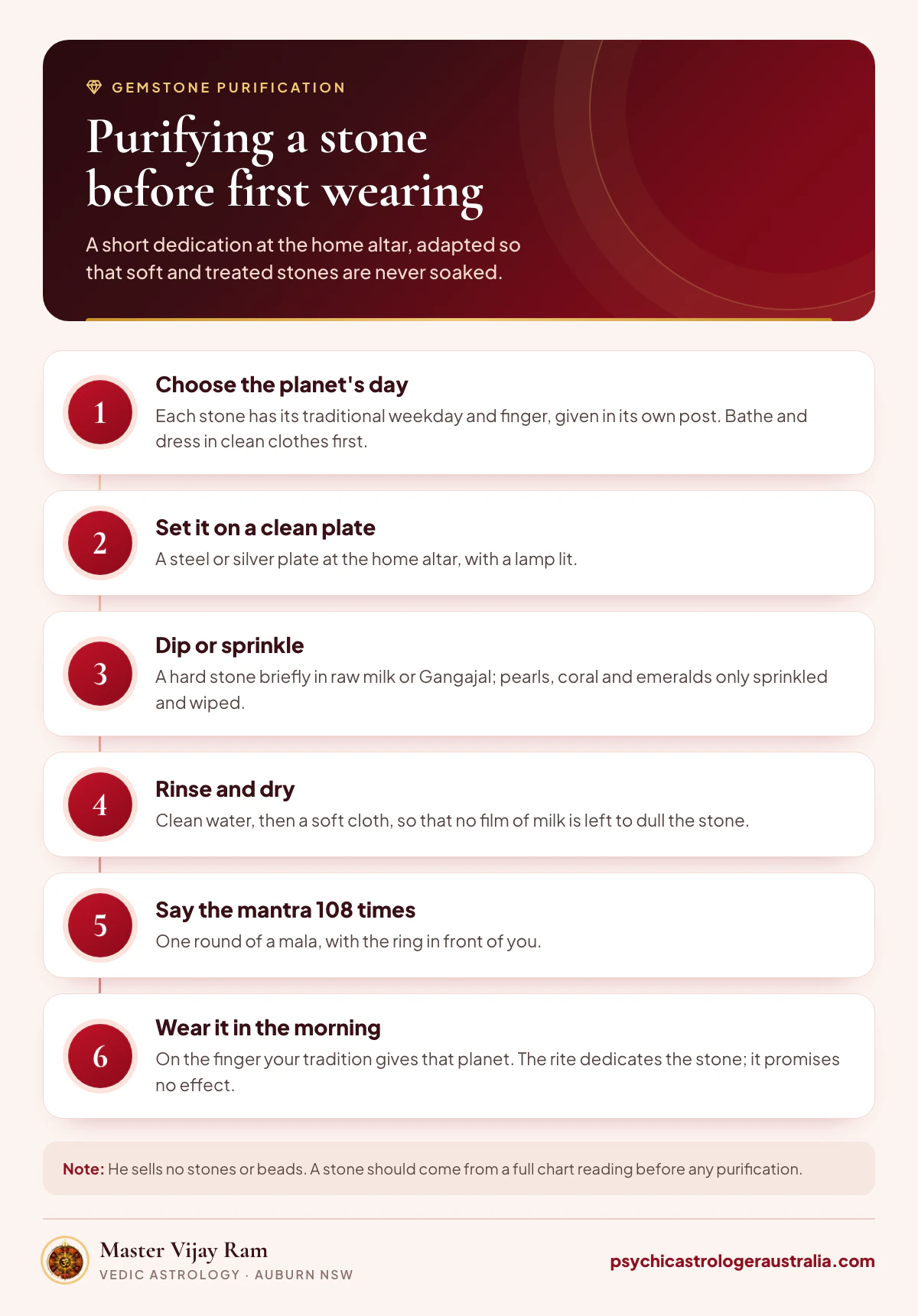
To purify a ring the household way, choose the day first. Each stone’s planet has its traditional weekday and finger, and the stone posts give them in full, from the pearl and its Monday wearing to the sapphires; this is the shape of the morning itself:
- Bathe and put on clean clothes, then sit at the home altar with a lamp lit.
- Place the ring on a clean steel or silver plate.
- Dip a hard stone briefly in raw milk or Gangajal; for a soft or treated stone, sprinkle a few drops instead.
- Rinse it in clean water and dry it with a soft cloth.
- Say the planet’s mantra 108 times, one round of a mala, with the ring in front of you.
- Put it on in the morning, on the finger your tradition gives that planet.
The whole rite takes twenty minutes or so, most of it the mantra. Families with a priest or a guru often have their own version, and theirs is as valid as any printed one.
Which stones must not be soaked?
This is where the ritual meets the jeweller’s bench, and where good intentions damage stones. Pearls and coral are organic, soft and porous, and many emeralds have oil or resin in their fractures, so a long soak, warm liquid or heat can dull or harm them; the Gemological Institute of America’s gem guides describe these sensitivities stone by stone.
| Material | What it is | Safe way to purify | Avoid |
|---|---|---|---|
| Ruby, sapphires, diamond, hessonite, cat’s eye | Hard mineral gems | A brief dip in raw milk or Gangajal, then a rinse and a dry | Overnight soaking in anything; rough scrubbing of the setting |
| Emerald | Often oil- or resin-filled in its fractures | A few drops sprinkled and wiped off at once | Soaking, warm liquids, heat, steam and ultrasonic cleaners |
| Pearl | Organic and soft; nacre built up around an irritant | A few drops, wiped off at once with a soft cloth | Soaking, salt, acids, perfume and heat |
| Coral | Organic, soft and porous | A few drops, wiped off at once | Soaking, salt, acids, heat and household chemicals |
| Rudraksha mala | Dried seeds on a thread | A rinse in water or Gangajal, dried in the shade | Soap, long soaking and drying in hot sun |
| Tulsi or sandalwood mala | Wood beads | Wiped with a damp cloth | Soaking, since wood swells and splits |
Milk left to dry also leaves a film that dulls any stone, so the rinse matters as much as the dip. Salt, which some online guides add to everything, has no place in the traditional rite and is hard on soft stones; the emerald’s particular needs are covered in emerald, oiling and care.
What is gemstone pran pratishtha, and do you need it?
Gemstone pran pratishtha is the fuller rite of the same idea: a priest invokes the planet’s presence in the stone with a longer sequence of mantras, often after a set number of repetitions of the planet’s mantra over days. It is the version a family chooses for a costly stone, a hard planetary period, or simply because it is how their elders did it.
Nobody needs it in order to wear a stone. The home rite above is complete in the tradition’s own terms, and the fuller one adds devotion and time, not a switch that the home rite failed to throw.
Can you “activate” or energise a gemstone?
People who want to energise a gemstone before wearing it are usually asking the right question in a seller’s words. The tradition speaks of purifying and dedicating a stone, never of charging it like a battery, and a printed certificate of energising adds nothing to a stone that the mantra did not.
What the dedication does is mark the start of a remedy chosen from the chart and keep the wearer mindful of it. No effect is promised, by the stone or by the rite, and any seller who promises one is making a claim Australian Consumer Law expects them to stand behind.
How is a rudraksha mala cleansed before first use?
To cleanse a rudraksha mala, rinse it in clean water or water with a few drops of Gangajal, pat it dry, and let it dry fully in the shade; many families then rub in a little oil and wipe off the excess. On a Monday, Shiva’s day, say Om Namah Shivaya over it 108 times, counting on the mala itself, before it is worn or used for japa.
Soap stays away from rudraksha, and so do perfume and pool water. The longer care of the bead in an Australian climate, and how to tell a real bead from a carved one, is in the honest guide to rudraksha.
A mala used for counting japa is traditionally kept for that alone and not lent, and many keep a separate one for wearing. When the thread frays, have it restrung with a knot between beads, so that a break loses one bead rather than all of them.
When should a stone or mala be cleansed again?
When it has been off for a while, many families say the mantra again before putting it back: eleven times after a short removal, the full 108 after a long one. A ring taken off for surgery or a scan, a mala that sat in a drawer through a move, a pendant borrowed by a cousin for a wedding: each is welcomed back the same way.
Some households also repeat the mantra on the planet’s day each week, which keeps the remedy present in the mind as much as in the stone. Traditions differ, and nothing goes wrong for a family that does it monthly instead.
What about a ring you inherited?
An inherited stone is purified as if it were new, because it is new to you, and the dedication is often the most moving part of receiving it. But a grandmother’s pukhraj was chosen for her chart, not yours, and a stone that served her well may be the wrong planet for you.
Have it read against your own chart before you wear it, and if it does not suit, keep it with love at the altar or in the family’s jewellery. That is no disrespect to her; it is what she would have done with a stone that did not suit.
What can a cleansing not do?
It cannot make the wrong stone right, turn a cracked or fake stone into a good one, or promise anything a stone itself cannot deliver. A stone chosen from a Moon sign alone stays a guess however carefully it is purified, which is why the chart comes first.
It treats nothing in the body, and no stone or mala replaces a doctor, a counsellor or a lawyer. Gemstone remedies are matters of faith; they are not medical, legal or financial advice.
What does Master Vijay Ram do, and what does it cost?
He sells no stones or beads, names no seller and takes no commission. His $50 consultation, by phone, video or WhatsApp, reads the chart, often through a full kundli reading, and says whether any stone is warranted, which one, and how to purify and first wear it at home.
A family that would rather have the pran pratishtha done for them books it as jaap and puja work from $250, agreed before it is performed, which he completes himself in Auburn with the family welcome to follow on video; online puja and havan explains how. Clients reached through astrology readings for Newcastle clients keep Sydney time, and a face-to-face consultation means coming to Auburn by appointment.
A ring purified before wearing belongs to the same family of practices as the morning bath and the sip of water before prayer, set out in body cleansing in the Vedic tradition.
Read next
- Gemstone Remedies by Birth Chart: Which Stone Actually Helps YouGemstone remedy by birth chart: how the lagna, its benefics, the dasha and a weak planet decide which stone helps, wi…
- Hessonite (Gomed): Rahu’s Stone and When It Is SuggestedHessonite (gomed) in Vedic astrology: Rahu’s stone, how it is judged without a sign, when it is suggested or avoided,…
- Diwali 2026 House & Aura Cleansing: Clear the Year's Heavy EnergyDiwali 2026 house and aura cleansing done honestly: clean first, use the Five-Lamp Check, and learn when heaviness is…
Frequently asked questions
How do you cleanse a gemstone before wearing it?
On the stone’s traditional day, after a bath, place the ring on a clean plate at the altar, dip a hard stone briefly in raw milk or Gangajal, or sprinkle a soft one, rinse it in clean water and dry it. Say the planet’s mantra 108 times with the ring before you, then put it on in the morning on the finger your tradition gives that planet.
Can a pearl or coral be dipped in milk?
Not soaked. Pearls and coral are organic, soft and porous, and long contact with liquids, salt, acids or heat can dull or damage them. Sprinkle a few drops of raw milk or Gangajal and wipe them off at once with a soft cloth, then say the Moon’s or Mars’s mantra as usual. The dedication is in the mantra, not the soaking.
How should an emerald be cleansed?
Gently. Many emeralds have oil or resin in their fractures, which warm liquids, soaking, steam, heat and ultrasonic cleaners can draw out. For the purification, sprinkle a few drops of raw milk or Gangajal and wipe them off straight away, then chant Mercury’s mantra on a Wednesday. For ordinary cleaning, follow the jeweller’s advice for that stone.
What is gemstone pran pratishtha?
The fuller rite of dedicating a stone, in which a priest invokes the planet’s presence in it with a longer sequence of mantras, often after many repetitions of the planet’s mantra over days. Families choose it for a costly stone or a hard planetary period. It is not required: the home purification with milk or Gangajal and 108 repetitions is complete in the tradition’s own terms.
How many times should the mantra be chanted?
The usual count for first wearing is 108, one full round of a mala, said over the stone on its planet’s day. Many families say it eleven times when putting a ring back on after a short removal, and the full 108 again after a long gap. Some repeat it weekly on the planet’s day; traditions differ, and none of them is wrong.
How do you cleanse a new rudraksha mala?
Rinse it in clean water or water with a few drops of Gangajal, pat it dry and let it dry fully in the shade, then rub in a little oil and wipe off the excess if your family does. On a Monday, say Om Namah Shivaya 108 times, counting on the mala itself. Keep soap, perfume and pool water away from it.
Should I cleanse a ring I inherited?
Yes, purify it as if it were new, because it is new to you. But have it read against your own chart first: a stone chosen for a grandparent’s chart may be the wrong planet for yours. If it does not suit, keep it at the altar or in the family’s jewellery with love, which honours the person far more than wearing the wrong stone would.
Is salt water a good way to cleanse a gemstone?
Not in the Vedic rite, which uses raw milk or Gangajal and the planet’s mantra. Salt, which many crystal guides recommend, is hard on pearls, coral and other soft or porous stones, and leaves a residue on settings. For a hard stone it does no ritual work the mantra does not already do, so it is simply left out.
Does Master Vijay Ram sell or energise stones?
He sells no stones or beads, names no seller and takes no commission. In a $50 consultation he reads the chart and says whether any stone is warranted and how to purify it at home. Where a family wants the pran pratishtha performed for them, he does it personally in Auburn as a puja from $250, agreed before it is performed.
People also ask
How do you activate a gemstone at home?
The tradition does not activate a stone so much as purify and dedicate it. On the planet’s day, dip a hard stone briefly in raw milk or Gangajal, or sprinkle a soft one, rinse and dry it, then say the planet’s mantra 108 times before wearing it. No certificate or bought energising adds anything, and no effect is promised.
Can I clean my gemstone with salt water?
It is better not to. Salt has no part in the Vedic purification, and it is hard on pearls, coral and porous or treated stones such as many emeralds. Use raw milk or Gangajal for the rite, briefly, and plain water and a soft cloth for everyday cleaning, with a jeweller’s advice for anything delicate or valuable.
Can I wear a gemstone without energising it?
Yes. The purification is a custom of dedication, not a condition of the stone working, and many people wear a stone after a simple wash and a prayer. The step that matters far more is the one before: whether the stone suits the chart at all, which a full reading decides. No rite, home or priestly, turns an unsuitable stone into a suitable one.
How do you purify a ring in Hinduism?
After a bath, at the home altar with a lamp lit, the ring is dipped briefly in raw milk or Gangajal or sprinkled, rinsed, dried and placed on a clean plate while the planet’s mantra is said 108 times. It is then worn in the morning on the finger the tradition gives that planet. Soft and treated stones are sprinkled, never soaked.
How often should a mala be cleaned?
Whenever it looks dull or after heavy use: a rinse in clean water for a rudraksha mala, dried fully in the shade, and a wipe with a damp cloth for a wooden one. Many families also re-dedicate a japa mala with its mantra after a long gap. Restring it when the thread frays, with knots between the beads.
References & further reading
Serving clients across Australia
Confidential consultations by phone, video & WhatsApp — including: