
Quick answer
Light the diya at dusk, and at dawn if you can, with ghee for the deities or sesame oil for Shani, using cotton wicks and the flame facing east or north; south is kept for Yama and the ancestors. Set it on a metal tray, never leave it alone, never cover a smoke alarm, and use an LED diya where flames are unsafe.
What does a diya for protection actually do?
A diya is a small lamp of clay, brass or silver with a cotton wick in ghee or oil, and lighting one at dusk is the oldest protective practice in a Hindu home. A diya for protection works, in the tradition’s own terms, by bringing light into the hour when day turns to night, the time a household is said to be most open to what it does not want. It is not a device that pulls anything out of a room; it is an offering and a moment of attention, kept every evening.
This page answers the questions families actually ask: ghee or oil, how many wicks, which way the flame should face, when to light it, and how to keep it safe in an Australian house. Negative energy removal covers the heavier work for a home where a lamp and a calm routine have not been enough.
Ghee or oil: which should you use?
Traditions differ, and every answer here is a custom rather than a rule. Ghee is the fuel most families keep for the deities: it burns with a clean, soft flame and little smoke, and many households reserve it for the altar lamp and the aarti. Sesame oil is the everyday lamp oil of much of south India and the oil of Shani, lit on Saturdays; mustard oil belongs to Hanuman and Shani worship in the north, and coconut oil fills the brass lamps of many Kerala homes.
The choice between a ghee diya or an oil diya therefore depends less on power than on purpose and family habit. A household that lights ghee at the altar and sesame oil at the door on Saturday is following two customs at once, not mixing them up.
Which lamp is used for what?
The table sets the four common fuels side by side. The days are those many families keep, and other families keep different ones.
| Fuel | Traditionally used for | Day many families choose | Practical notes |
|---|---|---|---|
| Ghee | The altar lamp, the aarti, Lakshmi and the household deities | Daily, and every festival | Little smoke; a round cotton wick stands up in it |
| Sesame (til) oil | Shani; the everyday lamp in many south Indian homes | Saturday for Shani; daily in the south | Burns steadily; a long wick lies along the spout |
| Mustard oil | Hanuman and Shani worship in north India | Tuesday and Saturday | Strong smell and more smoke; best near an open window |
| Coconut oil | Brass lamps in many Kerala homes | Daily | Sets solid in a cold room, so it suits warm houses best |
Whichever fuel you use, an oil lamp leaves soot on the wall or shelf above it over the months. A tile or a metal plate behind the lamp protects the paint, which matters in a rental when the bond comes back.
One, two or five wicks?
Cotton wicks come in two shapes at most Indian grocers: the round phool batti, which stands upright in a ghee lamp, and the long batti, which lies along the spout of an oil lamp. Use cotton, never synthetic thread, which melts and smokes.
The number of wicks follows family custom. Many households light one wick for daily worship, some light two for harmony in the home, and five-faced lamps are kept for the aarti and festival evenings; the brass nilavilakku of Kerala may carry one, two or five wicks depending on the family and the occasion. Nobody’s prayer is weaker for a single wick.
Which way should the flame face?
Diya direction follows the meanings families attach to the quarters. East, towards the sunrise, is for health and long life, and north, Kubera’s direction, is for prosperity, so most daily lamps face one or the other.
South belongs to Yama and to the ancestors, so the daily lamp is turned away from it and a south-facing lamp is kept for them. On the evening of Dhanteras, which falls on Wednesday 27 October 2027, many families set a lamp facing south outside the house for Yama, the Yama deepam, as a prayer that no untimely death enters the home, and the lamp for a departed relative faces south too.
West is used in some homes and avoided in others. None of this turns a misplaced lamp into a danger, and a lamp lit with attention matters more than the compass.
When should the lamp be lit?
Twice, in many homes: in the morning after the bath, at the altar before breakfast, and in the evening as the sun goes down. The evening lamp is the sandhya deep, lit at the meeting of day and night, the hour north Indian families also call godhuli, when the cattle came home through the village dust.
Many families say a short verse as the wick takes: Shubham karoti kalyanam, arogyam dhana sampadah, shatru buddhi vinashaya, deepa jyotir namostute. It greets the light of the lamp as the giver of what is auspicious, of health and wealth, and the destroyer of hostile thinking, which is why families reach for it when they light a lamp for protection.
Sunset moves through the year, so the lamp follows the sky rather than the clock. In Sydney, Melbourne and on the Central Coast daylight saving moves sunset an hour later by the clock from Sunday 3 October 2027, while Brisbane, Darwin and Perth never change; Geoscience Australia’s sunrise and sunset calculator gives the time for any town.
What about the lamp for the departed and the Navratri lamp?
After a death, many families keep a lamp burning for the departed through the mourning period, facing south, with fresh ghee or oil added morning and evening. During Navratri many keep an akhand jyoti, an unbroken lamp, for all nine nights; Chaitra Navratri begins on Thursday 8 April 2027 in Australia and Sharad Navratri on Friday 1 October 2027.
A lamp that burns day and night is a lamp that will at some point be left alone, so it needs more care than the evening diya. Use a deep brass lamp with a glass chimney on a metal tray, well away from curtains and shelves, and switch to an LED lamp for the hours when nobody is home or awake; many families make exactly that switch and consider the vow kept.
Which lamps belong to Shani and Hanuman?
A sesame-oil lamp on Saturday evening is the best-known Shani remedy, traditionally lit under a peepal tree; most Australian suburbs have no peepal nearby, so it is lit at home, and people in Sade Sati often keep it through the whole period. Sade Sati and Shani remedies explains when a chart actually calls for more than the lamp.
Mustard-oil lamps belong to Hanuman on Tuesdays and Saturdays, often with the Hanuman Chalisa read beside them, and the Hanuman Chalisa for fear and protection covers how many times and when.
How do you light, keep and close a lamp safely?
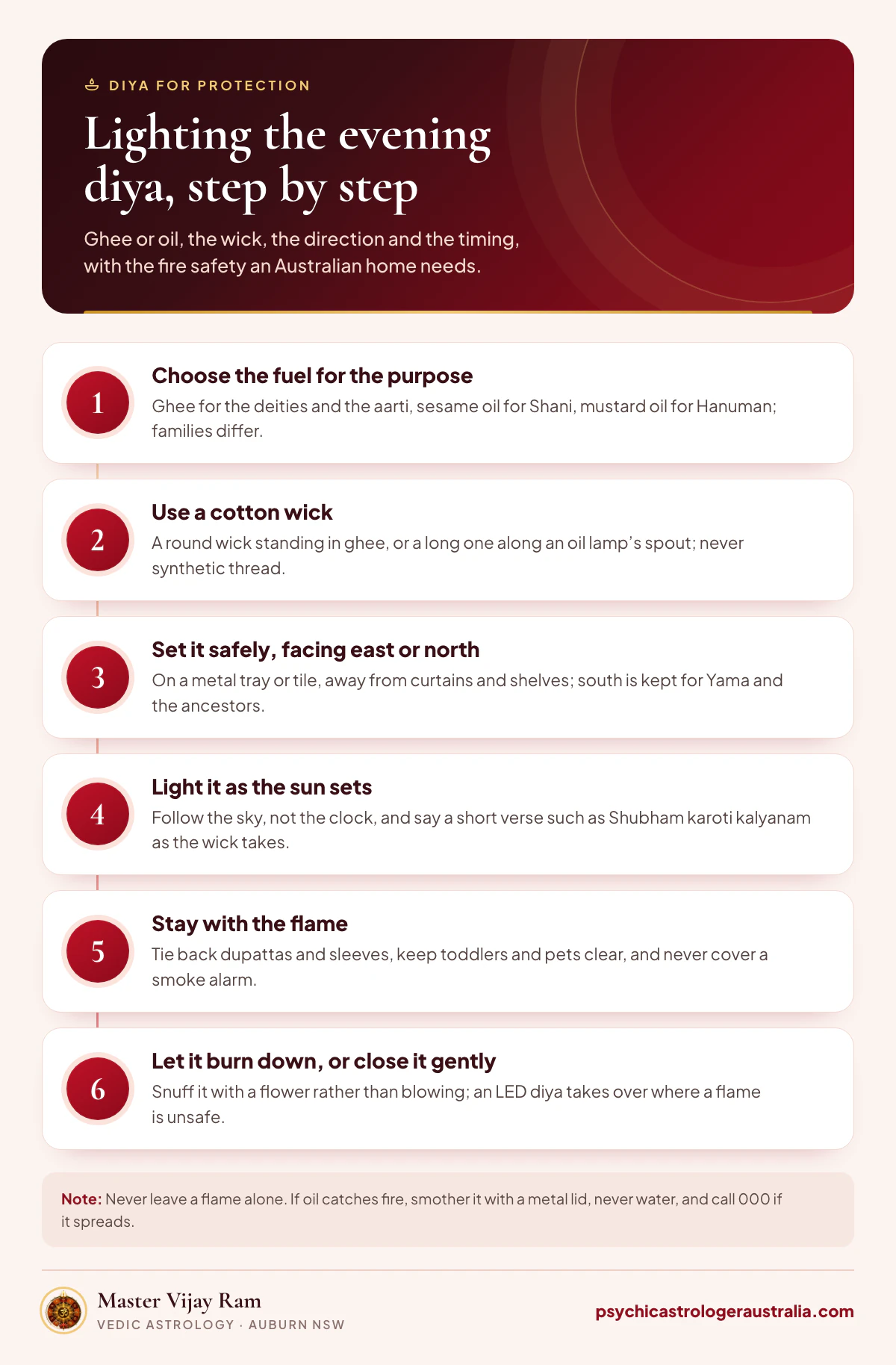
- Stand the lamp on a metal tray or a tile, on a stable surface, away from curtains, paper and any shelf above.
- Never leave a flame unattended, and fill only as much ghee or oil as will burn while someone is home.
- Tie back a dupatta, a sari pallu or long sleeves before the aarti, because synthetic fabric catches quickly.
- Never cover, disable or remove a smoke alarm for a puja; every state requires working alarms in homes.
- Close the lamp the way many families do, by letting it burn down or snuffing it with a flower, rather than blowing it out and scattering hot oil.
- If oil in the tray catches fire, smother it with a metal lid and never use water on burning oil; if the fire spreads, get everyone out and call 000.
These are not extra rules on top of the custom. The tradition asks for an attentive flame, and every point above is attention made practical.
What about toddlers, pets and the LED diya?
A lamp at floor height is a lamp at toddler height, and a cat’s tail or a dog’s wagging one can reach a flame on a low table. Keep lamps high and stable when small children and animals are about, and home cleansing with pets and toddlers covers camphor, smoke and salt in the same house.
An LED diya is the answer wherever a flame is not allowed or not safe: a strata building whose by-laws limit open flames, a rental whose lease rules out flames, a hospital room, an aged-care home, or the overnight hours of a long vigil. Many families light the real lamp for the prayer and the LED for the hours after, and the habit of lighting at dusk is kept either way.
What can a lamp not do?
A diya cannot heal an illness, settle a dispute, lift a pattern a chart shows or stand in for a smoke alarm, a doctor or the police. It is a devotion and a household custom; read this page as religious guidance, not as medical or legal advice, nor as safety advice beyond the fire basics above.
What it can do is mark the end of each day with light and a few quiet minutes, which is why it sits at the centre of the home cleansing calendar as the daily practice that is never skipped. For the camphor flame that closes the aarti, camphor, loban and dhoop explains what each is for.
When is a lamp not enough?
When the evening lamp has been kept faithfully for weeks, the ordinary causes of a heavy house have been checked, and something still feels wrong, especially if it began in a week you can name. A deepam for negative energy was never meant to carry that alone, and a reading looks at the timing in the household’s charts and says honestly whether anything more is warranted.
That reading with Master Vijay Ram costs $50, by phone, video or WhatsApp, in English, Hindi or Punjabi. If a puja or shanti is called for, its fee starts from $250 and is settled with you beforehand, and he carries out the rite himself in Auburn, where he practises; online puja and havan describes how families join by video.
In Melbourne the evening lamp moves an hour with the clocks twice a year, and an astrologer for Melbourne families explains how sessions are booked around work and family time.
Read next
- How to Remove Negative Energy From Yourself: Vedic MethodsVedic ways to clear negative energy from yourself: what to rule out first, safe home practices, the four-gate reset, …
- The Main Door: Toran, Swastik and the Threshold, Your Home’s First ProtectionMain door protection in a Hindu home: threshold customs, the toran and swastik, rangoli at the step, and what changes…
- Signs of Negative Energy in Your Home & How to Clear ItSigns of negative energy in a home, the ordinary causes to rule out first, and how nazar, heavier interference and me…
Frequently asked questions
Is a ghee diya better than an oil diya?
Neither is better in general; they serve different customs. Ghee is the fuel most families keep for the deities, the altar lamp and the aarti, and it burns with little smoke. Sesame oil is lit for Shani and used daily in much of south India, and mustard oil belongs to Hanuman and Shani worship in the north. Choose by purpose and family habit.
Which direction should a diya face?
In the explanations most families give, east is for health and long life and north is for prosperity, so the daily lamp faces one of those. South belongs to Yama and the ancestors and is kept for the lamps lit for them, such as the Yama deepam on Dhanteras evening. West is used in some homes and avoided in others, because traditions differ.
What time should the evening diya be lit?
As the sun goes down, in the dusk window the tradition calls sandhya, rather than at a fixed clock time. Sunset moves through the year, and in New South Wales, Victoria, the ACT, Tasmania and South Australia daylight saving shifts it by an hour overnight in April and October, while Queensland, the Northern Territory and Western Australia never change. Geoscience Australia gives sunset for any town.
How many wicks should a diya have?
Traditions differ. Many families light a single wick for daily worship, some light two for harmony in the home, and five-faced lamps are kept for the aarti and festival evenings. Use cotton wicks, the round kind standing upright in ghee or the long kind along the spout of an oil lamp, and never synthetic thread, which melts and smokes.
Can I leave a diya burning overnight?
Not unattended. An unbroken lamp for Navratri or for a departed relative is a long-held custom, but a flame left alone overnight is a real fire risk. Use a deep brass lamp with a glass chimney on a metal tray, away from curtains, and switch to an LED lamp for the hours when everyone is asleep or out; many families do exactly that.
Is it okay to use an LED diya?
Yes, wherever a flame is not allowed or not safe: a strata building whose by-laws limit open flames, a rental with a no-flame clause, a hospital or aged-care room, or the overnight hours of a vigil. Many families light a real lamp for the prayer and an LED one for the hours after, and the habit of lighting at dusk is what the custom keeps.
Why should a diya not be blown out?
Many families never blow out a lamp, treating breath on the sacred flame as disrespect, and instead let it burn down or close it gently with a flower. The practical side agrees, because a sharp breath can scatter hot ghee or oil. Fill only as much as will burn while someone is home, so the lamp can end on its own without ever being left alone.
Which oil is used for the Shani lamp?
Sesame oil, lit on Saturday evening and traditionally placed under a peepal tree. Most Australian suburbs have no peepal nearby, so the lamp is lit at home, and people in Sade Sati often keep it for the whole period. The lamp is a devotion; whether a chart calls for more than that is a question for a reading of the full kundli.
What prayer is said when lighting a diya?
Many families say Shubham karoti kalyanam, arogyam dhana sampadah, shatru buddhi vinashaya, deepa jyotir namostute as the wick takes. It greets the light of the lamp as the giver of what is auspicious, of health and wealth, and the destroyer of hostile thinking. Any prayer said with attention serves, and the verse is a tradition rather than a requirement.
People also ask
Which diya is best for removing negative energy?
In the tradition, a ghee lamp at the altar or an oil lamp at the entrance, lit every evening at dusk with a short prayer, is the protective practice families rely on; sesame oil is used for Shani and mustard oil for Hanuman. The lamp is an offering and a habit, not a device, and a house still heavy after weeks of lamps needs the ordinary checks and perhaps a reading.
Where should the evening diya be placed at home?
At the altar, often in the north-east of the home, and in many families also at the main door or beside the tulsi plant, with the flame facing east or north. Place it on a metal tray or tile, on a stable surface, away from curtains and any shelf above. In a unit, keep it inside the door, because a strata corridor is no place for a flame.
Can a diya face south?
The daily lamp is usually turned away from the south, which belongs to Yama and the ancestors. A lamp facing south is kept for them: the lamp for a departed relative during the mourning period, and the Yama deepam set outside the house on the evening of Dhanteras. Nothing harmful follows from a lamp placed facing south by mistake.
Is lighting a diya at home safe?
Yes, with ordinary care: a metal tray or tile, a stable surface, nothing flammable nearby, long sleeves and dupattas tied back, and never a flame left unattended. Smoke alarms are never covered or disabled for a puja, and an LED diya is the safe choice where flames are not allowed. If oil catches fire, smother it with a metal lid, never water, and call 000 if it spreads.
References & further reading
Serving clients across Australia
Confidential consultations by phone, video & WhatsApp — including: