
Quick answer
Bringing puja items to Australia starts with the Incoming Passenger Card: answer yes if you carry any food, plant material or animal product, then declare it. Rudraksha are seeds, cow-dung cakes are an animal product, and samagri, dried garlands, spices and sweets may be risks. Declare when unsure; officers decide, and items that pose no risk come back to you.
What does Australian biosecurity mean for a suitcase of puja items?
Australian biosecurity is the border system that keeps foreign pests and diseases out of the country’s farms, gardens and bush, and it is the reason a rudraksha mala or a packet of havan samagri gets a second look at the airport. It is not aimed at religion, and an officer looking at your puja bag is looking for seeds, plant material and animal products, not judging your faith. Knowing that makes the whole process a great deal calmer.
This guide to bringing puja items to Australia goes through the puja bag item by item, with one rule running through all of it: declare when unsure, and let the officers decide. It is guidance from a Vedic astrologer, not legal advice, and the department’s rules, not this page, govern what happens at the counter. For a family having a puja performed on request in Auburn, none of these items needs to travel at all.
What does the Incoming Passenger Card ask?
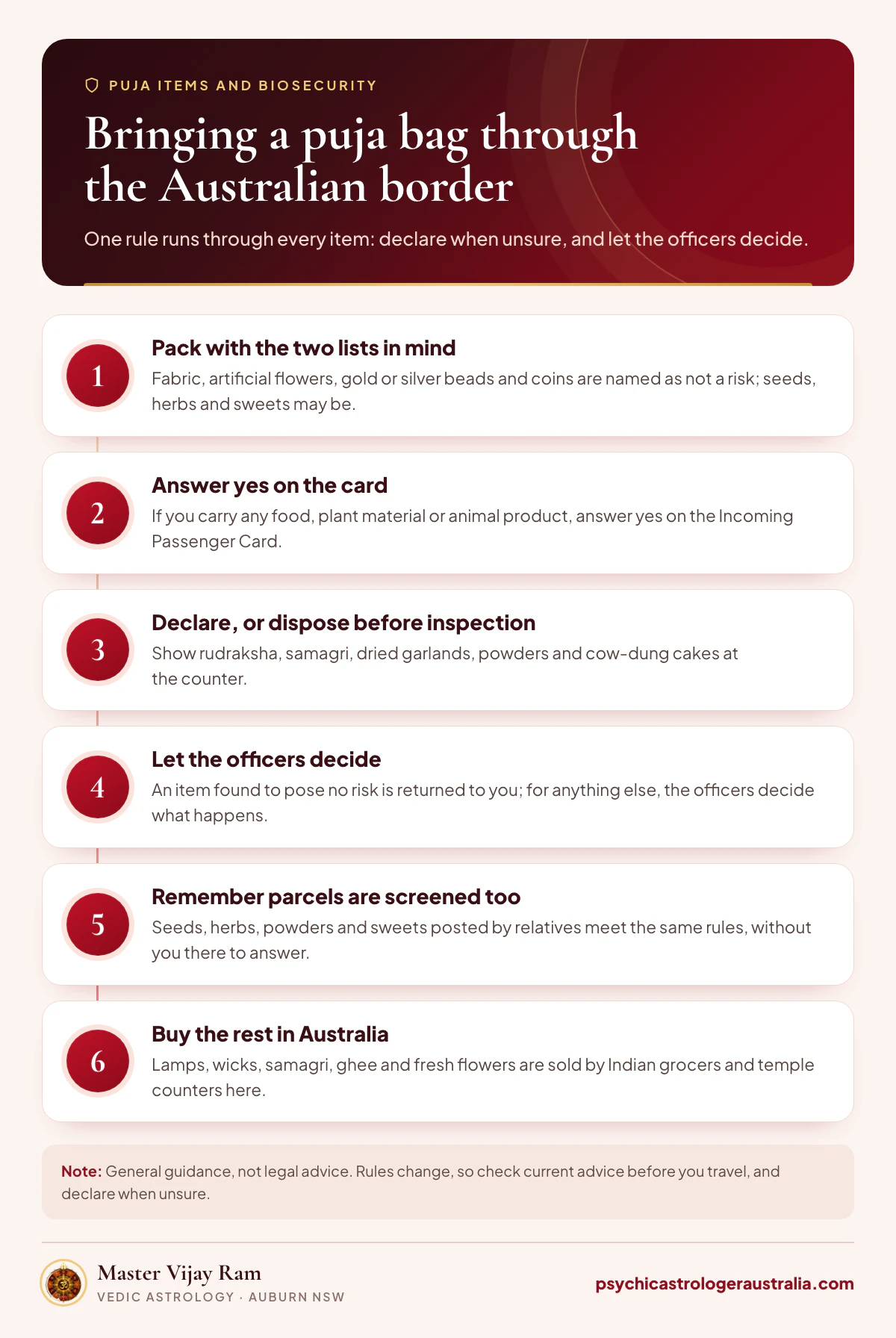
The card every arriving traveller fills in asks whether you are carrying food, plants or plant material, or animal products, among other things. If anything in your luggage might fit, the answer is yes, and you then declare those items to an officer, or dispose of them before you reach inspection. An item declared and found to pose no risk is returned to you.
That is why the Incoming Passenger Card is not something to fear. Ticking yes simply sends you to a counter where someone looks at what you have; it is the undeclared item found in a bag that causes trouble. Answering yes for a mala, a packet of kumkum and a box of pedas is entirely ordinary.
What does the department’s festival guidance say?
The Department of Agriculture publishes guidance for travellers around Indian festivals, and its lists are a useful starting point. It names sweets such as burfi, ras malai, rasgulla and pedas, dairy, fresh and dried fruit, spices and tea, and raw nuts, seeds and herbs as possible biosecurity risks. It names artificial flowers, fabric, gold or silver beads and coins as items that are not.
Most of a puja bag sits somewhere between those two lists, which is where the item-by-item table below comes in. The guidance changes from time to time, so check the department’s current advice before you pack rather than relying on what a cousin did last year.
Which puja items may need declaring, one by one?
The table sets out the common items, why each one may interest an officer, and the safe course. Where it says declare, the officers decide what happens next, and the outcome is not something this page can promise.
| Item | Why biosecurity may care | The safe course |
|---|---|---|
| Rudraksha mala or loose beads | Rudraksha are seeds | Declare; officers decide |
| Tulsi mala, sandalwood beads | Plant material | Declare when unsure |
| Dried garlands, dried flowers, petals | Plant material | Declare, or buy fresh flowers here |
| Havan samagri | A mix of herbs, grains, seeds and resins | Declare; often simpler to buy in Australia |
| Dried cow-dung cakes, dung-based dhoop | An animal product | Declare; officers decide |
| Haldi, kumkum, chandan and other powders | Spices and plant powders are among the named risks | Declare when unsure |
| Gangajal in a sealed bottle | Water from a river; not on either list | Declare when unsure |
| Temple prasad, pedas, laddoos, ghee | Sweets and dairy are named risks | Declare, or finish it before you land |
| Coconut, betel nut, cloves, cardamom | Fruit, nuts, seeds and spices | Declare, or buy here |
| Kalava thread, chunri, altar cloth | Fabric is named as not a risk | Pack normally |
| Artificial garlands, silver or gold beads, coins | Named as not a risk | Pack normally |
Metal lamps, bells and murtis are not food, plant or animal material, but straw, husk or dried leaves packed around them can be. If a brass Ganesh travels wrapped in straw from the shop, declare the bundle or repack it in cloth before you fly.
Why should you declare rudraksha?
Because a rudraksha is the dried seed of a tree, and seeds are exactly what the system exists to check. It makes no difference that the beads are strung, polished, blessed or certified by a laboratory; a certificate speaks to the bead’s authenticity, not to biosecurity. Declare rudraksha on the card, show the mala at the counter, and let the officer decide.
A single mala worn daily is a small thing to declare. A bag of loose beads bought as gifts for the whole extended family is a bigger question, and buying one mala here may be easier than explaining forty.
Can you bring Gangajal to Australia?
Many families do, and since Gangajal appears on neither of the festival lists above, it is exactly the case the rule was made for: declare when unsure. Carry it sealed and clearly labelled, in your checked luggage, because cabin rules on liquids are a separate matter from biosecurity. When bringing Gangajal to Australia, the officer at the counter, not a relative’s story, is the one who decides.
One bottle serves for a long while, because families mix a little into a larger pot of water rather than using it neat. How it is kept and used at home is covered in Gangajal at home in Australia.
What about havan samagri, dried flowers and cow-dung cakes?
Puja samagri is a mixture of herbs, grains, seeds and resins, which puts it squarely among the things officers examine. A family that wants a particular blend from a home temple should declare it and accept that some batches may not come through; a family that simply needs samagri for a festival havan will find it in Indian grocers here.
Dried garlands and petals are plant material, and dried cow-dung cakes are an animal product, so both are declared and the officers decide. The fresh marigolds, roses and jasmine of an Australian florist do the same work in a puja, and cow-dung fuel for a daily fire is better sourced here than carried in a suitcase.
Can you bring sweets and temple prasad?
Sweets and dairy are named as possible risks, so a box of pedas from a temple, a jar of ghee or a packet of ras malai is declared like any other food. Many families eat the prasad on the journey, share it with fellow passengers or leave a portion with relatives in India, which keeps the blessing and avoids the question.
There is no disrespect in that. Prasad is meant to be eaten and shared, and the tradition does not ask that it survive an international flight.
Are parcels posted from India treated differently?
No. Post and parcels are screened too, and a box of samagri, rudraksha or dried flowers posted by a relative meets the same rules as one carried in a suitcase. The difference is that you are not there to answer questions about it, so anything doubtful in a parcel is decided without you.
If relatives want to send something, fabric, artificial garlands and silver coins are on the not-a-risk list, and a printed picture is neither food, plant nor animal material; seeds, herbs, powders, sweets and dung are the things that invite questions. Families in smaller cities such as Hobart may find an Australian grocer that delivers easier than a parcel from India.
What is easier to buy in Australia instead?
Almost everything. Lamps, wicks, camphor, incense, kalava, rangoli colours, samagri, ghee and fresh flowers are sold by Indian grocers and at temple counters around Australia, and none of them has to pass an officer. A home cleansing kit for Australian homes lists the short set of items most households actually need.
What is worth carrying from India is usually what cannot be bought: a family murti, a mala a grandparent wore, a picture from a home temple. Those are mostly metal, fabric or paper, and the few that are seeds or plant material are simply declared.
Is an item taken at the border a bad sign?
No. A rudraksha that stays at the airport, a packet of samagri that is destroyed or a garland that is taken is a biosecurity decision, not an omen, and nothing in the tradition reads it as one. If the item mattered to you, say a short prayer of thanks for it at your own altar and replace it here.
Gifts and keepsakes from a visit carry the same calm logic, and visiting India, nazar and gifts covers the worries families bring back with them. Taweez and kavach bought abroad are a separate question, and a kavach is only ever prepared after a consultation shows it would help, as taweez and kavach protection explains.
How does a consultation fit, and what does a puja cost?
Nothing on this page needs a consultation, and Master Vijay Ram does not need anything brought from India for the work he performs. A consultation is $50 by phone, video or WhatsApp, and relatives in India can join the same call; phone and video readings explains how that works across time zones. Where a puja or havan is warranted, he carries it out in person at his Auburn place of practice, with relatives joining by video if they wish, starting at $250 and at a figure agreed before the day.
The same applies whether a family lives in Salisbury, on the Gold Coast or in Canberra; readings for Adelaide families explains the half-hour difference from Sydney. Diaspora families who worry that trouble back home has followed them here will find that question taken up in black magic fears among NRIs and the diaspora.
What can this guide not do?
It cannot tell you what an officer will decide about a particular item on a particular day, and it names no penalties or amounts because those are the department’s to state. Rules and guidance change; the Department of Agriculture and Home Affairs are the sources to check before you travel. This page is general guidance from a Vedic astrologer, not legal advice.
What it can do is make the airport less frightening. Declare what you are unsure of, accept the officer’s decision, and buy the rest here; the puja at home is just as complete either way.
Read next
- Finding Your Birth Time: Records in Australia and IndiaHow to find your birth time: hospital records, state registries, baby health books, Indian certificates and the ghati…
- Inheritance and Family Property Disputes, and the ChartInheritance and family property disputes: lawyers and Legal Aid in Australia and India first, then the eighth and fou…
- Diwali 2026 House & Aura Cleansing: Clear the Year's Heavy EnergyDiwali 2026 house and aura cleansing done honestly: clean first, use the Five-Lamp Check, and learn when heaviness is…
Frequently asked questions
Can I bring rudraksha to Australia?
You can carry it, but declare it. A rudraksha is a seed, and seeds are what biosecurity officers check, whether the beads are loose, strung, polished or certified. Answer yes on the Incoming Passenger Card, show the mala at the counter and let the officer decide. Declaring a single mala you wear is simple; a bag of loose beads as gifts means much more to declare.
Can I bring Gangajal into Australia?
Many families do. Gangajal is on neither of the festival lists, so the rule is to declare it when unsure and let the officers decide. Carry it sealed and labelled in checked luggage, since cabin liquid rules are a separate matter. Because only a little is mixed into a larger pot of water at a time, one bottle serves for a long while.
Do I need to declare puja samagri at customs in Australia?
Yes, declare it. Havan samagri is a mixture of herbs, grains, seeds and resins, which are among the things biosecurity officers examine, and some batches may not be allowed in. If you only need samagri for a festival havan, Indian grocers in Australia sell it, which avoids the question entirely. A special blend from a family temple is declared and the officers decide.
Can I bring cow-dung cakes into Australia?
Dried cow-dung cakes are an animal product, so they must be declared, and the officers decide whether they can come in. Dung-based dhoop and incense are treated the same way when unsure. Families who keep a daily Agnihotra or use dung in a havan usually find it simpler to source fuel in Australia than to carry it in a suitcase.
Can I bring Indian sweets or temple prasad to Australia?
Sweets such as burfi, ras malai, rasgulla and pedas, and dairy products such as ghee, are named as possible biosecurity risks, so they are declared like any other food. Many families eat temple prasad on the journey, share it with fellow travellers or leave it with relatives before flying, which keeps the blessing and avoids the question at the counter.
Which religious items are not a biosecurity risk?
The Department of Agriculture’s festival guidance names artificial flowers, fabric, gold or silver beads and coins as items that are not a risk. Kalava thread, a chunri or an altar cloth fall under fabric. Metal lamps and murtis are not food, plant or animal material, but any straw, husk or dried leaves packed around them can be, so repack them in cloth or declare the bundle.
What happens when I declare an item at the airport?
An officer looks at it. Anything found to pose no risk is returned to you, and for other items the officers decide what happens. Declaring is the safe habit with anything you are unsure about. It is the undeclared risk item found in a bag that causes trouble, not the honest answer on the card.
Can relatives post puja items to me from India?
They can post them, but post and parcels are screened too, and the same rules apply as for a suitcase. Fabric, artificial garlands and silver coins are named as no risk; seeds, herbs, powders, sweets and dung are what invite questions. Because you are not there to declare the parcel, buying those items from a grocer in Australia is usually simpler.
Is it a bad omen if a sacred item is taken at the airport?
No. A rudraksha, a packet of samagri or a garland that stays at the border is a biosecurity decision, not a sign, and nothing in the tradition reads it as one. If the item mattered to you, say a short prayer of thanks for it at your own altar and replace it in Australia. The worship at home is just as complete.
People also ask
What items must be declared when arriving in Australia from India?
Anything that is food, plant material or an animal product, which for a puja bag usually means rudraksha and other seeds, havan samagri, dried flowers and garlands, spices and powders, sweets, ghee and dried cow-dung cakes. Answer yes on the Incoming Passenger Card and declare them. When you are unsure about an item, declare it; officers decide what happens next.
Can I bring dried flowers into Australia?
Dried flowers, petals and garlands are plant material, so they are declared and the officers decide. Artificial flowers and fabric garlands are named in the festival guidance as not a risk. For a puja in Australia, fresh flowers from a local florist or garden do the same work and avoid the question entirely.
Can I bring incense sticks to Australia?
Declare them when unsure. Many incense sticks and cones contain plant material, resins or dung, and the officers decide whether a particular product needs inspection. Incense, dhoop and sambrani are sold widely by Indian grocers in Australia, so carrying a large supply rarely makes sense.
Can I bring a tulsi mala to Australia?
A tulsi mala is made of plant material, so declare it when unsure and let the officers decide. Declaring a single mala you wear is simple. Tulsi plants themselves are sold in many Australian garden centres, often labelled holy basil, so there is never a need to carry seeds or cuttings.
References & further reading
Serving clients across Australia
Confidential consultations by phone, video & WhatsApp — including: