

Quick answer
Keep the main door clean, lit and clear, hang a fresh toran of mango leaves or marigolds across the frame, draw a swastik with shubh and labh beside it, and step over the threshold rather than on it. In a unit, keep everything inside the door and never a flame in the corridor; working locks and a porch light come first.
Why does the main door matter so much in a Hindu home?
Because everything that enters the house comes through it. Main door protection in the Hindu tradition is less about defending a house than about keeping its mouth clean, lit and welcoming, so that Lakshmi, guests and good news find their way in. The dehleez is the threshold of the house, the line under the main door that the tradition treats as a boundary between the world outside and the family within.
Main entrance vastu gives the door more attention than any other part of the plan, and families in Australia ask about it more than about any other part too. A vastu consultation for the home reads the direction and layout of a particular door; this page covers the customs any household can keep at its own threshold, and where Australian houses and units change them.
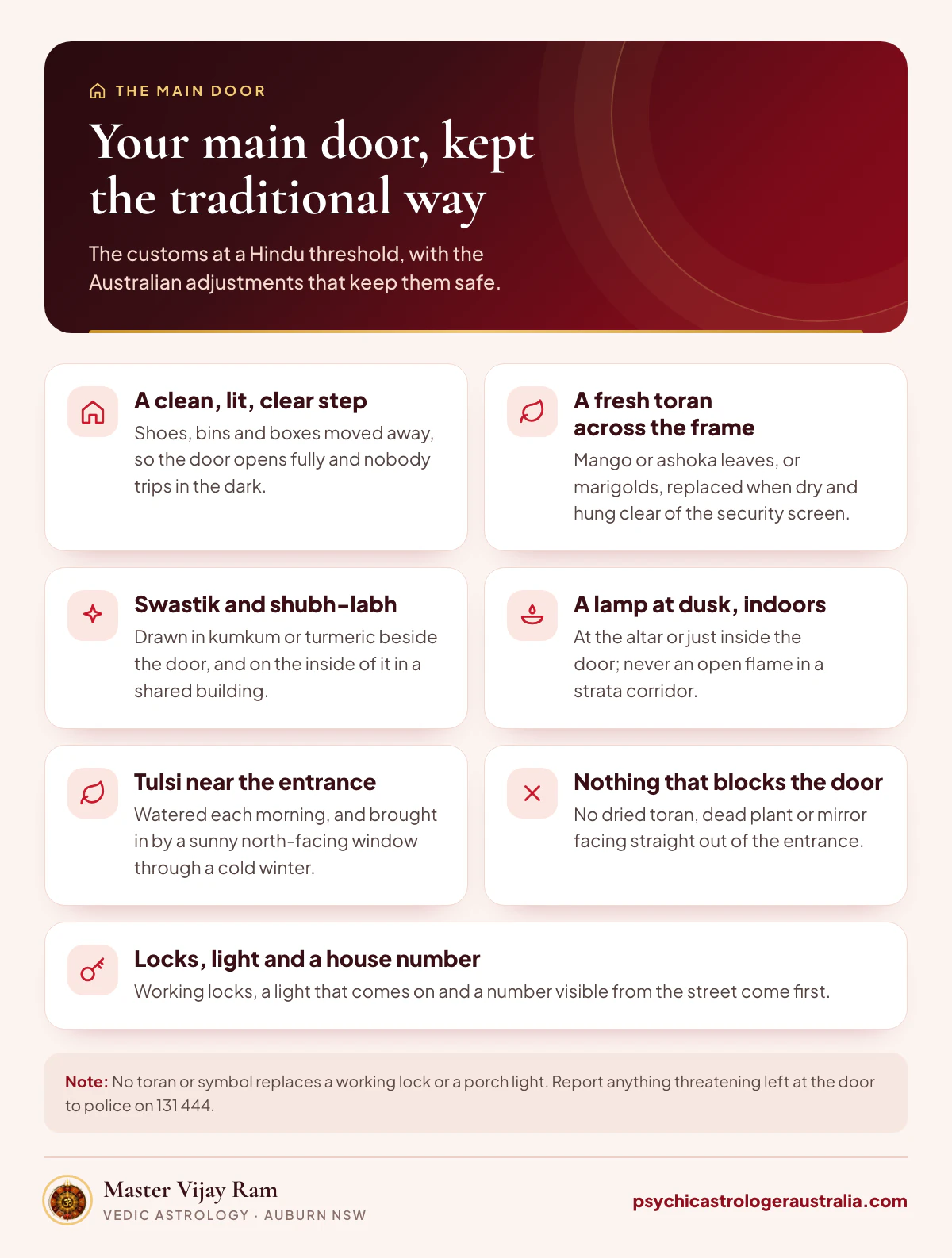
Why is the threshold treated as a boundary?
The threshold belongs to neither the house nor the street, and Hindu threshold rituals follow from that. Many families step over the dehleez rather than on it, enter a new home or a temple right foot first, and avoid sitting on the doorstep or handing things across it to someone standing outside.
A new bride’s entrance is the best-known threshold rite: in many north Indian families she tips a kalash of rice over the dehleez with her right foot before she steps in, a sign that plenty arrives with her. At a griha pravesh the whole family crosses together on the chosen muhurat, which is part of what a griha pravesh home blessing involves.
These are household customs, and traditions differ from region to region. Nobody brings harm on a house by sitting on its step once; the customs simply keep the boundary in mind.
What does the Narasimha story say about thresholds?
It is the threshold story of the tradition. Hiranyakashipu held a boon that he could be killed neither inside his house nor outside it, neither by day nor by night, so Vishnu came as Narasimha, half man and half lion, and ended him at twilight on the threshold to protect the boy Prahlada.
Families take one plain idea from it: the doorway and the hour of dusk are in-between places, and in-between places deserve care. That is one reason so many households light a lamp at the main door or the altar as the sun goes down, and Narasimha and Sudarshana, Vishnu’s protective forms tells the story in full.
What is a toran, and what should it be made of?
A toran, or bandhanwar, is the garland strung across the top of the door frame, and a toran on the main door is the simplest sign that a house is cared for. The traditional kind is fresh mango leaves on a cotton thread, sometimes with ashoka leaves or marigolds between them, and for festivals and weddings the marigolds take over.
Fresh leaves are replaced when they dry, because a dried toran reads as a house that has stopped paying attention. In Brisbane and on the Gold Coast many families can cut leaves from a backyard mango tree; in Canberra and Hobart, where frost rules mango trees out, a string of marigolds or a well-made fabric or beaded toran does the same work.
Hang it on the main door frame itself, inside any security screen, where it cannot catch on the screen door or stop it closing. A toran that keeps a door from shutting properly has made the house less safe, not more.
Where do the swastik and shubh-labh go?
The swastik on the door is drawn in kumkum, sindoor or turmeric paste, on the door itself or on either side of the frame, usually with a dot between the arms. Many families write shubh and labh, auspiciousness and gain, on either side of it, names that folk tradition also gives to Ganesha’s sons, and trading families renew them on the new account books at Diwali.
At Diwali many homes also draw small footprints stepping into the house, Lakshmi’s feet, in rice paste or with stickers bought for the purpose. Lakshmi Puja falls on Friday 29 October 2027, so the door is usually freshened in the days before it.
In Australia the swastik can puzzle a neighbour who knows the shape only from its misuse in the last century. The Hindu sign is far older, usually drawn upright in red or yellow, and a friendly word about what it means is generally all a neighbour needs; in a shared building, drawing it on the inside of the door avoids the question.
Rangoli and kolam: why draw at the door?
In many Tamil homes the doorstep is washed every morning and a kolam is drawn in rice flour before anyone leaves, a practice often explained as a welcome for the day’s blessings and a small meal for ants and birds. North Indian rangoli, in coloured powders, petals or lamps, is kept more for festivals, Diwali above all.
An Australian front path takes chalk or rice flour well, and both wash off with a bucket of water. Coloured powders can stain unsealed concrete and carpet, so in a unit a rangoli mat just inside the door keeps the custom without marking anything you will have to clean for the bond.
What should be cleared away from the entrance?
More than most people expect, and most of it is plain housekeeping. Shoes piled on the step, a wheelie bin beside the door, a dead pot plant, a broken doorbell, a squeaking hinge, a toran of dried leaves, cobwebs in the porch light and boxes stored behind the door all tell the tradition the same thing: the mouth of the house is blocked.
The practical side agrees. Shoes and boxes trip an older parent coming home in the dark, a door that cannot open fully is a hazard in a fire, and a cluttered porch is the first thing a guest notices; a mirror facing straight out of the front door is the one item vastu asks to move for its own sake.
What does each part of the door do?
The table sets the threshold customs beside their practical roots and the Australian adjustments. In almost every row the custom and common sense point the same way.
| At the door | The custom | The practical root | In an Australian home |
|---|---|---|---|
| Threshold (dehleez) | Stepped over, not on; entered right foot first | Attention at a step where people trip | A clean, non-slip step and a working light |
| Toran | Mango or ashoka leaves, or marigolds, across the frame | Fresh leaves show the house is tended | On the inner door frame, clear of the security screen |
| Swastik and shubh-labh | Drawn in kumkum or turmeric beside or on the door | A household marking its door as its own | Inside the door in a shared building |
| Rangoli or kolam | Drawn on the step each morning or for festivals | A swept, clean, welcoming step | Chalk or rice flour that washes off; nothing on carpet |
| Lamp at dusk | Lit at the door or the altar as the sun sets | A lit entry is a safer entry | Never an open flame in a strata corridor; a porch light or an LED lamp inside |
| Name and number | The family name at the door | Visitors, deliveries and ambulances find the house | A lit house number visible from the street |
| Shoes and clutter | Kept away from the doorway | No trip hazards; the door opens fully | A shoe cabinet inside, bins round the side |
What changes in a unit, a rental or behind a security screen?
A unit’s front door usually opens onto common property, and strata by-laws may limit what an owner or tenant can hang on it, stick to it or leave outside it. The toran and the swastik can go on the inside of the door or its frame, the mat stays inside the threshold, and an open flame never goes in a strata corridor, where it is both a by-law matter and a fire risk to every household on the floor.
A rental adds the lease: no drilling, no paint and nothing that leaves a mark, so adhesive hooks and washable materials do the work. Vastu for apartments and units covers the rest of a flat’s entrance and layout.
Behind a security screen, the solid door is the one the custom reads, and the screen stays locked. Nothing about a toran is worth propping a screen door open for.
Where do tulsi, lime and chillies fit?
A tulsi plant beside the entrance is one of the oldest protections a Hindu household keeps, watered in the morning and given a lamp at dusk where that is safe. In the colder cities it often spends winter indoors by a sunny north-facing window, and tulsi at home in Australia explains how to keep one alive through a Canberra or Hobart winter.
A lime and seven green chillies hung at the door are said to keep Alakshmi, misfortune, outside, and many homes and shops replace the bundle weekly. Something found at your door that you did not put there is a different matter: photograph it, bin it with gloves, and ring the police on 131 444 if it came with a threat, or 000 if anyone is in danger.
Which practical protections come first?
Locks that work, a door that closes and latches properly, a light that comes on when someone approaches, a peephole or a doorbell camera, and a house number visible from the street at night. These protect a family in ways no symbol can, and the tradition has never asked anyone to choose between them.
The customs then sit on top. A clean, lit, well-kept door is both safer and, in the tradition’s terms, more welcoming to good fortune, which is why the two lists overlap so much.
What can the customs at the door not do?
A toran cannot stop a burglar, a swastik cannot fix a lock and a kolam cannot keep out mould. Door customs are faith and household habit, offered here as religious guidance rather than security, legal or building advice, and nobody should pay for an object sold with a promise that it will protect a house.
What they can do is keep a family attentive to its own entrance, morning and evening, so that a broken light or a sticking lock gets noticed and fixed. That attention is most of the protection.
When is a vastu reading of the entrance worth having?
When the door faces a direction the family has been told is a problem, when the entrance opens straight onto a staircase or a toilet, or when a house has felt wrong since moving day and the practical checks have found nothing. Master Vijay Ram reads the plan by phone or video from a floor plan and compass photos in a $50 consultation, and most entrance questions are settled with changes of light, use and arrangement.
Where a fault cannot be moved, a vastu shanti is the traditional completion. It starts from $250, with the amount agreed before anything is performed, and Vijay Ram ji performs it in Auburn while the family watches by video if they wish, as online puja and havan describes; the home cleansing calendar shows the daily, weekly and yearly practices around the door.
A household in Brisbane, Perth or Adelaide is read exactly as one in Auburn is, and an astrologer for Brisbane households explains how sessions are booked across the time zones.
Read next
- Camphor, Loban and Dhoop: The Hindu Home Cleansing Alternatives to SmudgingCamphor, loban and dhoop: what each does in a Hindu home cleansing, how the evening dhuni is done safely at home, and…
- How to Remove Negative Energy From Yourself: Vedic MethodsVedic ways to clear negative energy from yourself: what to rule out first, safe home practices, the four-gate reset, …
- Broken Mirrors, Cracked Glass and Things That Keep Breaking at HomeA broken mirror or a run of breakages at home: the physical causes first, what Hindu folk belief and vastu say, safe …
Frequently asked questions
What should be hung on the main door for protection?
Most Hindu families hang a toran of fresh mango leaves, ashoka leaves or marigolds across the top of the frame, draw a swastik with shubh and labh beside it, and keep a tulsi plant near the entrance. Some add a lime and seven green chillies. None of these replaces a working lock and a porch light, and in a unit the strata by-laws decide what may hang outside.
How often should a mango leaf toran be changed?
When the leaves dry out, which can be within days in a hot, dry Perth or Adelaide summer and longer in humid weather. A dried toran is replaced because the tradition reads it as a house that has stopped paying attention. Many families keep a fabric or beaded toran all year and add fresh leaves or marigolds for festivals and family occasions.
Is it bad luck to step on the threshold?
Many families step over the dehleez rather than on it and enter a new home right foot first, and some avoid sitting on the doorstep or handing things across it. These are household customs that differ from region to region. Stepping on a threshold by accident brings no harm, and no honest practitioner will tell you that it has.
Where should the swastik be drawn on the main door?
On the door itself or on either side of the frame, in kumkum, sindoor or turmeric paste, usually with a dot between the arms and the words shubh and labh on either side. Many families renew it before Diwali. In a shared building, drawing it on the inside of the door keeps the custom without raising questions about common property.
Can I light a diya outside my apartment door?
Not in a strata corridor. The corridor is common property, the by-laws usually govern it, and an open flame there is a fire risk to everyone in the building. Light the lamp inside, at the altar or just inside the door, never leave it unattended, keep it away from curtains and never cover a smoke alarm; an LED diya works where flames are not allowed.
Which direction should the main door face according to vastu?
Vastu favours entrances in the north, east and north-east, but a door facing another way is not a disaster and never a reason to renovate in a hurry. The tradition’s remedies for a difficult entrance are light, a clear step, a toran and good use of the rooms inside. A vastu reading of the plan can say whether anything more is warranted.
What should not be kept near the main door?
Piles of shoes, wheelie bins, dead plants, broken items, boxes stored behind the door, a dried-out toran and a mirror facing straight out of the entrance. The tradition reads clutter at the door as a blocked mouth of the house, and the practical reasons agree: trip hazards for older parents, a door that cannot open fully in an emergency, and a porch that looks neglected.
Why is the Narasimha story linked to the threshold?
Hiranyakashipu had a boon that he could be killed neither inside nor outside his house, neither by day nor by night, so Narasimha ended him at twilight on the threshold to protect Prahlada. Families take from it the idea that the doorway and dusk are in-between places deserving care, which is one reason a lamp is lit at the door or the altar as the sun sets.
What should I do if something is left at my door?
Stay calm, photograph it, put it in the outside bin using gloves or paper, and wash the step with water. Most such finds have an innocent explanation, such as a neighbour’s festival offering or a prank. If it came with a threat or keeps happening, report it to the police on 131 444, or call 000 if anyone is in danger, and never accuse a neighbour on a suspicion.
People also ask
How do you protect your main door from negative energy?
Keep it clean, lit and clear, with a fresh toran across the frame, a swastik and shubh-labh beside it, and a lamp at the altar or just inside the door at dusk. A tulsi plant near the entrance is a traditional addition. Practical security comes first: working locks, a porch light and a visible house number protect a family in ways no symbol can.
What is a toran on the door?
A toran, or bandhanwar, is the garland strung across the top of a door frame, traditionally fresh mango leaves on a cotton thread, sometimes with ashoka leaves or marigolds. It marks the house as cared for and welcoming, and it is replaced when the leaves dry. Fabric and beaded torans are common in Australia, where fresh leaves are not always easy to find.
What does shubh labh mean on a door?
Shubh means auspiciousness and labh means gain or profit, and the two words are written on either side of a swastik at the main door or on new account books at Diwali. Folk tradition also gives them as the names of Ganesha’s sons. Trading families in particular renew them each Diwali, asking that what comes through the door be both good and prosperous.
Is it okay to keep shoes outside the main door?
Many families keep shoes off the doorstep, in a cabinet inside or to one side, because the tradition wants the entrance clear and the practical reasons agree. Shoes piled at a door are a trip hazard, especially for older parents coming home after dark. In a unit corridor, strata by-laws often limit what may be left outside, shoes included.
References & further reading
Serving clients across Australia
Confidential consultations by phone, video & WhatsApp — including: