
Quick answer
Camphor, loban and dhoop are the three smokes of a Hindu home cleansing: kapur burns for the aarti flame, loban is the resin smoked through the rooms at dusk, and dhoop is the incense kept burning at the altar. They are custom and fragrance, not medicine, and in an Australian home they are used briefly, with a window open and the smoke alarm respected.
What are camphor, loban and dhoop, and what does each do?
Kapur, loban and dhoop are the three smokes of a Hindu home cleansing, and each is a different thing: camphor is the flame that closes an aarti and burns without ash, loban is the resin set on a coal and carried through the rooms at dusk, and dhoop is the incense kept at the altar morning and evening. Families who have done all three for generations rarely separate them, which is why the English word smudging gets attached to practices that are older and quite distinct.
Master Vijay Ram is asked about them by two kinds of caller: the family that wants to do the evening dhuni properly in an Australian house, and the person who has been sold white sage and wonders whether it is the same. This page answers both, and negative energy removal describes the heavier work when smoke was never going to be enough.
Where do these practices come from?
Camphor belongs to the aarti, the circling of a flame before a deity that ends almost every Hindu puja; a camphor tablet burns completely and leaves no residue, which the tradition reads as the self consumed in devotion. Loban is the Hindi word for benzoin resin, and the name itself came through Arabic, which is why the evening loban dhuni is kept in Hindu and Muslim households alike across Punjab, Gujarat and the north.
Dhoop is the oldest of the three, the fragrant offering of the Vedic fire rite brought down to household size: a cone, a stick or a cup of sambrani or guggul smoked at the altar. All three are offerings first and cleansing second, and the fragrance that lingers is the house being told, in the tradition’s terms, that the day has been closed properly.
Kapur: what is camphor cleansing?
Camphor cleansing is the simplest practice of the three. A tablet is lit on a small brass or steel plate at the end of the evening prayer and allowed to burn out, or a single tablet is lit in the corner of a room that feels heavy and watched until it is gone. Natural bhimseni camphor is the traditional kind; the synthetic tablets sold in every Indian grocer burn the same way and are what most Australian households use.
Used as kapur for negative energy, the custom is to let it burn in each room that troubles the family, once, with the window open. Camphor is flammable, burns hot, and is poisonous if a child eats a tablet, so it lives on a high shelf and is never left burning in an empty room.
Loban: what is the evening dhuni?
The loban dhoop ritual is the one families mean when they talk about cleansing the house. A piece of charcoal is lit in a clay or brass pot until it glows, a pinch of loban is dropped on it, and the pot is carried slowly through every room, the corners especially, and set down at the entrance to finish. Thursday evening is the customary day in many households; others do it at dusk daily, or on the days the house feels heavy.
The loban benefits, as the tradition describes them, are a settled house, a fragrance that lingers into the night, and the sense of a day closed. A caller who asks for more than that is asking the smoke to do work that belongs to a reading.
Dhoop: what does it do at the altar?
Dhoop is kept burning at the altar at the two prayer times, and it is the smoke most families never think of as cleansing at all. Sticks and cones are the modern form; a cup of sambrani or a pinch of guggul on a coal is the older one. The scent marks the altar as the centre of the house, and a household that keeps it twice a day has a rhythm that does more for the rooms than any single ceremony.
Used as dhoop for negative energy, a cone or a sambrani cup is carried once through the rooms the way loban is. The two are interchangeable for that purpose, and loban is simply stronger and lasts longer.
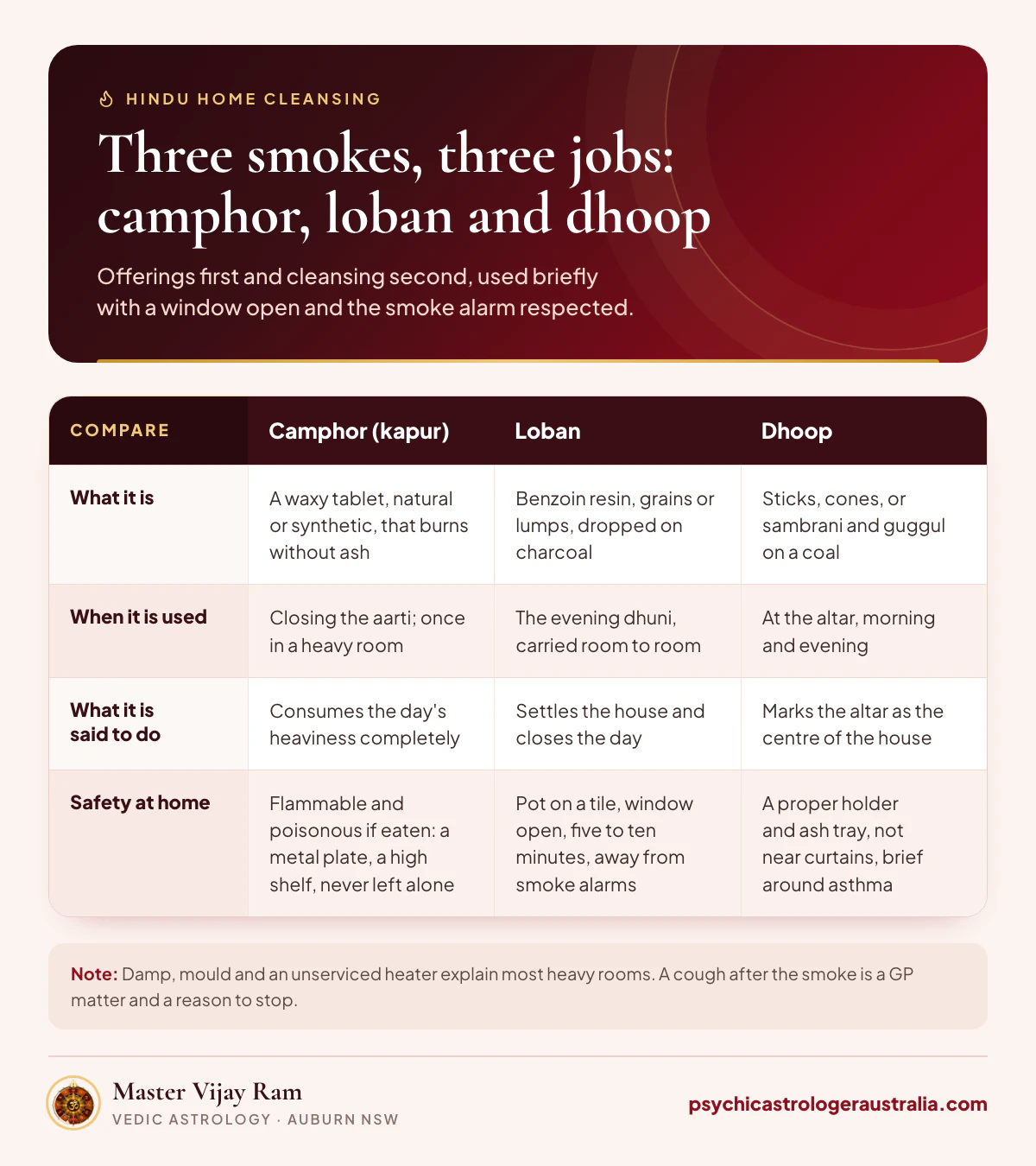
How do the three compare?
The table sets the three side by side with the safety notes that matter in an Australian house, where smoke alarms, strata rules and a child with asthma are more common than they were in the houses the customs grew up in.
| Material | What it is | When it is used | What it is said to do | Safety in an Australian home |
|---|---|---|---|---|
| Camphor (kapur) | A waxy tablet, natural or synthetic, that burns without ash | Closing the aarti; once in a heavy room | Consumes the day’s heaviness completely | Flammable and poisonous if eaten; on a metal plate, high shelf, never left burning alone |
| Loban | Benzoin resin, grains or lumps, dropped on charcoal | The evening dhuni, carried room to room | Settles the house and closes the day | Hot coal in a clay or brass pot on a tile; window open; five to ten minutes; away from alarms |
| Dhoop | Incense sticks, cones, or sambrani and guggul on a coal | At the altar morning and evening | Marks the altar as the centre of the house | A proper holder; ash tray; not near curtains; brief where anyone has asthma |
The room-by-room house cleansing guide shows where each smoke fits in a full sweep of the house, and why the entrance comes first.
How is the evening dhuni done safely in an Australian house?
Open a window in each room before you start, and keep the pot on a tile or a metal tray, never on carpet or a wooden shelf. Carry it slowly, five to ten minutes for the whole house, and finish at the front door so the last of the smoke leaves with you. Keep it well below and away from the smoke alarms, which are required in every Australian home and must never be disabled for a ceremony.
Keep children, pets and anyone with a chest condition out of the room while the coal is hot, and let the pot cool outside before it is emptied. In a strata block, check the by-laws on smoke and burning; many allow brief incense and some do not, and an electric loban burner, now sold in Indian shops, keeps the custom without the coal.
Why not white sage?
Because smudging is a ceremony from the Indigenous nations of North America, with its own meaning and its own people, and the Hindu household already has three smokes of its own. Buying white sage to cleanse a home in Blacktown is borrowing a practice that was never offered for sale while leaving the family’s own on the shelf. That is the whole argument, and it is not about the plant.
Reiki, smudging or Vedic cleansing compares the three practices properly for anyone deciding between them. Loban does what families hope sage will do, in the tradition they already belong to.
What should be ruled out before any smoke?
A house that feels heavy is often a house with bad air: damp, mould behind a wardrobe, a bathroom without a fan, a gas heater that has not been serviced, carpet that holds the previous occupant’s smoke. Smoke on top of that makes the air worse, not better, and a cough that follows the evening dhuni is a GP matter and a reason to stop.
A dehumidifier, a serviced heater and open windows do more for a heavy house than loban ever will, and he says so to families who ring about rooms that feel wrong. Then the smoke is a pleasure rather than a treatment.
When is smoke not enough?
When the heaviness began on a date you can name, lifts the moment you leave the house, and has outlasted a month of open windows, the evening dhuni and the ordinary fixes. That pattern is read rather than smoked: the chart of the head of the household against the dates, by phone or video, with an honest answer about whether the timing carries anything.
Most of the time it does not, and the family keeps its loban and its camphor as custom. Griha pravesh in Australia covers the fuller house blessing when a family wants the chapter closed properly rather than the air changed.
What does Master Vijay Ram do, and what does it cost?
He does not sell loban, camphor or dhoop, and he does not perform the evening dhuni for you; that is the household’s own practice. What he offers is the reading: a $50 consultation by phone, video or WhatsApp that says whether the house carries a pattern or simply needs its windows open. Where a shanti is warranted it is performed by him personally at his place of practice in Auburn on a chosen muhurat, from $250, agreed before anything is done.
Online puja and havan explains what a performed remedy includes and how the family joins, and griha pravesh and home blessing describes the version for a new home.
Loban in Darwin, dhoop in Brisbane: the smokes across Australia
The customs travel well. In Darwin’s wet season loban is kept for the dry evenings and the camphor stays in a sealed jar against the humidity; in Brisbane and on the Gold Coast the dhuni is done with the doors open to the deck; in a Newcastle winter the window is opened for the ten minutes and shut again. A caller in Brisbane or on the Central Coast is read the same way, and the only in-person option is Auburn by appointment.
The festival weeks bring the most questions, because every house is cleansed before Diwali and Navratri. Navratri 2027 in Australia sets out the dates and the sadhana for protection that goes with the smoke.
What the smokes cannot do
Camphor, loban and dhoop cannot cure a cough, remove mould, mend a marriage or lift a pattern that the chart shows and the smoke does not reach. They cannot be guaranteed, and nobody should pay anyone to burn them. Vedic astrology and the household customs are offered as faith-based guidance, not as medical, legal or financial advice.
What they can do is close a day, mark an altar, settle a room and give a family a practice that is theirs. That is why the customs have lasted, and why they belong in an Australian house with the window open.
Read next
- Navratri & Dussehra 2026: Cleanse Your Home of Negative EnergyNavratri and Dussehra 2026 land in an Australian spring. Here is what a home cleansing can honestly do at festival ti…
- The Hindu Ritual Bath for Cleansing: What to Add and What to SkipThe Hindu ritual bath for cleansing: what to add (salt, neem, turmeric, Gangajal, tulsi), what to leave out, the snan…
- Coming Home After a Hospital Stay: Gentle Cleansing for Patient and HouseComing home after a hospital stay: the discharge plan first, then a fresh smoke-free room, a recovery sankalp, prayer…
Frequently asked questions
What is the difference between loban and dhoop?
Loban is benzoin resin dropped on hot charcoal in a clay or brass pot and carried through the rooms at dusk; dhoop is incense, as sticks, cones or sambrani on a coal, kept burning at the altar at prayer times. For a once-through cleansing of the rooms they are interchangeable, and loban is simply stronger and longer lasting. Both are offerings first and cleansing second.
How do you use camphor to remove negative energy?
Light a tablet on a brass or steel plate at the end of the evening prayer and let it burn out, or light a single tablet in the corner of a room that feels heavy, with the window open, and watch it until it is gone. It is done once, not nightly. Camphor is flammable and poisonous if a child eats it, so it is kept on a high shelf and never left burning alone.
What are the benefits of loban at home?
In the tradition’s own terms: a settled house, a fragrance that lingers into the night, and the sense of a day closed properly, which is why many families keep the dhuni on Thursday evenings or daily at dusk. It is custom and fragrance, not medicine. A room that feels heavy because of damp or a bad heater needs the window and the tradesman first, and the loban afterwards for pleasure.
Can I burn loban in an apartment with smoke alarms?
Usually, briefly and carefully. Open a window first, keep the pot on a tile well below and away from the alarm, carry it for a few minutes only and finish at the door so the smoke leaves with you. Never disable an alarm for a ceremony. Check the strata by-laws, because some blocks forbid burning, and an electric loban burner from an Indian shop keeps the custom without coal or smoke.
Is Hindu home cleansing the same as smudging?
No. Smudging is a ceremony of the Indigenous nations of North America with its own meaning and its own people; the Hindu household has camphor, loban and dhoop, which are older, distinct, and the family’s own. Buying white sage to cleanse a Hindu home borrows a practice that was never offered for sale while leaving the family’s own on the shelf, and loban does the work families hope sage will do.
How often should the evening dhuni be done?
Thursday evenings in many households, daily at dusk in some, and on the days the house feels heavy in most. The honest rule is that it is a rhythm rather than a treatment: a house that needs the dhuni nightly to feel bearable has a problem the smoke is not reaching, and that is the point to open the windows, check for damp, and have the pattern read if it outlasts a month.
What should be checked before cleansing a heavy room with smoke?
Damp and mould behind furniture, a bathroom without a fan, a gas heater that has not been serviced, carpet holding a previous occupant’s smoke, and whether anyone in the house coughs after the dhuni. Smoke on bad air makes it worse. A dehumidifier, a serviced heater and open windows do more for a heavy room than loban, and a cough that follows the smoke is a GP matter.
Does Master Vijay Ram perform the loban cleansing for you?
No; the evening dhuni is the household’s own practice and he does not sell loban, camphor or dhoop. What he offers is the $50 reading of whether the house carries a pattern or simply needs its windows open, and, where a shanti is warranted, a cleansing performed personally at Auburn on a chosen muhurat from $250, agreed before anything is done, with the family joining by video if they wish.
People also ask
Which is better for negative energy, camphor or loban?
They do different jobs. Camphor burns once, completely, on a plate at the end of the aarti or in a heavy corner; loban is carried on a coal through every room at dusk and lingers. For a single room, camphor; for the whole house, loban. Neither is medicine, both need a window open, and a room that stays heavy needs damp and the heater checked before more smoke.
How do you do loban dhoop at home?
Light a piece of charcoal in a clay or brass pot until it glows, drop a pinch of loban on it, and carry the pot slowly through each room, the corners especially, finishing at the front door. Keep it on a tile, open a window first, keep it away from the smoke alarm and from children, and let the pot cool outside. Five to ten minutes is enough.
Is camphor smoke safe to breathe?
Briefly and with a window open, a single tablet is what households have burned for generations. It is flammable, burns hot, and the tablet is poisonous if eaten, so it belongs on a metal plate, out of children’s reach, and is never left burning in an empty room. Anyone with asthma stays out while it burns, and a cough afterwards is a reason to stop.
Can I use loban instead of white sage?
Yes, and for a Hindu household it is the better choice. Smudging with white sage is a North American Indigenous ceremony; loban is the family’s own evening dhuni, carried room to room on a coal, and it does what people hope sage will do. Burn it briefly with a window open, away from the smoke alarm, and finish at the door.
When is burning loban not enough?
When the heaviness began on a date you can name, lifts the moment you leave the house, and has outlasted a month of open windows, the dhuni and the ordinary fixes. Then the pattern is read rather than smoked: Master Vijay Ram reads the household’s chart against the dates for $50 by phone or video, and a shanti from $250 is described only where the timing carries something.
References & further reading
Serving clients across Australia
Confidential consultations by phone, video & WhatsApp — including: