
Quick answer
Karnavedha is the samskara of piercing a child’s ears, held anywhere from the first months to the early school years depending on family custom. In Australia a qualified piercer or GP does the piercing with sterile, single-use equipment, and the family’s prayers gather around it. The muhurat comes from the child’s chart and never overrides the child’s health.
What is karnavedha?
Karnavedha is a samskara that pierces a child’s earlobes with prayer, and it is one of the oldest rites of childhood still widely kept. The name joins karna, ear, with vedha, piercing. It sits ninth in the usual list of sixteen samskaras, between the first haircut and the first letters; the sixteen samskaras for Australian families shows where it falls.
Many families now pierce a daughter’s ears at a shopping centre kiosk without any rite at all, and many sons are never pierced. Families who do keep it as a samskara usually want two things: a good day, chosen through an auspicious date for a child’s ceremony, and a piercing that heals cleanly. This post covers both.
Why is the ear pierced at all?
The tradition gives several reasons. Karnavedha was an ornament and a mark of belonging, it was said to open the child to hearing sacred sound, and the old surgical text, the Sushruta Samhita, describes piercing the ear and caring for the wound. Some families also speak of protection from illness or the evil eye; those are beliefs, held with affection, rather than medical claims.
For most families in Australia it is simply what their elders did. A grandmother in Coimbatore expects to see earrings at the next video call, and a Gujarati family wants the gold studs from the naani worn on the day.
When is karnavedha done?
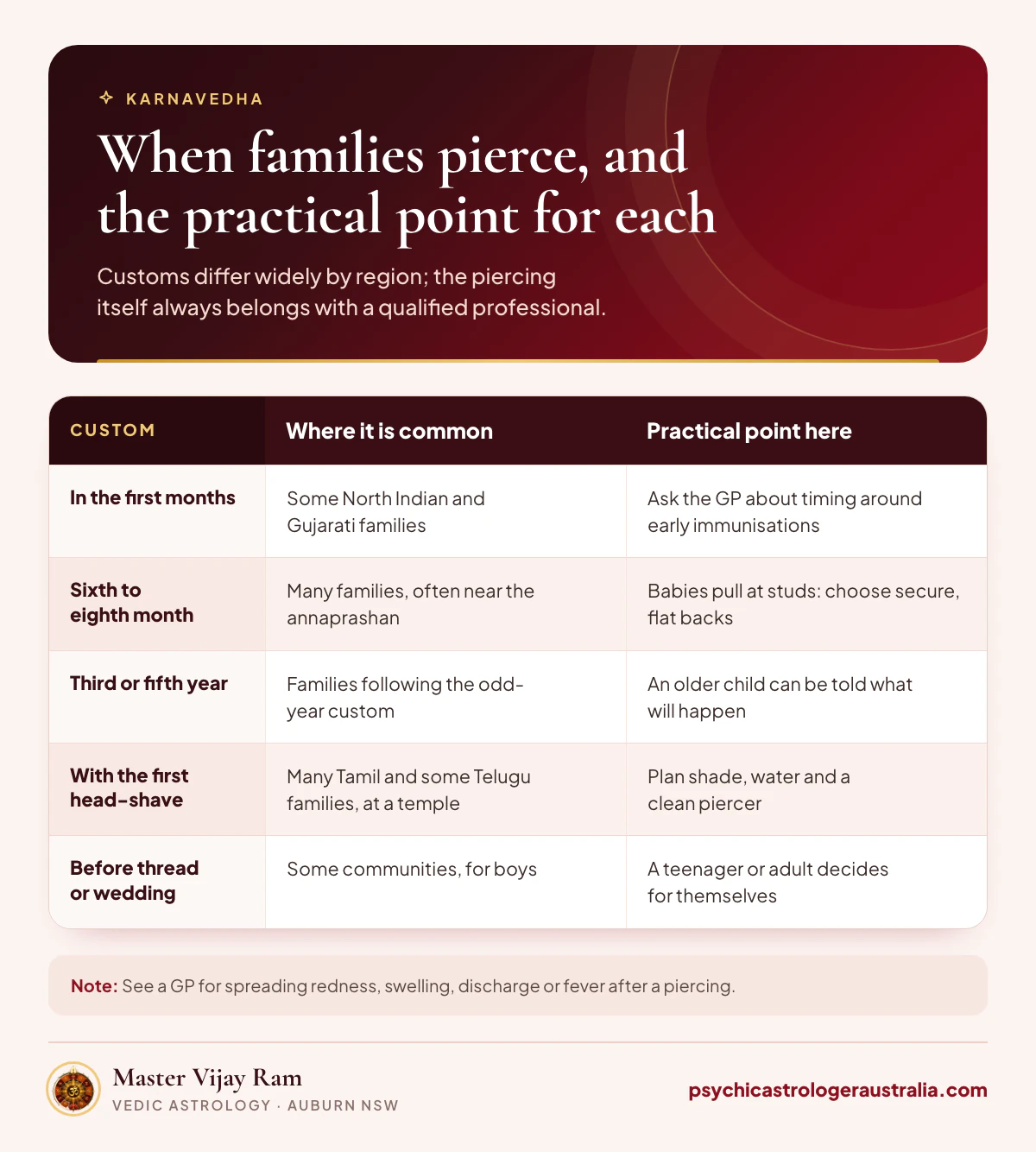
Customs differ widely by region and family. Some families pierce in the first months, often around the naming or soon after; some in the sixth, seventh or eighth month; others in an odd year of childhood, the third or fifth; and many Tamil families hold kaathu kuthu at the family deity’s temple, often alongside the first head-shave. The mundan in Australia explains that first haircut.
| Custom | Where it is common | Practical point in Australia |
|---|---|---|
| In the first months | Some North Indian and Gujarati families | Talk to the GP about timing around early immunisations |
| Sixth to eighth month | Many families, often near the annaprashan | A baby can still pull at studs: choose secure, flat backs |
| Third or fifth year | Families following the odd-year custom | An older child can be told what will happen, which helps |
| With the first head-shave at a temple | Many Tamil and some Telugu families | A hot, crowded day: plan shade, water and a clean piercer |
| Before upanayana or a wedding | Some communities, for boys | An adult or teenager decides for themselves |
Who should do the piercing?
Someone qualified, using sterile equipment. In Australia that usually means a GP who offers ear piercing or a professional piercer working in premises that meet local council and state health hygiene rules for skin penetration. The traditional goldsmith or a relative with a needle belongs to another time; families who honour the custom can invite the goldsmith to bring the gold, and let a professional do the piercing.
Many health guides prefer a sterile, single-use needle to a reusable piercing gun for young children, because a gun is harder to sterilise and can damage the tissue. Ask the piercer what they use, how they clean it, and whether the studs come sealed.
What makes it safe for a baby or child?
Hygiene, the right jewellery and good aftercare. The piercer washes hands and wears gloves, cleans the lobes, marks the spots with the parent watching, and uses sealed, sterile studs. For babies and toddlers, studs with secure, flat backs are safer than hoops or dangling earrings, which catch on clothing and fingers.
Aftercare is simple: clean hands, a gentle saline clean as the piercer advises, studs left in place for the healing time they recommend, and no pools or swimming in dams and rivers until healed. Watch for redness that spreads, swelling, discharge, fever or a stud sinking into the lobe, and see a GP if any appear.
Gold is traditional and usually well tolerated; nickel is a common cause of allergy, so cheaper costume metal is best avoided for a first piercing. A family with a history of keloid scarring should ask the GP first.
Which ear first, and does it matter?
Many families follow a custom of piercing a boy’s right ear first and a girl’s left ear first, and some say a short mantra into the ear before the piercing. It is a lovely detail and it takes nothing away from safety. A piercer who works on both ears at once, with two people, finishes faster and is often kinder to a small child, and most families accept that the order is symbolic.
How is the muhurat chosen?
Most childhood rites are kept to the bright fortnight, when the Moon is growing, and away from the three empty tithis, Chaturthi, Navami and Chaturdashi. For karnavedha in particular, texts name a group of favoured stars; Mrigashira, Chitra and Shravana turn up on most of those lists, though no two lists match exactly. An astrologer then weighs the weekday and the rising sign at the planned hour, keeps the piercing out of Rahu kaal, and compares the day’s star with the one the child was born under. That birth star was settled when the name was chosen; the child’s nakshatra and name explains how.
In practice the muhurat has to fit the piercer’s appointment book, the child’s health and the family’s week. Master Vijay Ram finds an hour within those limits rather than asking a family to fit a piercer around a single perfect window. Because sunrise and the clock differ between Townsville, Geelong and Chennai, the panchang is computed for the family’s own city.
How do families combine it with the ceremony?
A simple pattern works well. The family gathers at home or at the temple, a lamp is lit and a Ganesh prayer said; the child is then taken to the piercer at the chosen hour, or the piercer comes to a clean, well-lit room; the family returns for an aarti, sweets for the guests and a blessing from the elders. The rite and the procedure sit side by side rather than one replacing the other.
When karnavedha falls close to the first rice, some families hold both on the same week. Annaprashan, the first rice explains that ceremony and its own safety points.
What about sons, and teenagers who choose for themselves?
In the old texts karnavedha was for boys and girls alike, and in parts of South India and among some North Indian communities boys are still pierced, sometimes just before the sacred thread or a wedding. In Australia it is more common for a boy to be left unpierced and for the family to mark the samskara with a prayer only, which is also a recognised way of keeping it.
A teenager who asks for a piercing, or who refuses one, is old enough to be heard. Choosing the hour together, and letting them pick the studs, turns a family rule into something they own.
What if the child is frightened or in pain?
A baby cries for a moment and is usually comforted by a feed. A toddler or older child does better with an honest explanation, a parent’s hand to hold, and a reward planned for afterwards. Some GPs suggest a numbing cream; ask before the day rather than on it.
If a child is genuinely terrified, waiting a year is kinder than holding them down. The samskara is meant to bless the child, not frighten them, and there is no penalty in the tradition for a later date.
What about nazar?
Families sometimes worry that a newly decorated child attracts the evil eye. A kala tika behind the ear, kept away from the fresh piercing, or a short prayer at the end of the day are the common customs. Nothing should be tied to the earrings or placed on the healing lobe. A calm house in a baby’s first weeks talks about the gentler protective customs families keep around young children.
Is a puja needed?
Not for the piercing to count. Most families say a prayer at home or at the temple, with a grandparent or a local priest leading. Some parents, especially when the grandparents cannot travel, ask Vijay Ram ji to hold a Ganesh or Navagraha puja for the little one on the same hour; he performs it himself in Auburn, and the parents can watch on a video call. A puja performed on your behalf sets out how that is arranged. Readings cost $50, and puja work begins at $250, a figure settled with the family beforehand.
What can astrology not decide here?
It cannot judge whether a lobe has healed, whether a stud is infected or whether a child is too unwell to be pierced. Those belong with the piercer, the GP and, after hours, healthdirect. An ear piercing ceremony blesses the child and marks a stage; a karnavedha muhurat chooses the hour; clean hands and sterile studs do the rest.
Families in Newcastle, Wollongong, Geelong and Cairns consult by phone or video; readings for Wollongong families describes the phone and video sessions. He speaks with families in English, Hindi or Punjabi; the one place he meets anyone face to face is his Auburn practice, and only by booking. Families thinking about baby ear piercing in Australia should book the piercer first and the muhurat second.
Read next
- Mundan in Australia: The First Haircut Ceremony and What It Is Said to ClearMundan in Australia: what the first haircut is said to clear, the usual ages, the muhurat and rite, the hair afterwar…
- Upanayana: The Sacred Thread Ceremony for Australian FamiliesUpanayana in Australia: what the sacred thread and Gayatri initiation mean, age customs, how the muhurat is chosen, s…
- 11 Signs of Negative Energy in Your Life (and How to Clear It)Eleven signs of negative energy, the ordinary causes to rule out first, and the three-doors test that tells you wheth…
Frequently asked questions
At what age is karnavedha done?
Customs differ. Some families pierce in the first months, some in the sixth to eighth month, some in an odd year of childhood such as the third or fifth, and many Tamil families pierce at a temple alongside the first head-shave. A GP can advise on timing around early immunisations, and a frightened older child can wait without any penalty in the tradition.
Who should pierce my baby’s ears in Australia?
A GP who offers ear piercing or a professional piercer working in premises that meet local council and state health hygiene rules for skin penetration. Ask what equipment they use; many health guides prefer a sterile, single-use needle to a reusable gun for young children. Families can still invite a goldsmith to provide the traditional gold.
Which ear is pierced first in karnavedha?
Many families pierce a boy’s right ear first and a girl’s left ear first, sometimes saying a short mantra into the ear beforehand. The order is symbolic. Piercing both ears at once with two people is often quicker and kinder for a small child, and most families accept that as consistent with the custom.
How is the karnavedha muhurat chosen?
Childhood rites are usually kept to the bright fortnight and away from Chaturthi, Navami and Chaturdashi. Texts list favoured stars for karnavedha, and Mrigashira, Chitra and Shravana appear on most lists. The astrologer then weighs the weekday, the rising sign and Rahu kaal, compares the day’s star with the child’s birth star, and uses a panchang drawn for your own city.
What earrings are safest for a baby?
Sealed, sterile studs with secure, flat backs, in gold or a hypoallergenic metal. Hoops and dangling earrings catch on clothing and fingers, and nickel is a common cause of allergy. Leave the first studs in for the time the piercer advises and see a GP for spreading redness, swelling, discharge or fever.
Is karnavedha only for girls?
No. Traditionally it was performed for boys and girls, and some communities still pierce boys, often before upanayana or a wedding. In Australia many boys are not pierced, and many girls are pierced without any rite. Families keep the custom their own elders kept, and a teenager or adult decides for themselves.
Will Vijay Ram ji pierce the ears himself?
No. His part is the timing: in a $50 reading he picks an hour that suits the child’s chart and also fits the piercer’s diary and the child’s health. The piercing stays with a GP or a professional piercer. Families who want a Ganesh or Navagraha puja held for the child that day can ask him; it begins at $250, settled beforehand, and he performs it himself in Auburn.
Can karnavedha be combined with another ceremony?
Yes. Many families combine it with the first head-shave at a temple, and some hold it in the same week as the annaprashan. Combining saves travel and gathers relatives once, but a long, crowded day can tire a small child, so plan shade, water, feeds and a quiet place to rest.
People also ask
What is karnavedha samskara?
Karnavedha is the ninth of the sixteen samskaras in the usual list, the ritual piercing of a child’s earlobes. It was an ornament, a mark of belonging and, in tradition, an opening to sacred sound. Today families keep it with a prayer and a celebration around a piercing done by a qualified professional.
Is a piercing gun safe for babies?
Many health guides prefer a sterile, single-use needle for young children because a reusable gun is harder to sterilise and can damage the tissue. Ask the piercer or GP what they use and how it is cleaned, and choose sealed, sterile studs with secure backs for a baby.
Why do Hindus pierce ears in a ceremony?
The tradition gives several reasons: ornament, belonging to the family and community, opening the child to sacred sound, and in some families protection from illness or the evil eye. The protective beliefs are held with affection rather than as medical claims, and many families simply continue what their elders did.
What are signs of an infected ear piercing in a child?
Redness that spreads, swelling, warmth, discharge or pus, fever, or a stud sinking into the lobe can mean infection or a problem with the earring. See a GP, or call healthdirect after hours. Do not remove the stud yourself if the lobe has swollen around it.
References & further reading
Serving clients across Australia
Confidential consultations by phone, video & WhatsApp — including: