
Quick answer
A muhurat is a window of time chosen from the panchang for a particular act. The astrologer narrows a month to a day by tithi, nakshatra and weekday, then to an hour by the rising sign and the Rahu kaal, and checks that window against your own birth chart. Because it rests on local sunrise, a Delhi muhurat is not a Sydney one.
What is a muhurat?
A muhurat is a window of time chosen from the panchang for a particular act, so that the act begins when the sky is favourable for it. The word comes from muhurta, a unit of 48 minutes, thirty of which make up a day and night; electional astrology in India still thinks in those units. A wedding, a house entry, a shop opening and a baby's naming each have their own rules, and the shubh muhurat for one is rarely the right window for another.
This article explains how the choice is actually made, in the order an astrologer makes it, and why the same question gets a different answer in Perth, Sydney and Delhi. It is the method behind a muhurat consultation, set out so you can see what you are paying for and what a list of dates on a website leaves out.
What are the five limbs of the panchang?
Panchang means "five limbs", and every muhurat begins with them. Each describes a different relationship between the Sun and the Moon on a given day, and each has combinations that are kept and combinations that are avoided.
| Limb | What it measures | Generally favoured | Generally avoided |
|---|---|---|---|
| Tithi (lunar day) | Each 12° the Moon gains on the Sun; thirty from new moon to new moon | 2nd, 3rd, 5th, 7th, 10th, 11th, 13th of either fortnight; the full moon for some rites | 4th, 9th and 14th (the rikta tithis), the new moon, and the 8th and 12th for most beginnings |
| Vara (weekday) | The planet that rules the day from sunrise to sunrise | Monday, Wednesday, Thursday and Friday for most acts | Tuesday for peace-making and journeys; Saturday for anything meant to move quickly |
| Nakshatra (lunar mansion) | Which of the 27 star-groups the Moon occupies | Rohini, Mrigashira, Pushya, Uttara Phalguni, Hasta, Chitra, Swati, Anuradha, Uttara Ashadha, Uttara Bhadrapada, Revati and others depending on the act | Bharani, Krittika, Ardra, Ashlesha, Magha, Jyeshtha, Mula and the days a nakshatra changes |
| Yoga | The sum of the Sun's and Moon's longitudes, in 27 parts | Siddhi, Shubha, Shukla, Brahma, Indra, Harshana and most of the rest | Vyatipata and Vaidhriti above all; Vishkambha, Atiganda, Shula, Ganda and Vyaghata by many astrologers |
| Karana (half-tithi) | Each 6° the Moon gains on the Sun; eleven names cycling through the month | The seven movable karanas | Vishti, which is Bhadra, and in stricter practice the four fixed karanas at the month's turn |
A day on which all five limbs are clean is already a short list. From there the rest of the method is subtraction.
How is a muhurat narrowed from a month to an hour?
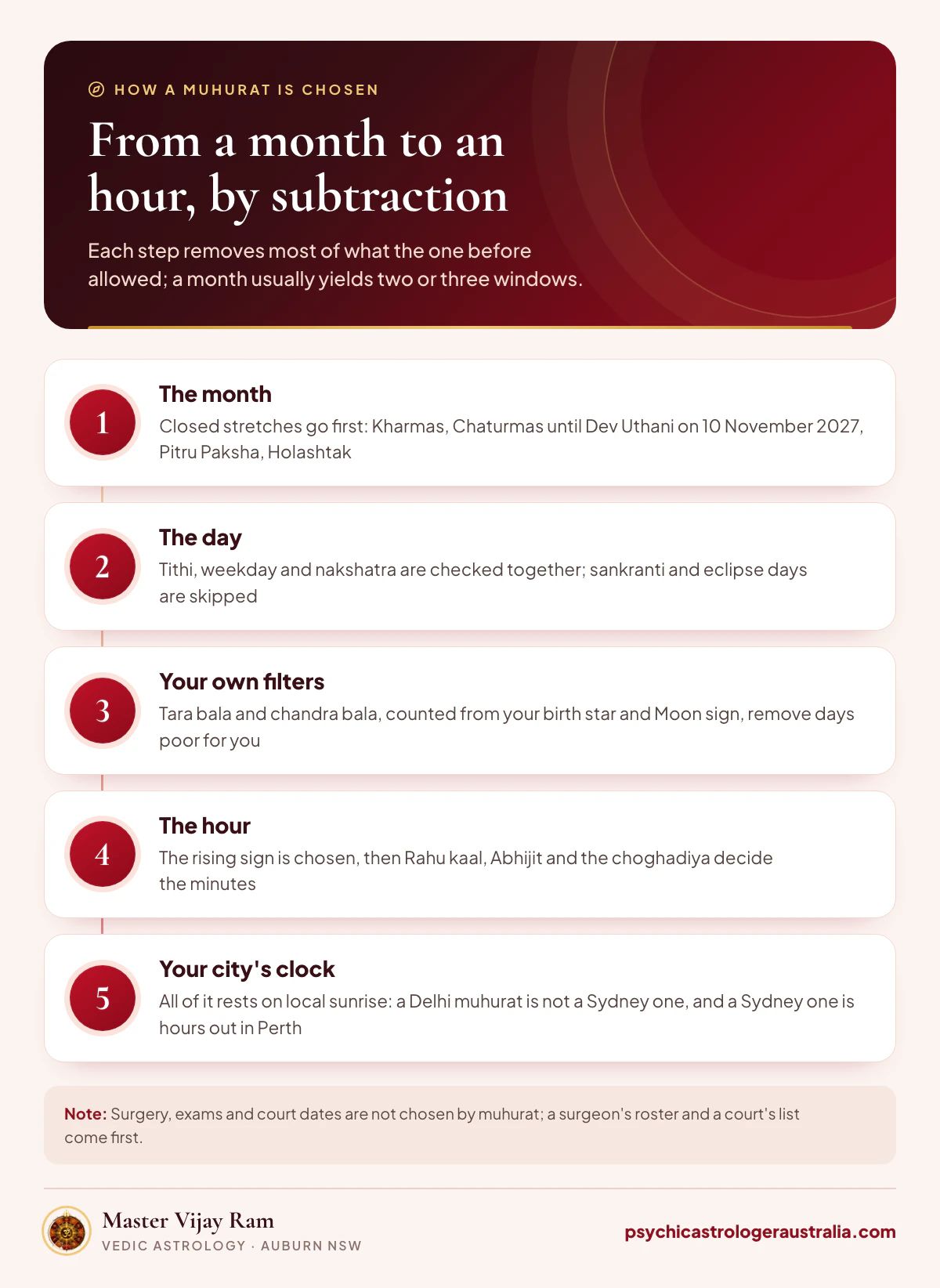
This is how a muhurat is calculated in practice, and the order matters because each step removes most of what the previous one allowed.
- The month. Some months are closed for some acts: Kharmas for weddings and house entries, Chaturmas for most beginnings, the Pitru Paksha fortnight for anything joyful. Within an open month the bright fortnight is preferred for growth, the dark fortnight is acceptable until about its tenth day.
- The day. Tithi, weekday and nakshatra are checked together, because a good nakshatra on a rikta tithi is still a poor day. The Sun's sign is read too: a sankranti day is skipped, and a day when the Sun or Moon is eclipsed is skipped with a wide margin.
- The personal filters. Tara bala and chandra bala, explained below, remove days that are fine in general but poor for this person.
- The hour. The rising sign is chosen, then the planets in its first, fourth, seventh, eighth, tenth and twelfth houses are examined, then the Rahu kaal, the Abhijit window and the choghadiya decide the minutes.
At the end of it there are usually two or three windows in a month, not twenty. That is the honest shape of the answer, and it is why Vijay Ram ji gives clients alternatives rather than a single sacred minute.
Why does the same muhurat change from city to city?
Everything in the panchang is reckoned from local sunrise. The tithi that rules a day is the one present at sunrise in that place, the Rahu kaal is a fixed eighth of that place's daylight, and the rising sign depends on the longitude and latitude of the venue. A muhurat published for Delhi can therefore fall on the wrong tithi in Sydney, and a Sydney muhurat read in Perth is off by two to three hours of clock time before anything else is considered.
| Where you are | Standard time | Daylight saving | Compared with Sydney |
|---|---|---|---|
| NSW (incl. Central Coast), Victoria (incl. Geelong), ACT, Tasmania | AEST, UTC+10 | AEDT, UTC+11 | Same as Sydney all year |
| Queensland (Brisbane, Gold Coast, Sunshine Coast, Townsville, Cairns) | AEST, UTC+10 | None | Same April–October; 1 hour behind October–April |
| South Australia (Adelaide) | ACST, UTC+9:30 | ACDT, UTC+10:30 | 30 minutes behind all year |
| Northern Territory (Darwin) | ACST, UTC+9:30 | None | 30 minutes behind April–October; 1½ hours behind October–April |
| Western Australia (Perth) | AWST, UTC+8 | None | 2 hours behind April–October; 3 hours behind October–April |
In 2027 daylight saving ends on Sunday 4 April and begins on Sunday 3 October.
Daylight saving adds a second layer: the south-eastern states change their clocks on those dates, while Queensland, the Northern Territory and Western Australia keep standard time all year. The practical rule is simple: a muhurat is cast for the place where the act happens, in that place's clock, and a family in Perth should never work from a Sydney page.
What do tara bala and chandra bala add?
Two checks make a general day into your day. Tara bala counts the day's nakshatra from your birth nakshatra in a cycle of nine, and keeps the second, fourth, sixth, eighth and ninth positions while avoiding the third, fifth and seventh. Chandra bala counts the day's Moon sign from your own Moon sign and favours the first, third, sixth, seventh, tenth and eleventh.
Both need your birth details, which is why a muhurat for a wedding uses the bride's and the groom's charts and a muhurat for a shop uses the owner's. Without a kundli the astrologer is choosing a day that suits everyone, which is another way of saying no one in particular; a kundli reading is the foundation this layer sits on.
Which periods are avoided altogether in 2027?
Some stretches close the calendar for beginnings regardless of the day's panchang, and a few of them are long.
- Kharmas (Dhanurmas): while the Sun is in Dhanu, from 16 December 2026 until the Makara entry on 15 January 2027, and again from 16 December 2027. Weddings and griha pravesh pause; readings, remedies and daily worship do not.
- Chaturmas: the four months of Vishnu's sleep, from Dev Shayani Ekadashi in July until Dev Uthani Ekadashi, which in 2027 falls on Wednesday 10 November in every Australian city. The table below gives the tithi by city.
- Pitru Paksha: the fortnight of the ancestors immediately before Sharad Navratri, which begins on Friday 1 October 2027 in Australia.
- Holashtak: the eight days before Holi, which falls on Tuesday 23 March 2027 here.
- Eclipse sutak: the hours before an eclipse that is visible where you are. In 2027 the two solar eclipses cannot be seen from Australia and the three lunar eclipses are penumbral, so no sutak applies here; the eclipse guide goes through each one.
- Bhadra: the Vishti karana, several hours in every fortnight, avoided for beginnings and for tying a rakhi.
- Combust Venus or Jupiter: when either is too close to the Sun to be seen, weddings in particular wait; the panchang marks these stretches and a consultation checks them for your date.
- Mercury retrograde: not a classical rule, but a modern one many clients ask for when a contract is being signed. In 2027 the retrogrades run 10 February to 3 March, 11 June to 5 July and 8 to 29 October in Sydney time, and the Mercury retrograde dates are set out by zone.
| City | Date | Kartika Shukla Ekadashi (local time) | Rule applied |
|---|---|---|---|
| Sydney | Wed 10 Nov 2027 | Tue 09 Nov 2027, 1:05 PM AEDT – Wed 10 Nov 2027, 2:42 PM AEDT | tithi present at sunrise (udaya tithi) |
| Melbourne | Wed 10 Nov 2027 | Tue 09 Nov 2027, 1:05 PM AEDT – Wed 10 Nov 2027, 2:42 PM AEDT | tithi present at sunrise (udaya tithi) |
| Brisbane | Wed 10 Nov 2027 | Tue 09 Nov 2027, 12:05 PM AEST – Wed 10 Nov 2027, 1:42 PM AEST | tithi present at sunrise (udaya tithi) |
| Perth | Wed 10 Nov 2027 | Tue 09 Nov 2027, 10:05 AM AWST – Wed 10 Nov 2027, 11:42 AM AWST | tithi present at sunrise (udaya tithi) |
| Adelaide | Wed 10 Nov 2027 | Tue 09 Nov 2027, 12:35 PM ACDT – Wed 10 Nov 2027, 2:12 PM ACDT | tithi present at sunrise (udaya tithi) |
| Canberra | Wed 10 Nov 2027 | Tue 09 Nov 2027, 1:05 PM AEDT – Wed 10 Nov 2027, 2:42 PM AEDT | tithi present at sunrise (udaya tithi) |
| Hobart | Wed 10 Nov 2027 | Tue 09 Nov 2027, 1:05 PM AEDT – Wed 10 Nov 2027, 2:42 PM AEDT | tithi present at sunrise (udaya tithi) |
| Darwin | Wed 10 Nov 2027 | Tue 09 Nov 2027, 11:35 AM ACST – Wed 10 Nov 2027, 1:12 PM ACST | tithi present at sunrise (udaya tithi) |
| New Delhi (reference) | Wed 10 Nov 2027 | Tue 09 Nov 2027, 7:35 AM IST – Wed 10 Nov 2027, 9:12 AM IST | tithi present at sunrise (udaya tithi) |
The tithi is one moment everywhere; only the clock and the sunrise differ, which is why a city can fall a day apart from India. Computed with the Swiss Ephemeris (Lahiri ayanamsa for Vedic positions) and checked against US Naval Observatory data. Times are rounded to the minute.
None of these is a superstition about bad luck striking on the day. They are the calendar's way of saying that some seasons belong to rest and remembrance, and that beginnings go better when they are not forced into them.
What is an abujha muhurat?
An abujha muhurat is a day the tradition treats as auspicious in itself, so that the usual tithi and nakshatra checks are waived. The best known is Akshaya Tritiya, Sunday 9 May 2027, followed by Vasant Panchami, Friday 12 February here and Thursday 11 February in Perth and India, Vijayadashami on Saturday 9 October, and for many families Dev Uthani Ekadashi itself. Phulera Dooj and Bhadali Navami are kept the same way in parts of north India.
Even on these days a careful astrologer still avoids the Rahu kaal and chooses the lagna, and still checks the couple's or the owner's chart. "Self-evident" describes the day, not the hour.
How do Rahu kaal, Abhijit and the choghadiya fix the hour?
Once the day is chosen, three tools divide it. The Rahu kaal is one eighth of the daylight, falling in a different eighth on each weekday: the second on Monday, the seventh on Tuesday, the fifth on Wednesday, the sixth on Thursday, the fourth on Friday, the third on Saturday and the eighth on Sunday. On a day with sunrise at six and sunset at six, Monday's Rahu kaal runs from 7:30 to 9:00 am; on a Sydney summer day with fourteen hours of light it is longer and later.
Abhijit is the eighth muhurta of the day, about 24 minutes either side of local solar noon, and is favoured for almost everything except Wednesdays. Local solar noon is rarely twelve o'clock on the clock: it is near 12:20 pm in Perth and near 11:50 am in Brisbane for much of the year, and a muhurat that says "noon" means the Sun's noon, not the kitchen clock. The choghadiya divide the daylight into eight named periods, of which Amrit, Shubh and Labh are kept and Rog, Kaal and Udveg avoided; they are a convenience for small acts rather than a substitute for the lagna.
Which events get a muhurat, and which part of the event?
The muhurat is fixed to the moment that matters in the ceremony, which is not always the moment people expect.
- A wedding is timed to the lagna of the pheras or the kanyadaan, not to the reception; the 2027 wedding season explains how Australian venues and that rule are reconciled.
- A griha pravesh is timed to the first step over the threshold with the kalash, which is why settlement day and puja day are often different days; the griha pravesh guide works through it.
- A business is timed to its first transaction, its signboard or its registration, whichever the owner treats as the birth; the business opening guide compares the three.
- A naming ceremony, a mundan, a new vehicle's first drive and the start of a course each have a short list of favoured nakshatras.
- Surgery, exams and court dates are not chosen by muhurat. A surgeon's roster and a court's list outrank the panchang, and an astrologer who says otherwise is overreaching.
Why can a list of "shubh muhurat 2027" dates mislead?
Lists are computed for one city, almost always Delhi or Ujjain, with one ayanamsa and one set of rules, and then read in Melbourne as if they were universal. The tithi at Delhi sunrise can be the next tithi by Sydney sunrise; the lagna times are hours out; and the list knows nothing about your nakshatra. They are a reasonable first sieve and a poor final answer.
The second problem is that a list cannot say no. A good muhurat for a wedding in a month when the groom's chart is running a difficult antardasha is still a difficult month, and an honest astrologer will say so and suggest a later one. That advice is the part a list can never give.
What can a muhurat do, and what can it not?
A well-chosen muhurat gives an act a clean beginning and gives the people involved the confidence of having done things properly. It does not guarantee the marriage, the business or the house; the tradition itself says that the chart of the person outranks the chart of the moment, and that effort and conduct outrank both. Vedic astrology is faith-based guidance, not medical, legal or financial advice, and no date replaces a conveyancer, an accountant or a doctor.
It is also not a reason for paralysis. When a venue, a settlement or a visa leaves only one possible day, the question becomes the best hour on that day, and there is always one.
How does Master Vijay Ram choose a muhurat?
Master Vijay Ram has chosen dates for families across Australia for more than forty years, by phone, video and WhatsApp, in English, Hindi and Punjabi. The consultation is $50. He asks for the birth details of the people at the centre of the act, the city where it will happen, and the fixed constraints: the venue's available days, the settlement date, the day the shop lease begins. He returns two or three windows with the reasoning for each, in the clock of that city, and says plainly if a month should be avoided.
Where a family wants a puja on the chosen day, he performs it personally at his own place of practice in Auburn on the muhurat, with the family joining by video; a puja or havan starts from $250 and the figure is agreed before anything is performed. A muhurat on its own is simply part of the consultation, and the wedding-date article shows the method applied to the biggest date most families ever choose.
Read next
- Muhurat for Starting a New JobA new job muhurat in Australia: the employer sets the start date, so time the signature, the resignation and leaving …
- Raksha Bandhan 2027: Date and the Best Time to Tie the RakhiRaksha Bandhan 2027 is Tuesday 17 August in Australia and India. Rakhi windows by city, why Bhadra rules out Monday, …
- Ex Love Spell vs Vashikaran: What Actually WorksEx love spell or vashikaran: what each word really means, what a Vedic reading can honestly do about an ex, and the p…
Frequently asked questions
What is the difference between a muhurat and a muhurta?
Muhurta is the unit, a period of 48 minutes, thirty of which make a day and night; muhurat is the everyday word for the auspicious window chosen for an act. In practice an astrologer gives a window of thirty to ninety minutes within which the key moment of the ceremony should begin, and the family plans the rest of the day around it.
Why is the tithi at sunrise the one that counts?
The Hindu day runs from sunrise to sunrise, and the tithi present at sunrise is taken as the day's tithi for most purposes even if it ends an hour later. That rule is why a festival or a muhurat can shift by a day between Perth, Sydney and Delhi: the same tithi ends at the same instant everywhere, but sunrise arrives at different clock times in each city.
Which weekdays are good for a muhurat?
Monday, Wednesday, Thursday and Friday carry the fewest restrictions and serve most beginnings. Tuesday is avoided for journeys, reconciliation and marriage by many families, Saturday for anything meant to move quickly, and Sunday is mixed. The weekday is only one limb of five, so a Thursday with a rikta tithi or a harsh nakshatra is still passed over.
What is Rahu kaal and how do I work it out for my city?
Rahu kaal is one eighth of the daylight between local sunrise and sunset, avoided for beginnings. It falls in the second eighth on Monday, seventh on Tuesday, fifth on Wednesday, sixth on Thursday, fourth on Friday, third on Saturday and eighth on Sunday. Take your city's sunrise and sunset for the date, divide the gap by eight, and count; in a Sydney summer each eighth is about 105 minutes long.
What is an abujha muhurat?
A day held to be auspicious in itself, on which the usual tithi and nakshatra checks are waived. The best known are Akshaya Tritiya, Vasant Panchami, Vijayadashami and, for many families, Dev Uthani Ekadashi. In 2027 those fall on Sunday 9 May, Friday 12 February (Thursday 11 February in Perth and India), Saturday 9 October and Wednesday 10 November in Australia. The hour is still chosen with care on these days.
Can a muhurat be chosen without my birth details?
A general muhurat can, using the five limbs of the panchang alone, and that is what published lists provide. A personal muhurat cannot, because tara bala and chandra bala count the day's nakshatra and Moon sign from your own, and the hour's lagna is weighed against your chart. Without the details the astrologer is choosing a day that suits people in general rather than you.
Does Mercury retrograde matter for a muhurat?
Classical muhurta texts do not mention it; it is a modern consideration that many clients ask for when a contract, a lease or a registration is involved. Where a signing date can move, Vijay Ram ji prefers it outside the retrograde and the fortnight after a station. In 2027 the retrogrades run 10 February to 3 March, 11 June to 5 July and 8 to 29 October in Sydney time.
Is there any eclipse sutak to observe in Australia in 2027?
No. Sutak applies only where an eclipse is visible, and the two solar eclipses of 2027 cannot be seen from Australia. The three lunar eclipses are penumbral, and penumbral eclipses carry no sutak in the usual panchang practice. Families following relatives in India should check their local panchang, since visibility there differs, but no 2027 date in Australia is closed by an eclipse.
What if the only available date is a poor one?
Then the question becomes the best hour on that day, and there always is one. A clean lagna, a window outside the Rahu kaal and the Abhijit period if it fits can carry a day whose tithi is not ideal, and a short puja performed before the act is the traditional support. An astrologer who says a fixed settlement or visa date must be abandoned is not helping; a muhurat serves the life, not the other way round.
People also ask
How is a muhurat calculated?
From the panchang's five limbs, tithi, weekday, nakshatra, yoga and karana, which narrow a month to a handful of days; then the personal tara bala and chandra bala, counted from your own birth star and Moon sign; then the hour, fixed by the rising sign, the planets around it, the Rahu kaal and the Abhijit window. Everything is reckoned from the sunrise of the place where the act will happen.
What is the best time of day for a shubh muhurat?
For most beginnings the Abhijit muhurta, about 24 minutes either side of local solar noon, is the strongest general window on any day except Wednesday, provided it falls outside the Rahu kaal. For weddings the lagna of the pheras is chosen individually and often falls in the evening. Solar noon is the Sun's noon, which is close to 12:20 pm in Perth and 11:50 am in Brisbane for much of the year.
Which months are not good for a muhurat in 2027?
For weddings and house entries: Kharmas while the Sun is in Dhanu, until 15 January and again from 16 December 2027; Chaturmas from Dev Shayani Ekadashi in July until Dev Uthani on Wednesday 10 November; the Pitru Paksha fortnight before Navratri, which begins on Friday 1 October; and Holashtak, the eight days before Holi on Tuesday 23 March in Australia. Daily worship, readings and remedies continue throughout.
Can I use an Indian panchang for a muhurat in Australia?
Only as a first sieve. The tithi at Delhi sunrise can differ from the tithi at Sydney sunrise, the Rahu kaal and the lagna depend on local sunrise and longitude, and Perth is two to three hours behind the east coast. A muhurat for an act in Australia should be cast for the Australian city where it happens, in that city's clock, with daylight saving taken into account.
Does a muhurat guarantee success?
No, and the tradition never claimed it did. A muhurat gives an act a clean beginning; the chart of the person and the conduct of the people involved carry far more weight than the chart of the moment. It is faith-based guidance and does not replace a conveyancer, an accountant or a doctor, and no astrologer can promise an outcome from a date.
References & further reading
Serving clients across Australia
Confidential consultations by phone, video & WhatsApp — including: