

Quick answer
Rahu kaal, Yamaganda and Gulika are three eighths of each day’s daylight that many Hindu families avoid for beginnings. Divide local sunrise-to-sunset into eight equal parts; the weekday decides which part each takes. Because they depend on your own sunrise, sunset and clock, times copied from Indian websites are wrong in Australia.
What are Rahu kaal, Yamaganda and Gulika?
Rahu kaal is a stretch of each day, one eighth of the daylight, that many Hindu families treat as unsuitable for starting anything new. Yamaganda and Gulika kaal are two more eighths of the same daylight, each with its own reputation, and a South Indian panchang prints all three side by side every morning. Together they answer a narrow question: which parts of today should a beginning avoid?
They are not omens and they do not make a day bad. They are a timing convention, and like every part of a muhurat chosen for an event, they are calculated from the place where you are standing, which is why a time copied from an Indian website is wrong in Australia before anything else is considered.
How is Rahu kaal calculated?
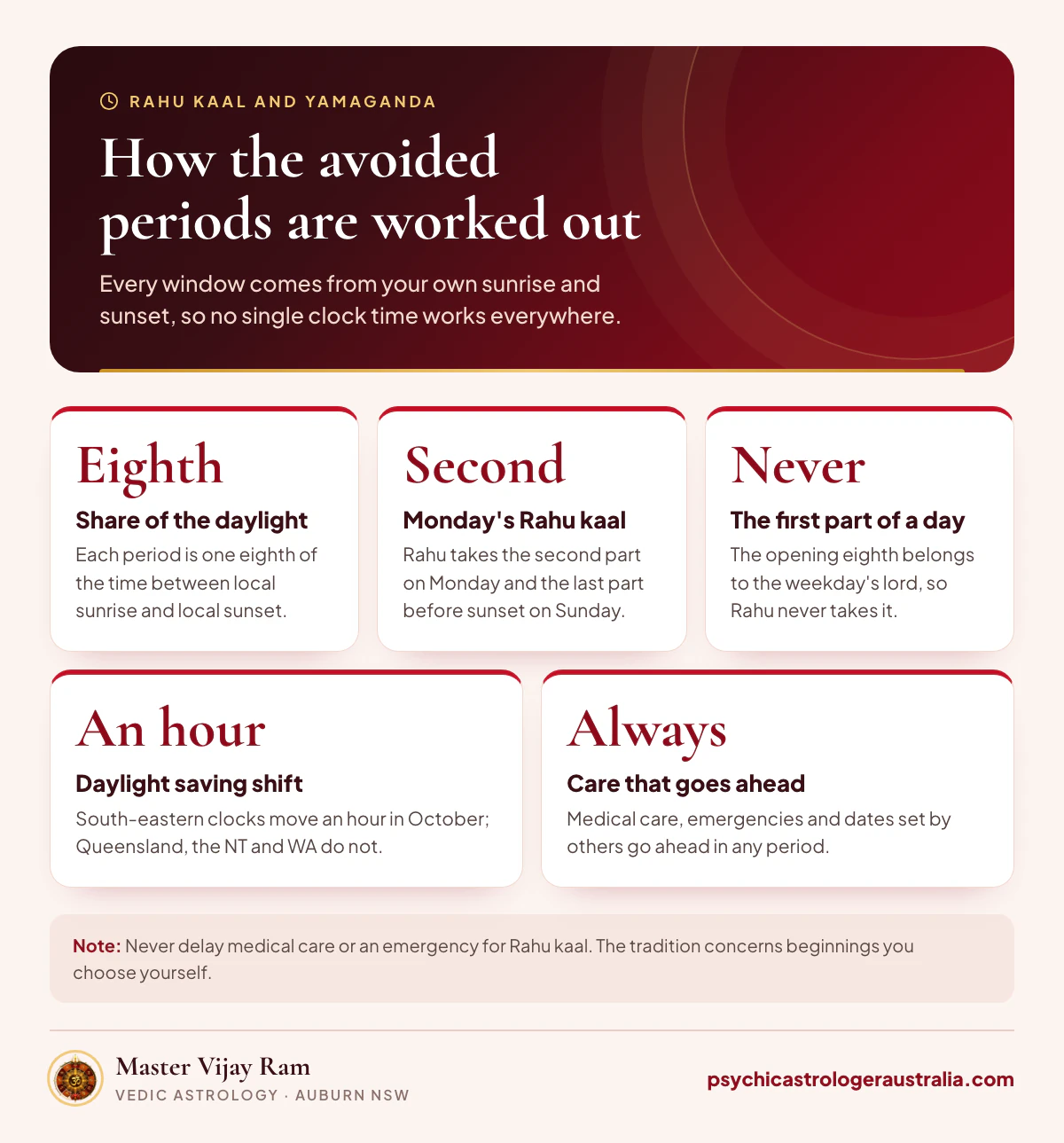
Take the moment of local sunrise and the moment of local sunset, and divide the daylight between them into eight equal parts. Each weekday gives one of those parts to Rahu: the second on Monday, the third on Saturday, the fourth on Friday, the fifth on Wednesday, the sixth on Thursday, the seventh on Tuesday and the eighth, the last part before sunset, on Sunday. Never the first part, because the day's beginning belongs to the lord of the weekday.
A schoolroom mnemonic keeps the order: Mother Saw Father Wearing The Turban Suitably, for Monday, Saturday, Friday, Wednesday, Thursday, Tuesday and Sunday, which take the second to the eighth parts in turn. The parts are equal only within a day; their length changes through the year with the length of daylight.
Which part of the day do Yamaganda and Gulika take?
The same eighths are used, allotted in other orders. Yamaganda, named for Yama, is read as poor for journeys and beginnings. Gulika, named for a shadowy son of Saturn, carries a curious tradition: whatever is begun in it tends to repeat, so families avoid it for anything they would not want twice, such as a funeral or the settling of a debt, while some deliberately choose it for things they would welcome again.
| Weekday | Rahu kaal | Yamaganda | Gulika kaal |
|---|---|---|---|
| Sunday | 8th | 5th | 7th |
| Monday | 2nd | 4th | 6th |
| Tuesday | 7th | 3rd | 5th |
| Wednesday | 5th | 2nd | 4th |
| Thursday | 6th | 1st | 3rd |
| Friday | 4th | 7th | 2nd |
| Saturday | 3rd | 6th | 1st |
Read the table as eighths counted from local sunrise, not as clock hours. Some panchangs also divide the night in the same way; most families use only the daytime periods.
Why can’t you copy a Rahu kaal time from an Indian website?
Because every boundary rests on sunrise and sunset where you are, and those differ by city, by season and by time zone. A Delhi table is computed for Delhi daylight and Indian Standard Time; read in Melbourne it is wrong twice over. Even within Australia, Brisbane and the Gold Coast share a clock with Sydney for half the year but see the Sun rise at a different moment, so their segments start at different minutes.
The fix is simple: use a panchang or app that asks for your city, or compute it yourself from the sunrise and sunset Geoscience Australia publishes for any location. That is also why this page gives no times at all; any time typed here would be wrong somewhere.
What does daylight saving do to it?
Nothing to the method, everything to the clock. When New South Wales, Victoria, the ACT, Tasmania and South Australia move their clocks forward in October, sunrise and sunset jump an hour later on the clock, and so does every segment. Queensland, the Northern Territory and Western Australia do not change, so from October to April the gap between Brisbane and Sydney clocks is an hour, and Gold Coast families with relatives across the border in Tweed Heads are reading two different clocks.
A printed calendar from a temple may have been prepared before the change, or for a different city. Check its heading, and when in doubt use an app set to your own suburb.
Why does Rahu kaal get longer in summer?
Because the daylight it is cut from gets longer. In a Hobart or Melbourne December the day between sunrise and sunset is long, so each eighth is long too; in June it is short and the eighths shrink. Close to the tropics, in Darwin, daylight changes little through the year and the segments hardly move.
The same logic explains why the Rahu kaal for a city sits at different clock times from week to week even on the same weekday. Nothing about the period has changed except the Sun.
What should and should not be started in these periods?
The tradition is about beginnings. Families avoid starting a journey, signing an agreement, opening a business, beginning a puja, paying a large deposit or taking delivery of a new car in these windows. Continuing what is already under way, such as a working shift, a lecture or a cooking marathon for a festival, is not affected.
- Fine at any time: medical care, emergencies, a flight the airline has scheduled, an exam or a court hearing someone else has set, and ordinary daily work.
- Commonly avoided: the first step of a journey, the signature on a contract, the first payment on a purchase, the start of a puja or a naming.
- Sometimes chosen on purpose: prayers to Durga in Rahu kaal, especially on Tuesdays and Fridays, a South Indian custom of lighting a lamp to the goddess who is said to tame Rahu.
If something important can only happen inside the window, it still happens. The tradition offers a small prayer before it rather than a cancellation; how a muhurat is chosen explains how a full muhurat weighs these periods against everything else.
How do you work it out yourself, step by step?
You need three things: today's weekday, your local sunrise and your local sunset, all in the same clock. The arithmetic takes a minute and is a good check on any app.
- Write down sunrise and sunset for your suburb, from a reliable source such as Geoscience Australia's calculator.
- Work out the daylight between them in minutes, and divide by eight. That is the length of one part today.
- Find today's part number in the table above: for Rahu kaal today on a Wednesday, the fifth.
- Count forward from sunrise by the number of whole parts before it, four in this case, and the window begins there and runs for one part.
- Repeat with the Yamaganda and Gulika numbers if your family follows them.
On a long summer day the parts come out well over an hour and a half each; in midwinter in the south they are noticeably shorter. If your answer and your app differ by more than a minute or two, check that the app has your city and not a default one.
Is Rahu kaal more important than the rest of the panchang?
No. It is the easiest part to calculate, so it is the part most people know, but a proper muhurat looks first at tithi, nakshatra, weekday and the rising sign, and checks the person's own chart.
Avoiding the Rahu kaal on a day whose tithi is unsuitable does not make the day good. The five limbs of the panchang are the foundation.
North Indian families often lean on the choghadiya instead, and the two systems sometimes disagree about the same hour; the choghadiya windows explained shows how. Many astrologers also look at the Abhijit muhurat at midday, which can rescue a day whose other options are closed.
Where does Rahu come from, and why fear it?
Rahu is the north node of the Moon, the point where the Moon's path crosses the Sun's, and in the myth the head of the demon Svarbhanu, who drank the nectar of immortality and swallowed the Sun and Moon at eclipses. He is a shadow planet: he has no body of his own and amplifies whatever he touches. A period named for him is read as unreliable for beginnings rather than evil.
When Rahu is strongly placed in a birth chart, or a Rahu dasha is running, some people ask for more than daily avoidance. That is a question for a reading and, where it is warranted, a Rahu graha shanti, not for anxiety about the clock.
How do families in different cities use it in practice?
A family in Perth checks a panchang set to Perth, three hours behind Sydney in summer, before booking the car pick-up. A couple in Adelaide, on a half-hour zone, learn that their city's segments never line up with a Melbourne relative's. A Brisbane household keeps one eye on the Sydney cousins' calendar and remembers it is an hour out in summer.
None of this requires an astrologer for ordinary days. Readers in the west can see readings for Perth families for how consultations work across the time difference.
When is it worth asking for a full muhurat?
When the act is large and its timing is genuinely flexible: a wedding, a griha pravesh, a business launch, a naming. Then Master Vijay Ram chooses the day and hour in a $50 consultation, by phone, video or WhatsApp in English, Hindi or Punjabi, in your city's clock. If a puja is wanted on that muhurat he performs it personally at his place of practice in Auburn; a puja on the chosen muhurat starts from $250, agreed before it is performed.
What no reading can do is make an inflexible day other than it is. When the date is fixed by a hospital, an airline or an employer, the answer is the best available hour, or a prayer before the step, never a missed appointment.
Read next
- Maha Shivratri 2027 in Australia: Date and Night TimingMaha Shivratri 2027 is Saturday 6 March in Australia and India. Nishita kaal and four-prahar puja times for Sydney, M…
- Abhijit Muhurat: The Midday WindowAbhijit muhurat explained: the eighth of fifteen day muhurtas around local solar noon, how to work it out, why Wednes…
- Is Vashikaran Real or Fake? How to Spot a ScamVashikaran is a real Vedic practice, but much of what is sold under the name is not. Learn the claims scammers repeat…
Frequently asked questions
How do I find Rahu kaal today in Australia?
Use a panchang or app set to your own city, or work it out yourself. Find local sunrise and sunset, divide the daylight into eight equal parts, and take the part for today’s weekday: second on Monday, third on Saturday, fourth on Friday, fifth on Wednesday, sixth on Thursday, seventh on Tuesday, eighth on Sunday.
Is Rahu kaal the same in Sydney and Perth?
No. Each city has its own sunrise and sunset, and Perth is on a different clock, two hours behind Sydney in winter and three in summer. The method is identical but the segments fall at different local times, so a Sydney panchang read in Perth gives the wrong window.
What is Yamaganda?
Yamaganda, or Yamagandam, is another eighth of the daylight, named for Yama and read as poor for journeys and beginnings. It falls in the first part on Thursday, second on Wednesday, third on Tuesday, fourth on Monday, fifth on Sunday, sixth on Saturday and seventh on Friday, counted from local sunrise.
Is Gulika kaal good or bad?
It is read as a period in which whatever begins tends to repeat. Families avoid it for things they would not want twice, such as funerals or settling a debt, and some choose it for things they would gladly repeat. Traditions differ, and it is usually weighed less heavily than Rahu kaal.
Can I go to hospital or fly during Rahu kaal?
Yes. Medical care, emergencies and anything scheduled by someone else, such as a flight, an exam or a court hearing, go ahead whatever the panchang says. The tradition concerns the beginnings you choose yourself. If it helps, say a short prayer before you leave, and keep the appointment.
Does daylight saving change Rahu kaal?
It changes the clock time, not the method. In the states that move their clocks in October and April, sunrise and sunset shift an hour on the clock and every segment shifts with them. Queensland, the Northern Territory and Western Australia keep the same clock all year.
Why is Rahu kaal never at sunrise?
The first eighth of each day belongs to the lord of that weekday, so the tradition never gives it to Rahu. Rahu takes one of the remaining seven parts, a different one each weekday, which is why the familiar order runs from the second part on Monday to the last part on Sunday.
Do I need an astrologer to avoid Rahu kaal?
Not for ordinary days; a reliable app set to your city is enough. A consultation matters for large, flexible events such as a wedding, griha pravesh or business opening, where tithi, nakshatra, the rising sign and your own chart are weighed together. That costs $50 with Master Vijay Ram.
People also ask
What should not be done in Rahu kaal?
Families avoid starting new things: beginning a journey, signing an agreement, opening a business, paying a first deposit, taking delivery of a vehicle or beginning a puja. Work already under way continues normally, and medical care and appointments set by others are never postponed for it.
Is Rahu kaal bad for everyone?
It is a general convention for beginnings, not a verdict on anyone’s day. A person’s own chart, the day’s tithi and nakshatra and the rising sign matter more for a major event. Some families even choose Rahu kaal for prayers to Durga, especially on Tuesdays and Fridays.
How long does Rahu kaal last?
One eighth of the daylight between local sunrise and sunset, so its length changes with the season and the latitude. It is longer in a southern summer than in winter, and in tropical Darwin it changes very little through the year. An app set to your city gives the exact window.
What is the difference between Rahu kaal and choghadiya?
Rahu kaal marks one unsuitable eighth of the day, with Yamaganda and Gulika beside it, and is used mostly in South Indian families. The choghadiya names all eight daytime parts and eight night parts as good, neutral or avoided, and is used more in north and west India. The two can disagree about the same hour.
References & further reading
Serving clients across Australia
Confidential consultations by phone, video & WhatsApp — including: