

Quick answer
Many Hindu families avoid cutting hair and nails on Tuesday, Thursday and Saturday, the days of Mars, Jupiter and Saturn, after sunset, and on Ekadashi, Amavasya, eclipses and birthdays. These are household customs that vary between families, and the night rule has a plain root in poor light and sharp blades. Ignoring them brings no bad luck.
Are there really days when Hindus should not cut hair or nails?
The haircut-day rule is a household custom that tells many Hindu families when hair and nails may be cut, and it is passed on by grandparents with the scissors far more often than read in any book. The commonest version says no haircut, shave or nail cutting on Tuesday, Thursday or Saturday, nothing after sunset, and nothing on certain lunar days, with every family adding or dropping a rule of its own.
People search for hair cutting days in astrology because the weekdays are tied to planets, and that is where a Vedic astrologer is asked about them. A kundli reading of your own chart says far more about your planets than any barber’s calendar, and this post explains the customs, their practical roots, and why nobody needs to fear a haircut.
The customs belong to the same household care for the body that body cleansing in the Vedic tradition describes: small disciplines, kept for meaning, never for fear.
Which days do families avoid, and why?
Tuesday, Thursday and Saturday, the days of Mars, Jupiter and Saturn. Which planet and deity belong to each weekday, and why families keep vows on them, is set out in fasting by weekday and planet; the haircut rules simply carry the same respect over to grooming.
A hair cut on a Tuesday is the one most families avoid, because the day belongs to Hanuman and to Mars, and many households keep it for prayer and a simple meal. Thursday is kept for Jupiter, the planet of growth, children and teachers, and some married women also avoid washing their hair that day.
Saturday belongs to Saturn, and nail cutting on Saturday is avoided in many homes as a small mark of respect to the strictest of the planets. Wednesday and Friday are the days most often called good for a trim, while Sunday and Monday are counted differently from one family to the next.
What do the common customs say, at a glance?
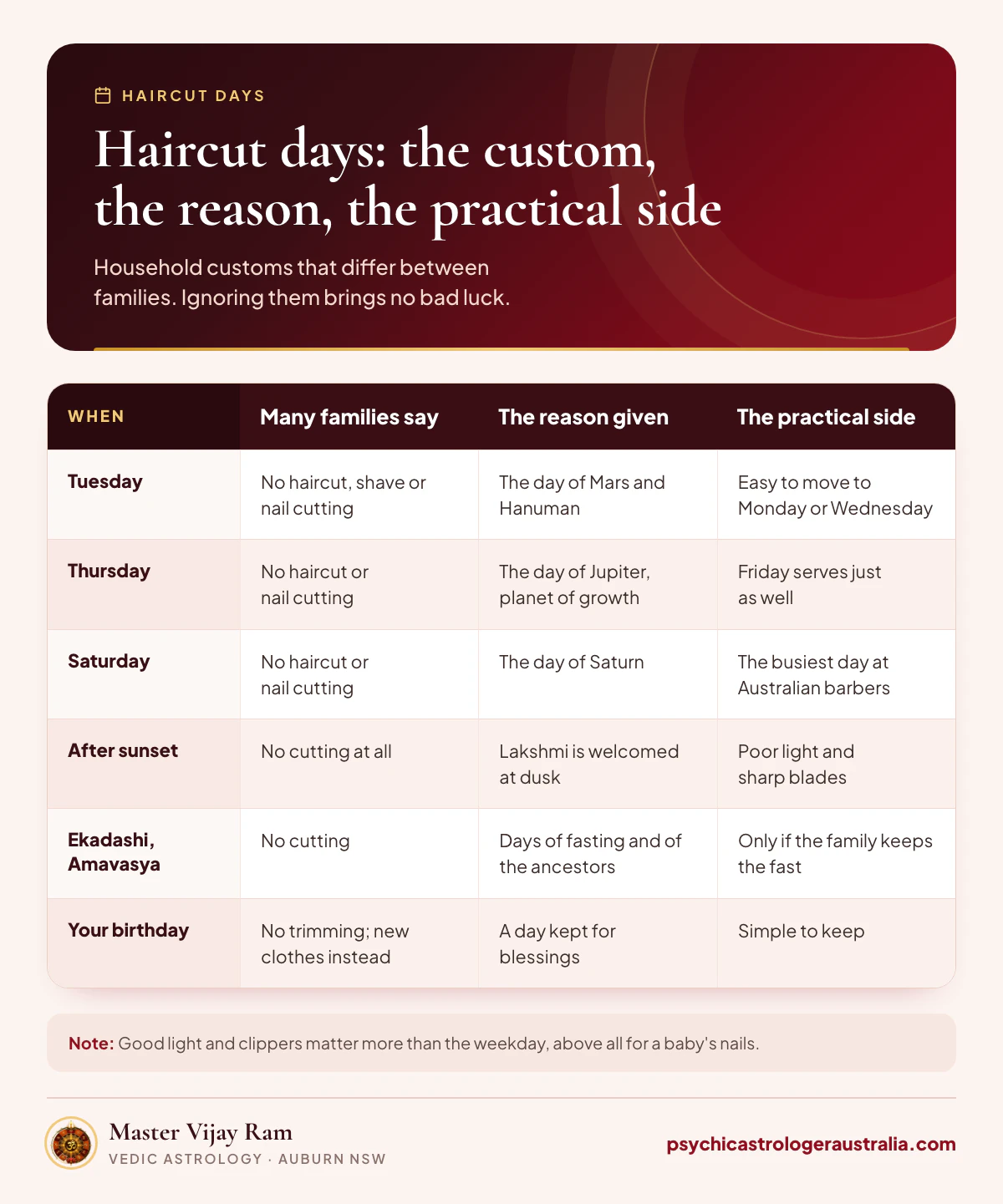
The table gathers the customs most families mention, the reason the tradition gives, and the practical side. None of it is a rule anyone outside your family can hold you to.
| When | The custom many families keep | The reason the tradition gives | The practical side |
|---|---|---|---|
| Tuesday | No haircut, shave or nail cutting | The day of Mars and Hanuman | Easy to move to Monday or Wednesday |
| Thursday | No haircut or nail cutting; some avoid washing hair | The day of Jupiter, planet of growth and children | Friday serves just as well |
| Saturday | No haircut or nail cutting | The day of Saturn | The hardest to keep: it is the busiest day at Australian barbers |
| After sunset | No cutting at all | Lakshmi is welcomed into the home at dusk | Poor light, sharp blades and clippings lost on the floor |
| Ekadashi and Amavasya | No cutting | Days of fasting, restraint and the ancestors | Only matters if the family keeps the fast; check the panchang |
| During an eclipse | No cutting, cooking or eating | The sutak period around an eclipse | Rare, and easy to work around |
| Your birthday | No trimming; new clothes and blessings instead | A day kept for blessings | Simple to keep |
Some families add the nine nights of Navratri, the month of Shravan, or the days of mourning after a death, when men in many communities leave their hair uncut until the final rites. Others keep none of these and only the after-sunset rule.
Why do families say no cutting nails at night?
The folk reason is that Lakshmi enters the home at dusk, and that cutting, sweeping and throwing things out as she arrives is no way to receive her. The practical reason is older and plainer: before electric light, cutting nails at night meant a blade in poor lamplight, slips and cuts, and slivers of nail lost on the floor where a child or a meal might find them.
Both reasons point the same way, and the practical one still holds. Good light, clippers rather than a blade, and a sheet of paper underneath make most of the rule redundant, and a family that keeps the custom anyway is keeping a sensible habit.
What about Ekadashi, Amavasya, eclipses and birthdays?
Ekadashi is a fasting day for many families and Amavasya a day for the ancestors, and both are kept as days of restraint, so grooming waits. The dates move every month and differ by city; families who keep them check the panchang rather than a list.
Eclipses carry the sutak customs, when cooking, eating and cutting are set aside until the eclipse ends and the house has bathed. Birthdays are kept by many families for new clothes, a temple visit and blessings from elders, and a haircut simply waits a day.
Pitru Paksha, the fortnight for the ancestors, is kept the same way in some homes, with men leaving hair and beard uncut. Its dates follow the lunar calendar, so families take them from their temple panchang each year.
Where do these rules come from?
Mostly from household practice, passed down rather than written down. Classical muhurat texts do give good and bad days for kshaura, the ceremonial shave, and for a child’s first haircut, and orthodox households once applied them to every shave; for most families today the weekday rules are simply custom, and they vary from region to region and family to family.
That is why a Tamil household and a Punjabi household may disagree about Sunday, and why a grandmother’s list may differ from her sister’s. Traditions differ, and every version is a family’s own way of showing care, not a law of the planets.
What about the working week in Australia?
Here the customs meet the roster. Saturday is when most working people can get to a barber or salon, and a family that avoids Saturday, Tuesday and Thursday is left with a narrow week. Many settle on a Friday after work, while it is still light, or a Sunday morning, or a lunchtime appointment on a Wednesday.
Take a family on the Central Coast, say, where the father commutes to Sydney and the only spare morning is Saturday: he can book the haircut and keep the custom in spirit with a short prayer that morning, or let it go entirely. Families reached through astrology readings for the Central Coast ask the same question, and the answer never involves a penalty.
Shift workers in Darwin or anywhere else count their own morning, so a nurse coming off nights can treat her own dawn as the start of the day. Asking which day to cut nails is worth an honest answer: the day you can do it safely, in good light, without stress.
Do the rules apply to children?
Lightly, if at all. A child’s first haircut, the mundan, is a samskara with its own chosen day, and the mundan in Australia explains how it is done; after that, a child’s hair and nails are cut when they need cutting.
For a baby, the child health nurse’s advice on trimming tiny nails safely comes first, and good light matters more than the weekday. Choosing the day for the mundan itself is a muhurat question, handled through choosing an auspicious date and hour.
What should be done with the clippings?
Sweep them up and put them in the bin or the compost, and wash the paper or the floor where they fell. Grandmothers who gathered clippings carefully were keeping a clean house first, and any fear that someone might use your hair or nails is answered calmly in the post on photos, hair and clothes.
Hair from a salon goes out with everyone else’s, and nobody needs to collect it. A custom of tidiness is worth keeping; a custom of dread is not.
Does ignoring these customs bring bad luck?
No. A Saturday trim causes no misfortune that any reading would recognise, and a family that books whatever day the week allows has lost nothing. The customs are respect for the planets and the household’s rhythm, offered freely; they were never a tax.
If a run of hard luck has a family wondering whether a haircut caused it, the honest answer is that it did not, and the useful question is what else changed. Vedic guidance is faith-based, not medical, legal or financial advice, and it never needs you to fear your barber.
Who keeps their hair uncut altogether?
Sikh families keep the hair uncut as an article of faith, kesh, which is a different matter entirely and not a folk rule about weekdays. Some Hindus also keep a vow to leave the hair uncut until a prayer is answered, then offer it at a temple such as Tirupati.
Both deserve respect at work and at school, and neither has anything to do with the weekday customs in this post.
When does a reading help, and what does it cost?
Rarely for an ordinary haircut. A reading helps when the haircut is part of a rite, a mundan or the end of a vow, and the family wants a good day and hour, or when a Saturn or Mars period is running and someone wants a practice for that planet’s day. That advice comes from Master Vijay Ram in a $50 consultation, taken on the phone, on video or on WhatsApp, in English, Hindi or Punjabi.
Should the family want a puja to mark the occasion, its cost begins at $250 and is agreed before it is performed; Vijay Ram ji performs it at his own Auburn practice, and parents and grandparents can be present on video, as online puja and havan sets out. Anyone who prefers to meet in person comes to Auburn by appointment.
Read next
- Hanuman Chalisa for Fear and Protection: How Many Times, and WhenHanuman Chalisa for protection and fear: what the forty verses say, how many times to recite it, which days suit it, …
- Sundarkand Path at Home: When Families Hold One, and HowSundarkand path at home: what the fifth book of the Ramayana tells, when families hold a path, how it runs in a house…
- 11 Signs of Negative Energy in Your Life (and How to Clear It)Eleven signs of negative energy, the ordinary causes to rule out first, and the three-doors test that tells you wheth…
Frequently asked questions
Which day is best to cut nails according to Hindu custom?
Wednesday and Friday are the days most often called good, and many families also use Monday or Sunday. Tuesday, Thursday and Saturday are the days commonly avoided, along with any time after sunset. These are household customs that differ between families, so the best day in practice is one with good light and time to do it carefully.
Why should you not cut hair on Tuesday?
Tuesday belongs to Mars and to Hanuman, and many households keep it as a day of prayer and a simple meal, so grooming is set aside as a small mark of respect. It is a household custom more than a rule, and nothing bad follows from a Tuesday haircut. Families who keep it simply move the appointment to Monday or Wednesday.
Is it bad to cut hair on Thursday?
Many families avoid it because Thursday belongs to Jupiter, the planet of growth, children and teachers, and some married women also avoid washing their hair that day. It is custom rather than law, and traditions differ widely. A Thursday haircut brings no misfortune; families who prefer to keep the custom find that Friday serves just as well.
Can I cut my nails on Saturday?
Yes. Many homes avoid nail cutting on Saturday as a mark of respect to Saturn, but it is a custom of respect, not a danger. If Saturday is the only day you have time and good light, use it. Families who keep the custom often trim nails on Friday instead, before sunset.
Why do Hindus not cut nails at night?
The folk reason is that Lakshmi enters the home at dusk and should not be met with cutting and sweeping. The practical reason is plainer: before electric light, a blade in poor lamplight meant slips, cuts and slivers of nail lost on the floor. With good light, clippers and a sheet of paper underneath, the practical risk mostly disappears.
Can I cut hair on Ekadashi or Amavasya?
Families who keep Ekadashi as a fast and Amavasya as a day for the ancestors usually leave grooming for another day, because both are days of restraint. If your family does not keep them, they need not shape your haircut. The dates move every month and differ by city, so families who observe them check their panchang.
What if Saturday is the only day I can get a haircut?
Book it. Saturday is the busiest day at Australian barbers precisely because it is when working people have time, and the tradition never asked anyone to give up a job or a weekend for a custom. Some keep the spirit with a short prayer that morning; others let it go entirely. Neither choice brings any harm.
Do these rules apply to children?
Only lightly. A child’s first haircut, the mundan, is a samskara with a chosen day; after that, children’s hair and nails are cut when they need it. For a baby, the child health nurse’s advice on trimming nails safely comes first, and good light matters far more than the weekday.
What should be done with hair and nail clippings?
Sweep them up and put them in the bin or the compost, and wipe the place where they fell. Older generations gathered clippings carefully mainly to keep a clean house. Hair left at a salon goes out with everyone else’s, and nobody needs to collect it or worry about it.
People also ask
Which day is good for a haircut as per astrology?
Folk custom usually names Wednesday and Friday, and many families also accept Monday and Sunday, while Tuesday, Thursday and Saturday are commonly avoided. Classical muhurat rules apply mainly to ceremonial haircuts such as the mundan. For an ordinary trim, a day with good light and time is the honest answer.
Is it okay to cut nails on Sunday?
Traditions differ. Some families avoid Sunday as the Sun’s day and a day for rest and worship; many others treat it as an ordinary good day, and for working families it is often the most practical one. A Sunday trim does no harm, so follow your family’s custom or your own week.
Can we cut hair on our birthday?
Many families keep the birthday for new clothes, a temple visit and blessings from elders, and let the haircut wait a day. It is a gentle custom rather than a rule, and a birthday haircut brings no harm. If the birthday is the only open day before an event, have the haircut and keep the blessings too.
Can we cut nails after sunset?
Many families avoid it, saying Lakshmi enters the home at dusk. The practical root is poor light and sharp blades, which made night trimming risky before electric light. With good light, clippers and a sheet of paper to catch the clippings, the risk is small, and families who keep the custom are keeping a sensible habit.
Why should we not cut hair on Saturday?
Saturday is Saturn’s day, and many families avoid haircuts and nail cutting on it as a mark of respect to the strictest planet. It is household custom, and in Australia it collides with the busiest day at the barber’s. Nothing bad follows from a Saturday haircut; keep the custom only if it suits your week.
References & further reading
Serving clients across Australia
Confidential consultations by phone, video & WhatsApp — including: