
Quick answer
Maran, mohan and uchchatan are names from a tantric list of six acts a mantra could be turned to, usually given as shanti, vashikaran, stambhan, vidveshan, uchchatan and maran, with mohan replacing one in some lists. Only shanti, pacification, is protective. Master Vijay Ram performs shanti and protection for a person and a home, and none of the other acts.
What are maran, mohan and uchchatan?
The shatkarma of tantra is a list of six purposes to which a mantra can be turned, running from pacification at one end to killing at the other. Maran, mohan and uchchatan are three of its names, and advertisements string them together, often with vashikaran, as if reading out a menu. The phrase maran mohan uchchatan on a website is usually a sales line rather than a description of any discipline.
This page names all six plainly, says what each word means and what families fear when they hear it, and gives no method for any of them. It also says what is offered in answer, which is the first act on the list and nothing further: black magic removal and protection as Master Vijay Ram practises it is shanti work, done for the person who asked.
Which six acts are on the list, and why do the lists differ?
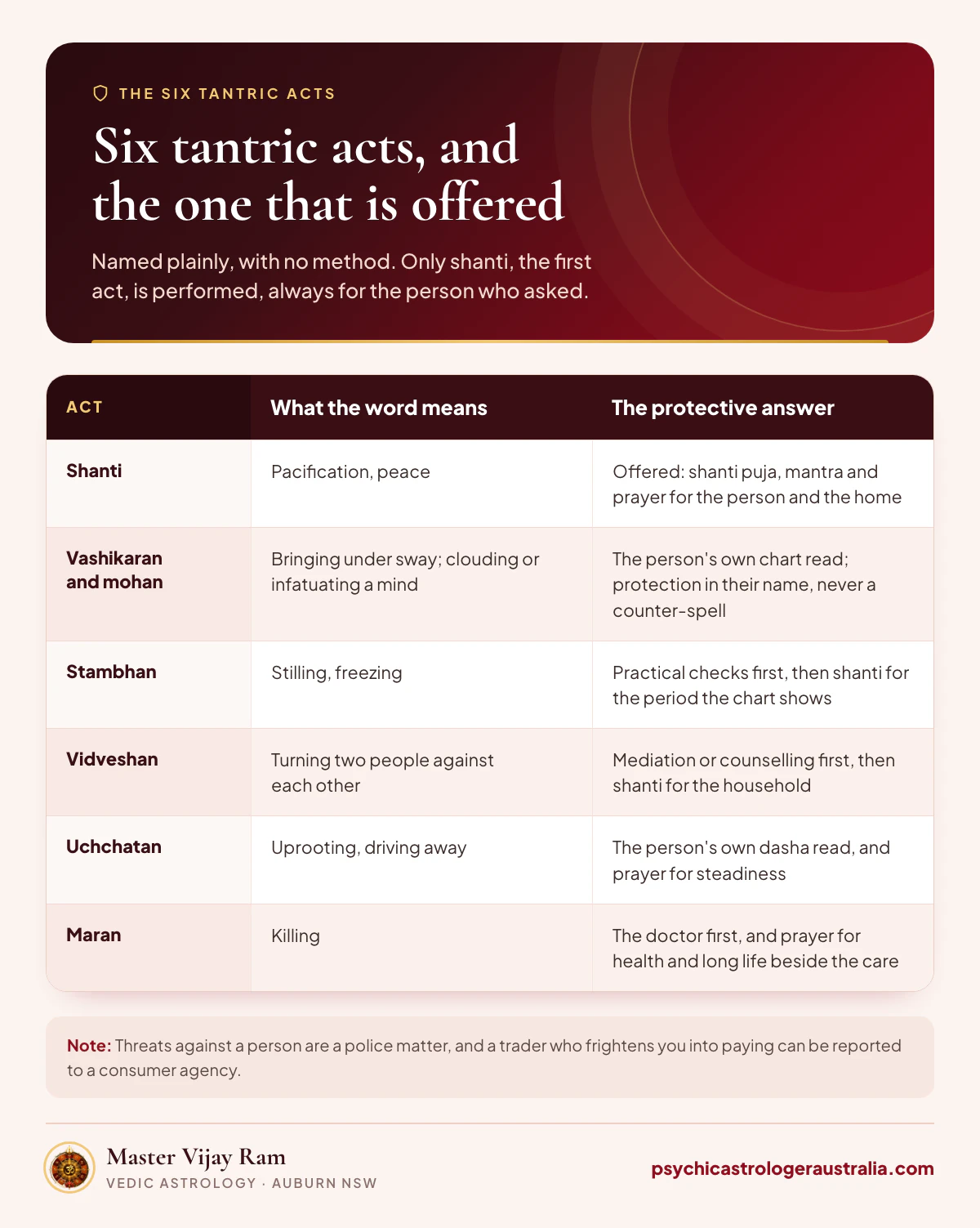
The list most often given runs: shanti, pacification; vashikaran, bringing under sway; stambhan, stilling or freezing; vidveshan, setting two people against each other; uchchatan, uprooting or driving away; and maran, killing. Some lists put mohan, the clouding of a mind, in place of one of these, and others make room for akarshan, attraction. Traditions vary on the members while keeping the number six.
What does not vary is the direction. The list moves from the act that calms to the act that kills, and the tradition attached its sternest cautions to the far end. Hostile work aimed at a person has an older name, abhichara, which abhichara in the Atharva Veda traces to its oldest source; Hindi advertising sells the same idea as abhichar karma.
Is this the same shatkarma as the yoga cleansing practices?
No, and the shared name causes real confusion. In hatha yoga, shatkarma means six cleansing practices for the body, listed in the Hatha Yoga Pradipika and repeated in the Gheranda Samhita: neti, dhauti, nauli, basti, kapalabhati and trataka. They concern the nose, the gut, the breath and the gaze, and have nothing to do with acting on another person.
A student who searches the word after a yoga class and lands on a page about maran has been badly served by the internet. The six yogic cleansing practices explains the yoga list and why most of it needs a teacher; the rest of this page is about the tantric one.
The six acts named plainly, and the answer to each
The table gives each act its literal sense, the shape the fear usually takes in an Australian household, and what is offered in answer. Nothing in the last column is aimed at anyone.
| Act | Literal sense | How the fear usually shows | The protective answer |
|---|---|---|---|
| Shanti | Pacification, peace | Rarely feared; it is what families hope for | Offered: shanti puja, mantra and prayer for the person and the home |
| Vashikaran | Bringing under sway | A son or daughter said to be under someone's control | A reading of that person's own chart; protection in their name, never a counter-spell |
| Mohan | Clouding or infatuating a mind | A partner said to be bewitched by someone new | The person's own chart, an honest conversation, a counsellor where needed |
| Stambhan | Stilling, freezing | A job, a sale or a court case that has stopped moving | Practical checks first, then shanti for the period the chart shows |
| Vidveshan | Turning two people against each other | Brothers or partners who stopped speaking after one event | Mediation or counselling first; shanti for the household |
| Uchchatan | Uprooting, driving away | Someone who cannot settle, or suddenly wants to leave | The person's own dasha read; prayer for steadiness |
| Maran | Killing | Whispered when someone is gravely ill | The doctor first; prayer for health and long life |
What does uchchatan mean?
The plain uchchatan meaning is uprooting: making a person restless in a place until they leave it, whether a house, a job, a city or a marriage. Of all the acts on the list it is the one families reach for most easily, because restlessness is common and its causes are hard to see from outside.
As an illustration, a young engineer in Perth who has changed jobs three times in two years and now talks about moving to Melbourne may have a mother in Amritsar who hears uchchatan where a friend would hear ambition, a hard manager or homesickness. The chart is often more useful than the word here. A Rahu or Ketu period, Saturn pressing on the Moon or an unsettled fourth house describe restlessness from the inside, and none of them needs anyone to have done anything.
Why is maran the word that frightens families most?
Maran means killing, and it is the word that surfaces when someone in the family is gravely ill and the illness has no obvious cause. A relative says it once, quietly, and from then on every hospital visit is read through it. That is the moment a family is most exposed to a practitioner who sells fear, and most in need of a doctor, a second medical opinion and plain information.
No reading can confirm that maran was done, and a practitioner who announces it, or offers to cut it for a rising fee, is trading on grief. In the tradition the answer to fear for someone's life is prayer for health and long life, kept beside the medical care rather than in place of it. The Maha Mrityunjaya mantra, from the Rigveda and addressed to Tryambaka, the three-eyed one, is the prayer most families turn to.
What do stambhan and vidveshan look like in a family?
Stambhan is stilling, a thing frozen in place. Families fear it when everything stops at once: a visa application stuck, a house that will not sell, a promotion promised and never given, a hearing adjourned again. The ordinary causes are usually close by, from processing queues to a slow property market, and a hard Saturn period can make a year feel exactly like that without help from anyone.
Vidveshan is enmity made between two people who were close: brothers, spouses, business partners, a mother and a daughter-in-law. When two people who once got on stop speaking, money, property, in-laws, alcohol and old resentments explain far more than any rite, and a family counsellor or a mediator does more than a puja. Stambhan also has a devotional side, since the goddess Bagalamukhi is worshipped for stambhana, stilling hostile speech into silence, and Baglamukhi puja and its ethical limits treats that carefully.
And vashikaran and mohan?
These are the acts aimed at another person's will: vashikaran to bring someone under sway, mohan to cloud or infatuate a mind. Families fear them most when a son or daughter chooses a partner nobody expected, or a husband's affection seems to move elsewhere. The usual explanation is the one nobody wants to hear, that an adult has made a choice, and the honest help is conversation rather than counter-ritual.
Sammohan and vashikaran compared draws the line between those words with care. Where someone truly fears that such work was done to them, vashikaran removal is protection performed in their own name, after their chart has been read for ordinary causes.
Why does shanti stand apart from the other five?
Because it is the only act on the list that cannot be pointed at a person to hurt them. Shanti calms: an inflamed planet in a chart, a household that has been frightened for months, a mind that keeps running through the worst case. It is performed in the name of the person who asked, for their own peace, and that is the whole of what Master Vijay Ram offers from this list.
The other acts are not offered in softened versions, for a good cause or for a higher fee. A request to freeze a rival, turn a partner, drive a tenant out or harm anyone at all is declined at the first mention, and the conversation turns to what the asker can protect in their own life.
How does protection work when a family fears one of these acts?
It starts with the person, not the suspected act. The chart and the timeline are read first: when the trouble began, which dasha is running, which transits press on the Moon. Most of the time the reading finds a demanding period or an ordinary cause, and the advice is practical: a GP, a lawyer, a financial counsellor, a family conversation that is overdue.
Where more is warranted, the answer is a shanti puja or havan that Master Vijay Ram performs in person at Auburn, which the person can watch by video if they choose, and a short practice for the home: a lamp at dusk, a mantra kept daily, a kavach only where the reading supports one. A puja or havan performed for you describes the arrangement. Nothing is sent back at anyone, and nobody is named.
What if someone offers to perform maran or uchchatan for you?
Decline, and keep your distance. Anyone selling harm to you is just as willing to sell fear about you, and the person who offers to drive a rival away this month is the one who will say next month that the rival has done it back. Threats against a person are a matter for the police, and a trader who frightens you into paying may be engaging in misleading or unconscionable conduct; Consumer Affairs Victoria and the fair trading agencies in other states take complaints.
The same applies inside a family. Never ask anyone to test a relative, never accept a name for who did it, and never let a word from this list turn a quarrel into an accusation.
Where do these words reach Australian families from?
Rarely from a book. They arrive in a forwarded video, an advertisement shared in a family WhatsApp group or a relative's warning from India. A family in Adelaide's northern suburbs might first hear the word vidveshan the week two brothers fall out over a shared business, from someone who also has a remedy to sell.
Searching for types of tantric black magic late at night tends to make the fear larger, because the results are written to sell. Astrology consultations for Adelaide families explains how a reading works from South Australia, by phone, video or WhatsApp, in English, Hindi or Punjabi.
What does it cost, and what is never for sale?
A consultation is $50. If a shanti puja, havan or jaap is warranted, it starts from $250, and the amount is settled with you before anything is performed. None of the harmful acts is available at any price, and nobody needs a package, a series or an emergency rate to be protected.
What no reading can detect
A reading cannot detect which act, if any, was performed, and it cannot identify a person. It is faith-based guidance, not medical, legal, financial or psychological advice, and it carries no promise about how quickly things will change. What it can do is replace a frightening list of words with a clear look at one person's chart and one family's situation, and offer the one act on the list that heals.
Read next
- Kala Jadu, Sihr and Voodoo: Which Tradition Is Your Family Describing?Kala jadu, sihr, voodoo, hooniyam and the evil eye: what each tradition means by harm, what undoes it, and how a Vedi…
- Tantrik, Ojha, Baba or Astrologer: Who Are You Actually Calling?Tantrik, ojha, baba, aghori, maulvi or astrologer: what each title really means, how advertisements misuse them, and …
- Does Black Magic Removal Really Work? Honest Answers & ReviewsDoes black magic removal really work? An honest look at what counts as evidence, why reviews mislead, when problems r…
Frequently asked questions
What does uchchatan mean?
Uchchatan means uprooting or driving away: making a person restless in a place until they leave it, whether a home, a job, a city or a marriage. Families reach for the word when someone cannot settle, but restlessness has many ordinary causes, and a Rahu or Ketu period or Saturn pressing on the Moon describes it from inside the person's own chart. No method is given here, and the act is never performed.
What are the six tantric acts?
The list most often given is shanti, pacification; vashikaran, bringing under sway; stambhan, stilling; vidveshan, setting two people against each other; uchchatan, uprooting; and maran, killing. Some lists put mohan, clouding a mind, in place of one of these, and others include akarshan, attraction, so traditions vary on the members. Only shanti is protective, and it is the only one Master Vijay Ram performs.
Is tantric shatkarma the same as yogic shatkarma?
No. Yogic shatkarma is a set of six cleansing practices for the body, listed in the Hatha Yoga Pradipika and the Gheranda Samhita: neti, dhauti, nauli, basti, kapalabhati and trataka. The tantric six acts share the name but are a list of purposes a mantra can be turned to, from pacification to killing. A yoga student who meets the word in class is dealing with the first list.
Does Master Vijay Ram perform maran, vashikaran or stambhan?
No. He performs shanti, the pacifying act, and protection for the person who asked: shanti puja, havan, mantra jaap and, where a reading supports it, a kavach. He performs none of the acts aimed at another person, in softened form or for a good cause, and declines any request to freeze, turn, drive away or harm anyone at the first mention.
Someone told me maran has been done on my family. What should I do?
Look after the person who is ill first: their doctor, a second medical opinion if you want one, and plain information. No reading can confirm that maran was done, and anyone who announces it and quotes a rising fee to cut it is trading on fear. In the tradition the answer is prayer for health and long life, such as the Maha Mrityunjaya mantra, kept beside the medical care.
Can these acts be sent back to whoever did them?
Not in this practice. Master Vijay Ram does not send anything back, does not name anyone and does not perform counter-rites. Where a person fears that one of these acts was aimed at them, the answer is protection in their own name: their chart read for ordinary causes, a shanti puja or havan where warranted, and a short daily practice for the home. Revenge is never part of protection.
Is mohan the same as vashikaran?
They are close but not the same. Vashikaran means bringing someone under sway; mohan means clouding or infatuating a mind, and some lists of the six acts put mohan in place of another act. Both are aimed at another person's will, and both are refused here. Where a family fears either was done to someone they love, the first step is that person's own chart and an honest conversation.
What is abhichar karma?
Abhichar karma is the Hindi advertising name for hostile rites, the harmful end of the six acts used against a person. The older word is abhichara, which goes back to the Atharva Veda, where it names rites done with intent to harm and sits on the side tradition links with hostile sorcery. A practitioner who offers it is offering harm, and the right response is to decline.
What does protection cost?
Consultations cost $50 and run by phone, video or WhatsApp in English, Hindi or Punjabi. Shanti work, where a reading supports it, is priced from $250 and agreed in advance, then performed at Auburn while the person follows by video if they like. There are no packages and no emergency rates, and none of the harmful acts is available at any price.
People also ask
What is maran in tantra?
Maran is the last of the tantric six acts and means killing. The word is mostly met today in advertisements and in frightened whispers when someone is gravely ill. No reading can confirm that it was done, the doctor always comes first, and the traditional answer to fear for a life is prayer for health and long life, never a counter-rite.
What is stambhan?
Stambhan means stilling or freezing, and families fear it when a job, a sale or a court case stops moving. Processing queues, a slow market and a hard Saturn period explain most of that. The word also has a devotional side in the worship of Bagalamukhi, who is said to still hostile speech, approached for calm and protection rather than to harm anyone.
What is vidveshan?
Vidveshan means turning two people against each other, and the fear appears when brothers, spouses or business partners stop speaking after one event. Money, property, in-laws and old resentments explain most such rifts, so a counsellor or mediator comes first. Any shanti that follows is performed for the household's peace, and nobody is named as the cause.
What are the types of tantric black magic?
Advertisements usually mean the harmful acts from the tantric list of six: vashikaran, stambhan, vidveshan, uchchatan and maran, with mohan in some lists. The first act, shanti, is pacification and is the only protective one. Naming the acts is not the same as fearing them, and most troubles families attribute to them have ordinary causes a reading can point to.
References & further reading
Serving clients across Australia
Confidential consultations by phone, video & WhatsApp — including: