

Quick answer
Kala jadu is the Hindi and Urdu word for black magic worked by a hired practitioner; sihr is the Islamic term for harm through forbidden means, answered by ruqyah; voodoo is a Haitian religion whose name has become a loose English label for any curse; malocchio and mati are the evil eye, not magic at all. The chart is read whichever word arrives.
Why the word your family uses matters
Kala jadu is the Hindi and Urdu name for deliberate harm worked against a person by ritual; sihr is the Arabic name for the same idea inside an Islamic frame; and voodoo is the English word most Australians use for any foreign-sounding curse. Each name carries its own idea of what the harm is, who can do it and what undoes it. A caller who says kala jadu is usually thinking of a practitioner hired to work a ritual; one who says sihr expects ruqyah at the end; one who says voodoo has most often taken the word from a film. Master Vijay Ram hears all three from Australian families in the same week.
The word matters because it tells him which tradition's remedy the family expects, which practitioner they may already have consulted, and sometimes whether the right person to call is him at all. This page sets the vocabularies side by side so that a household with two of them under one roof can at least agree on what is being described.
Kala jadu and jadu-tona: what Hindi and Punjabi speakers mean
Kala jadu is simply black magic in Hindi and Urdu, and Punjabi families use the same words. Jadu-tona is the broader term for sorcery in general, the charms, spells and small rituals, and it covers both the harm and the folk cures for it. The picture behind the words is of a tantrik or a practitioner engaged by someone with a grievance, working with the victim's name, hair, clothing or a photograph, often at a particular tithi or hour.
The traditional remedy sits inside Vedic practice: a diagnosis from the birth chart and the timeline, then a havan and mantra sadhana on a muhurat, with protection afterwards. That is the frame Master Vijay Ram works in, and kala jadu removal for Indians and Punjabis in Australia covers it in full. Nazar, the evil eye, is a separate and much more ordinary idea in the same vocabulary, and the two are often confused on a first call.
Sihr: the Islamic framing, and ruqyah as its remedy
Sihr is the Arabic word for magic, and in Islamic understanding it is harm worked through forbidden means, often with the help of jinn, by a sahir engaged by an envious or wronged party. The signs families describe overlap heavily with those described for kala jadu: sudden aversion between spouses, illness that answers to no treatment, a business that empties, dreams of being chased. The frame around them is different.
The remedy in that frame is ruqyah: recitation of specific verses of the Quran over the affected person or over water, by a raqi or by the family themselves, with prayer, and nothing bought or burned. It is a tradition with its own practitioners, and sihr removal and ruqyah describes how it is done in Australia. Master Vijay Ram offers ruqyah and spiritual healing alongside his Vedic work for families who ask for it, and is plain about which tradition each practice belongs to.
Voodoo: Haitian Vodou, and how the word is misused
Vodou is a religion. It grew in Haiti from West African traditions carried there by enslaved people and blended with Catholic practice, with its own priests, spirits and ceremonies, and the overwhelming majority of what happens in it has nothing to do with harming anyone. The voodoo of films and of the pierced doll is a Hollywood invention, and the word has drifted into Australian English as a loose label for any foreign-sounding curse.
When a caller says voodoo, he asks what they actually saw or were told, because the answer is almost never anything to do with Haiti. Usually it is a Caribbean, African or Pacific Islander neighbour's practice that the caller does not recognise, or a relative's word for jadu-tona. Voodoo removal in Australia and the voodoo removal service exist because the search term exists; the work behind them is the same Vedic diagnosis as for any directed harm, with respect paid to the tradition the caller is actually describing.
Hooniyam: the Sri Lankan usage
Sri Lankan families, Sinhala and Tamil alike, use hooniyam, also written huniyam or suniyam, for sorcery worked against a person, typically through an object buried near the home or a charm prepared by a specialist. The traditional remedies belong to Sri Lankan ritual practice, with its own healers and night-long ceremonies, and they are not Vedic in the north Indian sense even though the astrology underneath is shared.
In Australia the word reaches him mostly from Sydney's south-west and Melbourne's south-east, often from a household where one generation says hooniyam and the next says black magic. He reads the chart the same way for both; what he does not do is pretend to perform a Sri Lankan ceremony, and he will say when a family would be better served by a practitioner of their own tradition.
Malocchio and mati: the evil eye in Italian and Greek households
These are not black magic at all, and the distinction matters. Malocchio in Italian and mati in Greek describe the evil eye, harm done by an envious glance without any ritual or intention, the same idea as nazar in Hindi and Urdu and drishti in Tamil. The remedies are domestic: a prayer whispered by a grandmother, oil dropped in water, a blue bead or a horn worn against it.
Australian households are mixed enough that he hears malocchio from a Greek-Italian family in Melbourne's inner north and nazar from a Punjabi family in the same street, describing the same thing. Nazar work is lighter than removal work, and most of it can be done at home, which negative energy and evil eye removal explains.
The traditions side by side
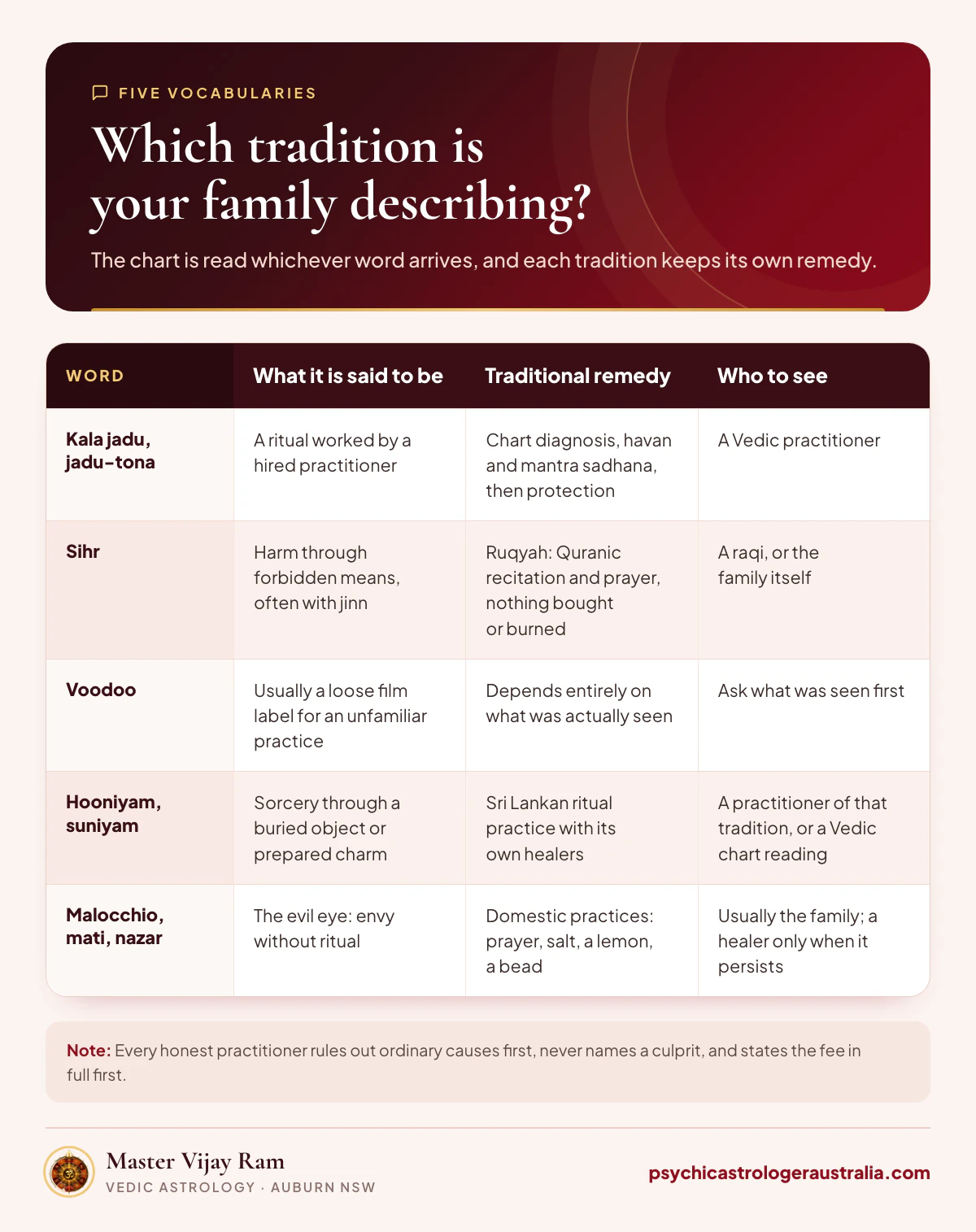
The table keeps the vocabularies apart so that a family can see which one it is actually using, and which practitioner that word points toward.
| Word | Language and setting | What it is said to be | Traditional remedy | Who to see |
|---|---|---|---|---|
| Kala jadu / jadu-tona | Hindi, Urdu, Punjabi; Hindu and Sikh households | A ritual worked by a hired practitioner against a named person | Chart diagnosis, havan and mantra sadhana, protection afterwards | A Vedic practitioner |
| Sihr | Arabic; Muslim households of any language | Harm through forbidden means, often with jinn | Ruqyah: Quranic recitation, prayer, nothing bought or burned | A raqi, or the family itself |
| Voodoo | English, from film; rarely from Haiti itself | Usually a loose label for an unfamiliar practice | Depends entirely on what was actually seen | Ask what was seen first |
| Hooniyam / suniyam | Sinhala and Tamil; Sri Lankan households | Sorcery through a buried object or prepared charm | Sri Lankan ritual practice with its own healers | A practitioner of that tradition, or a Vedic reading of the chart |
| Malocchio / mati / nazar | Italian, Greek, Hindi, Urdu, Tamil and more | The evil eye: envy without ritual | Domestic practices: prayer, salt, a lemon, a bead | Usually the family; a healer only when it persists |
Where do the traditions agree?
On more than their followers expect. All of them hold that envy is the usual motive, that harm follows visible good fortune, that the household feels it before the individual names it, and that protection is a daily habit rather than a single cure. All of them keep the remedy within the tradition that diagnosed it. And all of them, at their honest best, refuse to name a culprit from a reading, because the accusation does more lasting damage in a family than the harm it was supposed to explain.
Where do they differ?
In three places. Whether a ritual is required at all: the evil eye needs none, while kala jadu, sihr and hooniyam are each described as worked deliberately. Who the practitioner is: a tantrik, a sahir, a specialist with a buried object, or nobody. And what undoes it: a fire ritual and mantra, Quranic recitation, a Sri Lankan ceremony, or a grandmother's whisper. A remedy from the wrong tradition is not dangerous in his experience, but it is not what the family asked for, and it leaves them feeling unheard.
How does Master Vijay Ram work within the Vedic frame?
He reads the birth chart and the timeline first, whatever word arrived with them, and most of what he finds is an ordinary cause: illness, money, a marriage under strain, a business in a hard season. Where the chart and the sequence of events do show interference, the remedy is a havan with mantra sadhana on a muhurat, performed by him personally, and the family keeps a simple protective practice afterwards. The black magic removal service describes that work, and witchcraft and sihr removal covers the cases that arrive with those words.
He does not borrow another tradition's ceremony and perform it as his own. A Sinhala family asking for a Sri Lankan rite, or a Muslim family asking for ruqyah by a raqi of their own mosque, is told so plainly.
When does he point you to ruqyah or another tradition's practitioner?
When the family's own frame is the one they trust, and when the remedy they want is one that belongs to it. A Muslim household that wants Quranic recitation by someone from its own community is sent there with his blessing, and the sihr and ruqyah guide tells them what to expect. A Sri Lankan family wanting a traditional ceremony is told honestly that he does not perform one. What he offers every family, whatever its tradition, is the chart reading itself, which does not belong to any one of them.
Two vocabularies under one roof
In the newer suburbs it is common for one spouse to say kala jadu and the other sihr, or for a Punjabi daughter-in-law to say nazar where her Greek mother-in-law says mati. Neither is wrong. In Craigieburn three vocabularies share the same streets, and a consultation there often begins by agreeing on what the household is actually describing before any chart is read. That conversation is worth the hour on its own.
What every honest practitioner has in common
Ordinary causes first, in every tradition: the doctor before the raqi, the accountant before the tantrik. No culprit named from a reading. A remedy that stays inside the tradition that diagnosed it. A fee stated in full before anything is done, which with him is a $50 consultation and remedy work from $250 where the reading warrants it. And the willingness to say that nothing is there, which is the answer most families receive and the one that costs a dishonest practitioner the most.
The first step, whichever word you use
Bring the word your family uses and the story behind it, and let the chart be read before anyone decides what it is. The reading does not care which language the fear arrived in; it cares about the timeline, the dasha and the ordinary explanations that have to be ruled out first. Whether the answer is a havan, a referral to ruqyah, a practitioner of your own tradition or simply a hard season to be waited out, you will hear it plainly, in Hindi, Punjabi or English. The types of black magic people search for are, in the end, five ways of describing one fear, and the chart answers all of them the same way.
In Melbourne's mixed suburbs, is it harm or a neighbour's protection?
Streets in Dandenong, Footscray and Sunshine hold many traditions side by side, and many of the objects that frighten a family turn out to belong to one of them. A lemon and green chillies hung by a doorway, a blue bead on a car mirror, a red thread tied to a gate or a small offering at a doorstep are protective customs, not curses: someone is guarding their own house, and the object is aimed at nobody.
So before a household in Clayton or Glen Waverley settles on kala jadu, sihr or voodoo, it helps to ask the plainest question first: whose custom is this, and what is it for? A photograph sent on WhatsApp is often enough for him to say whether it looks like a neighbour's protection, a child's game or something that needs a closer look, and most prove to be one of the first two.
Families who keep their festivals at the Murugan Temple in Sunshine North or the Shri Shiva Vishnu Temple at Carrum Downs can ask a priest there about a Hindu custom they do not recognise, and a Muslim household can ask at its own mosque in the same way.
Where something does need reading, Vedic readings for Melbourne families happen on a phone or video call or over WhatsApp, in whichever of English, Hindi or Punjabi the grandparent who uses the old word prefers; face-to-face appointments are only ever in Auburn, in Sydney. Both black magic removal for Dandenong households and evil eye and nazar removal in Footscray begin with that same reading, and no neighbour is ever accused, whichever word the family arrived with.
Read next
- Black Magic Removal Near Me: What “Near” Actually Buys YouBlack magic removal near me: what a visit genuinely adds, what it does not, how the work reaches every suburb from Au…
- Black Magic on Marriage: Signs Your Relationship Is TargetedSigns that black magic may be affecting a marriage, how the drift unfolds week by week, and the ordinary causes to ru…
- Black Magic Removal in Australia: Cost, Process & ResultsBlack magic removal in Australia explained honestly: how fees are built, what should never be charged, how the work i…
Frequently asked questions
Is kala jadu the same thing as sihr?
They describe the same experience from two religious frames. Kala jadu is the Hindi and Urdu term, carrying the picture of a tantrik or practitioner hired to work a ritual; sihr is the Arabic and Islamic term for harm worked through forbidden means, often with jinn. The signs families report overlap almost completely. The remedies differ: a Vedic havan and mantra sadhana for one, Quranic recitation and prayer for the other.
Is voodoo real, and is it what my neighbour is doing?
Vodou is a real religion with roots in West Africa and Haiti, and almost nothing in it is about harming anyone. What most Australians mean by voodoo comes from films. If you have seen a neighbour's practice you do not recognise, describe exactly what you saw rather than naming it; it is far more likely to be an ordinary devotional or protective custom from their own culture than an attack on you.
What is jadu-tona?
The broad Hindi and Punjabi term for sorcery and charms in general, covering both the harm people fear and the small folk remedies used against it: knotted threads, lemons and chillies, ash at a threshold. Kala jadu is the darker end of the same vocabulary. When a relative says jadu-tona has been done, ask what was seen or found, because the objects people find at a doorstep are often a neighbour's own protective practice.
Can Master Vijay Ram perform ruqyah?
He offers ruqyah and spiritual healing for families who ask for it and is plain about which tradition it belongs to. Where a Muslim household wants Quranic recitation by a raqi from its own community, he says so and sends them there without hesitation. What he offers every family regardless of tradition is the reading of the birth chart against the timeline, which belongs to no single faith and usually finds an ordinary cause.
What is hooniyam?
The Sri Lankan word, Sinhala and Tamil, for sorcery worked against a person, usually described as an object buried near the home or a charm prepared by a specialist. Its traditional remedies are Sri Lankan ceremonies with their own healers. Master Vijay Ram reads the chart for families who bring the word to him and does not pretend to perform a ceremony that is not his; he will say when a practitioner of their own tradition is the right call.
Is the evil eye a kind of black magic?
No, and keeping them apart saves families a great deal of fear. The evil eye, whether called nazar, drishti, malocchio or mati, is envy without ritual or intention, and every tradition treats it with domestic practices: a prayer, salt, a lemon, a bead. Black magic in any vocabulary means deliberate work by a practitioner. A grandmother's remedy is the right first response to one and no response at all to the other.
Does it matter which word I use when I call?
Only because it tells him which tradition's remedy you expect and which practitioner you may already have seen. The reading itself is the same whatever word arrives: the birth chart against the timeline, ordinary causes first. Bring the word your family uses and the story behind it, and let the chart decide what, if anything, is there; most of the time the answer is a hard season with an ordinary cause.
My husband says sihr and my mother-in-law says kala jadu. Who is right?
Both, in their own language, and the disagreement is about frame rather than fact. The experience they are describing is the same; what differs is whether the family expects ruqyah or a havan at the end of it. In a consultation he begins by getting the household to agree on what is actually being described, then reads the chart, and then says which remedy, if any, fits and which tradition it belongs to.
What does a consultation cost, whichever word I bring?
The consultation is $50, by phone, video or WhatsApp, in English, Hindi or Punjabi, with family welcome to join from overseas. Most consultations end with an ordinary cause found and nothing further charged. Where the chart shows interference and a Vedic remedy fits, the work starts from $250 and the figure is agreed before anything is performed; where another tradition's remedy fits better, he says so.
People also ask
What is the difference between black magic and sihr?
Black magic is the English and Hindi (kala jadu) frame, where a practitioner is hired to work a ritual; sihr is the Islamic frame, where harm is worked through forbidden means, often with jinn. The reported signs overlap almost entirely. The remedies belong to different traditions: havan and mantra sadhana for one, ruqyah for the other.
What are the types of black magic?
Across traditions the types are better described as vocabularies: kala jadu and jadu-tona in Hindi and Punjabi, sihr in Arabic, hooniyam in Sri Lanka, and the film word voodoo. Each describes deliberate harm by a practitioner. The evil eye, nazar, malocchio or mati, is not a type of black magic but envy without ritual, and is treated at home.
Can a Hindu astrologer remove sihr?
He can read the chart and perform a Vedic remedy for the interference it shows, and many Muslim families consult him for exactly that. What he cannot do is make the work ruqyah, which belongs to Islamic practice and a raqi; where a family wants that, he says so. The reading comes first in either case, and it usually finds an ordinary cause.
Is voodoo the same as black magic?
No. Vodou is a Haitian religion with West African roots, and harming people is no part of its ordinary practice. The English word voodoo has become a loose label, mostly from films, for any unfamiliar curse. When a caller uses it, the useful question is what was actually seen, because it is rarely anything Haitian and often nothing hostile at all.
What does a Sri Lankan family mean by hooniyam?
Sorcery worked against a person, usually through an object buried near the home or a charm prepared by a specialist, with remedies that belong to Sri Lankan ritual practice. The astrology underneath is shared with the Vedic tradition, so a chart can be read for the family, but the ceremony itself is not Vedic and an honest practitioner says so.
References & further reading
Serving clients across Australia
Confidential consultations by phone, video & WhatsApp — including: