
Quick answer
Baglamukhi puja is worship of Bagalamukhi, one of the ten Mahavidyas, whose power is stambhana, the stilling of hostile speech. Families ask for it during court cases, workplace hostility and gossip. Done ethically, it is prayer for your own calm and protection after your lawyer or Legal Aid; it never targets an opponent, witness or judge and never promises a verdict.
Who is Bagalamukhi, and why do people ask for her in a dispute?
Bagalamukhi is one of the ten Mahavidyas, the great wisdom goddesses of the Shakta tradition, worshipped as Pitambara, the goddess in yellow, whose particular power is stambhana: stilling an enemy into silence. That phrase explains why her name, usually spelled Baglamukhi in Hindi, is the one families reach for when someone is speaking against them in a courtroom, an office or a community hall. A Baglamukhi puja is worship of the goddess with that stilling in mind.
The question here is what that stilling may honestly be asked for. The short version is protection and composure for the person praying, never harm or silence imposed on someone else, and never a promised verdict, which is how help with enemies and court cases is offered by Master Vijay Ram.
What does stambhana mean in her worship?
Stambhana means stilling or fixing in place, from the same root as stambha, a pillar. In the tantric list of six acts, stambhan is one of the purposes a mantra can be turned to, and aimed at a person to freeze them it is hostile work; the six tantric acts explained sets that list out plainly. In devotion to Bagalamukhi the same idea is read protectively, as the goddess stilling the hostility directed at her devotee.
Devotees describe it in ordinary terms: slander that stops spreading, an angry exchange that cools before it becomes a feud, their own panic and their own tongue held steady when a hard question is put to them. That is the reading of stambhana Vijay Ram ji works with, and the only one.
Why do people ask for her worship in court cases and at work?
Because a dispute feels like being talked about by people with power over you. A family fighting over a parent's house, a father in a parenting matter, a shop owner pursued by a former partner, a nurse facing a complaint she says is false: each feels surrounded by words, and a goddess who stills hostile speech seems made for the moment. That feeling sits behind most searches for Baglamukhi for court case help.
Hostility at work arrives the same way: a colleague who briefs against you, a manager who seems set on your exit, a group chat where your name keeps coming up. Signs your career is being blocked looks at the spiritual side of a stalled working life; this page stays with the prayer people want and its limits.
Why does a lawyer or Legal Aid come first?
Because the case is decided on evidence, procedure and law, and no puja touches any of them. A lawyer reads the documents, knows the deadlines and can tell you whether to settle; if money is the obstacle, Legal Aid NSW, the Legal Aid commission in every other state and territory, and community legal centres give advice. For trouble at work, the first calls are to HR, your union or an employment lawyer.
Keep every document, write down dates while you remember them, and never miss or move a court date for an astrological reason. The prayer sits beside a case that is already in competent hands; it is not a way to save on the lawyer.
Where are the ethical limits?
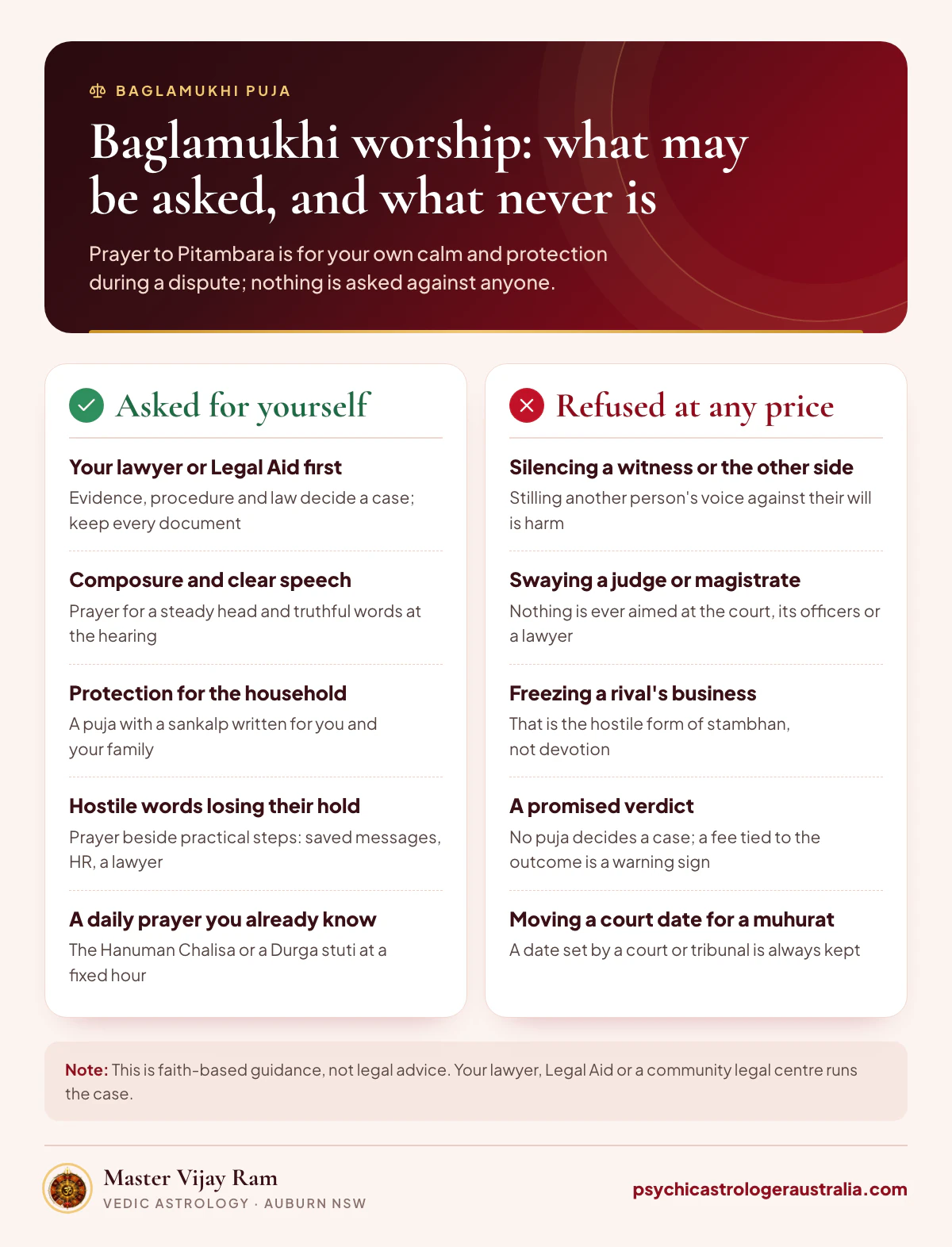
The table sets the requests families actually make beside what is offered in their place. The pattern is simple: whatever is asked for the person praying can usually be met, and whatever is asked against someone else is refused.
| What is asked for | What is offered | Why |
|---|---|---|
| Win the case | Prayer for composure, a clear head and truthful speech at the hearing | A verdict rests on evidence and law; no one can promise one |
| Silence a witness or the other side | Refused | Stilling another person's voice against their will is harm, whatever it is called |
| Sway the judge or magistrate | Refused | Nothing is ever aimed at the court, its officers or a lawyer |
| Stop gossip or slander | Prayer that hostile words lose their hold, beside practical steps | A defamation question belongs with a lawyer; the prayer is for your steadiness |
| Protect the family during the case | A puja for the household's protection and calm | Protection works on your own side and harms nobody |
| Freeze a rival's business or career | Refused | That is the hostile form of stambhan, not devotion |
Can a puja decide a verdict?
No, and anyone who says otherwise is selling. A verdict depends on what can be proved and what the law says, and a judge or magistrate decides it in open court. What a puja can do is steady the person who has to live through the months before it, and that matters: people who are steadier give their lawyers clearer instructions, keep their appointments and say less that they later regret.
Be wary of anyone who ties a fee to the outcome, offers a stronger puja for a bigger case, or quotes a different price once they hear what is at stake. The figure for prayer here is the same whatever the court decides.
What does a Baglamukhi puja involve when it is offered?
A consultation comes first, because not every dispute calls for a fierce form of the goddess, and a Hanuman prayer or a planetary shanti is often the better fit. Where Bagalamukhi worship is right, Master Vijay Ram performs it himself at his place of practice in Auburn, on a muhurat chosen from your chart, with a sankalp, the stated intention, written for your protection, composure and household. You can join by video if you wish.
A Baglamukhi anushthan is the longer form: a set course of mantra jaap over a fixed number of days, carried by the same sankalp, and puja and anushthan performed on request describes how it is arranged. The Baglamukhi mantra itself is not handed out for home use in the middle of a dispute, because it is traditionally received from a guru with initiation, and because the intention behind it matters more than the syllables.
Why is she approached with discipline?
The Mahavidyas include the tradition's fierce forms of the goddess, Kali first among the ten, and fierce forms are approached with discipline, steadiness and a teacher. Sadhana of Bagalamukhi is a guru's matter, not a weekend project from a video, and it is never undertaken to frighten or intimidate anyone. Maa Kali and protection takes up the same question for the first Mahavidya.
Her best-known temples in India are at Bankhandi in Kangra, Himachal Pradesh, and the Pitambara Peeth at Datia in Madhya Pradesh, and families visiting India sometimes make the trip. A visit made in devotion carries the same ethics as a puja here: protection asked for yourself, nothing asked against anyone.
What can you keep up at home while the case runs?
Less than people expect, and all of it for your own side. Sleep on a schedule, eat properly before a hearing, and keep one short prayer at a fixed hour, the Hanuman Chalisa or a Durga stuti if the family already knows one. A lamp at dusk in the room where the case papers live is a quiet way of saying the matter is in hand.
Leave the other side out of your prayers except to wish them no harm, which is harder than it sounds in the middle of a fight. Where a reading finds that a protective object would steady you through the hearings, a kavach prepared for one person is the traditional addition; it is prepared for you, not against anyone, and nothing is sold ready-made.
What about gossip, slander and bad wishes?
Hostile words hurt most in close communities, where the same people meet at the temple, the gurdwara and every wedding. The tradition takes spoken ill will seriously, and shrap and spoken curses explains how it weighs a curse against the relationship behind it. The protective answer is the same here: prayer for your own steadiness, a lamp at home, and no reply in kind.
Practical steps sit beside the prayer. Save the messages, step back from the group chat, and if what is being said is false and damaging, ask a lawyer whether it is defamation rather than asking a priest to stop it.
How does a chart reading help during a case?
It describes the season rather than the outcome. The sixth house, the house of opponents and disputes, read with Mars, Saturn and the dasha running, shows how hot the conflict is likely to run, where delays come from and when the pressure tends to ease. Where one planet is pressing hard, a graha shanti puja for that planet is often more fitting than any fierce form.
The reading also describes you in the dispute: whether you tend to settle too early from exhaustion, or fight past the point where fighting helps. That self-knowledge is often the most practical thing a reading gives.
What does a Baglamukhi puja cost?
Before any puja there is a $50 consultation, by phone, video or WhatsApp, in English, Hindi or Punjabi. A Baglamukhi puja, jaap or anushthan, if the consultation supports one, starts from $250, and its figure is agreed with you before it is performed. The amount does not move with the size of the case or with the result.
Who calls about this, from Canberra to Hobart?
As illustrations: a public servant in Canberra facing a workplace investigation she believes is unfair, a Wollongong couple in a building dispute that has run past a year, a Hobart family whose share of a house in Punjab is tied up in an Indian court. Each is usually told the same things in the same order: the lawyer, the records, the sleep, then the prayer.
Astrology readings for Canberra explains how consultations work from the capital, and the same call can include a relative in India where the matter is theirs too. In person, the only place he practises is Auburn, by appointment.
What this cannot do
A Baglamukhi puja cannot win a case, silence anyone, reveal who is behind the hostility or replace legal advice. This is faith-based guidance, not legal, financial, medical or psychological advice, and no result is promised. If a dispute is wearing you down, Beyond Blue on 1300 22 4636 and Lifeline on 13 11 14 are there for the nights when it feels like too much.
Read next
- Kaal Bhairav: The Guardian Deity and Protection From FearKaal Bhairav, Shiva’s guardian form: the Kashi story, his dog, Kalashtami and Bhairava Ashtami, the Kalabhairava Asht…
- Maa Kali and Protection: What the Fierce Goddess Is Invoked ForMaa Kali and protection: the first Mahavidya, her sword and tongue, Dakshina Kali at home, Kali Puja on the 2027 Amav…
- Best Black Magic Removal Specialist in Australia: How to ChooseHow to choose a black magic removal specialist in Australia: the four refusals a genuine practitioner makes, green an…
Frequently asked questions
Can Baglamukhi puja help me win a court case?
It cannot decide a verdict, and nobody can honestly promise one. A case turns on evidence, procedure and law, which your lawyer or Legal Aid can assess. What the puja is offered for is your own composure, clear speech and protection through the months the case takes, with a sankalp written for you and your household. Anything sold as a certain win should be refused.
Who is Pitambara Devi?
Pitambara, the goddess in yellow, is a name of Bagalamukhi, one of the ten Mahavidyas of the Shakta tradition. Her power in the tradition is stambhana, stilling an enemy into silence, which devotees read as protection from hostile speech. Her best-known temples are at Bankhandi in Kangra, Himachal Pradesh, and the Pitambara Peeth at Datia in Madhya Pradesh.
Is it safe to chant the Baglamukhi mantra at home?
Fierce forms of the goddess are traditionally approached with a teacher, and the Baglamukhi mantra is received from a guru with initiation rather than copied from a video. During a dispute, most families do better with prayers they already know, such as the Hanuman Chalisa, said for their own steadiness. Nothing should ever be recited with the aim of silencing or harming another person.
Will Master Vijay Ram perform a Baglamukhi puja against my opponent?
No. Nothing is performed against an opponent, a witness, a lawyer, a judge or a magistrate, under any name. Where Bagalamukhi worship is right for you, it is performed with a sankalp for your own protection, composure and household, after a consultation and alongside your lawyer. Requests to silence, freeze or weaken anyone are declined at the first mention.
What is a Baglamukhi anushthan?
An anushthan is a set course of mantra jaap over a fixed number of days, performed with a stated intention. For Bagalamukhi it is done by Master Vijay Ram personally at his place of practice in Auburn, on a muhurat chosen from your chart, with the sankalp written for your protection and calm. It starts from $250 and the amount is agreed before anything is performed.
I cannot afford a lawyer. What should I do?
Contact the Legal Aid commission in your state or territory, such as Legal Aid NSW, or a community legal centre; they give legal advice, and many people qualify for further help. For workplace matters, your union or an employment lawyer is the place to start. Keep every document and note dates as they happen. Prayer is a companion to that help, never a replacement for it.
Can Baglamukhi puja stop gossip at work or in the community?
It can be prayer that hostile words lose their hold on you, and many devotees find their own steadiness returns. It cannot stop anyone from talking. Save the messages, step back from group chats, raise workplace conduct with HR or your union, and ask a lawyer about defamation if what is said is false and damaging. Never answer gossip with a rite aimed at the speaker.
Should I choose my court date by muhurat?
No. A date set by a court or tribunal is kept, and no hearing should ever be delayed or missed for an astrological reason. Where a decision really is yours, such as when to send a settlement offer, attend mediation or sign an agreement, a reading can suggest a favourable window. Your lawyer's advice on timing always outranks the chart's.
How much does a Baglamukhi puja cost?
A consultation is $50, by phone, video or WhatsApp, and it decides whether a Bagalamukhi puja is the right prayer at all. If it is, the puja, jaap or anushthan starts from $250, agreed before anything is performed, and it is performed personally in Auburn with you joining by video if you wish. The fee is the same whatever the court decides.
People also ask
What is Baglamukhi puja used for?
Devotees turn to Bagalamukhi, the goddess of stambhana or stilling, during disputes, court cases, workplace hostility and gossip. Practised ethically, the puja asks for the devotee's own protection, composure and clear speech, and for hostility directed at them to lose its hold. It is never used to silence, freeze or harm another person, and it never promises a verdict.
What does stambhan mean?
Stambhan, or stambhana, means stilling or fixing in place. In the tantric list of six acts it names a hostile act aimed at freezing a person, which is refused here. In devotion to Bagalamukhi the idea is read protectively: hostile speech directed at the devotee stilled, and the devotee's own panic and tongue held steady.
Which temples are famous for Baglamukhi?
The best-known are at Bankhandi in Kangra, Himachal Pradesh, and the Pitambara Peeth at Datia in Madhya Pradesh, and there are others across India. Families visiting India sometimes go in devotion. The ethics of a temple visit are the same as for a puja performed here: protection asked for yourself, nothing asked against anyone.
Is Baglamukhi a dangerous goddess to worship?
She is a fierce form, not a dangerous one, and fierce forms are approached with discipline, steadiness and a teacher. Simple devotion, such as visiting a temple or joining a puja performed for you, is open to anyone. Intensive sadhana belongs with a guru, and worship of any form of the goddess aimed at frightening or harming someone falls outside the tradition's protective purpose.
References & further reading
Serving clients across Australia
Confidential consultations by phone, video & WhatsApp — including: