

Quick answer
A jyotishi reads birth charts, a pandit performs rites, a tantrik belongs to an initiated tantric lineage, an ojha is a village folk healer, a baba or sadhu is a renunciate and an aghori is an ascetic, not a seller of black magic. Advertisements blur them all. Check anyone by whether their conduct matches their title, their lineage, a fixed price and no fear.
Who are you actually calling when you ring a tantrik, an ojha or an astrologer?
A tantrik is a practitioner initiated into a tantric lineage, an ojha is a folk healer from village India, a baba is a holy man or renunciate, and a jyotishi is an astrologer who reads birth charts; the advertisements a frightened family finds at midnight blur all four into one promise. Each title once described a real role with its own training and limits. Knowing which role you need, and whether the person on the phone fits the title they use, settles more than any review.
This page goes through the titles one by one, fairly, because real traditions sit behind most of them. It ends with what Master Vijay Ram is in these terms, and how black magic removal fits within the roles he does hold.
What does a jyotishi, or astrologer, actually do?
A jyotishi reads the birth chart: the planets at the moment of birth, the dasha periods that time a life, the transits that press on it now, and the muhurat for an undertaking. The work is diagnosis and timing. A jyotishi asks for a date, time and place of birth and a timeline of events, and does not need your hair, your photograph or your enemy's name.
The question behind tantrik vs astrologer searches is usually which one can tell whether something has been done. A chart can show when a person is under pressure and which kind of pressure it resembles, and that is often the whole answer; a full kundli reading is that first step.
What is a purohit or pandit for?
A purohit is a family priest, and pandit is the respectful title for a learned Brahmin priest or scholar. Their work is rites performed by the book: naming ceremonies, weddings, house-warmings, funerals, pujas on festival days. A good pandit knows which rite fits which occasion and performs it correctly; most do not diagnose curses and do not claim to.
In Australia many families meet their pandit through a temple or a community association, and that relationship is worth keeping. When a household wants a puja performed for protection, a priest attached to a temple, or a practitioner like Vijay Ram ji who performs rites himself, is the right kind of person to ask.
Is a tantrik a black magic specialist?
Not in the tradition's own sense. Tantra is a large family of Hindu and Buddhist traditions with initiation, a guru, ritual, meditation and mantra, practised for centuries by people who would never sell harm. A genuine tantric practitioner can name a teacher and a lineage, and spends most of the time on their own discipline rather than on clients.
The advertising tantrik is a different creature: a phone number, a list of powers and a promise to control, punish or reunite. A search for a tantrik in Australia returns mostly the second kind, offering the harmful acts that the six tantric acts describes. The word has been taken from a tradition and used as a brand.
What is an ojha?
The plain ojha meaning is a folk healer in parts of north and east India, called to villages for fever, fits, spirit trouble and, dangerously, snakebite, often far from any doctor. Many ojhas work by blowing, sweeping and reciting over the sick person, the practice described in jhaad-phoonk and where it must stop. The role grew where medicine was absent, and it is at its most harmful when it delays medicine that is present.
There is a darker side that families should know. Witch accusations still kill people in parts of India, overwhelmingly women: Wikipedia's account of witch hunts in India, drawing on NCRB figures, records over 2,500 killed between 2000 and 2016. Any healer, of any title, who names a person as the cause of a family's trouble should be left at once.
What do baba and sadhu actually mean?
Baba is a word of affection and respect, father or elder, given to holy men and saints; a sadhu is a renunciate who has left household life for a spiritual one. Real sadhus and real babas exist, and many families have one they revere. The title, though, can be claimed by anyone, and in advertising it is usually self-given.
The phrase baba ji black magic on a flyer or a website describes a business, not a renunciation. A renunciate with a price list, a WhatsApp number for love spells and a fee that rises with your fear has not renounced very much, and a respectful title should not lower your guard.
Are aghoris black magic sellers?
No. The Aghori are an ascetic Shaiva order, associated with cremation grounds and with deliberately breaking ordinary taboos as a discipline of non-attachment. They are renunciates on a severe path, they are not for hire, and the tradition has nothing to do with taking bookings by phone.
Searches for aghori black magic are fed by documentaries and by advertisers who borrow the word because it frightens. An advertisement offering an aghori's services for a fee is using the order's reputation, not its practice.
Maulvi and amil: the Islamic side of the advertisements
A maulvi is an Islamic scholar or cleric, and a raqi is the person who performs ruqyah, the recitation of Quranic verses for protection and healing. An amil, in South Asian usage, is someone who performs amal, spiritual workings such as writing a taweez; the advertising title amil baba usually belongs to a business with no tie to any mosque. Muslim families are generally best served by a raqi or imam from their own community.
Ruqyah or Vedic healing explains how to decide between the two traditions. Master Vijay Ram offers ruqyah and spiritual healing for families who ask, without claiming to be a maulvi, and says plainly when their own imam is the better choice.
The titles side by side
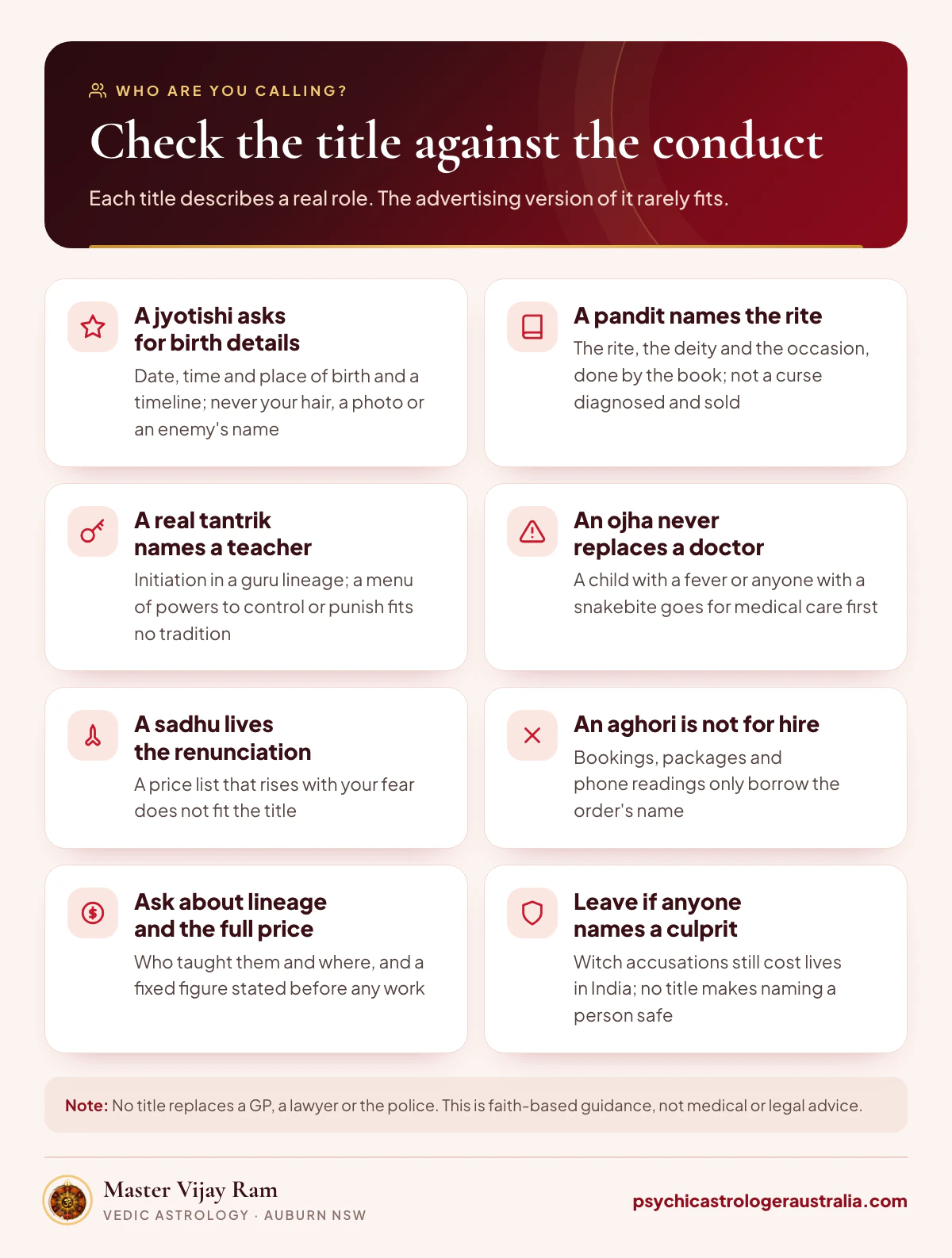
The quickest check on anyone is whether their conduct fits the title they use. The last column lists what does not belong to the role, whoever is claiming it.
| Title | The real role | What it should look like | What does not fit the title |
|---|---|---|---|
| Jyotishi | Reads birth charts for timing and tendency | Asks for birth details and a timeline | Asking for hair, photos or an enemy's name |
| Purohit or pandit | Performs rites by the book | Names the rite, the deity and the occasion | Diagnosing a curse and selling its removal |
| Tantrik | Initiated practitioner in a guru lineage | Names a teacher and a tradition | A menu of powers to control or punish |
| Ojha | Village folk healer | Prayer beside a doctor, never instead | Delaying a hospital, naming a witch |
| Baba or sadhu | Renunciate or revered elder | Lives the renunciation | A price list that rises with your fear |
| Aghori | Ascetic Shaiva order | Not for hire at all | Bookings, packages and phone readings |
| Maulvi, raqi or amil | Scholar; reciter of ruqyah; taweez writer | Recitation within Islam | Sihr for sale, or harm sent back |
So who removes black magic?
The honest answer to who removes black magic depends on the tradition the family keeps and on what is really happening, which is usually less than feared. In the Vedic frame, the work belongs to someone who can read the chart and the timeline and then perform protective puja, havan and mantra; in Islam, to a raqi; in the folk frame, to a healer whose cure must never stand between a sick person and a doctor.
Whoever it is, the first job is ordinary: a GP for the body, a lawyer for the dispute, a counsellor for the marriage. Removal is a narrow piece of work that follows those, not a title you ring instead of them.
What is Master Vijay Ram, in these terms?
A jyotishi who also performs rites. Master Vijay Ram has practised Vedic astrology and spiritual healing for more than forty years in a Himalayan lineage, reads the chart first, and performs any puja, havan or jaap himself at his only place of practice, in Auburn. About Master Vijay Ram gives the background.
He is not a tantrik for hire, not an aghori, not a maulvi and not a psychic medium. He consults in English, Hindi and Punjabi; for Tamil-, Telugu- and Nepali-speaking families, a family member can interpret on the call.
How can you check anyone, whatever they call themselves?
Ask about lineage: who taught them, in which tradition, and where. A genuine practitioner answers without irritation, while an evasive one changes the subject to your problem. Ask for the full price before any work, and notice whether it is a fixed figure or a figure that depends on how frightened you sound.
Listen for a guarantee or a culprit, because either one ends the conversation, and notice whether you feel calmer or more afraid when the call ends. Choosing a black magic removal specialist sets out the full list of refusals and warning signs, so it is not repeated here.
What does it cost to consult him?
Consulting him costs $50, by phone, video or WhatsApp. A puja, havan or jaap, where the reading calls for one, starts from $250, is agreed before it is performed and is done by him at Auburn, with you watching by video if you like; online puja and havan explains the arrangement. No remedy is sold on a first call; the reading comes first.
What if nobody local seems trustworthy?
In Cairns, Townsville or Darwin the choice of practitioners is small, and the advertisements fill the gap. As an illustration, a couple in Kirwan whose baby will not settle might find three numbers online, each with a different title and the same promises, and no one nearby to ask. A priest or elder at your own temple or mandir is the best first person to ask about who performs rites in your community.
Vedic readings for Townsville explains how a consultation works from North Queensland, where clocks stay on Brisbane time all year. The reading is the same by phone as in person, and the only in-person option is Auburn, by appointment.
What no title can do
No title, however old, makes a person able to promise a result, name who harmed you or replace a doctor, a lawyer or the police. This is faith-based guidance, not medical, legal, financial or psychological advice. The useful thing a title can tell you is what kind of help to expect, and the useful thing you can do is check whether the person lives up to it.
Read next
- Kala Jadu, Sihr and Voodoo: Which Tradition Is Your Family Describing?Kala jadu, sihr, voodoo, hooniyam and the evil eye: what each tradition means by harm, what undoes it, and how a Vedi…
- Black Magic Removal Near Me: What “Near” Actually Buys YouBlack magic removal near me: what a visit genuinely adds, what it does not, how the work reaches every suburb from Au…
- Black Magic vs Bad Luck: How to Tell the DifferenceBlack magic or a plain bad run? Use the three-S test of spread, start line and stall, and rule out the ordinary medic…
Frequently asked questions
What is the difference between a tantrik and an astrologer?
An astrologer, or jyotishi, reads the birth chart for timing and tendency and needs only birth details and a timeline. A tantrik, in the tradition's own sense, is a practitioner initiated into a tantric lineage under a guru, mostly occupied with their own discipline. The advertising tantrik who sells control or punishment is neither. For the question of whether something has been done, a chart reading is the sensible first step.
What does ojha mean?
An ojha is a folk healer in parts of north and east India, called for fever, fits, spirit trouble and snakebite in villages where a doctor was far away. Many work by blowing, sweeping and reciting over the sick. The role is at its most harmful when it delays medical care that is available, and any ojha who names a person, often a woman, as the cause should be left at once.
Do aghoris do black magic for clients?
No. The Aghori are an ascetic Shaiva order associated with cremation grounds and with breaking ordinary taboos as a discipline of non-attachment. They are renunciates on a severe path and are not for hire. Advertisements offering an aghori's services by phone are borrowing the order's frightening reputation to sell something the tradition has nothing to do with.
Is a baba ji the same as a sadhu?
Baba is a respectful word, father or elder, given to holy men and saints, while a sadhu is a renunciate who has left household life. Real babas and sadhus exist and many families revere one. Anyone can claim the title, though, and on a flyer or website it is usually self-given; a renunciate with a rising price list has not renounced very much.
Who should a Muslim family call about sihr or jinn?
Usually a raqi or imam from their own community, since ruqyah, the recitation of Quranic verses for protection and healing, is the remedy their tradition prescribes. Be cautious with advertisements for an amil baba, which are often businesses with no tie to any mosque. Master Vijay Ram offers ruqyah and spiritual healing for families who ask, without claiming to be a maulvi, and says when their own imam fits better.
Is Master Vijay Ram a tantrik?
No. He is a jyotishi, a Vedic astrologer, who also performs rites: puja, havan and jaap, which he performs himself at his place of practice in Auburn. He has practised for more than forty years in a Himalayan lineage. He performs nothing aimed at another person, sells no powers to control anyone, and names no culprit, which is a large part of what separates his work from the advertising tantrik.
How do I check a practitioner's lineage?
Ask who taught them, in which tradition and where, and listen to how the question is received. A genuine practitioner answers plainly and without irritation; an evasive one turns the talk back to how serious your problem is. You cannot verify every lineage, but you can notice whether the title, the teacher and the conduct fit together, and whether the price was fixed before any work.
Can a pandit remove black magic?
A pandit's role is to perform rites correctly, such as weddings, house-warmings and festival pujas, and many families rightly ask their temple priest to perform a protective puja. Most pandits do not diagnose curses and do not claim to. Where a family fears black magic, a chart reading of the timeline comes first, and any protective puja follows only if the reading warrants it.
What does a consultation with Master Vijay Ram cost?
He charges $50 for a consultation, by phone, video or WhatsApp, in English, Hindi or Punjabi. A puja, havan or jaap follows only where the reading warrants it, from $250, with the figure agreed before he performs it at Auburn, and you can join by video. No result is promised, and nothing is added to the bill later.
People also ask
Who removes black magic?
It depends on the family's tradition and on what is really happening, which is usually less than feared. In the Vedic frame, someone who reads the chart and timeline and then performs protective puja, havan and mantra; in Islam, a raqi. The ordinary help comes first in every case: a GP, a lawyer or a counsellor where the trouble is theirs to solve.
What is a tantrik?
In the tradition's own sense, a tantrik is a practitioner initiated into a tantric lineage under a guru, with ritual, meditation and mantra as a personal discipline. In advertising, the word has become a brand for anyone selling powers to control, punish or reunite. A genuine practitioner can name a teacher and a tradition; an advertiser usually names a fee.
What is an amil baba?
Amil comes from amal, a spiritual working, and in South Asian usage an amil is someone who performs such workings, such as writing a taweez. Amil baba is mostly an advertising title for black magic and love spell services, often with no connection to any mosque. Muslim families are generally better served by a raqi or imam from their own community.
Is it safe to go to an ojha?
Prayer from a folk healer beside proper medical care is one thing; a folk cure in place of a doctor is dangerous, especially for a child with a fever or anyone with a snakebite. Leave at once if a healer names a person as the cause of the trouble. Witch accusations still cost lives in parts of India, and they often begin with a name.
References & further reading
Serving clients across Australia
Confidential consultations by phone, video & WhatsApp — including: