

Quick answer
Sammohan and vashikaran are two words from the same tantric vocabulary: sammohan means to charm or befuddle, vashikaran means to bring under influence. Master Vijay Ram practises neither as control; the only work he performs is shanti sadhana on the obstruction between people, read from their charts for a $50 consultation, with any remedy from $250 agreed first.
Why do two words keep appearing in the same adverts?
Type either word into a search box and the other arrives beside it: sammohan mantra, vashikaran mantra, sammohan vashikaran specialist. Sammohan is a Sanskrit term for charming, fascinating or befuddling another mind, and vashikaran is the term for bringing a person under one’s influence. They come from the same vocabulary, and the market uses them interchangeably because both sell the same hope: that someone else can be made to feel what you want them to feel.
Master Vijay Ram uses neither word for what he does, and this article is about why. It sets out what each word actually means, where akarshan and mohini fit, which of these acts the tradition itself treats as legitimate, and the single ethical line that sorts an honest practice from a sales page.
What does vashikaran mean?
The word joins vash, meaning under one’s sway, with karan, the act of doing. Read literally, vashikaran meaning is the act of bringing someone or something into one’s sway. In the older texts the object is often not a person at all: a sadhaka seeks vashikaran over his own senses, over fear, over a restless mind. The narrowing of the word to “make this person love me” is a modern commercial reading, not the only one.
Within Vijay Ram ji’s practice the word is used in a strict sense: mantra sadhana that lifts what obstructs affection which genuinely existed, never work on another adult’s will. The vashikaran service page describes the practice in those terms, and the terms do not change with the word on the advert.
What does sammohan mean?
Sammohan comes from moha, the delusion or infatuation that clouds judgement, with the prefix sam intensifying it. To do sammohan on someone is to befuddle them, to charm them into a state where they cannot see clearly. The related modern word is hypnotism, and in Hindi sammohan is simply the ordinary word for hypnosis. That tells you a good deal about what is being sold when sammohan vidya appears in an advertisement for love.
It is, by its own definition, a clouding of someone else’s mind. There is no reading of the word under which the person on the receiving end has consented, understood or chosen. That is why it is the one word in this vocabulary he will not practise in any form, and why a “sammohan mantra for love” is the clearest signal that a page is selling control.
Akarshan, mohini and the rest of the vocabulary
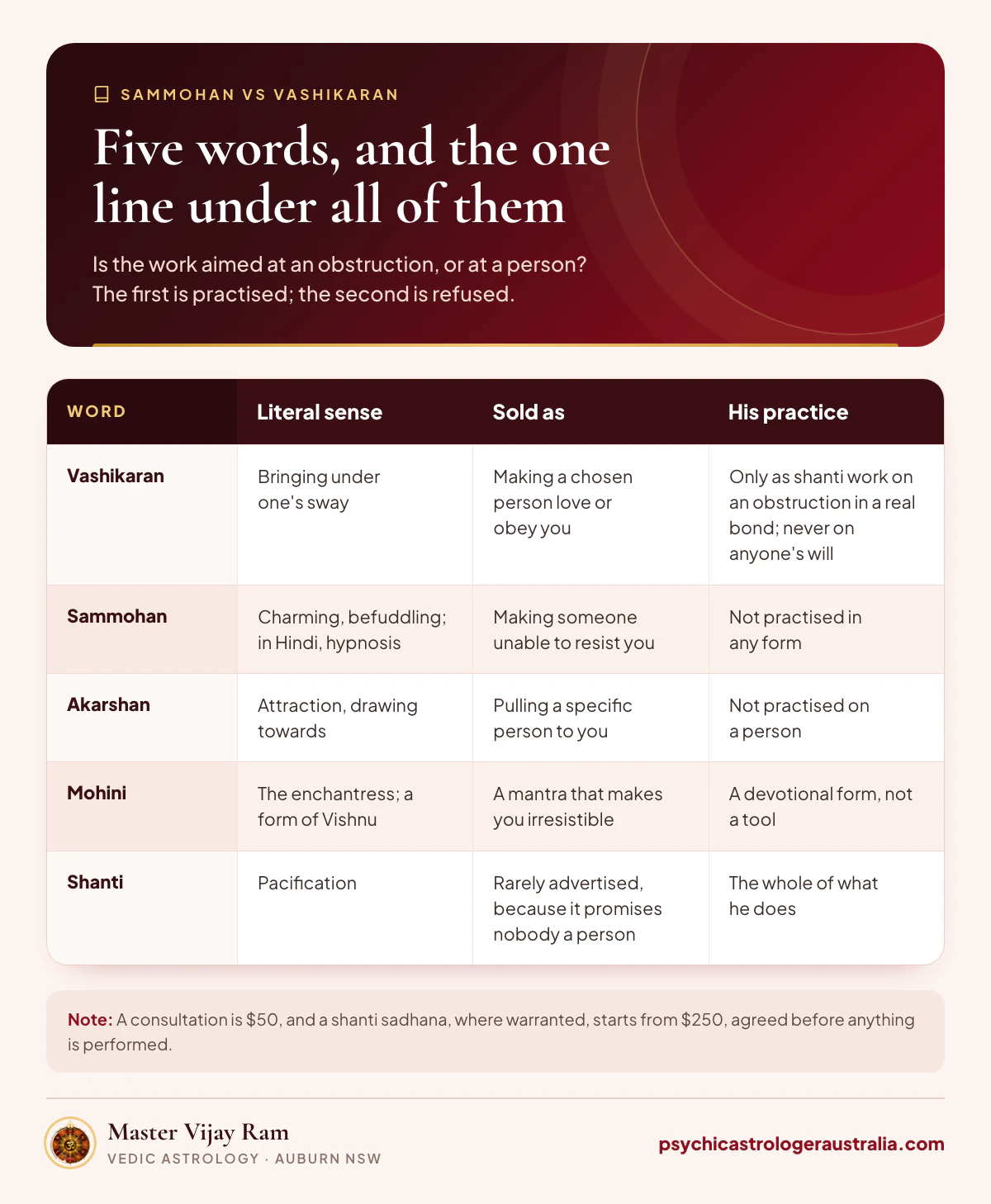
Three more words travel with the first two, and the market blurs all five into one. The table sets them side by side.
| Word | Literal sense | What the market sells it as | His practice |
|---|---|---|---|
| Vashikaran | Bringing under one’s sway | Making a chosen person love or obey you | Only as shanti work on an obstruction between people who had a real bond; never on anyone’s will |
| Sammohan | Charming, befuddling; in Hindi, hypnosis | Making someone unable to resist you | Not practised in any form |
| Akarshan | Attraction, drawing towards | Pulling a specific person to you | Not practised on a person; what draws people back is the calmed atmosphere the shanti work leaves |
| Mohini | The enchantress; a form of Vishnu | A mantra that makes you irresistible | A devotional form, not a tool; see the separate guide |
| Shanti | Pacification | Rarely advertised, because it promises nobody a person | The whole of what he does |
Notice which word is missing from the adverts. Shanti does not sell, because it cannot be pointed at a person, and it is the only one of the five that a clean practice performs. The guide to mohini vashikaran and attraction mantras takes the mohini question on its own.
Where do the words come from, and which does a clean practice keep to?
The tantric texts list a set of acts, usually six, that a mantra may be directed towards: pacification, bringing under sway, immobilising, causing enmity, driving away and destroying. The list is a map of what a mantra could be turned to, not a menu of what a practitioner should offer, and the same texts surround it with warnings about the cost to the one who misuses it.
A clean practice keeps to the first act and reads the second in its narrowest sense. Pacification of an inflamed planet, of a hostile household, of a fear that has settled over a person: that is work with a subject who has asked for it, performed in their own name. The guide to vashikaran, karma and free will sets out why the tradition treats the rest as a debt that comes due.
The one ethical line under all the words
Strip the vocabulary away and a single question remains: is the work aimed at an obstruction, or at a person? Work on an obstruction reads two charts, finds what has come between people who once got on, and pacifies it. Work on a person tries to change what that person wants. The first is practised; the second is refused whatever word the request arrives in.
The line is not softened by good intentions. A woman who wants her husband to stop drinking, a man who wants his fiancée’s father to say yes, a student who wants a lecturer to grade kindly: each is asking for a person to be changed, and each is told so gently and declined. What can be read is why the drinking, the refusal or the grade sits where it does, and what in the asker’s own chart can be eased.
What is a sammohan mantra for an interview or an exam really for?
A second market sells sammohan mantra practice for job interviews, exams and court appearances, promising that the panel, the examiner or the magistrate will be charmed. Set aside whether it works; notice what it asks for. It asks that the people across the table lose their judgement, and it is therefore the same request as the love version with the names changed.
What Vijay Ram ji offers instead is honest: a reading of the asker’s own chart for the period of the interview or exam, a shanti practice for the nerves that a difficult Moon or Mercury brings, and a muhurat for the day where one can be chosen. None of that touches the panel. It steadies the person who has to walk into the room, which is the only mind anyone is entitled to work on.
What happens when someone asks for sammohan on a specific person?
He asks what happened. That question sorts the requests into the three kinds every vashikaran practitioner hears: a relationship that existed and has broken, a hope that has never been a relationship, and a fear that something was done to the asker. The first is a reading worth doing; the second is answered honestly, with the news that no mantra makes a stranger choose you; the third is a different piece of work altogether.
For the third, vashikaran removal and reversal is a protective practice performed in the frightened person’s own name, after their chart has been read for the ordinary explanation first. A person who believes they have been charmed against their will is usually in a Rahu or Saturn period that accounts for the fog; where the chart shows more, the protection is performed, and nobody is named as the culprit.
What does he actually do? Shanti work on the obstruction
Where two charts show that affection existed and something has come between the people, the work is a shanti sadhana performed by Master Vijay Ram at his own place of practice in Auburn, on a muhurat chosen for the charts. It is directed at the obstruction: a planet inflamed in one chart, a dasha pressing on the other, an atmosphere in a home. The person who asked is told the day and the hour, and may sit in prayer at the same time wherever they live.
A puja or havan performed personally is the form it takes, and it is performed for the relationship rather than on either person in it. What people notice afterwards is not that someone has been charmed but that a conversation becomes possible again, which is a smaller claim and a truer one.
How do you tell which word a practitioner is really practising?
The word on the website tells you nothing; the answers to a few questions tell you everything.
- Ask what they need. A birth chart for each person means a reading; a photograph and a name means control.
- Ask what they will refuse. A practitioner who takes every request is not practising a discipline.
- Ask what is aimed at whom. “The obstruction between you” is shanti; “their mind” or “their heart” is sammohan under another name.
- Ask about the fee. One figure stated before any work is a practice; a figure that grows after the first payment is a funnel.
- Ask what happens if the charts say no. An honest practitioner says that many consultations end there.
The guide to ex love spells and vashikaran applies the same tests to the most common request of all, and the vocabulary used in a kundli reading is explained in the guide to kundli terms in Hindi.
When is this not the answer?
When the person you have in mind has said no, no word in any language changes it, and the honest help is a counsellor rather than a mantra. When the request is about a court case, a visa officer or an employer, the right help is a lawyer, a migration agent or preparation, and Vijay Ram ji will say so. And when the fog you feel has come with sleeplessness or low mood, a doctor comes before any reading; faith-based guidance sits beside medical and psychological care, never in its place.
Fees and the first call
A consultation is $50, by phone, video or WhatsApp, in English, Hindi or Punjabi, and it is where the words are set aside and the actual situation is heard. Where a shanti sadhana is warranted it starts from $250, agreed before anything is performed and not raised afterwards. Callers in Western Australia are told the muhurat in Perth time, and the Perth page explains how the work reaches the west.
Sammohan vs vashikaran turns out, on the phone, to be a shorter conversation than the adverts suggest. Neither word is what you are buying; the obstruction in your charts is, and that is the only thing worth paying anyone to read.
Hearing these words in Australian homes, and talking them through in Hindi or Punjabi
In many Australian homes these words arrive on a phone rather than from a book: a forwarded clip in a family WhatsApp group, a sammohan mantra video sent by an aunt in India, an advert passed round after a community function. Parents who grew up speaking Hindi know sammohan simply as the word for hypnosis, while their children in Blacktown or Dandenong may only ever have met it in a love advert. The same word can mean two different things at one dinner table.
That is why the conversation can be held in English, Hindi or Punjabi, whichever lets everyone at the table follow it. The Hindi and Punjabi consultations page explains how a grandparent in Ludhiana can be on the line from India, and the one ethical line is drawn identically in every language: work on the obstruction between people, never on a person.
The Blacktown love spell guidance and the Dandenong love spell page, close to the Little India precinct on Foster Street, describe how a request that arrives under either word is read for families in Western Sydney and Melbourne's south-east.
The exam and interview version of the same pitch reaches students and job seekers here too, and what is offered instead is the same in Australia as anywhere: the student's own chart read for the exam period, a steadying practice for nerves and a well-chosen day, with nothing directed at the panel. The conversation can happen on a WhatsApp or video call, by ordinary phone, or across a table in Auburn, which is the only in-person option.
Read next
- Mohini Vashikaran and Attraction Mantras: What the Tradition Actually SaysMohini vashikaran and attraction mantras: where the name comes from, what the texts prescribe, why a mantra for love …
- Love Vashikaran Specialist: Reunite With the One You LoveWhat a love vashikaran specialist can and cannot do, how to tell real interference from an ordinary breakup, and when…
- Vashikaran for In-Laws and Family Harmony: What Is EthicalVashikaran for in-laws, explained honestly: what the work can address in a tense household, the requests Master Vijay…
Frequently asked questions
What is the difference between sammohan and vashikaran?
Sammohan comes from moha, delusion, and means charming or befuddling another mind; in Hindi it is simply the word for hypnosis. Vashikaran joins vash, under one’s sway, with karan, the act, and means bringing someone or something into one’s influence. The market uses both to sell the same thing, control of a chosen person. Master Vijay Ram practises neither as control and does not practise sammohan at all.
Does Master Vijay Ram do sammohan?
No, in any form. By its own definition sammohan clouds another person’s judgement without their consent, and there is no reading of the word under which the person on the receiving end has chosen. What he performs is shanti sadhana, pacification of the obstruction between people who once got on, read from both charts and aimed at the obstruction rather than at anyone’s mind.
What does vashikaran actually mean in the Vedic tradition?
Literally, the act of bringing something into one’s sway. In the older texts the object is often the practitioner’s own senses, fear or restless mind, not another person. The modern commercial sense, making a chosen person love or obey you, is a narrowing of the word. In this practice it is used strictly for mantra work that lifts what obstructs affection that genuinely existed between two people.
What is akarshan, and is it different from vashikaran?
Akarshan means attraction, drawing towards. The market sells it as pulling a specific person to you, which makes it the same request as vashikaran under a gentler name. It is not practised on a person here. What draws people back towards each other, where the charts show an obstruction has been lifted, is the calmer atmosphere the shanti work leaves, not a pull exerted on anyone.
Is a sammohan mantra for job interviews or exams legitimate?
It asks that the panel, the examiner or the magistrate lose their judgement, which is the love version of the request with the names changed. The honest alternative is a reading of your own chart for the period, a shanti practice for the nerves a difficult Moon or Mercury brings, and a muhurat for the day where one can be chosen. That steadies you; it does not touch anyone across the table.
Which of the tantric acts does a clean practice perform?
The texts list a set of acts a mantra may be turned to, usually six, beginning with pacification and running through control, immobilising, enmity, driving away and destruction. The list maps what a mantra could do, not what a practitioner should offer, and the same texts warn of the cost of misuse. A clean practice keeps to pacification and reads vashikaran in its narrowest sense.
I think someone has done sammohan on me. What should I do?
Have your own chart read first and look for the ordinary explanation. A Rahu or Saturn period commonly accounts for the fog, low spirits and poor judgement that people describe, and most such fears turn out to have a cause of that kind. Where the chart shows an external obstruction, a protective removal practice is performed in your own name, without anyone being named as the culprit.
What does a consultation about this cost?
A consultation is $50, by phone, video or WhatsApp, in English, Hindi or Punjabi. Where a shanti sadhana is warranted it starts from $250, with the figure agreed before anything is performed and not raised afterwards. A good number of consultations end at the verdict, because the obstruction turns out to be a decision or an ordinary cause, and then the consultation fee is all that is charged.
How do I tell which word a practitioner is really practising?
Ask what they need: a birth chart for each person means a reading, a photograph and a name means control. Ask what they refuse, because a practitioner who takes every request is not practising a discipline. Ask what is aimed at whom, since the obstruction between you is shanti and their mind or heart is sammohan. Ask for one fee before any work, and ask what happens if the charts say no.
People also ask
What is sammohan vidya?
Sammohan vidya is the knowledge or art of charming and befuddling another mind; the word sammohan is the ordinary Hindi term for hypnosis. In advertisements for love it means making someone unable to resist you, which is control by definition. Master Vijay Ram does not practise it in any form and performs only shanti work on the obstruction between people.
Is vashikaran the same as hypnosis?
No. Hypnosis is the ordinary meaning of sammohan, a clouding of judgement. Vashikaran in the Vedic sense is mantra sadhana that brings something into one’s sway, and in an ethical practice its object is the obstruction between two people who had a real bond, never another person’s will. Where it is sold as making someone obey you, it has become sammohan under a different name.
Which is more powerful, sammohan or vashikaran?
The question assumes both are tools for working on a person, and that is the assumption an honest practitioner refuses. Neither is performed on anyone here. What is performed is shanti sadhana aimed at the obstruction the charts show, and its strength is judged by whether a conversation becomes possible again, not by any effect on another person’s mind.
What is the ethical line in vashikaran?
Whether the work is aimed at an obstruction or at a person. Pacifying what has come between people who once got on is legitimate; changing what a person wants, whatever word is used for it, is refused. The line is not softened by good intentions, and a practitioner who takes every request has no line at all.
What does Master Vijay Ram do instead of sammohan?
He reads both charts, discusses intent first, and where an obstruction exists performs a shanti sadhana at his own place of practice in Auburn on a muhurat chosen for the charts. The consultation is $50 and a sadhana starts from $250, agreed before it is performed. Many consultations end at the verdict with no sadhana recommended.
References & further reading
Serving clients across Australia
Confidential consultations by phone, video & WhatsApp — including: