
Quick answer
The Atharva Veda, the fourth Veda, does record black magic: hostile rites called abhichara and sorcery called kritya. But most of its 730 hymns are for healing, long life, a peaceful home and protection, including amulets tied on with a hymn. Genuine Vedic practice today draws only on that protective side and performs nothing aimed at another person.
What does the Atharva Veda actually say about black magic?
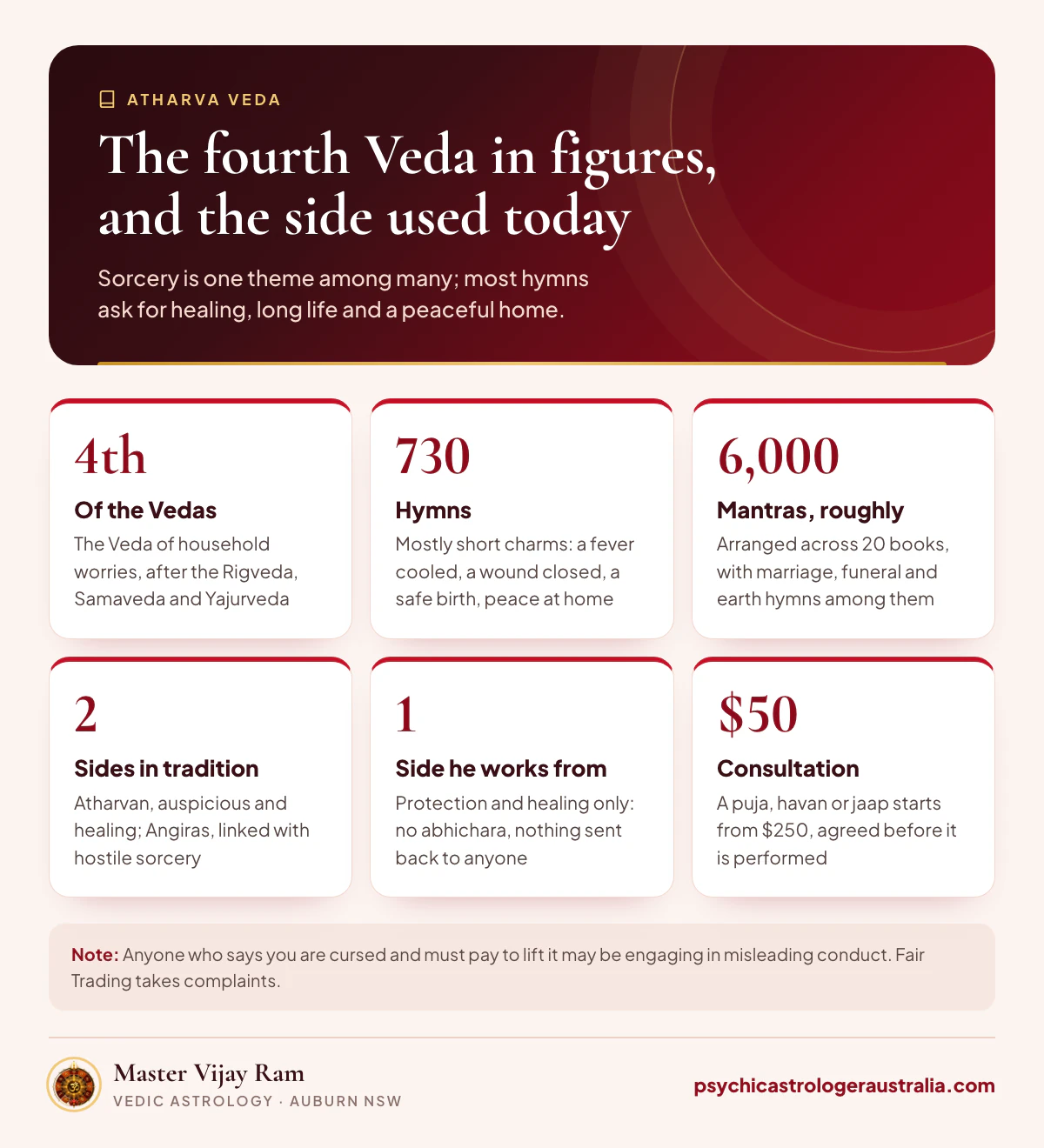
The Atharva Veda is the fourth of the Vedas, a collection of 730 hymns and about 6,000 mantras in 20 books that speaks to the worries of ordinary households: fever, quarrels, childbirth, crops, rivals and long life. It does name hostile sorcery, which is why the phrase Atharva Veda black magic appears in so many advertisements. What the advertisements leave out is that most of the collection is about healing and protection.
Families usually meet the phrase second-hand: a relative in India who blames a run of trouble on “something from the Atharva Veda”, a website promising Vedic power over enemies, an uncle who once heard that the fourth Veda is the dangerous one. This page sets out what the collection contains, what its words for sorcery mean, and why black magic removal as Master Vijay Ram practises it draws only on the protective side.
Why is it called the fourth Veda, and what is in it?
The Rigveda, Samaveda and Yajurveda gather the hymns, chants and formulas of the great fire sacrifices. The fourth collection keeps different company. Its hymns are mostly short and practical, and they address what a family brings to a priest: a child with a fever, a cough that lingers, a wound, a snake in the field, a wedding, a quarrel under one roof, a death.
Tradition counts 730 hymns, roughly 6,000 mantras and 20 books. Beside the household charms sit the marriage and funeral hymns and long, searching hymns on time, the earth and the frame of the cosmos. Sorcery is one theme among many, and a good deal of what the collection says about it is said against it.
Atharvan and Angiras: what are the two sides of the collection?
Tradition ties the collection to two names from the old priestly lines, Atharvan and Angiras, and gives each a side. The Atharvan side was seen as auspicious and healing: the charms that cool a fever, guard a pregnancy and settle a family. The Angiras side was linked with hostile sorcery, the rites aimed against a rival or an enemy.
The pairing is honest about people. The same households that prayed for a child to be safely born also feared a rival's ill will, and sometimes wanted to strike first. The Veda records both wishes; a modern reader does not have to admire the second to understand it, and a practitioner does not have to perform it because it is old.
What do abhichara and kritya mean?
Abhichara is the tradition's word for a hostile rite, work done against a person with intent to harm, and most of it belongs to the Angiras side. Kritya is narrower and stranger: literally a thing made, a piece of sorcery given a shape and pictured as being sent to a household or left where its people live and work. In the hymns a kritya is something to be found, named and driven off.
Neither word is a method, and this page gives none. What matters for a frightened family is the shape of the idea. The old texts imagined harm as something sent, and so the protective hymns imagine protection as a boundary: an amulet on the body, a word said over water, a blessing laid on the home.
Which hymns were written for healing and protection?
Most of them. There are charms against fever and cough, for wounds and broken bones, for a safe birth, for long life, for a household where people speak kindly to one another, and for a fair hearing in the village assembly. Many are addressed to healing plants, to the waters and to the fire, and their requests are modest: that a fever cool, a wound close, a family stay at peace.
The Atharvaveda protection hymns ask the gods, the plants and the fire to stand between a household and harm. Some are spoken over an amulet that is then tied on, some over water, some over the home itself. The idea is far older than any thread or locket a family buys today, and it is gentler than the advertisements suggest.
What was a mani, and how did it become the kavach?
A mani, in these hymns, is an amulet: a piece of wood, a plant, a shell or a bead of metal over which a hymn was recited before it was tied on the wearer. The hymn praises the amulet as a guardian and asks it to turn away illness, enemies and sorcery. The words and the object belonged together; an amulet without its hymn was only a bead.
Many teachers see in that pairing of recited word and worn object the root of the kavach. A kavach today, from the Sanskrit for armour, is either a protective hymn recited for a person or a small locket over which a mantra has been said many times. Taweez, kavach and yantra compared explains the objects themselves; the point here is their lineage, which was protective from the start.
Where a consultation finds that one would help, Master Vijay Ram prepares a kavach for the named person, and kavach preparation and protection describes how. He sells no ready-made amulets, beads or kits.
What were the counter-charms, and why does he leave them alone?
Alongside the protective hymns sit counter-charms against kritya, and some of them ask that the sorcery travel back to the one who made it. The wish is old and very human: if someone sent harm, let it land on them. It is the same wish that drives the “return to sender” rituals sold online today, which come from quite different traditions.
Master Vijay Ram does not use that part of the inheritance. In his practice protection means a boundary around the person and the home, not a weapon pointed outward, and nothing is sent to anyone, named or unnamed. Why a Vedic healer never sends harm back sets out the reasoning in full.
The hymns by kind, and where each stands today
The table sorts the collection's household material by what it asks for. The last column is the practical one: what, if anything, a family meets of that kind of hymn in genuine Vedic practice now.
| Kind of hymn | What it asks for | Its character | Where it stands today |
|---|---|---|---|
| Healing charms | A fever cooled, a cough eased, a wound closed | Atharvan: auspicious and healing | Prayer beside the doctor, never in place of one |
| Long life and household peace | Long life, a safe birth, kind speech at home | Atharvan | Shanti puja, mantra jaap and the family's own evening prayer |
| Amulets (mani) | An object that guards its wearer | Protective | The kavach and the protective thread, prepared for one person |
| Against sorcery (kritya) | Harm sent to a home, found and driven off | Protective in aim, fierce in language | Protection and cleansing; nothing returned to anyone |
| Hostile rites (abhichara) | Injury to a rival or an enemy | Angiras: hostile sorcery | Refused outright |
| Love charms | To win or keep a lover's affection | Some are written as compulsion | No binding of anyone's will |
Does the Atharva Veda prove that black magic works?
It proves that people feared sorcery for a very long time and wanted words to answer the fear. That is a different thing. A text that records a belief is evidence of the belief; it settles nothing about whether a particular family's trouble this year was sent by anyone.
The point matters because black magic in the Vedas is often used to close an argument: the Veda mentions it, so it must be what is happening to you. A careful reading runs the other way, since the same collection gives far more room to fevers, quarrels and childbirth, which remains a fair guide to where most household trouble comes from.
Why does the Veda's name turn up in advertisements?
Because it sounds ancient, secret and powerful, and fear sells. A practitioner who offers “Atharva Veda maran” against an enemy, or announces that your family is under an Atharva Veda spell and quotes a fee to lift it, is borrowing a scripture's name to sell work its own auspicious side never blessed. In Australia, a trader who says “you are cursed, pay to remove it” may be engaging in misleading or unconscionable conduct, and NSW Fair Trading, Consumer Affairs Victoria, Queensland's Office of Fair Trading and WA Consumer Protection take complaints.
The six tantric acts and the protective answer looks at the later list of hostile acts these advertisements also borrow, and kala jadu, sihr and voodoo compared helps when a household is using several words for one fear.
Where is the ethical line?
Protective and healing work only. Master Vijay Ram will pray for a person, a family and a home, recite for their protection, perform a puja or havan for their peace and prepare a kavach where one is warranted. He will not perform any rite aimed at another human being, will not name or hint at who might have done anything, and will not tell anyone they are cursed in order to sell a remedy.
That line is not a modern softening of the Veda. The tradition itself kept the healing and the hostile apart, gave them different names and different reputations, and the side it called auspicious was always the protective one.
How is the protective side used in a reading today?
The chart and the timeline come first. A consultation looks at the dasha running, the transits and the order in which things went wrong, and most of the time it finds an ordinary cause or a demanding period rather than anything sent. A doctor, a lawyer or a counsellor comes before any ritual where one is needed, and the reading says so plainly.
Where a remedy is warranted it is prayer, mantra jaap, a shanti puja or a havan, which Master Vijay Ram performs himself at his place of practice in Auburn while the family joins by video if they wish, followed by a short daily practice at home. Puja and havan performed on your behalf describes how that work is arranged.
What does protective work cost?
The reading itself is a $50 consultation, by phone, video or WhatsApp, in whichever of English, Hindi or Punjabi suits the family. Protective puja, havan or jaap starts at $250, a figure agreed with you before it is performed. Nothing is billed by the minute, and the price never rises because a frightening word from the Veda has been used about your family.
What if the warning came from a relative in India?
Many of these calls begin with another call. As an illustration, a nurse finishing a run of night shifts at Royal Darwin Hospital hears from her mother in Punjab that a priest has looked at the family's troubles and blamed an Atharva Veda rite; the mother is frightened, the daughter is exhausted, and nobody has slept well in a fortnight.
The useful response is the same from Darwin, Cairns or the Central Coast. Thank the elder for her worry, decline to guess at who or why, and have the chart read against the dates before any ritual is booked. Vedic readings for Darwin families explains how a Top End call fits around the half-hour or hour-and-a-half gap with Sydney, and a priest at your own temple is a good second voice on what the Vedas do and do not say.
What no scripture or reading can settle
A reading cannot prove that anyone did anything, and it cannot settle a fear by quoting scripture at it. It is faith-based guidance, not medical, legal, financial or psychological advice, and nobody can promise how or when a hard period will lift. What it can do is separate the ancient text from the present trouble, and put the protective half of that text to work for the people who asked.
Read next
- Curse Removal vs Black Magic Removal: What Is the Difference?Curse vs black magic removal: a curse is a spoken or inherited ill-wish, black magic is deliberate ritual work, and t…
- After a Spell Removal: Aftercare for the First Forty DaysAfter a spell removal: a week-by-week aftercare plan for the first forty days, the daily practice, what to avoid, sig…
- Protecting Children From Black Magic & Negative EnergyA grounded guide for parents worried about black magic or negative energy around a child: what it usually turns out t…
Frequently asked questions
Does the Atharva Veda teach black magic?
It records it, among much else. Most of its 730 hymns are charms for healing, long life, safe birth, household peace and protection, and a smaller group belongs to the side tradition links with hostile sorcery, called abhichara. Recording a practice is not recommending it. Genuine Vedic work today draws on the protective and healing hymns and refuses the hostile ones outright, which is where Master Vijay Ram stands.
What is abhichara?
Abhichara is the tradition's word for a hostile rite: work done against a person with the intention of harming them. In the Atharva Veda it belongs mainly to the side associated with the Angiras name, as distinct from the auspicious, healing Atharvan side. No method is given here or anywhere on this site, and Master Vijay Ram performs no rite aimed at another person, whatever reason is offered for it.
What does kritya mean?
Kritya literally means a thing made. In the hymns it is sorcery given a shape and pictured as being sent to a household or left where its people live and work, and the protective hymns name it in order to drive it off. The word is useful mainly for what it shows about the old imagination: harm was thought of as something sent, so protection was thought of as a boundary.
Is a kavach mentioned in the Atharva Veda?
The hymns speak of the mani, an amulet of wood, plant, shell or metal over which a hymn was recited before it was tied on the wearer. Many teachers see in that the root of the kavach, which today is either a protective hymn recited for a person or a small locket prepared with many repetitions of a mantra. Both are protective by design; neither is a weapon against anyone.
Can I recite Atharva Veda hymns at home for protection?
Vedic recitation is traditionally learned from a teacher, because pronunciation and accent are part of the practice, so most families do better with the prayers they already know and say daily. If you want a Vedic hymn in particular, learn it from a priest or teacher at your own temple. Never recite anything framed against another person; a protective prayer is said for your household, not at anyone.
Someone offered me an Atharva Veda ritual to destroy an enemy. What should I do?
Decline, and do not pay. Rites aimed at harming a person are exactly what the protective side of the tradition refuses, and a trader who tells you that you are cursed and must pay to lift it may be engaging in misleading or unconscionable conduct; NSW Fair Trading, Consumer Affairs Victoria, Queensland's Office of Fair Trading and WA Consumer Protection take complaints. If you have been threatened, that is a matter for the police.
Does Master Vijay Ram perform Atharva Veda rituals?
He performs protective and healing work in the Vedic tradition: prayer, mantra jaap, shanti puja, havan and, where a consultation finds it will help, a kavach prepared for one person. He performs nothing from the hostile side, nothing aimed at another human being and nothing that sends harm back. Every remedy follows a reading of the chart and the timeline, and most readings end without one.
How many hymns does the Atharva Veda have?
Tradition counts 730 hymns and about 6,000 mantras, arranged in 20 books, which makes it the fourth of the Vedas after the Rigveda, Samaveda and Yajurveda. The hymns range from short household charms for fever, childbirth and harmony at home to marriage and funeral hymns and long hymns on time, the earth and the cosmos. Sorcery is one theme among many rather than the heart of the collection.
What does a reading or a puja cost?
Master Vijay Ram charges $50 for a consultation, held by phone, video or WhatsApp in English, Hindi or Punjabi. Protective work the reading supports, whether a puja, havan or jaap, begins at $250, with the exact sum agreed before he performs it at Auburn, where families can follow along by video. No result is promised.
People also ask
Which Veda contains black magic?
The Atharva Veda, the fourth Veda, is the one that records sorcery, in a group of hymns tradition links with the Angiras side and calls abhichara. The same collection is far richer in healing, protective and household hymns, and its auspicious side was always the Atharvan, healing one. Recording sorcery is not the same as teaching anyone to use it.
What is the difference between the Atharvan and Angiras sides?
Tradition reads the fourth Veda as having two sides named after two old priestly lines. The Atharvan side was seen as auspicious and healing: charms for fever, long life, safe birth and household peace. The Angiras side was linked with hostile sorcery against rivals and enemies. Genuine Vedic practice today draws on the first and refuses the second.
What is a mani in the Atharva Veda?
A mani is an amulet: a piece of wood, a plant, a shell or a metal bead over which a hymn was recited before it was tied on the wearer to guard against illness, enemies and sorcery. The hymn and the object belonged together. Many teachers trace the kavach, the protective locket or recited armour of later practice, to that pairing.
Can Vedic mantras remove black magic?
In the tradition, protective mantras, prayer and puja are the answer to fear of sorcery, and they are said for a person and a home, never against anyone. They are not a substitute for a doctor, a lawyer or the police where those apply. A reading of the chart comes first, and most readings find an ordinary cause rather than anything sent.
References & further reading
Serving clients across Australia
Confidential consultations by phone, video & WhatsApp — including: