

Quick answer
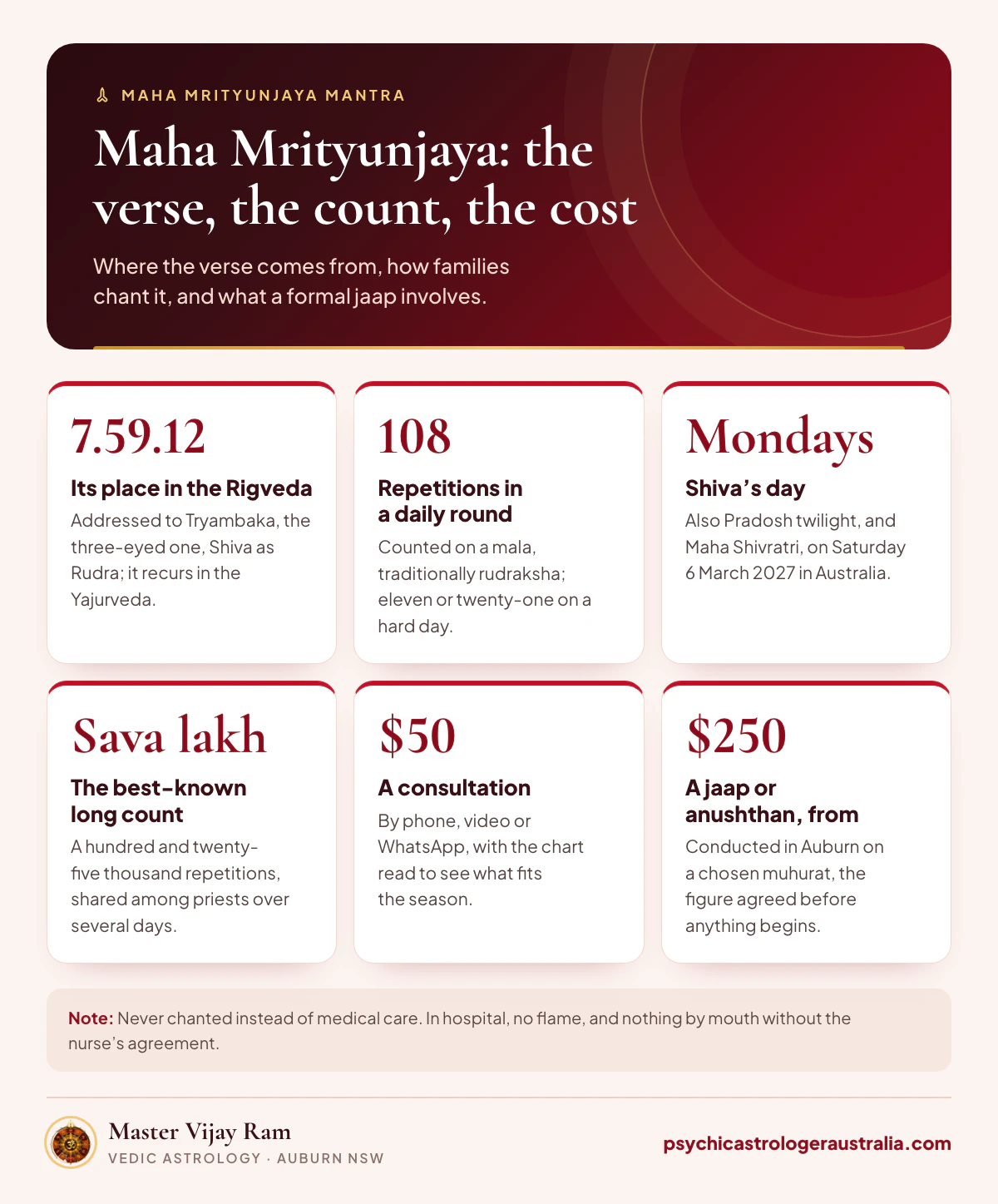
The Maha Mrityunjaya mantra is a verse of the Rigveda (7.59.12) addressed to Tryambaka, the three-eyed one, Shiva as Rudra. It asks to be released from death as a ripe cucumber is released from its vine. Families chant it 108 times on a rudraksha mala in illness, fear or a hard period, always alongside medical care and never in place of it.
What is the Maha Mrityunjaya mantra?
The Maha Mrityunjaya mantra is a Vedic verse that asks Shiva, as Tryambaka, the three-eyed one, for release from death and from the fear of it. It is verse twelve of hymn fifty-nine in the seventh book of the Rigveda, Rigveda 7.59.12, and it recurs in the Yajurveda, which places it among the oldest prayers still said every day in Hindu homes. Mrityunjaya means “victory over death”, and the “maha” marks it as the great form of that prayer.
Families reach for it when someone is ill, when fear has settled into a house, or when a reading shows a hard stretch ahead. Master Vijay Ram gives it to many callers as a daily practice, and it is also the heart of the graha shanti puja he performs when a chart calls for more than a household prayer.
What are the exact words?
The verse is short enough to learn in a week. In the transliteration most families use:
Om tryambakam yajamahe sugandhim pushtivardhanam,
urvarukamiva bandhanan mrityor mukshiya mamritat.
Families and teachers spell it in slightly different ways, and some add seed syllables before and after it. If a guru, a temple or a grandmother taught you a particular form, keep it; the verse above is the core that every version shares.
What does it mean, line by line?
The Maha Mrityunjaya mantra meaning is clearest when the verse is taken a phrase at a time. The table gives the words, a word-by-word gloss and the sense of each phrase in plain English.
| Phrase | Word by word | The sense |
|---|---|---|
| Om tryambakam yajamahe | tri, three; ambaka, eye; yajamahe, we worship | We worship the three-eyed one |
| sugandhim pushtivardhanam | sugandhi, fragrant; pushti, nourishment; vardhana, one who increases | who is fragrant and makes life grow strong |
| urvarukamiva bandhanan | urvaruka, cucumber; iva, like; bandhana, the bond or stalk | as a cucumber is freed from the stalk that holds it |
| mrityor mukshiya mamritat | mrityu, death; mukshiya, may I be released; ma, not; amrita, the deathless | may I be freed from death, but not from the deathless |
Read as a whole, it is a prayer of trust rather than bargaining. The person praying asks to be nourished while alive and, when the time comes, to be let go gently, without being cut off from what does not die.
Why is there a cucumber in a prayer about death?
Because of how a ripe cucumber or melon leaves its vine. It is not torn away: when it is ready, the stalk loosens and the fruit drops by itself, whole. The verse asks for that kind of release from death’s grip, natural, unforced and at the right time, rather than a violent or untimely end.
The last two words carry the second half of the thought. “Not from the deathless” asks that release from death should never mean separation from amrita, the immortal, which teachers read as the soul’s freedom or as Shiva himself. That is why the mantra is chanted at both ends of life: for recovery in illness, and for peace when recovery is no longer the question.
How do you pronounce it?
Slowly, and by ear if you can. Break it into syllables at first: tryam-ba-kam ya-ja-ma-he, su-gan-dhim push-ti-var-dha-nam, ur-va-ru-kam-i-va ban-dha-nan, mri-tyor muk-shi-ya maa-mri-taat. The “try” at the start is one quick sound, the “dh” is a soft d with a breath behind it, and “mri” takes a short ri, close to the “ri” in “rich”.
Hearing it from someone who already chants it, a priest, a parent or a teacher on a video call, settles the rhythm faster than any written guide. A mistake made in sincerity harms nobody, whatever a frightened relative may say; the tradition asks for care and attention, not a perfect accent on the first day.
How do you chant it: count, mala and time?
The traditional practice is Mahamrityunjaya 108 times, counted on a mala of 108 beads, and for this mantra the bead is usually rudraksha, the seed long associated with Shiva. Choosing a rudraksha mala covers the beads themselves, and any mala, or counting on the finger joints, serves just as well. An unhurried round of 108 takes something like a quarter of an hour.
Morning after a bath is the classic time, with a ghee lamp lit and the face to the east or north as your family prefers. Mondays belong to Shiva, the Pradosh twilight on the thirteenth lunar day is another favoured hour, and the great night is Maha Shivratri, which falls on Saturday 6 March 2027 in every Australian city. The nine planet mantras explains counting, whispering and silent japa in more detail, and the same rules apply here.
On a hard day, eleven or twenty-one repetitions at the usual hour keep the thread unbroken. A small count kept daily for six weeks does more than a heroic count once.
When do families turn to it, and what comes first?
Most families who chant Mahamrityunjaya for health are already doing everything medicine asks, and the mantra is what they do with the rest of their worry. The table sets the usual occasions beside the practical step that always comes first.
| Occasion | The mantra’s place | What comes first |
|---|---|---|
| An illness or a new diagnosis | A daily prayer for strength, by the patient or the family | The GP, the specialist and the treatment plan, followed exactly |
| Surgery or a hospital stay | Jaap by the family in the days before and after | The surgical team’s instructions, including any nil-by-mouth order |
| Fear of death, or a frightening dream | A steady practice that gives the fear somewhere to go | A GP if the fear lasts for weeks or sleep breaks down |
| Sade Sati or a difficult dasha | A Monday practice beside the usual Saturday remedies | A reading of the chart before any large anushthan |
| A long journey | A few rounds before leaving, a custom in many families | Rest, travel insurance and any vaccinations the GP advises |
In 2027 Sade Sati touches the Aquarius, Pisces and Aries Moon signs, and Taurus for part of the year, so many of the Monday calls will come from those charts. The mantra steadies; it does not shorten a transit.
Can you chant it for someone else?
Yes, and families do it constantly. Before you begin, make a sankalp, a stated intention: the person’s name, their gotra if you know it, and the purpose, such as “for the health and recovery of my father”. Then chant as usual, offering the count for them.
A scattered family can share the work. A daughter in Townsville whose father is recovering at the university hospital might take the mornings, her brother in Ludhiana the evenings Indian time, and a cousin in Toronto the weekends, each adding rounds to a count they keep together on a group chat. Readings for Townsville families work the same way as anywhere else: by phone, video or WhatsApp.
Keep it a prayer, not a procedure done to someone. Nothing is tied on a patient, put in their food or drink, or performed over them without their agreement, and an adult who does not share the family’s faith is prayed for quietly rather than pressed.
Can it be chanted in a hospital?
Quietly, yes. Chant under your breath or silently at the bedside, use headphones for a recording, and remember that the person in the next bed may be very unwell too. Many hospitals have a quiet or multifaith room, and the ward staff can say where it is.
Never light a diya, incense or camphor in a hospital, where open flames are not allowed and oxygen is often in use. If the family custom is to chant over a little water for the patient, ask the nurse before anything goes by mouth; a touch of the water on the forehead keeps the custom without breaking a fasting order. Coming home after a hospital stay picks up the story once the patient is discharged.
What is a Mahamrityunjaya jaap or anushthan?
A mahamrityunjaya jaap in the formal sense is a set count of the mantra, chanted with a sankalp on a chosen muhurat and usually closed with a havan. The full anushthan is its long form: traditions name large counts, the best known being sava lakh, a hundred and twenty-five thousand repetitions, which priests traditionally share between them over several days. The count, the days and the closing rite are set from the reading rather than from a website.
The mantra is also chanted during a Rudrabhishek, the bathing of the Shiva linga with water, milk and other offerings, alongside the Shri Rudram; Rudrabhishek and the Shri Rudram describes that rite and when families choose it.
Who can chant it, and is it ever harmful?
Some orthodox traditions hold that Vedic verses should be learned from a teacher, or only after initiation, and families follow their own lineage on this. Many households today chant it at home regardless, men and women alike, and Master Vijay Ram teaches it to anyone who asks with respect.
It is not harmful. No honest teacher says that a wrongly said syllable brings misfortune, and fear of the mantra defeats its purpose. The only real risk is the one this page keeps returning to: a family that leans on the prayer and lets a medical appointment slide.
What does a jaap cost with Master Vijay Ram?
Most people need only the practice, and that is taught in the consultation: $50, by phone, video or WhatsApp, in English, Hindi or Punjabi, with the chart read to see whether the mantra alone fits the season or whether a fuller rite would help. He sells no malas, rudraksha or kits, and nothing is posted for anyone to wear.
A jaap or anushthan, where the reading points to one, is conducted by him at his place of practice in Auburn on a muhurat he selects. It starts from $250, and because the count and the number of days change the work, the figure is agreed with the family before anything begins; a jaap or havan performed on request describes how relatives join by video, and chart-based health remedies covers the reading behind it.
What the mantra cannot do
The Maha Mrityunjaya mantra cannot cure an illness, replace a treatment, prevent a death that is coming, or be guaranteed to change anything at all. It is never chanted instead of medical care, and anyone who sells it as a substitute for a doctor is misusing a very old prayer. This page is faith-based guidance, not medical advice.
It can, though, give a frightened family something steady to hold, morning after morning, while the doctors do their work. For as long as the verse has been remembered, that has been reason enough to keep saying it.
Read next
- Aura Reading: What a Vedic Astrologer Means by Your AuraAura reading from the Vedic side: what people expect from aura colours, what the birth chart really shows about your …
- Spiritual Healing: What a Specialist Actually Does (Havan, Mantra and the Chart)What a spiritual healing specialist does: the chart, the havan, mantra sadhana, nazar work and protection, what it co…
- 11 Signs of Negative Energy in Your Life (and How to Clear It)Eleven signs of negative energy, the ordinary causes to rule out first, and the three-doors test that tells you wheth…
Frequently asked questions
What does the Maha Mrityunjaya mantra mean in simple words?
We worship the three-eyed one, fragrant, who makes life grow strong; as a ripe cucumber is freed from its stalk, may he free us from death, but not from the deathless. It is a prayer to be nourished while alive and, when the time comes, released gently and naturally, without being cut off from what the tradition calls immortal.
How many times should the Maha Mrityunjaya mantra be chanted?
One round of 108 on a mala is the traditional daily practice, and eleven or twenty-one repetitions at the usual hour keep it going on a hard day. A formal jaap or anushthan uses much larger counts, the best known being sava lakh, but those are set from a reading and often shared between priests over several days, not attempted alone.
Can women chant the Maha Mrityunjaya mantra?
Traditions differ. Some orthodox lineages hold that Vedic verses need a teacher or initiation, and families follow their own lineage on that question. Many households today chant it at home, women and men alike, and Master Vijay Ram teaches it to anyone who asks with respect. Sincerity and steady practice matter far more than anyone’s permission slip.
When is the best hour for the Maha Mrityunjaya mantra?
Morning after a bath is the classic time, facing east or north as the family prefers, with a ghee lamp if you keep one. Mondays belong to Shiva, the Pradosh twilight is another favoured hour, and Maha Shivratri, Saturday 6 March 2027 in Australia, is the great night for it. Keeping one hour faithfully counts for more than hunting for the ideal one.
Can I chant it for a parent who is in hospital?
Yes. Begin with a sankalp naming your parent, their gotra if known, and the purpose, then chant as usual, quietly or silently if you are at the bedside. Never light a lamp or incense in a hospital, and ask the nurse before giving your parent anything by mouth, including water you have chanted over. The treating team’s plan always comes first.
Is it bad luck to pronounce the mantra wrongly?
No. A syllable said imperfectly in sincerity harms nobody, and fear of getting it wrong defeats the purpose of the prayer. Learn it slowly, by ear if you can, from a teacher, a temple or a recording, and let your pronunciation settle over weeks. The tradition asks for care and attention, not a flawless accent on the first day.
Can the Maha Mrityunjaya mantra cure an illness?
No, and it should never be chanted instead of medical care. Families chant it beside treatment, as a prayer for strength and recovery and as a way of carrying their fear. Anyone who sells the mantra or a jaap as a substitute for a doctor is misusing it. Follow the GP and the specialist, and keep the prayer alongside them.
What does a Mahamrityunjaya jaap cost?
With Master Vijay Ram, a consultation is $50, and most people leave with a daily practice and nothing more to pay for. Where the reading points to a formal jaap or anushthan, he conducts it at his place of practice in Auburn on a chosen muhurat, starting from $250; the figure depends on the count and the days and is agreed before anything begins.
Is a rudraksha mala necessary for this mantra?
No. Rudraksha is the traditional bead for Shiva’s mantras, but any mala of 108 beads works, and so does counting on the finger joints. What matters is the count kept steadily at the same hour each day. Master Vijay Ram sells no malas or rudraksha, and nobody needs an expensive one for the prayer to be complete.
People also ask
Where does the Maha Mrityunjaya mantra come from?
It is a verse of the Rigveda, the twelfth verse of the fifty-ninth hymn in the seventh book, Rigveda 7.59.12, and it recurs in the Yajurveda. The tradition treats the Vedas as revealed scripture rather than the work of one author. The verse is addressed to Tryambaka, the three-eyed one, Shiva in his form as Rudra.
Which god is the Maha Mrityunjaya mantra for?
Shiva, addressed as Tryambaka, the three-eyed one, and in the Vedic setting as Rudra. That is why the mantra is chanted on Mondays, at Pradosh and on Maha Shivratri, and why it is part of a Rudrabhishek. Many families keep a small Shiva linga or picture at the altar while they chant it.
What happens when you chant Maha Mrityunjaya 108 times?
In the tradition, a daily round of 108 is a prayer for protection, strength and freedom from the fear of death. What people commonly describe is steadiness: a fixed quarter of an hour in an anxious day. Nobody can promise a particular outcome, and the mantra is kept beside medical care, never instead of it.
Can we chant Maha Mrityunjaya at night?
Families differ, and many chant at dusk or before sleep, especially at the bedside of someone unwell. The twilight of Pradosh and the whole night of Maha Shivratri are traditional times for Shiva’s mantras. Morning remains the classic hour, but a steady daily time you can actually keep matters more than the clock.
References & further reading
Serving clients across Australia
Confidential consultations by phone, video & WhatsApp — including: