
Quick answer
Ashlesha nakshatra is the ninth lunar mansion, spanning 16°40′ to 30° of sidereal Cancer. Its deities are the Nagas, the serpent beings, its symbol a coiled serpent and its lord Mercury, so an Ashlesha Moon begins in Mercury's seventeen-year dasha. It is a gandmool star, read for insight, intensity and protectiveness, and nothing to be afraid of.
What is Ashlesha nakshatra?
Ashlesha is the ninth nakshatra, spanning 16°40′ to 30° of sidereal Cancer, the last stretch of the sign before Leo begins. Its name means the embrace or the entwining, its deities are the Nagas, the serpent beings of Hindu myth, its symbol is a coiled serpent, and its lord is Mercury. Ashlesha nakshatra is the star of the serpent's gifts: a penetrating mind, patience, protectiveness and the power to shed an old skin.
It also carries more fear than any other star in the first nine, partly because it is gandmool and partly because of what people assume about snakes. This page takes the fear apart calmly and puts the tradition back in its place, and a careful kundli reading is where any real question about an Ashlesha chart gets answered.
Who are the Nagas, and why are they honoured rather than feared?
In the Puranas the Nagas are the children of the sage Kashyapa and Kadru, guardians of the waters, the underworld and its treasures. They are not villains. Shesha, the great serpent, bears the earth and makes the bed on which Vishnu rests; Vasuki served as the rope with which gods and demons churned the ocean for the nectar of immortality.
When the young Krishna danced on the hood of the serpent Kaliya, who had poisoned the Yamuna, he subdued him and sent him away rather than killing him. That is the tradition's attitude to Ashlesha in one story: serpent power is strong, sometimes dangerous, and best respected and directed rather than destroyed.
What does the coiled serpent say about Ashlesha people?
A coiled snake is gathered energy, still and watchful, ready to move the moment it chooses. The tradition reads Ashlesha people the same way: quiet, observant, slow to show their hand and very quick once they decide. The embrace in the star's name adds attachment, the habit of holding close the people, secrets and loyalties that matter.
The serpent also sheds its skin and is renewed, and the medical staff of the ancient world was a serpent wound round a rod. Insight that heals, after first going deep into what hurts, is the best of what the star offers.
Why does Mercury rule the serpent's star?
Mercury is the planet of intelligence, speech, analysis and trade, and it rules Ashlesha, Jyeshtha and Revati. Those three are the closing stars of the three runs of nine, just as Ketu's stars, Ashwini, Magha and Mula, are the opening ones. Each closing Mercury star meets an opening Ketu star at a junction of water and fire signs, and those three junctions are exactly where the six gandmool stars sit.
Through Ashlesha, Mercury becomes the strategist's mind: perceptive about motives, persuasive in speech, good at reading a room or a balance sheet. The Ashlesha nakshatra Mercury combination is read as cleverness that needs a good purpose, because it is equally able to heal a family quarrel or to win an argument nobody needed.
Which dasha does an Ashlesha Moon begin with?
Mercury's, seventeen years in full. A Moon at the start of the star has nearly all of it to run, a Moon at 23°20′ of Cancer about eight and a half years, and a Moon in the last degrees of the sign very little. Ketu's seven years follow, then Venus's twenty, the Sun's six and the Moon's ten.
So most Ashlesha children are in Mercury, the planet of school and speech, through the early years, then pass through Ketu's shorter, more inward period, and meet Venus somewhere between about seven and twenty-four. A teenager who suddenly withdraws for a few years and then blossoms socially may be describing exactly that sequence.
Ashlesha's padas and the gandanta quarter
Ashlesha's four quarters run through the navamsa from Sagittarius to Pisces: the first, 16°40′ to 20° of Cancer, is Jupiter's and philosophical; the second, 20° to 23°20′, and the third, 23°20′ to 26°40′, are Saturn's, practical and private; and the fourth, 26°40′ to 30°, returns to Jupiter's Pisces and is the most sensitive and intuitive. Their naming sounds are Di, Du, De and Do, heard in names such as Divya, Dinesh, Durga, Dushyant, Dev and Devika.
The fourth pada is also the gandanta portion, the last few degrees of a water sign before a fire sign begins, and traditions that treat one quarter of a gandmool star as the sensitive one usually name this one. Naming a child by the Ashlesha padas shows how the hospital time settles the quarter and the sound together.
Is an Ashlesha birth a reason to worry?
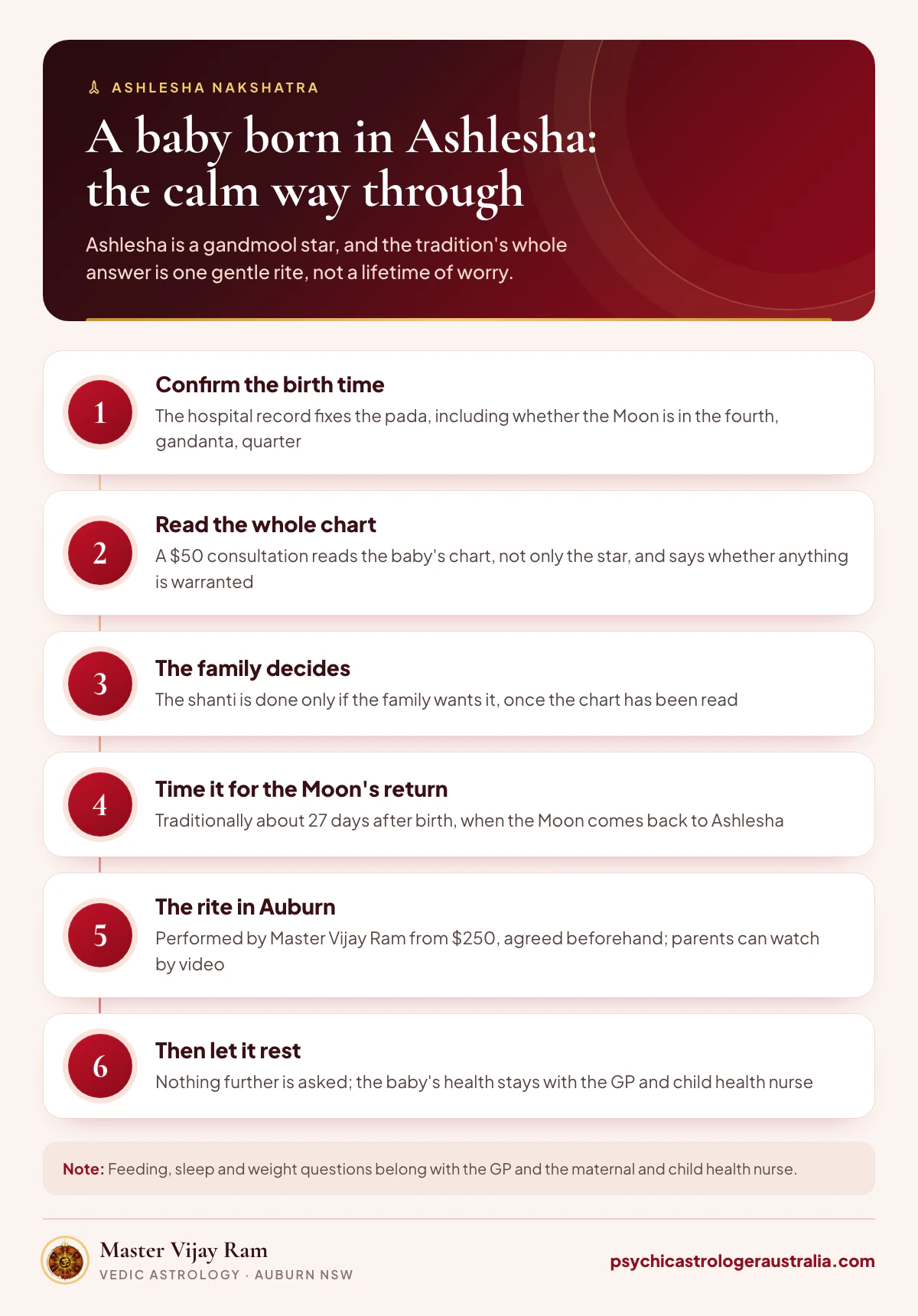
No. Ashlesha is gandmool because it ends a water sign just as Magha begins a fire sign, Cancer giving way to Leo, and the tradition's response to that seam is one small, calm rite. It is timed for the Moon's first return to Ashlesha, about 27 days after the birth, and once it is done nothing further is asked.
The gandmool shanti, explained without alarm goes through the old instructions line by line. If the family would like it done, Master Vijay Ram conducts it himself in Auburn, with the cost, from $250, settled beforehand and the parents welcome to watch by video; how an online puja is joined explains the arrangements.
Some regional booklets go further and assign each pada to a particular relative who is supposedly at risk. Those lists vary from region to region, are not part of the classical rule, and are nothing to lose sleep over; anything about the baby's health, from feeds to sleep, is for the GP and the maternal and child health nurse.
Which fears about Ashlesha are worth letting go?
Most of the worry families bring about this star is folk belief that has grown around a few lines of text. The table sets the common fears beside what the tradition says and what a reading actually checks.
| The fear | What the tradition actually says | What a reading checks |
|---|---|---|
| An Ashlesha baby brings bad luck | one gentle shanti when the Moon first returns to the star, and nothing after it | the pada, the whole chart and whether the family wants the rite |
| An Ashlesha bride harms her mother-in-law | a folk belief, not part of the matching rules most astrologers use | both charts, the seventh houses and the dasha timing |
| Serpent-star people are deceptive | Rakshasa gana means independent and intense, not wicked | the Moon's aspects, Mercury's strength and the lagna |
| A serpent star means Kaal Sarp dosha | Kaal Sarp depends on Rahu and Ketu, not on the Moon's star | where every planet sits relative to the nodes |
| Ashlesha always needs an expensive remedy | the shanti is simple, and most Ashlesha questions need no ritual at all | whether anything is warranted before anything is offered |
Vijay Ram ji does not treat the mother-in-law belief as a reason to refuse a match, and he says so to families who raise it. The Kaal Sarp and Pitra dosh check covers the separate question of the nodes for anyone who has been told the two are the same.
What are Ashlesha nakshatra traits?
The Ashlesha nakshatra traits the tradition describes are penetrating intelligence, sharp perception of other people's motives, persuasive speech, patience, resilience, a protective loyalty to one's own, and an interest in what lies beneath the surface, from psychology to mysticism. Its gana is Rakshasa, the independent and intense temperament, which is why Ashlesha people dislike being managed.
The cautions are real and worth naming without drama: suspicion, secrecy, jealousy, a long memory for slights, and a temptation to use cleverness to control. Of the Ashlesha nakshatra characteristics, the one families describe most warmly is fierce care in a crisis: the cousin who quietly arranges everything when someone is in hospital.
Ashlesha nakshatra career: which work rewards seeing beneath the surface?
The tradition sends Ashlesha toward work that reads beneath the surface: psychology, psychiatry and counselling, research, investigation and intelligence work, cybersecurity, law, negotiation and diplomacy, politics, marketing and persuasion, writing, and the serpent's old trades of medicine and poison, meaning pharmacy, toxicology, anaesthesia and chemistry. Mercury adds trading, accounting and analysis.
A psychologist in Melbourne, a cybersecurity analyst in Sydney, a hospital pharmacist in Adelaide and a contract negotiator in Brisbane might all share this Moon. The Ashlesha nakshatra career theme is insight put to use; these people do well where seeing what others miss is the job. Which field, in the end, is the tenth house's business and the dasha's.
How does an Ashlesha partner love?
An Ashlesha partner is deep, private, loyal and protective, slow to trust and very committed once trust is given. The tradition's cautions are jealousy, possessiveness and a habit of testing a partner rather than asking directly. Ashlesha nakshatra marriage tends to go well with patience, clear honesty and a partner who does not take a need for privacy as rejection.
For matching, Ashlesha is Rakshasa gana, Antya nadi and cat yoni (male). Punarvasu, the female cat, completes the yoni from the Adi nadi, which keeps nadi out of the way, though the Deva gana of Punarvasu sits at the far end of the gana scale. The cat's traditional enemy is the rat, and Magha, the next star and Ashlesha's gandmool partner across the junction, carries the male rat and shares the Antya nadi as well.
Families worried about any of this, or about the in-law belief, are better served by a full nakshatra compatibility reading than by a rule of thumb. Tension with in-laws that already exists is a matter for honest conversation, and for a family counsellor if it is hurting the marriage.
What does the tradition say about Ashlesha and health?
The tradition ties Cancer to the chest and stomach, and the serpent to the nervous system and to sensitivity to what is taken in: rich food, alcohol, medicines and allergens. The commonest Ashlesha pattern is stress carried in the gut, with worry and secrecy making it worse.
Eating calmly, telling someone what is wrong, and reading the label on anything new are the ordinary advice. These are tendencies offered for care rather than alarm, and anything persistent is for a GP to look at.
Ashlesha in muhurat and the ritual year
In muhurat Ashlesha is one of the sharp stars, with Ardra, Jyeshtha and Mula, used for ending what needs ending and removing obstacles, and not for weddings or gentle beginnings. In Karnataka and Kerala, serpent rites are often performed on the day the Moon is in Ashlesha, and the Ashlesha Bali at the Kukke Subramanya temple is the best known of them.
The serpent festival itself follows the tithi rather than the star: Nag Panchami falls on Fri 6 Aug 2027 everywhere. Families who keep it with milk and flowers at a temple or at home are honouring the same Nagas who preside over Ashlesha.
Where does a reading of an Ashlesha chart begin?
Vijay Ram ji confirms the pada, especially whether the Moon is in the gandanta quarter, works out Mercury's balance and the Ketu and Venus periods to come, and then reads Mercury's dignity, the aspects on the Moon and the houses. A consultation costs $50 and can be done over the phone, on video or by WhatsApp in any of English, Hindi and Punjabi, and Sydney families can also see him in person, since Auburn is in Sydney's west.
A reading describes tendencies and timing; it cannot make a match decision for a family, diagnose a baby or replace a doctor, a lawyer or a counsellor. Before Ashlesha in the cycle comes Pushya, the nourishing star, and after it, across the gandmool junction, Magha, the star of the ancestors.
Read next
- Jyeshtha Nakshatra: The Eldest Star and Its ResponsibilitiesJyeshtha nakshatra, 16°40′ to 30° Scorpio: Indra and the amulet, Mercury as lord, duties of the eldest, padas, name s…
- Revati Nakshatra: The Final Star of Safe JourneysRevati nakshatra explained: Pushan, guardian of journeys, Mercury as lord, padas and name sounds, gandmool calmly, tr…
- Online Istikhara Service in Australia for Marriage & DecisionsHow online istikhara for marriage and other decisions works in Australia, what a genuine practitioner asks for, and t…
Frequently asked questions
What is Ashlesha nakshatra?
Ashlesha is the ninth nakshatra, covering 16°40′ to 30° of sidereal Cancer. Its deities are the Nagas, the serpent beings, its symbol a coiled serpent and its lord Mercury. The name means the embrace, and the tradition reads the star for penetrating intelligence, perception, patience, protectiveness and renewal, alongside cautions about suspicion and secrecy.
Is Ashlesha nakshatra bad?
No. It is intense and it is gandmool, which is why it frightens some families, but neither makes a person or a birth bad. The gandmool shanti is a single short rite in the baby's first month, and many of the fears attached to the star, including the in-law beliefs, are folk additions rather than classical rules. The whole chart decides far more than the star's reputation.
Does an Ashlesha baby need a shanti?
Tradition recommends one, timed for the Moon's return to Ashlesha roughly four weeks after the birth, and some lineages stress it most for the fourth pada, the gandanta portion. It is a single, gentle rite. If the family wishes, Vijay Ram ji performs it in Auburn from $250, priced in advance, following a $50 consultation that reads the baby's chart first.
Is it true an Ashlesha bride is bad for the mother-in-law?
That is a folk belief, not part of the matching rules most astrologers use, and Master Vijay Ram does not treat it as a reason to refuse a match. A marriage is judged from both whole charts, the seventh houses, the dasha timing and the kootas. Tension that already exists between a bride and her in-laws is better helped by honest conversation or a family counsellor than by a star.
Which name sounds come from Ashlesha?
Di for the first pada, Du for the second, De for the third and Do for the fourth. Divya, Dinesh, Durga, Dushyant, Dev and Devika are common examples. The quarter depends on the minute recorded at the hospital, and because the fourth pada is the gandanta portion, families often want the time confirmed carefully before both the name and the shanti are settled.
Which planet rules Ashlesha nakshatra?
Mercury is its dasha lord, the Nagas its presiding deities, and Cancer, the sign that holds it, belongs to the Moon. An Ashlesha Moon opens life in Mercury's seventeen years, less whatever the Moon had already crossed, then moves through Ketu's seven and Venus's twenty. Mercury also rules Jyeshtha and Revati, the other two stars that close a run of nine.
Who makes a good match for an Ashlesha Moon?
No single star decides a match. Punarvasu, the female cat, pairs well on yoni and on nadi but is as gentle as Ashlesha is fierce on the gana scale, while Magha carries the rat, the cat's traditional enemy, and shares the Antya nadi. Two Ashlesha Moons in separate padas fall under the familiar nadi exception, and nothing is final until the full set of kootas and both seventh houses have been read.
What careers suit Ashlesha nakshatra?
Work that sees beneath the surface suits it: psychology and counselling, research, investigation, cybersecurity, law, negotiation, diplomacy, marketing, writing, and pharmacy, toxicology, anaesthesia and chemistry, with trade and accounting from Mercury. These describe a temperament rather than a destiny; the actual career shows in the tenth house and the dasha sequence.
Is Ashlesha nakshatra the same as Kaal Sarp dosha?
No. Ashlesha is a nakshatra whose deities are serpents; Kaal Sarp dosha is a chart pattern in which all the planets fall on one side of the Rahu and Ketu axis. The two are unrelated, and a Moon in Ashlesha does not create Kaal Sarp dosha. Any concern about the nodes needs the whole chart checked.
People also ask
What does Ashlesha's coiled serpent mean?
Gathered, watchful energy that moves only when it chooses, the embrace that holds people and secrets close, and renewal, since a serpent sheds its skin. The tradition reads Ashlesha people through the symbol as patient, perceptive and protective, with suspicion and secrecy named as the cautions that come with those gifts.
Who are the deities of Ashlesha nakshatra?
The Nagas, the serpent beings of Hindu myth, children of the sage Kashyapa and Kadru and guardians of the waters and hidden treasure. Shesha, who bears the earth and Vishnu's bed, and Vasuki, the rope at the churning of the ocean, are the best known. They are honoured, not feared, and Nag Panchami is their festival.
Is Ashlesha a gandmool nakshatra?
Yes. The six gandmool stars sit in pairs at the three points where a water sign hands over to a fire sign, and Ashlesha, closing Cancer, pairs with Magha, opening Leo. A newborn with an Ashlesha Moon traditionally has a short shanti once the Moon comes back to the star, roughly four weeks later, and nothing more.
When is Nag Panchami in 2027?
Nag Panchami falls on Fri 6 Aug 2027 everywhere, because it follows the Panchami tithi of Shravana's bright fortnight rather than the Ashlesha nakshatra. Families keep it with milk, flowers and prayers to the Nagas, the same serpent deities who preside over Ashlesha, at a temple or at home.
References & further reading
Serving clients across Australia
Confidential consultations by phone, video & WhatsApp — including: