
Quick answer
Bhoomi pujan is the puja that asks the earth’s blessing before a house is built. In Australia it is held after land settlement and before the builder’s site start, on a chosen muhurat, with Ganesh worship, a kalash, the first soil and an acknowledgement of the Traditional Owners. The builder’s site rules apply. Consultation $50; the puja from $250.
What is a bhoomi pujan, and why hold one on a bare block?
Bhoomi pujan is a puja that asks the earth, worshipped as Bhoomi Devi or Prithvi, for permission and blessing before the ground is dug and a house rises on it. For families arranging a bhoomi pujan in Australia, the ground is usually a rectangle of scraped clay in a new estate, pegged by a surveyor, with a builder's sign already at the kerb.
The tradition treats digging as a wound to a mother, so the puja opens with an apology as much as a request. The family asks forgiveness for the disturbance, worships Ganesh so the build meets no obstacle, and invites the vastu purusha to settle beneath the house to come; the foundation-stone rite, shilanyas, is often joined to it so the first bricks carry the same prayer.
The day is what most families ask about first, and a muhurat consultation for the block fixes it from the panchang and the owners' own charts.
Where does it fit in an Australian build?
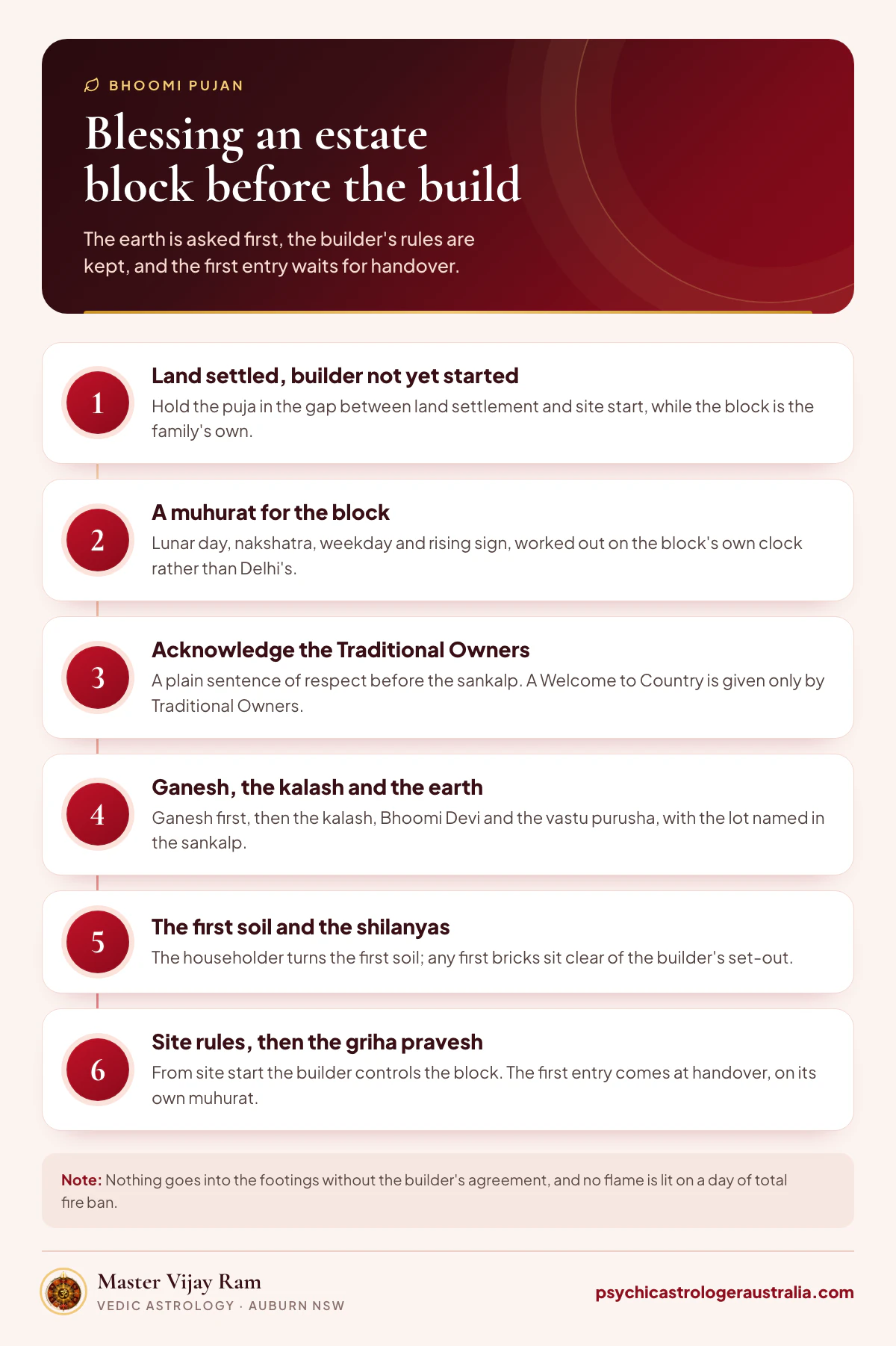
An estate block passes through several hands before anyone lives on it: the developer until the title registers, the family after land settlement, and the builder from site start until handover. The bhoomi pujan belongs in the gap between settlement and site start, when the land is plainly the family's and nobody's workplace.
| Stage | Who controls the land | What the family can do |
|---|---|---|
| Before the title registers | The developer | Visit only where the estate allows; choose the muhurat and read the plan |
| Land settled, before site start | The family | The full bhoomi pujan on the block itself |
| Site start to slab | The builder | A short prayer at the fence, or at the footings with permission and induction |
| Frame to lock-up and fit-out | The builder | Nothing on site without the supervisor's agreement |
| Handover | The family again | A clean, then the first entry on its own muhurat |
If the builder has already scraped and fenced the site, nothing is lost. The family asks the supervisor for a time to come on, or prays at the fence line, and the sankalp names the lot either way.
How is the day chosen?
A bhoomi pujan muhurat weighs the lunar day, the nakshatra, the weekday and the sign rising at the block itself, on the block's own clock rather than Delhi's. Some panchangs also mark days on which the earth is said to rest, and digging is kept off them; lineages differ on how strictly.
Australian calendars cooperate more than people expect. Kharmas, the Sun's month in Dhanu from mid-December, lands on the summer shutdown when most builders close anyway, and families who keep Chaturmas strictly simply wait for Dev Uthani Ekadashi in November before breaking ground, while many others do not.
What happens at a bhoomi pujan, step by step?
Priests and regions keep their own order, but a family-sized ceremony on an Australian block usually runs like this.
- The family walks the block, finds the corners and marks the north-east with a phone compass, clearing rubble from the spot chosen for the puja.
- Someone says a short acknowledgement of the Traditional Owners, in the family's own words.
- Ganesh is worshipped first, for a build without obstacles.
- A kalash of water with mango leaves and a coconut is set down, and prayers go to Bhoomi Devi, to the vastu purusha and to the dikpalas who keep the eight directions; some families also honour the serpent said to bear the earth.
- The sankalp names the householders, their gotra, the lot number and the street.
- The householder turns the first soil with a new spade, and the elders and children follow.
- Where the family wishes, the first bricks or a small stone are set down as the shilanyas, on a board or at the edge of the block, clear of the builder's set-out.
- Prasad is shared, and a box of sweets is left for the crew who will start the work.
Many families hold the puja at the north-east corner, the direction the tradition holds most sacred. Customs differ on where the first stone belongs, and some lay it in the south-west, the corner meant to be heaviest.
Can anything be buried in the footings?
Many families grew up with the custom of burying a small copper pot in the first pit, sometimes holding a silver serpent, coins, turmeric and grains. In an Australian build the footings and the slab are engineered and inspected, and nothing goes into them without the builder's agreement.
The respectful alternatives work well. Keep the kalash at home and pour its water into the garden after handover, bury the small items in a garden bed once the house is yours, or ask the builder whether a token can sit somewhere it interferes with nothing; never slip anything into a trench unannounced.
How do we acknowledge the Traditional Owners respectfully?
Every block in Australia stands on Country that Aboriginal or Torres Strait Islander people cared for long before any estate was drawn. Many families now open the ceremony with a sentence acknowledging the Traditional Owners, and it sits naturally with a puja that itself begins by asking the land's permission.
An acknowledgement can be said by anyone, in plain words: whose Country this is, and respect for Elders past and present. A Welcome to Country is different and is given only by Traditional Owners themselves; your council can tell you whose Country the estate stands on, and the acknowledgement should never borrow Aboriginal ceremony or symbols to decorate a Hindu rite.
What rules does the builder's site carry?
From site start the block is a construction site under the builder's control, and building contracts commonly require owners to arrange visits through the builder. Ask the supervisor for a time, complete any induction they ask for, and come in closed shoes, with hard hats and high-visibility vests if they are required.
Children stay well back from trenches and excavations, and nobody climbs stacked materials for a photograph. A lamp or a small havan flame needs the supervisor's agreement, a metal tray and an adult beside it, never on a day of total fire ban, and everything brought, from the coconut shell to the flowers, goes home again in the car.
Who performs it if no priest can come to the block?
If your temple has a priest who visits building sites, a bhoomi pujan with the family standing on its own ground is the tradition at its fullest. On an estate an hour from the nearest temple, or on a weekday morning, that is often impossible.
Master Vijay Ram then performs the Vedic part himself in Auburn, on the muhurat: the sankalp naming the lot, the invocations to the earth and the vastu purusha, and the havan. The family on the block follows on a video call and does its own part at the same hour, the acknowledgement, the Ganesh prayer, the kalash and the first soil; he does not travel to blocks or sites.
New estates often have patchy mobile coverage. Test a video call from the block a day or two before, and keep a printed copy of the steps in case the signal drops.
Should the house plan be read before the slab is poured?
This is the cheapest moment vastu will ever get. Before the slab, a builder can often mirror a standard plan, swap two bedrooms or move the puja nook, and a vastu reading of the floor plan done now spares a family arguments with concrete later.
Bring the facing of the block, the street side, and where the entrance, kitchen, main bedroom and any toilet fall. Nothing in vastu outranks the slope of the land, the council's setbacks or the engineer's advice.
Knocking down and rebuilding?
A knockdown-rebuild begins with a goodbye. Before the old house comes down, many families thank it with a lamp and a short puja, which leaving a home well describes, and the land puja before building follows on the cleared ground.
Adding rooms to a house you keep is a smaller case. Footings for an extension can carry a brief earth prayer, and vastu shanti after a renovation covers the house once that work is finished.
Buying off the plan: is there any land to bless?
An apartment or townhouse bought off the plan sits on land shared with every other owner and held by the developer until completion. There is no block of your own to dig, and the developer's site is closed to buyers, so a bhoomi pujan has nowhere to happen.
The custom is to wait. A quiet prayer at the home shrine on the day the contract is signed, if the family wishes, and a proper entry when the keys arrive are all the tradition asks of an off-the-plan buyer.
What comes after: the build and the griha pravesh?
The order is simple: bhoomi pujan on the bare land, construction under the builder, then the first entry at handover. A brand-new house is entered with the apoorva form of griha pravesh, the strictest on timing, and how a house-warming puja is done covers that ceremony, so it is not repeated here.
Between the two nothing is required. Some families visit on festival days with the supervisor's agreement, others simply wait for the keys, and if the finished house ever feels heavy, the physical checks for mould, damp and gas come before any further ritual.
What does it cost?
Choosing the muhurat, and reading the plan if the family wishes, happens in a $50 consultation. A bhoomi pujan performed personally by Vijay Ram ji costs from $250, settled with the family before he begins, and the online puja and havan service sets out how a family joins from the block.
The kalash, coconut, flowers and sweets come from the family's kitchen or an Indian grocer, and the builder's costs are entirely separate. A family in Geelong, consulting by phone or video building in Armstrong Creek arranges a foundation stone puja exactly the same way as one in Western Sydney or Brisbane's south.
What can a bhoomi pujan not do?
It cannot approve a plan, test the soil, shorten a build or keep a builder solvent. Soil reports, engineering, permits and the contract belong to the professionals licensed for them, and a dispute goes to your state's building regulator or a solicitor.
Bhoomi pujan is an act of faith and gratitude, not engineering, legal or financial advice, and it carries no promise about how the build will go. What it gives a family is a beginning they chose: the elders on the call from Ludhiana or Ahmedabad, the children with clay on their shoes, and a block that was asked before it was dug.
Read next
- Vastu Shanti After a Renovation or Extension: Cleansing a Changed HomeVastu shanti after a renovation or extension: which changes call for one, approvals and asbestos checks first, a muhu…
- Diwali 2026 House & Aura Cleansing: Clear the Year's Heavy EnergyDiwali 2026 house and aura cleansing done honestly: clean first, use the Five-Lamp Check, and learn when heaviness is…
- Clearing Obstacles Before a New Start: Ganesha Puja and Vighna NivaranGanesha puja before a new job, house, business, exam or journey: what vighna nivaran means, a simple home puja, Sanka…
Frequently asked questions
What is the difference between bhoomi pujan and shilanyas?
Bhoomi pujan is the worship of the earth itself, asking permission and forgiveness before the ground is dug. Shilanyas is the laying of the foundation stone or first bricks, often joined to the bhoomi pujan on the same day so both carry one prayer. On an Australian block the shilanyas is usually symbolic, set down at the edge of the land rather than in the builder’s set-out.
When should bhoomi pujan be done for a house-and-land package?
After the title has registered and the land has settled, and before the builder’s site start, because in that window the block belongs to the family and is nobody’s workplace. The muhurat is chosen inside that gap. If settlement and site start are close together, ask the builder for a day or two of grace, or hold the prayer at the fence line.
Can bhoomi pujan still be done after the builder has started?
Yes. Ask the site supervisor for a time to come on, complete any induction required and follow the site’s safety rules, or hold the prayer at the fence line without entering. The sankalp names the lot either way. Many families who missed the earlier window hold a short earth prayer at the footings stage, and nothing in the tradition counts the delay against them.
Can we light a lamp or a small havan on the block?
Only with the supervisor’s agreement if the builder has the site, on a metal tray, with an adult beside it, and never on a day of total fire ban. Wind on an open block makes a flame hard to manage, so a lamp in a glass holder suits better than a havan. If no flame is possible, the havan can be performed in Auburn while the family prays on the block.
How do we include an acknowledgement of the Traditional Owners?
Before the sankalp, someone says in plain words whose Country the block stands on and offers respect to Elders past and present. Anyone can make an acknowledgement; a Welcome to Country is given only by Traditional Owners themselves. Your council can tell you whose Country the estate is on. Keep it sincere and simple, and do not add Aboriginal symbols or ceremony to the puja.
Can Master Vijay Ram come to our block?
No. Blocks, building sites and homes are outside his practice, which is held only in Auburn. If a temple priest can come to the land, that is the tradition at its fullest. Otherwise he performs the sankalp, the invocations and the havan personally in Auburn on the muhurat while the family follows by video and does its part on the block.
What does a bhoomi pujan cost?
The consultation is $50 and covers choosing the muhurat and, if you wish, reading the house plan. A bhoomi pujan performed personally by Master Vijay Ram costs from $250, a figure the family agrees to before the puja. The family brings its own kalash, coconut, flowers and sweets, and the builder’s costs are separate. Nothing is sold to you and nothing is added later.
Can we bury a kalash or a silver snake in the foundation?
Not without the builder’s agreement. Australian footings and slabs are engineered and inspected, and an object placed in a trench without permission can cause problems for the build. Respectful alternatives are to keep the kalash at home and pour its water into the garden after handover, bury the small offerings in a garden bed later, or ask the builder where a token could safely sit.
Is a bhoomi pujan needed for an extension or a granny flat?
It is not required, though many families say a brief earth prayer when new footings are dug for an extension or a granny flat. The fuller ceremony belongs to building a whole house on new ground. For an extension, the more common rite is a vastu shanti once the work is finished, and for a granny flat an entry puja for whoever will live in it.
People also ask
What is bhoomi pujan?
Bhoomi pujan is the Hindu ceremony performed before construction begins, asking the earth, worshipped as Bhoomi Devi, for permission and blessing. A typical ceremony opens with Ganesh, sets up a kalash, calls on the vastu purusha and the directional guardians, names the owners and the land in a sankalp, and ends with the householder turning the first soil. The foundation-stone rite, shilanyas, often follows on the same day.
Which day is good for bhoomi pujan?
One chosen from the panchang against the owners’ charts: a suitable lunar day, nakshatra and weekday, with the rising sign calculated for the block’s own location and clock. Some panchangs mark days when the earth is said to rest, and digging is avoided on them. Many families also avoid Kharmas, the Sun’s month in Dhanu from mid-December. A muhurat consultation gives the window.
What items are needed for bhoomi pujan?
A kalash of water with mango leaves and a coconut, a picture or small murti of Ganesh, flowers, rice, turmeric, kumkum, incense, a lamp in a holder, a new spade, and sweets for prasad and for the building crew. On an Australian block a metal tray for any flame, water for the hands and bags to carry everything home are as important as the puja items.
Who should turn the first soil at a bhoomi pujan?
Customarily the householder, the person in whose name the sankalp is made, turns the first soil with a new spade, and the rest of the family follows, elders first and children last. Customs differ between regions and families. On a site the builder already controls, the first soil is turned only where the supervisor agrees, and never inside an open trench.
Is bhoomi pujan necessary before construction?
It is a custom of respect, not a requirement, and a family that builds without one has broken no rule. Many families value it as the start of the house’s story, alongside the griha pravesh at handover. What is necessary before construction is practical: the title, approvals, soil reports, engineering and the builder’s contract, which no puja replaces.
References & further reading
Serving clients across Australia
Confidential consultations by phone, video & WhatsApp — including: