

Quick answer
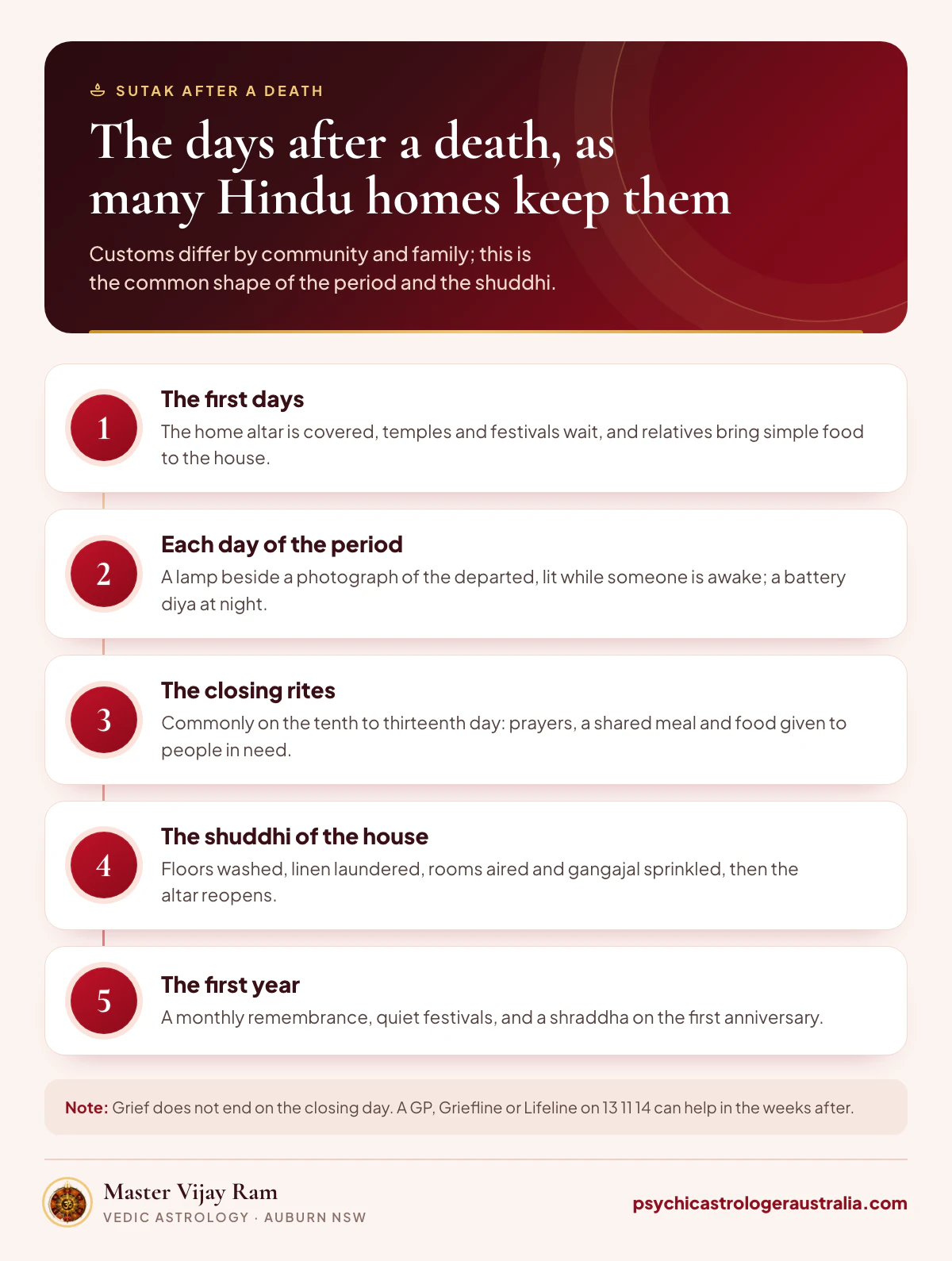
Sutak after a death is the period of ritual impurity a Hindu household keeps, commonly ten to thirteen days, though families differ. The home altar rests, festivals wait, a lamp is kept for the departed, and on the closing day the house is cleaned, the altar reopened and ordinary life resumed with a puja. Grief keeps its own time.
What is sutak after a death, and why does a house keep it?
Sutak after death is the period of ritual impurity that a Hindu household keeps from the death of a close relative until the family is declared clean again, commonly ten to thirteen days. The Sanskrit texts call it ashaucha; some north Indian families say patak for a death and keep sutak for a birth, and many simply say sutak for both. Whatever the word, it is a pause the tradition writes into the calendar so that a family can stop, mourn and see the departed off properly.
Impurity in this sense is not dirt and it is not blame. It marks a household that has stood close to a death and is, for a while, set apart from temples, weddings and festivals, which is usually where a grieving family wants to be. Some families close the period with a small puja or havan for the house, and home blessing and vastu shanti describes that kind of blessing as Master Vijay Ram performs it.
This page is about the period and the house. The clothes, jewellery and phone of the person who has died are covered in a loved one’s belongings after a death, and the bath on the way home from the crematorium has its own page, why Hindus bathe after a funeral.
How long does the period last in your family?
Ten days in some families, twelve or thirteen in others, longer in a few communities, and the length also depends on how close the relationship was. The household of the person who died, and their sons and brothers, usually keep the full period; married daughters, cousins and more distant relatives often keep fewer days. No single rule covers every Hindu family, and anyone who insists on one is describing their own tradition.
Many families count from the day of death, and some from the cremation, which in Australia can be a week or more later. Ask the eldest person who remembers how the last death in the family was kept, and the priest at your temple, then write their answer down: the same questions come back at the first anniversary.
What does the household pause, and what carries on?
The pause is practical and quiet. The altar rests, celebrations wait, and the house fills with people who come to sit with the family, while the departed is remembered every day.
| Part of home life | What many families do | In an Australian house |
|---|---|---|
| The home altar | Murtis covered with a clean cloth or the puja room closed; no daily aarti | A cloth over the shelf in a unit; nothing is thrown away or moved out |
| Temples and festivals | Not visited or celebrated until the shuddhi | Let the temple committee know if you volunteer there; the festival can wait a year |
| Cooking | Little or none in the first days; relatives and friends bring simple vegetarian food | A roster of friends dropping meals at the door |
| Visitors | People come to sit with the family; evening prayers, kirtan or a reading | A set hour each evening, so the household can still sleep |
| Personal care | Many men leave hair and beard uncut until the tenth day; no new clothes or jewellery | A word to a manager explains the beard |
| The departed | A lamp and a photograph; the Gita or the Garuda Purana read in many homes | A battery diya overnight; the recitation played quietly if no one can read it |
Everyday tidying, washing up and laundry carry on, because a kitchen and a bathroom have to stay clean whatever the custom. Many families save the deep clean, the real home cleansing after death, for the closing day.
Why is a lamp kept for the departed, and how is it kept safely?
In many homes a lamp of ghee or sesame oil is lit beside a photograph of the departed, or near where they last lay, and kept through the period, often with a cup of water beside it. The tradition speaks of it as light for the journey, and families speak of it as company. Both are reasons enough, and neither has anything to do with fear.
A flame kept for thirteen days needs care. Set the diya in a deep brass holder on a metal tray, away from curtains, flowers and the photo frame, and never leave it burning in an empty house or while everyone sleeps. Many families light the oil lamp while someone is home and awake and switch to a battery diya at night, which keeps the custom unbroken.
Smoke alarms are required in every Australian home and stay switched on, whatever the custom. Incense through the evening prayers is fine with a window open, and kept brief where an elderly relative or a child has asthma.
What happens on the tenth, twelfth and thirteenth days?
The closing days carry the main rites, and their names and order differ between communities. In many north Indian households the men of the family have their heads shaved on the tenth day, a rite often held on the twelfth day joins the departed with the family’s ancestors, and the thirteenth day, the terahvi or tehravin, brings relatives, a priest and a shared meal, with food given to people in need in the departed’s name.
In many Punjabi families a turban is tied on the eldest son on the closing day as the new head of the household, and in many south Indian families the closing ceremonies fall between the tenth and the thirteenth day. Your temple can usually suggest a priest who performs them at home or in a funeral chapel.
How is the house cleansed for the shuddhi?
The shuddhi after 13 days, or after ten or twelve by your custom, is first a thorough clean and then a prayer. Floors are washed, bedding and curtains laundered and the rooms aired; in India some families whitewashed the walls, and in an Australian rental a wipe-down of walls and doors does the same work. A few drops of gangajal in the mopping water, or sprinkled through the rooms with a mango or tulsi leaf, is the customary finish.
Then the altar reopens. The cloth comes off, the murtis are bathed and dressed, fresh flowers are offered and the altar lamp is lit for the first time since the death; many families hold a small havan, a Satyanarayan katha or a Ganesh puja that day, and the house is understood to have returned to ordinary life.
Where the death came at home after a long illness, the practical clean is part of the same shuddhi: hired medical equipment collected, unused medicines returned to a pharmacy, the room aired and the linen washed hot. Doing those jobs together, as a family, is often the moment the house starts to feel like home again.
What if the death happened in India and you are here?
It is one of the hardest situations an Australian family meets: a parent dies in Ludhiana or Hyderabad, a flight is days away or impossible, and the household in Parramatta or Perth does not know what to keep. Many families begin the period from the day the news arrives and keep it in the Australian house as they would have in India.
The household here can keep the Hindu rituals after death at home: the altar covered, the lamp beside a photograph, simple food, and a gathering on the closing day at the hour the rites are held in India. A morning rite in India falls in the early afternoon in Perth and in the middle of the afternoon on the east coast, so a video call is usually possible within an ordinary working day.
Whether to fly for the closing rites is a family decision, not a ritual one. The priest in India can say which rites a child abroad should keep, and many families ask the eldest relative present to perform them on the absent child’s behalf.
Funeral homes, crematoria and ashes: what is different in Australia?
Here a funeral director looks after the body, the paperwork for the death certificate and the booking at the crematorium, and the funeral is often several days after the death rather than the next morning. If someone dies unexpectedly at home, call 000; an expected death under palliative care is confirmed by the doctor or nurse caring for them, and the funeral director comes afterwards.
Tell the funeral director early what the family needs: time for rites in the chapel, the family present at the cremation, a priest. Rules about open flames, ghee and numbers can differ between crematoria, and it is easier to plan around them than to find out on the day.
The ashes come back some days after the cremation. Many families carry them to India for immersion in the Ganga at Haridwar, Prayagraj or Kashi; others leave them with the funeral director or keep them in a quiet place until a trip is possible, and a priest can say how your family handles the wait. Rules for scattering ashes differ by state and by place, so ask before choosing a beach or a river, and send flowers, garlands and other puja items to compost or the green bin, never into the water.
What about the first year?
The thirteen days end the impurity, not the mourning. Many families mark the death each month on its tithi with a simple offering, keep the first Diwali, Holi or Lohri quietly with a single lamp rather than a celebration, and hold a shraddha on the first anniversary, the barsi.
Weddings and house-warmings already planned for that year are a family decision: some go ahead quietly after the shuddhi, some wait for the anniversary, and the elders on both sides usually decide together. In later years the departed is remembered with the ancestors in Pitru Paksha, the fortnight that ends at the new moon before Navratri; take its dates from your temple’s panchang.
Where a family worries that a death left something unfinished, the chart can be read for it, and pitra dosh and ancestral karma explains how carefully that reading is made. The pitra dosh chart check finds nothing of the kind in many charts, and most families need only the yearly remembrance.
Is there anything to fear in the house?
No. A house where someone lived and died is a house where they were loved, and the rites of these days are care, not defence: the lamp, the water and the offerings are given for the departed’s journey and for the family’s own return to ordinary life.
In the weeks after a death people often hear a familiar step on the stairs or catch a perfume and stop. That is grief listening for someone it loved, and it is gentle, not a warning. Families buying or renting a home where a death happened, rather than living through their own loss, have different questions, answered in buying a house where someone died.
What if the grief does not lift after the thirteen days?
The house is often fullest in the first two weeks and emptiest just after, when relatives fly home and the routine returns. That is when many people feel the loss properly for the first time. Sleeplessness, not eating, or feeling unable to go on are reasons to see a GP, and Griefline supports anyone who is grieving.
If you or someone in the family is struggling to stay safe, Lifeline is on 13 11 14, and in an emergency call 000. Asking for help is part of mourning well, not a failure of it.
What can Master Vijay Ram do, and what does it cost?
For most families, very little, and he says so: the rites of these days belong to the family and its priest. Where a family has no priest nearby, is unsure which customs to keep, or needs a date for a wedding planned after the period, a $50 consultation by phone, video or WhatsApp settles it, in English, Hindi or Punjabi.
Where the family wants the shuddhi closed with a havan and cannot hold one at home, he performs it personally at his place of practice in Auburn, from $250, agreed before anything is done, with the family joining by video. Online puja and havan explains what that includes. Families in Perth, Adelaide or on the Gold Coast are helped the same way by phone or video, as Vedic astrology readings in Perth describes, and Auburn is the only in-person option.
What these rites cannot do
They cannot shorten grief, settle an argument about the will, or stand in for the doctor, the counsellor or the solicitor when those are needed. The shuddhi is faith-based practice and a reading is faith-based guidance, not medical, legal or psychological advice.
What the rites can do is give a family a shape for the worst days, and a clear morning on which to begin living in the house again.
Read next
- Bringing a Newborn Home: Sutak After Birth, the Naming Day and a Calm HouseSutak after birth, jatakarma and the naming day in Australia: what the house keeps, how it is cleansed, and why no sm…
- Coming Home After a Hospital Stay: Gentle Cleansing for Patient and HouseComing home after a hospital stay: the discharge plan first, then a fresh smoke-free room, a recovery sankalp, prayer…
- Signs of Negative Energy in Your Home & How to Clear ItSigns of negative energy in a home, the ordinary causes to rule out first, and how nazar, heavier interference and me…
Frequently asked questions
How many days is sutak after a death?
Commonly ten to thirteen days, though families differ. Some communities keep ten, many north Indian families keep thirteen, and a few keep longer; married daughters and more distant relatives often keep fewer days than the household of the person who died. Ask the eldest relative how the last death in the family was kept, and your temple priest, and follow that rather than a rule from another community.
Can we do puja at home during sutak?
Many families pause the daily puja: the murtis are covered with a clean cloth or the puja room is closed, and no aarti is done at the altar until the shuddhi. Prayer itself does not stop. Reading the Gita or the Garuda Purana, chanting the divine name and the lamp kept for the departed all continue, and the altar reopens with a bath for the murtis and fresh flowers on the closing day.
Can we go to a temple or a wedding during the thirteen days?
Traditionally not. The household stays away from temples, weddings, house-warmings and festivals until the shuddhi, and hosts in the community will understand an apology. After the closing day, temple visits resume. A wedding within the first year is a family decision: some hold it quietly after the shuddhi and some wait for the first anniversary.
What is done on the thirteenth day after a death?
In many north Indian families the thirteenth day, the terahvi or tehravin, closes the period: relatives gather, a priest leads prayers, a meal is shared and food is given to people in need in the departed’s name. In many Punjabi families a turban is tied on the eldest son as the new head of the household. Afterwards the house is cleaned and the altar reopened.
How do you cleanse the house after a death in a Hindu family?
On the closing day the house is cleaned thoroughly: floors washed, bedding and curtains laundered, rooms aired, with a few drops of gangajal in the mopping water or sprinkled through the rooms. Then the altar is reopened, the murtis bathed and dressed and the lamp lit, and many families hold a small havan, a Satyanarayan katha or a Ganesh puja to mark the return to ordinary life.
My parent died in India and I could not travel. What should we keep here?
Many families begin the period from the day the news arrives and keep it in their Australian home: the altar covered, a lamp beside a photograph, simple food, no celebrations. Join the closing rites in India by video, which usually fall in the Australian afternoon, and ask the family priest which rites a child abroad should keep. Many families ask the eldest relative present to perform them on your behalf.
Is it safe to keep a lamp burning for thirteen days?
Only with care. Use a deep brass diya on a metal tray, away from curtains, flowers and photo frames, and never leave a flame burning in an empty house or while everyone sleeps. Many families keep the oil lamp while someone is home and awake and use a battery diya overnight, which keeps the custom unbroken. Smoke alarms stay switched on whatever the custom.
What do Hindu families in Australia do with the ashes?
Many carry the ashes to India for immersion in the Ganga at Haridwar, Prayagraj or Kashi, and others leave them with the funeral director or keep them in a quiet place until a trip is possible. Rules for scattering ashes in Australia differ by state and by place, so ask the funeral director or council first. Flowers and other puja items go to compost or the green bin, never into the water.
Does Master Vijay Ram perform the rites after a death?
The rites of the thirteen days belong to the family and its priest, and he says so. A $50 consultation by phone, video or WhatsApp helps a family unsure which customs to keep or needing a date for a later wedding. Where a family wants the shuddhi closed with a havan it cannot hold at home, he performs it personally in Auburn, from $250, agreed before anything is done, with the family joining by video.
People also ask
What should not be done during sutak after a death?
In many families the daily altar puja, temple visits, festivals, weddings, house-warmings and new purchases wait until the shuddhi, and many mourners avoid new clothes, jewellery and haircuts until the tenth day. Customs differ by community. What never stops is ordinary hygiene, prayer in your own words, and asking for help when grief becomes too heavy to carry alone.
Can you clean the house during the 13 days after a death?
Yes. Everyday tidying, washing up and laundry carry on in almost every home, because a kitchen and bathroom must stay clean whatever the custom. What many families save for the closing day is the deep clean: floors washed through, bedding and curtains laundered, rooms aired and gangajal sprinkled, followed by reopening the altar.
Why is a lamp lit for 13 days after a death?
The tradition describes the lamp as light for the departed’s journey during the days before the closing rites, and families often describe it as company. It is usually lit beside a photograph or where the person last lay, with a cup of water beside it. It is an act of care rather than protection, and it should never be left burning unattended.
Do Hindus celebrate Diwali in the year someone dies?
Many families keep the first Diwali after a death quietly, lighting a single lamp instead of celebrating, and the same often applies to Holi and Lohri. Others celebrate simply for the children’s sake. There is no single rule; the elders of the family usually decide, and from the second year the festivals return in full.
What is shuddhi after a death?
Shuddhi is the purification that ends the period of ritual impurity after a death, commonly on the tenth, twelfth or thirteenth day. It is a thorough clean of the house followed by reopening the altar, often with a small havan or puja. After it the household returns to temples, festivals and auspicious events, while the mourning itself continues at its own pace.
References & further reading
Serving clients across Australia
Confidential consultations by phone, video & WhatsApp — including: