

Quick answer
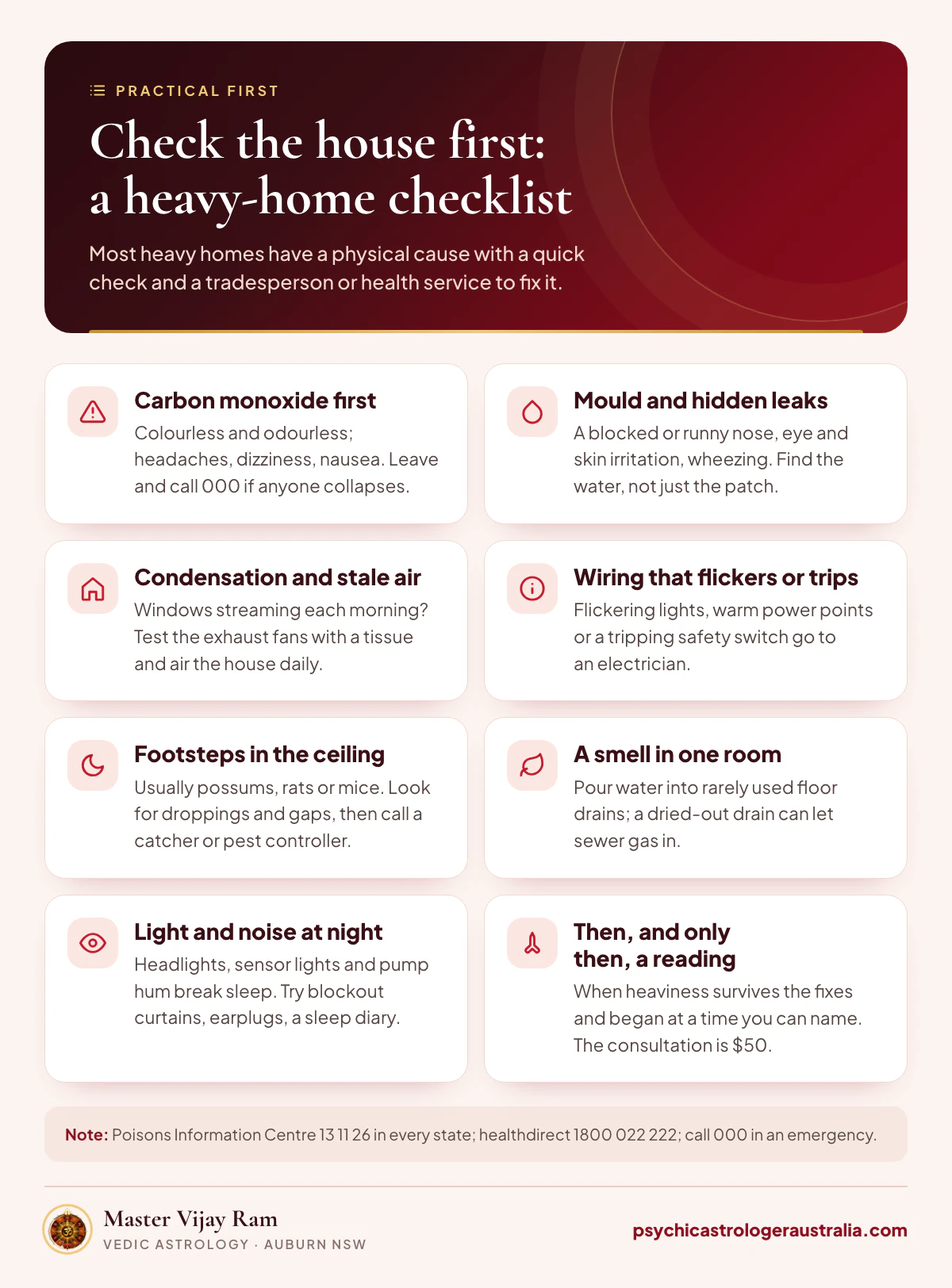
Check the house first. Mould can cause a blocked or runny nose, eye and skin irritation and wheezing, and can trigger asthma; carbon monoxide is colourless and odourless and causes headaches, dizziness and nausea. Damp, stale air, faulty wiring, pests and night-time noise or light also make a home feel heavy. A cleansing fits only after these are checked.
Why check the house before blaming negative energy?
A heavy house is a home where something in the air, the walls, the wiring or the night makes the people in it tired, irritable or uneasy, and most of those somethings can be found and fixed. Before anyone burns camphor or books a puja, the building deserves the same careful look a doctor gives a patient.
This is not scepticism about the tradition. Master Vijay Ram asks about damp, gas heaters and sleep before he asks for a birth chart, because a family that has a leaking roof treated with a havan has been let down twice: once by the roof and once by the reader.
Negative energy removal has its place, and this page explains where; first, the physical causes, in the order worth checking them.
What does mould do to the people in a house?
NSW Health lists the effects of mould plainly: a blocked or runny nose, eye and skin irritation, sometimes wheezing; it can trigger asthma. A family describing mould symptoms at home often says only that the house feels close, that everyone has a cold that never quite finishes, and that one bedroom smells wrong.
Look behind wardrobes and beds pushed against outside walls, inside built-in robes, on bathroom ceilings, around window frames and under sinks. A musty smell that is worse after rain or first thing in the morning is a clue even where nothing is visible yet.
Wiping the patch is not the fix; finding the water is. A leak goes to a plumber or roofer, a structural damp problem to a builder, and a tenant reports mould or a leak to the agent in writing, keeping a copy.
How do damp and stale air make a house feel heavy?
A house sealed against winter cold holds every breath, shower and simmering pot inside it. Water streaming down the inside of the windows in the morning, a bathroom mirror that never clears and clothes drying on racks in the lounge all mean the air is carrying more moisture than the house can lose.
Check that the bathroom and kitchen exhaust fans actually work: hold a tissue to the grille and see whether it is pulled flat. Run them during showers and cooking, open windows on opposite sides of the house for a short spell each day, and move furniture a hand's width off cold outside walls.
Families in Hobart, Canberra and the Blue Mountains meet this every winter; families on the Gold Coast meet it in humid summers. The cure for a stale, damp house is airflow and warmth, and no ritual substitutes for either.
Could it be carbon monoxide?
This is the one cause that can kill, so it comes before every other. Carbon monoxide is colourless and odourless, and it causes headaches, dizziness and nausea: have gas heaters serviced, and leave the house and call 000 if anyone collapses.
The pattern to watch for is several people in the house feeling unwell together, worse when a gas heater or appliance has been running, and better after time away. That pattern is not a sign of anything spiritual, and it needs a gasfitter to check the appliance before it is used again.
For advice on symptoms, the Poisons Information Centre is on 13 11 26 in every state, and healthdirect is on 1800 022 222. A carbon monoxide alarm near the sleeping areas is a sensible addition in any house with gas heating, and carbon monoxide symptoms at home are always a reason to act the same day.
What else hides in the walls and ceilings?
Wiring faults show themselves quietly: lights that flicker, a power point that feels warm, a safety switch that trips, a faint burning smell near the switchboard. Each is a job for an electrician, and none should be left while the family waits to see whether a cleansing helps.
Footsteps in the ceiling at night, scratching inside a wall and a run of noises around midnight are, across much of Australia, possums or rats. Possums are native animals, so use a catcher who knows the local rules, and call a pest controller for rodents; droppings, gnawed cables and a gap under the eaves usually confirm it.
A bad smell confined to one room is worth a practical look too. A floor drain in a shower or laundry that is rarely used can dry out and let sewer gas in, and pouring a jug of water into it each week often ends the problem; a smell that comes and goes for a fortnight and then fades may simply be an animal that died in a cavity.
Is it the noise and light at night?
Sleep is the first thing a heavy house takes, and the cause is often outside. Headlights sweeping through the bedroom, a neighbour's sensor light, a streetlight through a thin blind or the hum of a pool pump will each break sleep night after night, and a family short of sleep reads its own home as hostile.
Blockout curtains, earplugs, moving the bed to the quieter wall and a fortnight's sleep diary sort out most of it. For a house where the street itself throws light and noise at the front rooms, houses at a T-junction or busy road covers the practical fixes, and a GP is the right call if sleep stays broken after the room is dark and quiet.
What should be checked first? A checklist
The table sets what families notice beside the physical cause to rule out, a quick check anyone can make, and who fixes it. Work down it before asking whether anything spiritual remains.
| What you notice | Physical cause to check | A quick check | Who fixes it |
|---|---|---|---|
| Headaches, dizziness or nausea in several people | Carbon monoxide from a gas appliance | Worse with the heater on, better away from home? | Leave and call 000 if anyone collapses; a gasfitter |
| Musty smell, worse after rain | Mould or a hidden leak | Behind furniture, inside robes, on ceilings | Plumber, roofer or builder; the agent in writing if renting |
| Blocked nose, itchy eyes, wheezing at home | Mould, dust or smoke | Does it ease within days of being elsewhere? | A GP; remove the source |
| Windows streaming every morning | Condensation and poor airflow | Tissue test on the exhaust fans | Ventilation, heating, an electrician for fans |
| Flickering lights, a tripping safety switch | A wiring fault | When does it happen, and on which circuit? | An electrician |
| Footsteps or scratching in the ceiling | Possums, rats or mice | Droppings, chewed cables, gaps under the eaves | A possum catcher or pest controller |
| A bad smell in one room | A dry floor drain or a dead animal | Pour water into unused drains | A plumber, or time |
| Waking at the same hour every night | Light, noise, heat or a medical cause | A fortnight's sleep diary | Blockout curtains, earplugs, a GP |
Most families who work through the table never need the last question. Those who do reach it have earned an honest answer to it.
Can a cleansing make the air worse?
It can, if it is done with smoke in a closed house. Incense smoke can trigger asthma, camphor is dangerous if a young child swallows it and belongs locked away, and every state requires working smoke alarms in homes, which are never covered, disabled or removed for a puja.
A family with an asthmatic child that answers a heavy feeling with more incense is adding to the problem it is trying to solve. smoke-free home cleansing for asthma households sets out the customs that need no flame at all.
Negative energy or mould: does it have to be one or the other?
Not in the tradition's own terms. Vastu has always wanted a dry, bright house with an open, airy north-east and clean corners, and a damp, dark, cluttered room is a vastu worry as much as a health one; a vastu reading of the plan often ends by recommending light and airflow before anything else.
So the question of negative energy or mould usually dissolves once the damp is fixed: the house is healthier, brighter and, in the tradition's language, lighter. Cleaning and cleansing were never as far apart as people assume.
What changed in the house recently?
Ask what changed in the month the heaviness began. A new gas heater, a renovation that left dust in every vent, a house closed up for a long holiday, a new carpet, a new baby, a new night shift: each changes how a house feels, and each has an ordinary fix.
After building work, the dust alone can make a home feel stale for weeks, which is one reason a vastu shanti after a renovation always waits for the final clean.
Where does a spiritual cleansing fit?
After the checks, not instead of them. A cleansing is worth discussing when the physical causes have been looked for and fixed, the heaviness began at a time the family can name, and it lifts when the family is away and returns when they come home; the signs of negative energy in a home sets out that test in full.
Then the consultation, $50 by phone, video or WhatsApp, reads the household's charts against that date and says plainly whether anything remains. Where a cleansing is warranted it costs from $250, and Master Vijay Ram performs it in Auburn once the family has accepted the figure, as online puja and havan explains.
A family in Adelaide, consulting by phone or video with a ducted heater nobody has serviced in years, or in Newcastle with a bathroom fan that has quietly died, is asked about those first. Often the call ends there, with a tradesperson to ring and nothing to perform.
What a cleansing cannot fix
It cannot remove mould, stop a gas leak, rewire a switchboard, evict a possum or darken a bedroom. Those belong to the tradespeople and health services above, and they come first because they are the ones that can actually change the air your family breathes.
Vijay Ram ji's work is faith-based guidance, not medical, building or legal advice, and it carries no promise of a result. A heavy feeling in a house deserves to be taken seriously, and taking it seriously starts with a torch, a tissue and a phone call to the right trade.
Read next
- Signs of Negative Energy in Your Home & How to Clear ItSigns of negative energy in a home, the ordinary causes to rule out first, and how nazar, heavier interference and me…
- 11 Signs of Negative Energy in Your Life (and How to Clear It)Eleven signs of negative energy, the ordinary causes to rule out first, and the three-doors test that tells you wheth…
- Diwali 2026 House & Aura Cleansing: Clear the Year's Heavy EnergyDiwali 2026 house and aura cleansing done honestly: clean first, use the Five-Lamp Check, and learn when heaviness is…
Frequently asked questions
How do I know if my house has mould or negative energy?
Check for mould first: a musty smell worse after rain, spots behind furniture or inside robes, and symptoms NSW Health lists, a blocked or runny nose, eye and skin irritation and sometimes wheezing. Fix the water source and air the house. If the heaviness remains after the house is dry and well ventilated, and it began at a time you can name, a reading can look at what is left.
What are the signs of carbon monoxide in a home?
Carbon monoxide is colourless and odourless, so there is nothing to see or smell. It causes headaches, dizziness and nausea, often in several people at once, worse when a gas heater or appliance has been running and better after time away. If anyone collapses, leave the house and call 000. For advice, ring the Poisons Information Centre on 13 11 26.
Who should I call about a gas heater that might be faulty?
Stop using it and call a gasfitter to check and service it before it runs again. If anyone in the house has a headache, dizziness or nausea that you think may be linked to it, ring healthdirect on 1800 022 222 or the Poisons Information Centre on 13 11 26 for advice, and call 000 if anyone collapses. Gas heaters should be serviced regularly, not only when something seems wrong.
Why does my house feel heavy in winter?
A house closed up against the cold holds the moisture of every shower, kettle and breath, and condensation, stale air and mould follow. Short, regular airing from both sides of the house, working exhaust fans, steady heating and furniture moved off cold outside walls usually lighten it. A gas heater that has not been serviced is the first thing to check in a winter house.
I hear footsteps in the ceiling at night. Is the house haunted?
Across much of Australia, footsteps and scratching in the ceiling at night are possums, rats or mice. Look for droppings, chewed cables and gaps under the eaves. Possums are native animals, so use a catcher who knows the local rules; a pest controller deals with rodents. Once the roof is sealed, the night-time noises usually stop with them.
Can burning incense or camphor clear a heavy house?
Not if the heaviness is damp, mould or stale air, and smoke can make it worse. Incense smoke can trigger asthma, camphor is dangerous if a young child swallows it, and smoke alarms must never be covered or disabled. Fix the physical cause first. Smoke-free customs, such as salt water, a lamp in a safe holder and fresh air, suit a household with asthma.
When should I book a spiritual cleansing for my home?
After the physical causes have been checked and fixed, when the heaviness began at a time you can name and lifts when the family is away. The consultation is $50 and reads the household’s charts against that date; many such calls end with a tradesperson to ring instead. A cleansing, where it is warranted, costs from $250, agreed before it is performed in Auburn.
I rent. What should I do about mould or a faulty heater?
Report it to the agent or landlord in writing, keep a copy, and photograph the problem with the date. Do not use a gas heater you think may be faulty. Repairs are generally the landlord’s responsibility under your state’s tenancy rules, and a reading is never a substitute for that written request. Your state’s fair trading or tenancy body can advise if nothing happens.
People also ask
What causes a heavy feeling in a house?
Most often something physical: damp and mould, stale air in a closed-up house, a poorly serviced gas heater, faulty wiring, pests in the roof, or light and noise that break sleep. Household stress, illness and grief add to it. Each has a practical check and a person who fixes it, and those come before any spiritual explanation.
What are the symptoms of mould in a house?
NSW Health lists a blocked or runny nose, eye and skin irritation, and sometimes wheezing, and says mould can trigger asthma. In the house itself, look for a musty smell, spots on ceilings and behind furniture, and condensation on windows. Fix the source of the water rather than only wiping the surface, and see a GP about persistent symptoms.
Can carbon monoxide make you feel like something is wrong in the house?
Yes. Carbon monoxide is colourless and odourless and causes headaches, dizziness and nausea, which families can mistake for a heavy or unsettled house. If symptoms are worse when a gas appliance runs and ease away from home, stop using it, have it checked, and call 000 if anyone collapses. The Poisons Information Centre is on 13 11 26.
Is negative energy real or is it the house?
Often it is the house. Damp, poor airflow, gas appliances, wiring and broken sleep explain most heavy homes, and fixing them changes how the home feels. Where a heaviness survives those fixes, began at a nameable time and lifts away from home, the tradition takes the question seriously and a reading can look at it honestly.
References & further reading
Serving clients across Australia
Confidential consultations by phone, video & WhatsApp — including: