
Quick answer
A little every day, a mop each week, a quiet reset around each new moon, one deep cleanse a year before Diwali or Navratri, and an extra one after illness, a death, a long visit ending or a move. That rhythm suits most Hindu households. More is not better: a calendar is a habit of care, not a defence against fear.
How often should you cleanse your home?
The honest answer to how often to cleanse your home is a little every day, a little more each week, a quiet reset each month, one thorough cleanse a year, and an extra one when something changes the household. A home cleansing calendar is a rhythm of small practices that keeps a house cared for, so that nothing ever has to be done in a hurry or in fear. Most of it takes minutes, and none of it needs to be bought from anyone.
Master Vijay Ram hears the question most often from families who have read that they should be doing something every hour and worry they have been doing too little. This page sets out the calendar many Hindu households keep, layer by layer, with the time each layer takes; the room-by-room house cleansing guide covers the where, and this page covers the when. Negative energy removal is the heavier work for the rare house that a calendar does not settle.
What does the whole calendar look like?
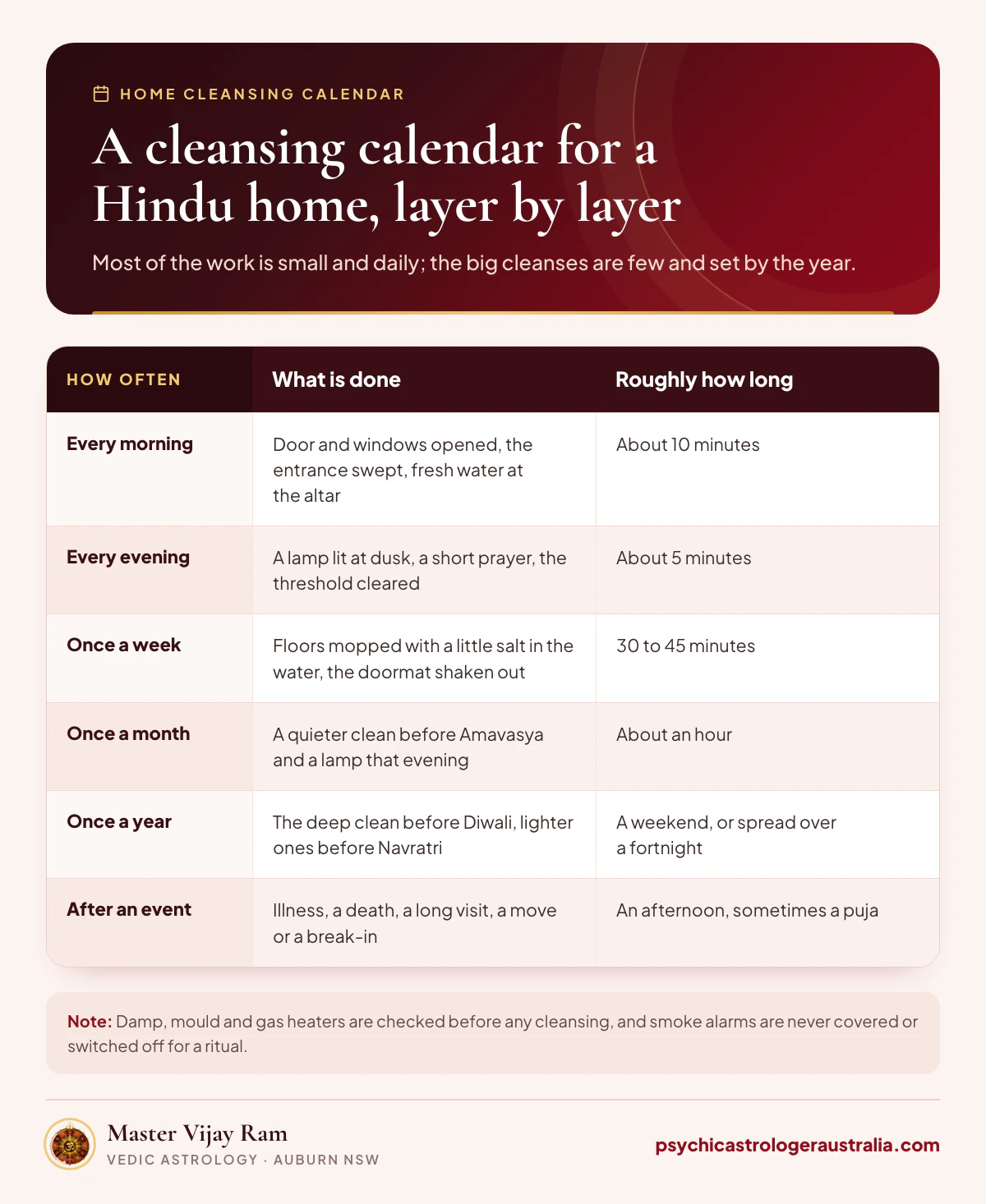
The table is the house cleansing calendar on one page. The times are rough guides for one person working without hurry in an ordinary house; a large house, a festival week or small children all stretch them.
| How often | What is done | Roughly how long | Worth knowing |
|---|---|---|---|
| Every morning | Front door and windows opened for fresh air; the entrance swept; fresh water and a flower at the altar | About 10 minutes | Done before the household scatters for work and school |
| Every evening | A lamp lit at dusk; a short prayer; shoes, bags and parcels cleared from the threshold | About 5 minutes | Timed by sunset, not by the clock |
| Once a week | Floors mopped with a little salt in the water; doormat shaken out; old flowers and used puja items cleared | 30 to 45 minutes | The day is a family custom, and traditions differ |
| Once a month | A quieter clean before Amavasya and a lamp that evening; Purnima or Sankranti for some families | About an hour | The observance day follows your local panchang |
| Once a year | The deep clean before Diwali, with lighter ones before the two Navratris and Makar Sankranti | A weekend, or spread over a fortnight | In Australia the Diwali clean is also the spring clean |
| After an event | A reset after illness, a death, a long visit, a move or a break-in | An afternoon, sometimes a puja | Practical steps first, every time |
Read down the middle column and one thing stands out. The daily layer is the smallest and the most important, because it is the one that is never skipped.
What belongs in a daily home cleansing routine?
A daily home cleansing routine in a Hindu house has two ends. In the morning the front door and a few windows are opened, the entrance is swept, and the altar gets fresh water and a flower before anyone leaves. At dusk the lamp is lit, a short prayer is said, and the threshold is cleared of the day’s shoes, bags and parcels.
That is all, and it is enough. A house that is opened, swept and lit every day rarely has time to grow heavy, and the family notices early when something changes. Lighting a diya for protection covers the evening lamp itself: ghee or oil, the direction of the flame, and keeping it safe.
Many families also keep the sweeping to daylight hours and the broom out of sight, customs that are household habit rather than scripture. Nobody needs to fear a missed evening; the lamp is simply lit again the next night.
What does a weekly house cleansing ritual involve?
In most Indian homes the weekly house cleansing ritual is a mop, not a ceremony. A little salt goes into the bucket, the floors are worked towards the front door, and the used water is poured away outside the house. Salt-water mopping done safely gives the method, the amounts and the floors that should never get salt.
The weekly layer is also where the easily skipped jobs live: the doormat shaken out, last week’s flowers taken from the altar, the fridge cleared, the recycling out before the weekend. Some households add the evening dhuni on a Thursday or the Hanuman Chalisa on a Tuesday and a Saturday. Those are devotions with their own rhythm, and the house gains from the habit whichever day it falls.
Does the day of the week matter?
Traditions differ, and no day is wrong. Many families give each weekday to a deity: Monday to Shiva, Tuesday to Hanuman, Wednesday to Ganesha, Thursday to Vishnu and Brihaspati, Friday to Lakshmi and the Devi, Saturday to Shani, Sunday to Surya.
The household habits follow from that. A clean house by Friday evening, because Lakshmi is welcomed on Fridays, is the most widespread; the salt-water post lists the mopping days families favour and the ones some avoid. A family where both parents work Monday to Friday usually cleans on the weekend whatever the custom says, and that is a sensible place to land.
What happens once a month?
The monthly layer follows the moon. Amavasya, the new moon, is the night many families treat as the quietest of the month: the house is cleaned the day before or that morning, a lamp burns through the evening, and the ancestors are remembered with water and a prayer. Purnima, the full moon, is kept in many homes with a fast or the Satyanarayan katha, so it is a day of worship more than of mopping.
The table gives the 2027 new moons in Australian time. Through the first half of the year they fall early in each calendar month, and by spring they have drifted to its end, with two in September; tie the monthly clean to the moon rather than to the first Saturday and your cleaning day moves with them.
| Date (Sydney) | Exact time (Sydney) | Perth | Date in India | Hindu month name | Moon’s Vedic sign · nakshatra |
|---|---|---|---|---|---|
| Fri 8 Jan | 7:24 am AEDT | Fri 8 Jan, 4:24 am | 8 Jan | Margashirsha Amavasya (Pausha in the north Indian calendar) | Dhanu · Purva Ashadha |
| Sun 7 Feb | 2:56 am AEDT | Sat 6 Feb, 11:56 pm | 6 Feb | Pausha Amavasya (Magha in the north Indian calendar) | Makara · Dhanishta |
| Mon 8 Mar | 8:29 pm AEDT | Mon 8 Mar, 5:29 pm | 8 Mar | Magha Amavasya (Phalguna in the north Indian calendar) | Kumbha · Purva Bhadrapada |
| Wed 7 Apr | 9:51 am AEST | Wed 7 Apr, 7:51 am | 7 Apr | Phalguna Amavasya (Chaitra in the north Indian calendar) | Meena · Revati |
| Thu 6 May | 8:59 pm AEST | Thu 6 May, 6:59 pm | 6 May | Chaitra Amavasya (Vaishakha in the north Indian calendar) | Mesha · Bharani |
| Sat 5 Jun | 5:40 am AEST | Sat 5 Jun, 3:40 am | 5 Jun | Vaishakha Amavasya (Jyeshtha in the north Indian calendar) | Vrishabha · Rohini |
| Sun 4 Jul | 1:02 pm AEST | Sun 4 Jul, 11:02 am | 4 Jul | Jyeshtha Amavasya (Ashadha in the north Indian calendar) | Mithuna · Ardra |
| Mon 2 Aug | 8:05 pm AEST | Mon 2 Aug, 6:05 pm | 2 Aug | Ashadha Amavasya (Shravana in the north Indian calendar) | Karka · Pushya |
| Wed 1 Sep | 3:41 am AEST | Wed 1 Sep, 1:41 am | 31 Aug | Shravana Amavasya (Bhadrapada in the north Indian calendar) | Simha · Purva Phalguni |
| Thu 30 Sep | 12:36 pm AEST | Thu 30 Sep, 10:36 am | 30 Sep | Bhadrapada Amavasya (Ashwin in the north Indian calendar) | Kanya · Hasta |
| Sat 30 Oct | 12:37 am AEDT | Fri 29 Oct, 9:37 pm | 29 Oct | Ashwin Amavasya (Kartika in the north Indian calendar) | Tula · Swati |
| Sun 28 Nov | 2:24 pm AEDT | Sun 28 Nov, 11:24 am | 28 Nov | Kartika Amavasya (Margashirsha in the north Indian calendar) | Vrishchika · Anuradha |
| Tue 28 Dec | 7:12 am AEDT | Tue 28 Dec, 4:12 am | 28 Dec | Margashirsha Amavasya (Pausha in the north Indian calendar) | Dhanu · Mula |
Brisbane and Queensland: subtract one hour from Sydney time between January and 4 April and from 3 October; otherwise the same. Adelaide is always 30 minutes behind Sydney. Computed with the Swiss Ephemeris (Lahiri ayanamsa for Vedic positions) and checked against US Naval Observatory data. Times are rounded to the minute.
The exact time printed is not always the day you keep. A fast follows the tithi at sunrise in your own city, so the observance can land a day either side of the date shown, and your temple’s panchang settles it.
Sankranti, the day the Sun moves into a new sidereal sign, is the third monthly marker, kept mostly by families who follow a solar calendar; Punjabi households know it as Sangrand. In 2027 each one falls between the 13th and the 18th of the month in Sydney time.
Which festivals bring the yearly deep cleanse?
Diwali is the big one. The house is cleaned from top to bottom in the fortnight before Dhanteras, which falls on Wednesday 27 October 2027, so that it is ready for Lakshmi Puja on Friday 29 October 2027. In Australia that is spring, so the Diwali clean and the spring clean are one job, done with the windows open.
Navratri brings two lighter cleans. Chaitra Navratri begins on Thursday 8 April 2027 in Australia, the same day as Ugadi and Gudi Padwa, and Sharad Navratri’s Ghatasthapana falls on Friday 1 October 2027. Makar Sankranti, on Friday 15 January 2027 in Sydney, is the January marker for families who begin the year with a bath, a gift to someone in need and a scrubbed kitchen.
Not every family keeps all three. A household that manages only the Diwali clean is keeping the one that matters most, and it has not fallen behind.
When should an event reset the calendar?
Some cleanses are set by what happens rather than by the date. Each of the events below changes a house, and marking the change helps the people living in it.
- After an illness: once the patient is up, the sickroom is aired, the sheets are washed and a lamp is lit; the doctor’s advice about infection comes first.
- After a death: families follow their own community’s mourning period, which commonly runs ten to thirteen days, and the house is cleaned and blessed when it ends.
- After a long visit: when parents fly home after months with you, the spare room is aired and the house put back in order; it marks the change and says nothing against the guests.
- After a move: the old home is left clean and thanked, and the new one is blessed before the boxes are unpacked, with a griha pravesh home blessing where the family wants one.
- After a break-in: police first, on 000 if it is happening and 131 444 afterwards, then the locks; the threshold is washed and a lamp lit once the house is secure.
A reset is a marker, not a verdict. Nothing in it suggests that anyone brought anything bad into the house.
Can you cleanse a house too often?
Yes. The calendar works because it is calm, and once practices are added out of fear, each new one makes the next feel necessary until the house is something to guard rather than a place to live. Salt-mopping every day, extra lamps after every argument, or checking the doorstep each morning are signs the rhythm has stopped helping.
That deserves kindness rather than more ritual. If the worry has become constant, talk to your GP or call Beyond Blue on 1300 22 4636; if something specific began on a date you can name, a reading can look at it once, calmly, and then put it down.
How does the calendar work in a unit or a smoke-sensitive home?
Every layer survives without a flame. In a unit with a touchy smoke alarm, a rental with a no-flame clause or a home where someone has asthma, the lamp can be an LED diya, the dhuni can become a mantra said room by room, and sound can do the work that smoke does elsewhere.
Smoke-free cleansing for units and renters sets out the whole calendar without smoke, and the conch and the bell explains sound as a cleansing, with hours that keep the neighbours on side. Smoke alarms are never covered or switched off for a ritual, in any home.
What should come before any calendar?
The ordinary checks. A house that feels heavy is often damp, mouldy, badly aired or warmed by a gas heater that has not been serviced, and carbon monoxide gives no smell or colour, only headaches, dizziness and nausea. Fix those first; the calendar is for a house that is already sound.
Two practical habits slot neatly into it. Press the test button on each smoke alarm during the monthly clean, and book the heater service before winter rather than after the first headache.
Where does a reading or a puja fit?
Only after the calendar has been kept and something still feels wrong. Knowing when to cleanse a house spiritually, rather than simply clean it, is what a consultation is for: Master Vijay Ram’s is $50 by phone, video or WhatsApp, and he asks when the heaviness began and what the household has tried, then reads the chart of the head of the household against those dates. Most calls end with the calendar adjusted and nothing more.
Where a shanti is warranted, a puja or havan starts from $250, the figure agreed before anything is performed, and Vijay Ram ji does it personally at his place of practice in Auburn while the family joins by video if they wish. Online puja and havan explains what a performed remedy includes.
Distance changes nothing in the reading. A household in Perth keeps the same calendar two or three hours behind Sydney, which is why its new moon can fall on a different date, and an astrologer for Perth families explains how calls across the time zones are arranged.
What a cleansing calendar cannot do
A calendar cannot repair a roof, treat an illness, settle a debt or mend a marriage, and no practice in it can be promised to change anything. It is household custom and faith-based guidance, not medical, legal or financial advice.
What it can do is give a house a steady rhythm and a family a way of noticing early when something has shifted. For most homes, that is the whole of what cleansing was ever meant to be.
Read next
- Cleansing the Home After a Death: Sutak, the Thirteen Days and ShuddhiSutak after a death, gently explained: what a Hindu home pauses for ten to thirteen days, the lamp, the terahvi, the …
- House Cleansing for Negative Energy: A Room-by-Room Vedic GuideA room-by-room Vedic guide to house cleansing for negative energy: what to rule out first, what is safe to do yoursel…
- Leaving a Home Well: A Thank-You Puja Before You Sell or Move OutLeaving a home well: a thank-you puja before you sell or move out, moving the deities, the last lamp, a clean handove…
Frequently asked questions
How often should a Hindu home be cleansed?
Most households keep a small daily practice, opening the house in the morning and lighting a lamp at dusk, a salt-water mop once a week, a quieter clean around each new moon, and one deep cleanse a year before Diwali or Navratri. Events such as illness, a death, a long visit or a move add an extra reset. Beyond that, more cleansing does not mean more protection.
Is it bad to skip the evening lamp?
No. The lamp is a daily act of care, and a missed evening is simply lit again the next night. No tradition worth following threatens a household for a busy day, and no honest practitioner will tell you that a skipped lamp invited trouble. If lighting it has become a source of anxiety rather than calm, that is worth noticing and talking about with someone you trust.
Which day of the week is best for a home cleansing?
Traditions differ. Many families clean before Friday evening because Fridays belong to Lakshmi, some keep Tuesday and Saturday for Hanuman, and some north Indian households avoid mopping with salt on a Thursday. A working family that can only clean on the weekend is doing nothing wrong. The habit matters more than the weekday, so choose the day you will actually keep.
Should the house be cleaned on Amavasya?
Many families clean the day before Amavasya or that morning, then light a lamp in the evening and remember their ancestors. The new-moon instant printed in a table is not always the day you keep, because the observance follows the tithi in your own city and can fall a day either side. A temple panchang or a muhurat consultation settles the exact day where it matters.
When is the yearly deep cleanse done in Australia?
Before Diwali, for most families: in 2027 Dhanteras falls on Wednesday 27 October and Lakshmi Puja on Friday 29 October, so the cleaning fills the fortnight before. Lighter cleans come before Chaitra Navratri, which begins on Thursday 8 April 2027 in Australia, and before Sharad Navratri, from Friday 1 October 2027. Because Diwali falls in the Australian spring, the festival clean and the spring clean can be one job.
Should a house be cleansed after guests leave?
Many families air the spare room, wash the linen and light a lamp when a long visit ends, especially when parents fly home after months in Australia. It marks the change in the household and helps the family settle back into its own routine. It says nothing against the guests, and it is never a reason to suspect anyone of bringing something into the house.
What should be checked before deciding a house needs cleansing?
Damp, mould, poor airflow and gas heaters come first. Mould can cause a blocked or runny nose, eye and skin irritation and sometimes wheezing, and carbon monoxide from a faulty heater has no smell or colour but causes headaches, dizziness and nausea. If anyone collapses, leave the house and call 000. A sound house that still feels wrong after a month of the calendar is the time to ask for a reading.
Can a home cleansing calendar be kept in a rental unit?
Yes. Every layer works without altering the property or lighting a flame: an LED diya for the evening lamp, a salt-water mop on floors that can take it, mantra and sound in place of smoke, and windows opened at dawn. Check the strata by-laws before burning anything, never cover or disable a smoke alarm, and save anything that could mark a floor or wall for a home you own.
How much does it cost to have a home cleansing done?
The calendar itself is the household’s own practice and needs nothing bought from anyone. Master Vijay Ram’s consultation, by phone, video or WhatsApp, is $50. Where a shanti is warranted, a puja or havan starts from $250, agreed before it is performed, and he performs it personally at his place of practice in Auburn, with the family joining by video if they wish. No outcome is promised.
People also ask
How often should you cleanse your house of negative energy?
For a settled house, a small daily practice and a weekly salt-water mop are enough, with a deeper cleanse once a year and a reset after a death, an illness or a move. Cleansing more often than that rarely helps. If the house still feels wrong after a month of the routine and the practical checks for damp, mould and gas, that is the point to have the pattern read.
What is the best time of day to cleanse a house?
Morning for opening the house, airing it and sweeping, and dusk for the lamp and a short prayer. Many families avoid sweeping after dark, which is a household custom rather than a rule of scripture. The dusk lamp follows sunset, so its clock time moves through the year, and in the states that keep daylight saving it jumps by an hour overnight in April and October.
Do you need a priest to cleanse your home?
Not for the calendar. The daily lamp, the weekly mop, the monthly new-moon clean and the yearly Diwali clean are the household’s own practices. A priest or healer is needed only for a puja, a havan or a griha pravesh, or when a pattern has outlasted the ordinary fixes and the family wants it read. A consultation with Master Vijay Ram is $50, by phone, video or WhatsApp.
Is it bad luck to clean the house on certain days?
Some families avoid mopping with salt on a Thursday or sweeping after sunset, and some keep festival mornings for worship rather than housework. These are household customs, and traditions differ from region to region. None of them is a threat: a house cleaned on an unusual day has not invited anything, and the practical root of most of these customs is simply keeping the week in order.
What is a home cleansing schedule?
A home cleansing schedule is the rhythm a household keeps to stay cared for: a morning airing and an evening lamp each day, a salt-water mop each week, a quieter clean around each new moon, one deep cleanse before Diwali or Navratri, and a reset after events such as an illness, a death or a move. Most of it takes minutes, and it is kept calmly, not out of fear.
References & further reading
Serving clients across Australia
Confidential consultations by phone, video & WhatsApp — including: