

Quick answer
In many Hindu homes the broom is linked with Lakshmi, so it is not stepped over, it is kept out of sight lying flat or hung, the house is not swept after sunset, and a new broom is bought on Dhanteras. These are folk customs with practical roots, not scripture, and ignoring them brings no misfortune.
Why is the broom linked with Lakshmi?
Because Lakshmi is said to live where the house is clean, and the broom is what keeps it that way. In many Hindu homes the jhadu is a household broom that is treated with quiet respect because it removes dirt and, in the old way of speaking, makes room for prosperity. That respect has produced a set of customs about how the broom is handled, when it is used and where it is kept.
These customs are folk practice, passed from grandmother to granddaughter rather than written in scripture, and what is now written up as broom vastu is mostly the same household lore. A vastu consultation for the home covers the layout of a house; this page explains the broom customs, their practical roots and how they sit in an Australian home.
Is there a goddess who holds a broom?
Yes. Shitala Mata, the goddess many north Indian families pray to for protection from fevers and pox, is shown holding a broom, a pot of cool water and neem leaves, riding a donkey. Her broom sweeps disease away, and families who keep her festival take it as a reminder that cleanliness and health go together.
That image, more than any rule, explains why the broom is never treated as rubbish. It is a tool that protects the household, so it is handled with the care any protective thing receives.
What are the common jhadu rules?
The jhadu rules most families know are short. The broom is not touched with the feet or stepped over, it is kept out of sight and lying down rather than standing on its bristles, the house is not swept after sunset, and nobody sweeps the moment a family member leaves on a journey.
A new broom is bought on Dhanteras, the old one is retired quietly rather than burned, and a broom is never used to hit a person or an animal. Each of these has a story behind it and, usually, a practical reason as well.
Why not step over a broom or touch it with your feet?
Touching anything that stands for Lakshmi with the feet is treated as disrespect, in the same way that books, money and food are never kicked in a Hindu home. A child who steps over the broom is corrected gently, not scolded, and an adult who does it by accident touches the broom and then their forehead, the gesture used for a book or a plate of food.
The practical reason is simple: a broom lying across a floor is a trip hazard, and bristles that have been through the dust are not something anyone wants on their feet. Keeping it out of the walkway answers both concerns at once.
Why do families avoid sweeping after sunset?
The custom against sweeping after sunset says Lakshmi visits the house at dusk, when the lamp is lit, and a broom moving towards the door at that hour sweeps her out with the dust. In Tamil homes the same rule is often put as no sweeping once the lamp is lit.
The practical root is older than electric light. Sweeping in the dark meant a dropped earring or coin went out with the dirt and a scorpion in the corner went unseen, and the dust raised by a broom hangs in lamplight; so the floors were done by day and the evening was kept for the lamp and the meal.
Modern life bends the custom. A nurse finishing a night shift in Townsville, or a couple in Wollongong who only reach the floors after dinner, can sweep when they can or leave the crumbs for the morning, and in the states with daylight saving the sun sets an hour later by the clock from October, which gives evening sweepers more light through summer.
Why not sweep straight after someone leaves on a journey?
Because, in the custom, sweeping the moment a family member walks out with their bags sweeps their luck, or their safe return, out of the house after them. Some families wait until the traveller has arrived, or at least until the next morning, before the floors are done.
The kindest reading is courtesy. Nobody wants to look as if they are cleaning someone out of the house, and a home that waits a few hours before sweeping is a home still thinking about the person who left.
Where should the broom be kept?
Out of sight, lying flat or hung up, and away from the kitchen, the puja shelf and the dining table. On where to keep the broom, many vastu writers name the south-west or the west of the house, and almost all of them keep it out of the north-east, the corner given to the altar.
Many Australian houses already have the answer: the broom cupboard in the laundry, or a hook behind the laundry door. In a unit without one, a tall wardrobe corner or a hook inside a cupboard door does the job, and nobody needs to rearrange a flat around a broom.
The custom against a standing broom has a practical root too. A broom left standing on its bristles bends them out of shape and falls over, while one hung up or laid flat lasts longer.
What are the practical roots of the broom customs?
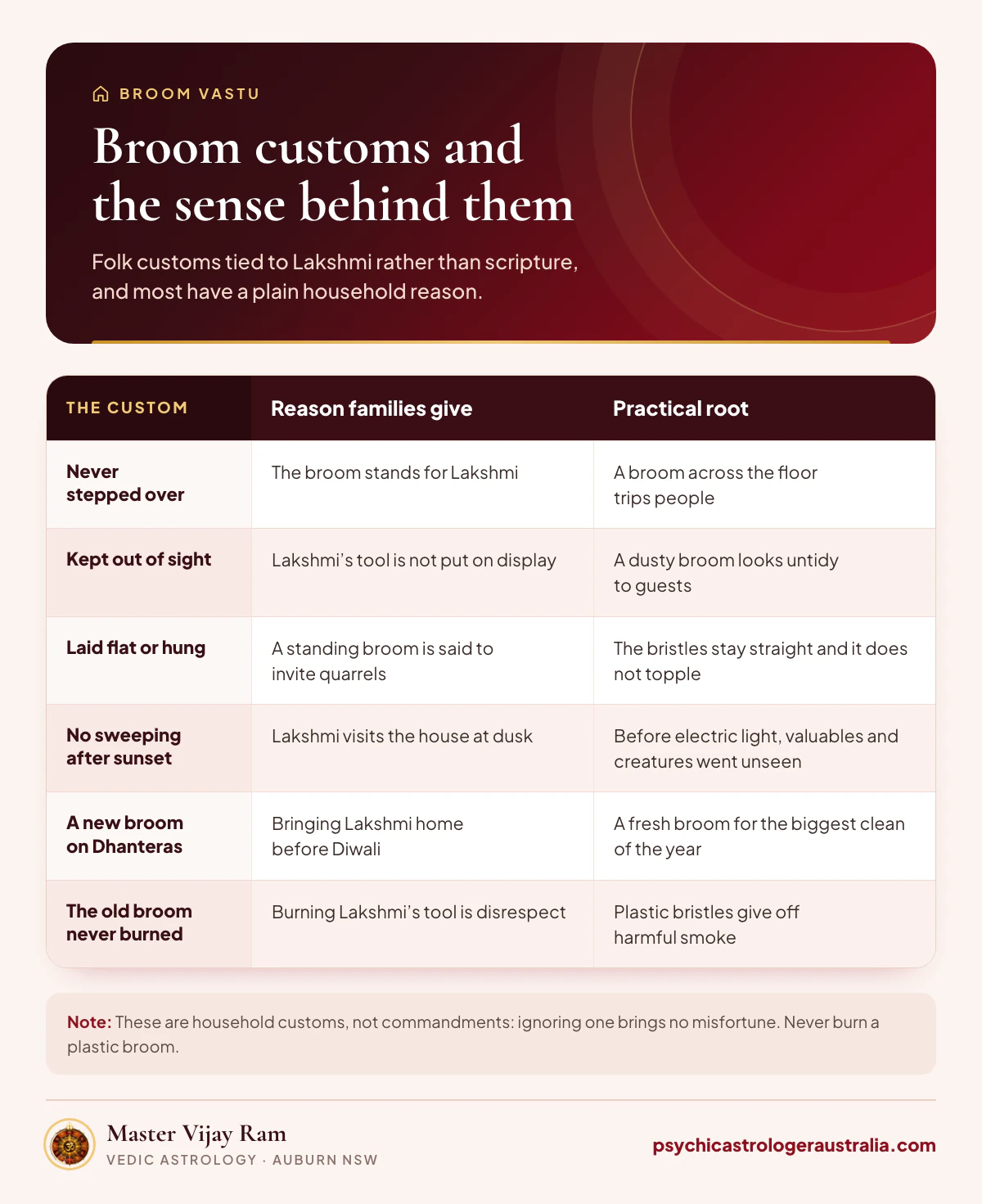
The table sets each custom beside the reason families give and the plain household sense underneath it. Most of the customs would survive even without their stories.
| The custom | The reason families give | The practical root |
|---|---|---|
| Never touched with the feet or stepped over | The broom stands for Lakshmi | A broom across the floor trips people; dirty bristles on bare feet |
| Kept out of sight | Lakshmi’s tool is not put on display | A dusty broom in the living room looks untidy to guests |
| Laid flat or hung, not standing | A standing broom is said to invite quarrels | Bristles stay straight and the broom does not topple |
| No sweeping after sunset | Lakshmi visits at dusk | Before electric light, dropped valuables and creatures went unseen |
| No sweeping right after a traveller leaves | It sweeps their luck away | Courtesy to the person who has just left |
| A new broom on Dhanteras | Bringing Lakshmi home before Diwali | A fresh broom for the biggest clean of the year |
| The old broom never burned | Burning Lakshmi’s tool is disrespect | Plastic bristles give off harmful smoke |
Why buy a new broom on Dhanteras?
Dhanteras opens the Diwali festival, and the custom of buying something new for the house that day includes, for many families, a new broom on Dhanteras alongside a steel pot or a little silver. In 2027 Dhanteras falls on Wednesday 27 October 2027, with the Trayodashi tithi running from 6:34 am that morning to 4:20 am on the Thursday, Sydney time, and Lakshmi Puja follows on Friday 29 October 2027.
Some families start using the new broom the next morning, in keeping with the rule against sweeping after dark, and retire the old one. Nothing expensive is needed: an ordinary broom from the supermarket is as welcome as any, and nobody needs gold to keep the custom.
The Diwali clean itself fills the fortnight before, and the home cleansing calendar shows where it sits among the daily, weekly and yearly practices.
What about the vacuum cleaner?
The customs were made for the broom, and families decide for themselves how far they stretch. Many keep the sunset rule for the broom and run the vacuum whenever their hours allow; others treat any cleaning after dark the same way, and some simply set the robot vacuum for the morning.
The spirit of the customs carries over easily: keep the vacuum tidy, keep it out of the walkway, and empty it into the outside bin. Most Australian homes vacuum the carpets and keep a broom for the tiles, the patio, the deck and the garage, and the broom customs still apply to that broom.
How do you retire an old broom?
Quietly and sensibly. The custom says an old broom is not burned and not thrown with the feet; some families wait for a Saturday or an Amavasya to put it out, and some touch it with respect once before it goes.
In practice that means the rubbish bin, following your council’s rules: a plastic broom usually goes in general waste, and one of natural grass or coconut fibre may go in the green bin where the council accepts it. Never burn a plastic broom, in the backyard or anywhere else, because the smoke is harmful to breathe.
Is it bad luck to ignore the broom customs?
No. These are household customs, not commandments, and nothing in the tradition says a family that sweeps at night or keeps the broom by the back door has invited misfortune. Families who keep them do so out of respect and habit, and families who do not are in no danger.
Like the folk rules about which days to cut hair and nails, they carry a household’s memory of how a home was kept, and hair and nail cutting days looks at those rules in the same spirit. If a custom has turned into a worry that keeps you awake, the worry deserves a gentle conversation, not a stricter rule.
When is a house problem more than housekeeping?
When the home stays heavy even though it is swept, aired and checked for damp, mould and a faulty heater, or when the trouble started in a week the family can point to. No broom causes that and no broom fixes it, and negative energy removal describes what is looked at when the house itself is the question.
A $50 consultation with Master Vijay Ram, by phone, video or WhatsApp, is where that starts, and many families leave it knowing what to fix and with no remedy at all. If a vastu shanti or a Lakshmi puja is called for, the fee starts from $250 and is agreed before anything is performed; he does it personally in Auburn, and online puja and havan explains how families take part by video.
The Lakshmi side of the home, from the safe to the cash box, is covered in vastu for wealth and the money corners, and households in north Queensland are read the same way as anyone else; an astrologer for Townsville families explains how sessions run.
Read next
- Broken Mirrors, Cracked Glass and Things That Keep Breaking at HomeA broken mirror or a run of breakages at home: the physical causes first, what Hindu folk belief and vastu say, safe …
- A Loved One’s Belongings After Death: What to Keep, Give Away and CleanseA loved one’s belongings after a death: what Hindu families keep, give away and cleanse, from clothes and jewellery t…
- Diwali 2026 House & Aura Cleansing: Clear the Year's Heavy EnergyDiwali 2026 house and aura cleansing done honestly: clean first, use the Five-Lamp Check, and learn when heaviness is…
Frequently asked questions
Why should we not sweep after sunset?
The custom says Lakshmi visits the house at dusk, when the evening lamp is lit, and sweeping then would push her out with the dust. The practical root is older than electricity: in the dark, dropped valuables were swept out and insects went unseen. It belongs to household habit, not to scripture, and a family that has to sweep at night has done nothing wrong.
Where should a broom be kept in the house?
Out of sight, lying flat or hung up, and away from the kitchen, the dining table and the puja shelf. Many vastu writers suggest the south-west or the west, and nearly all keep it out of the north-east. In most Australian homes the laundry broom cupboard or a hook behind the laundry door suits the custom perfectly well.
Is it bad to keep a broom standing up?
Many families say a broom left standing invites quarrels, so they lay it flat or hang it instead. The practical reason is that a broom stored on its bristles bends them out of shape and tends to fall over. Hanging it on a hook keeps the bristles straight and the floor clear, which satisfies both the custom and common sense.
When is Dhanteras 2027, and should I buy a broom?
Dhanteras falls on Wednesday 27 October 2027 in every Australian city, two days before Lakshmi Puja on Friday 29 October 2027. Many families buy a new broom that day along with a steel pot or a little silver, and retire the old one. An ordinary supermarket broom is all the custom asks for, and nothing expensive is needed.
What happens if you step on a broom?
Nothing harmful. In many homes stepping over or kicking a broom is avoided as disrespect to Lakshmi, much as books and food are never kicked, and someone who does it by accident touches the broom and then their forehead. A broom lying across the floor is also a trip hazard, which is the practical reason to keep it out of walkways.
Can I use a vacuum cleaner at night?
The traditional customs were made for the broom, and families decide how far they stretch. Many keep the sunset rule for sweeping but vacuum whenever their working hours allow, and some set a robot vacuum for the morning. Nothing in the tradition says a vacuum at night brings misfortune, and the respect the customs ask for is easy to carry over.
How should an old broom be thrown away?
Quietly and according to your council’s bin rules. Many families avoid burning a broom or throwing it with their feet, and some wait for a Saturday or an Amavasya to put it out. A plastic broom usually goes in general waste, and a natural fibre broom may go in the green bin where the council accepts it. Never burn plastic bristles.
Is the broom custom found in scripture?
Not as a set of rules. The broom customs are folk practice handed down in families, and they differ between regions and communities. The link between cleanliness and Lakshmi is old and widely held, and Shitala Mata is shown holding a broom, but the specific rules about sunset, standing brooms and journeys belong to household tradition, kept out of respect rather than fear.
Why not sweep after someone leaves on a trip?
Some families say sweeping the moment a person leaves on a journey sweeps their luck or their safe return out after them, so they wait a few hours or until the next morning. The kindest reading is courtesy, because nobody wants to look as if they are cleaning a person out of the house. It is a custom, and no harm follows from breaking it.
People also ask
What are the vastu rules for a broom?
Keep it out of sight and away from the kitchen, dining area and puja shelf, lay it flat or hang it rather than standing it on its bristles, and avoid the north-east; many vastu writers suggest the south-west or west. Do not step over it, do not sweep after sunset, buy a new one on Dhanteras and retire the old one quietly. These are household customs, not scripture.
Is a broom a symbol of Lakshmi?
In many Hindu homes it is treated that way, because Lakshmi is said to live where the house is clean and the broom keeps it clean. That is why it is not kicked, stepped over or put on display, and why a new one is bought on Dhanteras. The link is folk tradition rather than a rule of scripture, kept as a gesture of respect for the home.
Can we sweep the house on Diwali night?
Many families avoid sweeping on the evening of Lakshmi Puja, in keeping with the custom against sweeping after sunset, and do the floors that morning or the next day instead. In 2027 Lakshmi Puja falls on Friday 29 October, so the deep clean is finished in the days before. A family that has to tidy up after guests that night has done nothing wrong.
What should you not do with a broom?
In the folk tradition: do not touch it with your feet or step over it, do not leave it standing on its bristles, do not sweep after sunset or the moment someone leaves on a journey, do not burn an old one, and never use a broom to hit a person or an animal. Most of these customs also have a plain practical reason behind them.
References & further reading
Serving clients across Australia
Confidential consultations by phone, video & WhatsApp — including: