

Quick answer
Dissolve a tablespoon or small handful of salt in a bucket of warm water, mop from the room furthest from the main door towards the entrance, wash the doorstep last and pour the water into the toilet or laundry tub. Keep salt off marble and stone, wring the mop well on timber, and treat it as a weekly custom, not a cure.
What is salt-water mopping, and why do families do it?
Salt water mopping, namak pocha in Hindi, is a weekly household practice in which a little salt is dissolved in the mop water and the floors are washed from the inside of the house out towards the main door. It is cleaning and custom at once: the floor comes up clean, and the family has marked the end of a week. Most Indian homes in Australia keep some version of it, often without anyone remembering who started it.
Master Vijay Ram is asked about it in two ways: by families who want to do it properly, and by people who have read that it will clear a curse. This page is for the first group, with the method, the floor care and the honest limits; negative energy removal covers what happens when a house needs more than a mop.
What does salt in the mop water mean?
Salt is the absorber of Indian folk practice. It is passed over a person to take nazar, set in a bowl to hold a room’s heaviness, and thrown away rather than reused, because whatever it took is believed to stay in it. In the bucket the same idea is spread across the whole floor, so the week’s dust and the week’s tension are said to leave the house together.
Vastu writers have their own reading of salt in mop water: a floor washed this way is said to keep the ground of the home clean for Lakshmi, with the main door as the place the cleansing ends. A vastu consultation for your home answers the direction questions for a particular house, and what salt, lemon and chillies mean explains the wider family of salt customs.
How much salt, and which kind?
Less than most people think. Many families use a tablespoon of salt, or a small handful, in a standard household bucket, and a heavier hand adds nothing except a white film on the floor. Stir until it has fully dissolved before the mop goes in, because undissolved grains scratch finishes and stick to bare feet.
Coarse rock salt or sea salt from an Indian grocer is the usual choice, since it is closest to what grandmothers used in India. For rock salt home cleansing the grain size makes no difference once it is in the water, and ordinary table salt dissolves the same way. Pink salt sold at a premium for the purpose does exactly what the cheap bag does.
How is it done, step by step?
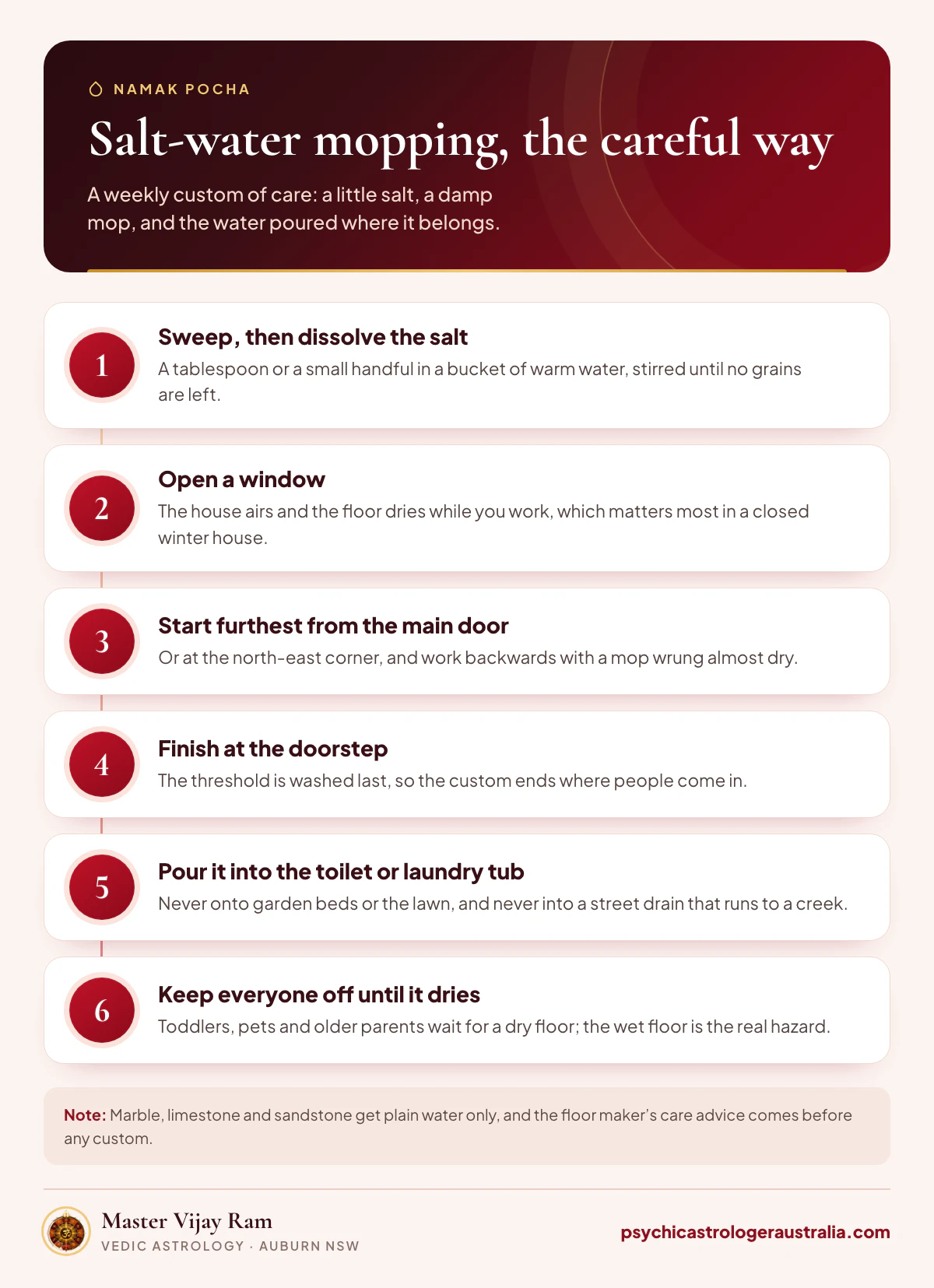
- Sweep or vacuum first, so the mop is washing a floor rather than pushing dust around.
- Fill the bucket with warm water and dissolve the salt completely.
- Open a window or the back door, so the floors dry and the house airs while you work.
- Start in the room furthest from the main door, or at the north-east corner where many altars stand, and work backwards towards the entrance.
- Wring the mop well; a damp mop does the job, and a sopping one leaves salt in the grout and the joins.
- Finish at the threshold and wash the doorstep last, then empty the bucket and rinse the mop in plain water.
- Wash your hands, and keep children and pets off the floor until it is dry.
A whole house takes most families thirty to forty-five minutes, and a unit less. Nobody needs to mop every room every week; the entrance, the kitchen and the living area carry most of the traffic.
Which way should you mop?
The custom says towards the main door, so that whatever the floor held leaves by the way people come in. Some families begin at the altar or the north-east and move clockwise through the rooms before heading out; others simply start at the back of the house. Traditions differ, and none of them is a mistake.
The practical root is plain. Mopping backwards towards an exit means you never walk across a floor you have just washed, which is the same advice any cleaner gives, so the custom and the common sense point the same way.
Where should the used water go?
Many families in India tip the bucket outside the gate or at the edge of the property, never in the kitchen sink and never where people walk. In an Australian house the sensible equivalent is the toilet or the laundry tub, both of which carry it to the sewer.
Two places are wrong for it. Salty water poured on garden beds or lawn builds up in the soil and harms plants, and a street gutter or stormwater drain usually leads to a creek or the beach rather than a treatment plant. The custom asks only that the water leaves the house; it does not ask that it goes on the roses.
Which floors can take salt water?
Salt is mildly abrasive and it draws moisture, so the floor matters more than the custom. The first rule is the floor maker’s own care advice, which outranks anything a website says; the table is a general guide to the floors found in most Australian homes.
| Floor | Salt water? | How | Watch for |
|---|---|---|---|
| Glazed ceramic or porcelain tiles | Yes | An ordinary damp mop, then a plain-water pass over the grout | Salt drying white in the grout lines |
| Sealed timber or engineered boards | Sparingly | A well-wrung mop or a damp cloth, then a dry cloth straight after | Water in the joins; a dull film on the finish |
| Laminate and hybrid planks | Sparingly | A barely damp mop, never pooled water | Edges swelling where water sits |
| Vinyl, lino and polished concrete | Yes | A damp mop, with a plain rinse if a residue shows | A sticky or cloudy film |
| Marble, limestone, travertine, sandstone | No | Plain water, or the cleaner the stone supplier recommends | Salt soaking into the pores and crystallising; lemon and vinegar etch marble too |
| Carpet and rugs | No | Vacuum, and keep the custom to the hard floors and the entrance | A damp backing that turns to mould |
On any floor, a final pass with plain water lifts what is left of the salt. Where the floor cannot take it at all, a small bowl of salt by the door, changed weekly, keeps the custom without touching the surface.
Which day of the week do families mop with salt?
Traditions differ more here than anywhere else in the practice. Many north Indian families avoid a salt mop on Thursday, Brihaspati’s day, and some extend that to washing hair and clothes; others choose Tuesday or Saturday, the days of Hanuman and Shani, because those feel like days for clearing. In many south Indian homes the threshold is washed with water every morning before the kolam is drawn, which does daily what the weekly mop does elsewhere.
The day before Amavasya and the morning before a festival puja are common extra days, and most families keep the mop to daylight, finishing before the evening lamp. The home cleansing calendar shows where the weekly mop sits among the daily, monthly and yearly practices.
What should stay out of the bucket?
- Turmeric and kumkum: both stain grout, pale stone and timber, and the mark outlasts the week.
- Camphor: swallowed camphor can cause seizures in young children, so it never goes in a bucket a toddler can reach and is safest kept locked away.
- Bleach together with vinegar, lemon or ammonia cleaners: mixed, they give off harmful fumes, so use one product at a time and rinse between them.
- Essential oils, where there is a cat: cats lack a liver enzyme that breaks them down, and they walk the floor and lick their paws.
- Large amounts of salt: residue is there for pets to lick, and salt eaten in quantity is dangerous to dogs.
A few drops of Gangajal or a tulsi leaf are the additions some families make, and both are harmless. If someone in the house has been ill, the household disinfectant does the hygiene and the salt is the custom on top, because a pinch of salt in a bucket is no substitute for a disinfectant.
Is it safe with toddlers, pets and older parents?
The real hazard is the wet floor, not the salt. Keep crawling babies and toddlers out of the room until it dries, mop the hallway while an older parent is resting rather than walking through, and lay a towel where a tiled area meets timber.
Dissolve the salt fully and keep the measure small, and the animals are safe on a dry floor. Home cleansing with pets and toddlers sets out the wider rules for camphor, smoke and salt in a house with small children and animals.
How does the weather change it?
In a Canberra or Hobart winter a mopped floor can stay damp for hours in a closed house, so mop in the late morning, use less water and open a window while it dries. On the Sunshine Coast and through a humid Newcastle summer the advice is the same for a different reason: slow drying leaves residue behind and invites mould into the grout.
Sea salt floor cleansing in Geelong or Wollongong is no different from anywhere else. Mop when the house can air, and the floor will be dry before the lamp is lit.
What does a salt mop do, and what can it not do?
Done weekly, it keeps the floors clean, gives the week an end, and gives the family a small shared practice that feels like care rather than worry. In the tradition’s terms it lifts the week’s heaviness from the house, and many families say the rooms feel lighter afterwards.
It cannot fix rising damp, a leak under the floor or mould behind a skirting board, and it cannot settle a quarrel or lift a pattern a chart shows. It is a household custom, offered here as faith-based guidance rather than medical, building or legal advice, and doing it every day does not make it stronger.
When is a mop not enough?
When four weeks of mopping, airing and fixing have changed nothing, or when the unease can be traced to one particular week. A harder mop will not reach that; a reading of the household’s charts against those dates might.
Master Vijay Ram talks it through in English, Hindi or Punjabi by phone, video or WhatsApp for $50, and most people come away with practical advice and no remedy. If he does advise a shanti, the puja is quoted from $250 and the amount is agreed with you first; he carries it out himself in Auburn, where the family can join by video if they wish, and a puja or havan on request explains what that involves.
A household in Canberra is read exactly as one in Auburn is, by phone or video, and an astrologer for Canberra households sets out how sessions are arranged.
Read next
- Neem in Home and Body Cleansing: The Tradition and Safe UseNeem in Hindu home and body cleansing: Ugadi neem and jaggery, the neem bath, leaves at the door, why neem smoke stay…
- Navratri & Dussehra 2026: Cleanse Your Home of Negative EnergyNavratri and Dussehra 2026 land in an Australian spring. Here is what a home cleansing can honestly do at festival ti…
- Camphor, Loban and Dhoop: The Hindu Home Cleansing Alternatives to SmudgingCamphor, loban and dhoop: what each does in a Hindu home cleansing, how the evening dhuni is done safely at home, and…
Frequently asked questions
How much salt do you put in mop water?
Many families use about a tablespoon of salt, or a small handful, in a standard household bucket of warm water, stirred until it has fully dissolved. More salt does not strengthen the custom; it only leaves a white film on tiles and timber and residue for pets to lick. If a bloom shows on the floor once it dries, use less next week and finish with a plain-water pass.
Which salt is best for mopping, rock salt or sea salt?
Most families use coarse rock salt or sea salt from an Indian grocer, because it is the kind their families used in India. Table salt dissolves the same way and serves the custom just as well. There is no need for expensive salts sold for cleansing; the practice depends on the intention and the weekly habit, not on the price of the packet.
Can I mop timber floors with salt water?
Sealed timber and engineered boards can take a little salt water if the mop is wrung almost dry and the floor is wiped with a dry cloth straight after. Water in the joins and a film on the finish are the risks. Check the floor maker’s care advice first, and if it rules out additives, keep the custom with a small bowl of salt by the door instead.
Is salt water safe on marble or natural stone?
Generally not. Marble, limestone, travertine and sandstone are porous, and salt can soak into the stone and crystallise as it dries, which damages the surface over time; lemon and vinegar etch marble as well. Use plain water or the cleaner your stone supplier recommends, and keep the salt custom to a small bowl by the entrance rather than on the stone itself.
Which day should you not mop with salt water?
Traditions differ. Many north Indian families avoid a salt mop on Thursday, the day of Brihaspati, and most keep mopping to daylight, finishing before the evening lamp. Others prefer Tuesday or Saturday, or the day before Amavasya. None of these is a threat: a family that can only mop on a Thursday evening has done nothing wrong, and keeping the habit at all is what counts.
Where do you throw salt mop water?
The custom says outside the house and never in the kitchen sink. In an Australian home the sensible choice is the toilet or the laundry tub, which take it to the sewer. Keep it off garden beds and lawns, where salt builds up in the soil and harms plants, and out of the street gutter, which usually drains to a creek or the beach rather than a treatment plant.
Does salt water mopping remove negative energy?
In the tradition it is said to lift the week’s heaviness from the floors, and many families find the house feels lighter afterwards. It belongs to custom, not to medicine: it cannot fix damp, mould or a gas leak, and it cannot lift a pattern that began on a date you can name and outlasts a month of care. That is when a reading helps more than mopping harder.
Is salt water mopping safe with a dog or cat?
Yes, with a small measure fully dissolved and the floor left to dry before the animals walk on it. Salt eaten in quantity is dangerous to dogs, so never leave undissolved salt or a salt bowl where a dog can reach it. Leave essential oils out of the bucket if there is a cat, because cats lack a liver enzyme that breaks them down; the Animal Poisons Helpline can advise if a pet eats something.
Can I add Gangajal or turmeric to the mop water?
A few drops of Gangajal or a tulsi leaf are harmless additions some families make. Turmeric and kumkum are best left out, because both stain grout, pale stone and timber, and the stain lasts far longer than the week. Camphor should never go in a bucket, since swallowed camphor can cause seizures in young children, and it is safest kept locked away altogether.
People also ask
What is namak pocha?
Namak pocha is the Hindi name for mopping the floors with a little salt dissolved in the water, a weekly custom in many Indian homes. The floors are worked from the inside of the house towards the main door, the doorstep is washed last, and the water is poured away. It is cleaning and custom at once, and it is meant to close the week calmly rather than anxiously.
Why do Indians put salt in mop water?
Because salt is the absorber in Indian folk practice: it is believed to take on heaviness and nazar, and it is thrown away rather than reused. Dissolved in the mop water, it spreads that idea over the whole floor so the week’s dust and tension leave together. Vastu writers add that a salt-washed floor keeps the ground of the home clean for Lakshmi.
Which direction should you mop the floor in vastu?
The custom is towards the main door, so that whatever the floor held leaves by the entrance; some families begin at the north-east corner or the altar and finish at the doorstep. Traditions differ. The practical reason matches the custom, because mopping backwards towards an exit means you never walk across a floor you have just washed.
How often should you mop with salt water?
Once a week is the usual rhythm, with an extra mop before Amavasya or a festival puja in some families. Daily salt mopping is not more powerful, and it is hard on timber, stone and grout. If you find yourself mopping with salt every day because the house feels wrong, the worry itself is worth talking about with your GP or someone you trust.
References & further reading
Serving clients across Australia
Confidential consultations by phone, video & WhatsApp — including: