
Quick answer
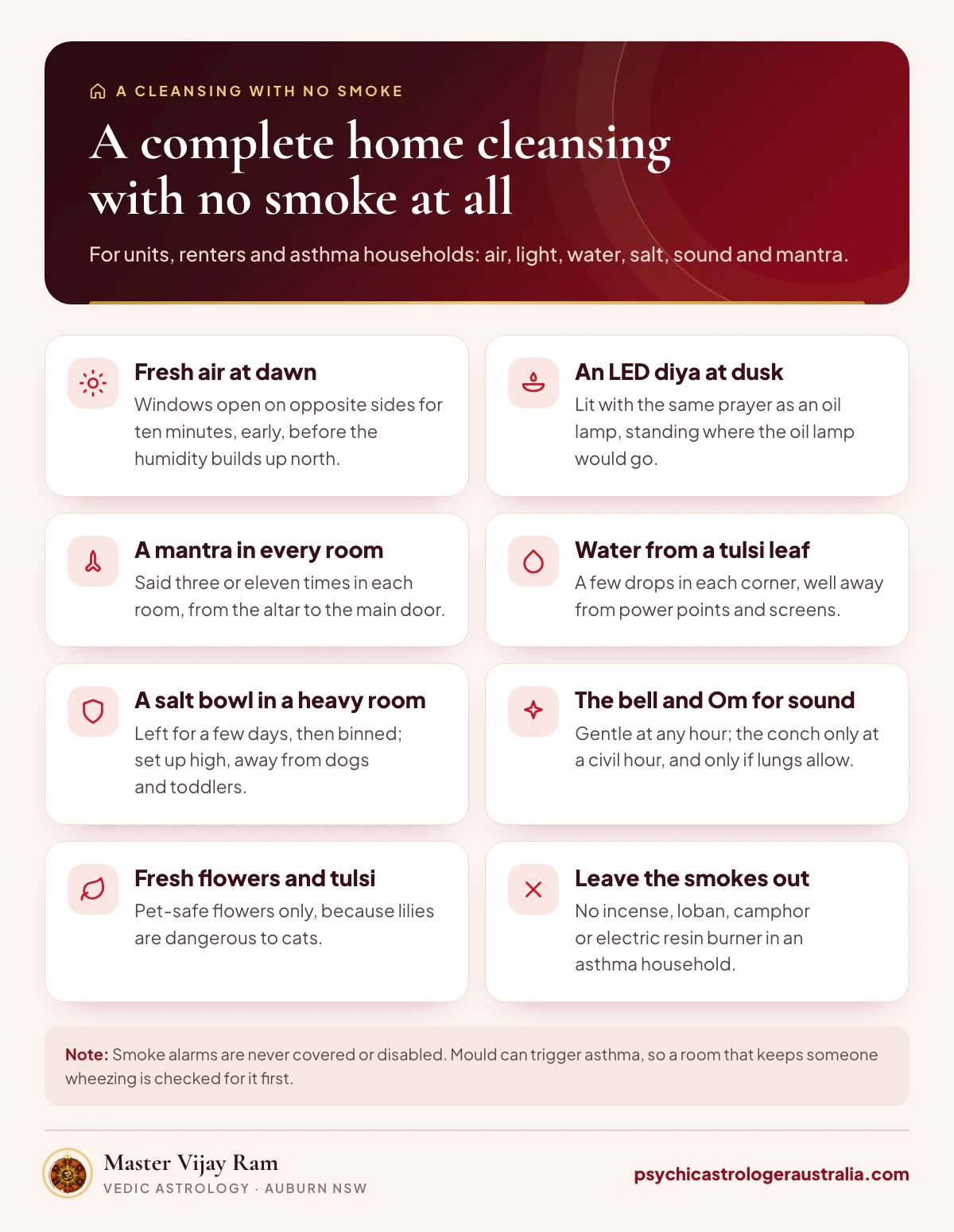
A full Hindu home cleansing works without any smoke: fresh air at dawn, an LED diya at dusk, a mantra said in each room while water is sprinkled from a tulsi leaf, a salt bowl in a heavy room, and the bell and Om for sound. It suits units, rentals and asthma households, and any havan is performed in Auburn instead.
What is smoke-free home cleansing?
Smoke-free home cleansing is a full Hindu cleansing of a house or unit that uses air, light, water, salt, sound and mantra instead of dhoop, loban, camphor or a havan fire. It is for the households that cannot burn anything, or should not: a unit whose smoke alarm trips at a candle, a lease that bans open flames, a home where a child has asthma, a newborn, a pet bird. Each job that smoke does in other homes has a smokeless way of being done, and nothing in the tradition is lost.
Families ask Master Vijay Ram about this more each year, often feeling guilty for giving up the evening dhuni. They need not: negative energy removal as he practises it has never depended on how much smoke a house can hold, and this page sets out the whole routine without any.
Why does smoke matter in an Australian home?
Cleansing for asthma households starts from one fact: incense smoke can trigger asthma. Babies should be kept away from smoke, camphor and strong incense altogether, pet birds are very sensitive to smoke, and in a sealed modern unit the smoke has nowhere to go.
The building has its own rules too. Every state requires working smoke alarms in homes, and an alarm is never covered, disabled or removed for a puja; strata by-laws can limit open flames and smoke, and smoke can drift through shared vents and corridors into the neighbours’ units. A lease may forbid burning altogether, and a ceiling stained by years of dhoop can cost a renter part of the bond.
What replaces each smoke?
The table pairs each smoky practice with the smokeless one that does its job. The right-hand column is the honest note on what changes and what to watch.
| Usual practice | Smoke-free alternative | What to watch |
|---|---|---|
| Dhoop or agarbatti at the altar | Fresh flowers, a tulsi plant and a window opened at prayer time | Some flowers are toxic to pets; strong scents bother some people with asthma |
| The evening loban dhuni through the rooms | A mantra said in each room, with water sprinkled from a tulsi leaf | Water and electrics do not mix: avoid power points and screens |
| The ghee or oil lamp at dusk | An LED diya lit at the same time, with the same prayer | A real flame only where it is allowed and someone stays with it |
| Camphor at the close of the aarti | The bell rung and Om chanted to close the prayer | Camphor is safest not kept in a home with young children |
| An electric loban burner | Left out: it removes the coal but still releases fumes | Counts as smoke in an asthma household |
| A havan at home | Performed at his place of practice in Auburn, the family joining by video | The fire stays in Auburn, not in your unit |
Camphor deserves a word of its own. Swallowed camphor can cause seizures in young children, sometimes within minutes, and the Victorian Poisons Information Centre advises not keeping camphor blocks or camphorated oil in the house, so a smoke-free home has no reason to keep it at all.
Why start with fresh air at dawn?
Because air is the cleanser every other practice depends on. Open windows and doors on opposite sides of the home for ten minutes in the early morning and let the air run through every room while the kettle boils; the tradition treats the hours around dawn as the purest of the day, and a house that breathes once each morning rarely smells stale by evening.
In Darwin, Cairns and Townsville the wet season changes the method: open up early, before the humidity builds, run the bathroom and kitchen exhaust fans, and close up again when the air turns heavy. In a Geelong or Central Coast winter, ten minutes with the heater off is enough to change the air without chilling the house.
How does a mantra cleansing work, room by room?
Mantra home cleansing is the heart of the smoke-free routine, and it takes about fifteen minutes in an ordinary home. Start where the altar stands, choose one mantra the family knows well, and say it a set number of times in each room, three or eleven being common, while sprinkling a few drops of water from a tulsi leaf into the corners.
Move through the rooms in one direction and finish at the main door, where the last of the water goes on the threshold. Families use the mantra they already keep, whether Om Namah Shivaya, Om Namo Narayanaya, the Gayatri mantra, the Hanuman Chalisa or simply Om, and the steadiness of the voice matters more than the choice.
Where do water and salt fit?
Water is the oldest cleanser after air. A few drops of Gangajal in a bowl of clean water, or plain water with a tulsi leaf and a short prayer said over it, is sprinkled through the rooms during the mantra, and the weekly floor wash can carry a pinch of salt where the floors allow it.
A small bowl of coarse salt in the corner of a room that feels heavy is the other smokeless custom, left for a few days, then tipped into the rubbish bin rather than the garden, and the bowl washed. Keep it out of a dog’s reach, because salt eaten in quantity is dangerous to dogs, and set it up high in a house with toddlers.
What about sound?
Sound is the cleansing that needs no flame at all: the bell rung through the rooms, Om at each doorway, a bhajan sung or played softly after the evening lamp. The conch and the bell explains each practice, the breathing cautions for the conch and the hours that keep strata neighbours content, so this routine simply borrows it.
In a unit, the bell and Om are the sound practices to rely on day to day. The conch can be kept for the aarti at a civil hour, if lungs and building allow.
How do you bring in light without a flame?
An LED diya, lit at dusk with the same prayer as an oil lamp, keeps the habit that matters: a light at the altar as the day turns. Choose a warm-coloured one with a gentle flicker if that helps the family feel the custom, stand it where the oil lamp would go, and switch it off at bedtime or leave it on through a night-long vigil.
Daylight is the other light. Open the curtains fully each morning and let the sun reach the rooms that feel heaviest; in Australia the sun sits in the north, so north-facing rooms get the most of it, and a dark south-facing bedroom is the one to air and brighten first.
Which flowers, plants and scents are safe?
Fresh flowers at the altar, changed before they wilt, and a tulsi plant near a sunny window give the house the living fragrance that incense gives elsewhere. Marigolds, jasmine and roses are the familiar choices, and a potted tulsi is welcome in any room the sun reaches.
Two cautions matter. Lilies are dangerous to cats, so check any flower against a pet-safe list before it comes inside, and essential oils in diffusers are a risk for cats too, because they lack a liver enzyme that breaks the oils down; strong fragrances can also bother some people with asthma, so in an asthma household the gentler the scent, the better. Home cleansing with pets and toddlers sets out the wider safety rules.
What does a full smoke-free routine look like?
- Every morning: windows open for ten minutes, curtains drawn back, fresh water at the altar.
- Every evening: the LED diya lit at dusk with a short prayer, the bell rung once, the threshold cleared.
- Every week: the floors washed with a pinch of salt where they allow it, the flowers changed, a mantra said through the rooms.
- When a room feels heavy: a salt bowl for a few days, water sprinkled from a tulsi leaf, and the room aired and checked for damp.
- After a move, an illness or a death: the whole routine once, slowly, and a puja on your behalf if a reading finds one warranted.
The rhythm is the one the home cleansing calendar describes for every Hindu home, with the smoke taken out.
What should renters and strata residents keep in mind?
Renter-friendly home cleansing leaves no mark: no nails, no paint, no soot, nothing stuck to a door on common property, and nothing that could breach the lease. Every practice on this page can be undone in a minute, which is exactly why it suits a rental.
The practical jobs come first, and in a rental they belong to the landlord. A mouldy bathroom ceiling, a broken exhaust fan or a heater that smells wrong is reported to the agent in writing, and a room that keeps someone wheezing may be mouldy: NSW Health lists a blocked or runny nose, eye and skin irritation and sometimes wheezing among mould’s effects, and mould can trigger asthma.
When a family moves into a new rental and wants it blessed, a griha pravesh home blessing can be done for the new address without any fire in the unit.
What if a havan or puja is needed?
Then the fire is lit in Auburn, not in your unit. Where a reading finds a shanti or havan warranted, Master Vijay Ram performs it himself on a chosen muhurat at his only place of practice, in Auburn, with the family watching by video if they wish, so a household with asthma, a newborn or a strict strata committee never has to choose between the rite and the rules.
Whether anything is needed at all is settled in a $50 conversation by phone, video or WhatsApp, and most end without a remedy. Any puja or havan is priced from $250 and agreed with you before it is performed, and online puja and havan explains what is included.
What can smoke-free cleansing not do?
It cannot treat asthma, clear mould, fix a heater or settle a dispute with a neighbour, and nothing in it can be promised to lift what a chart shows. An asthma action plan from your GP, a repair request to the agent and an honest conversation do those jobs, and this page is religious guidance that sits beside them, not medical, legal or building advice.
What it can do is give a family every part of its cleansing custom back, without the cough, the alarm or the strata letter. Households in Cairns, Darwin and on the Central Coast get the same reading by phone or video as anyone else, and an astrologer for Cairns families sets out how those sessions work; for homes where smoke is welcome, camphor, loban and dhoop covers the smokes themselves.
Read next
- Havan at Home in an Apartment: Smoke Alarms, Strata and a Small, Safe FireHavan at home in an apartment: how small a safe fire can be, smoke alarms that must never be covered, strata by-laws,…
- Home Cleansing With Pets and Toddlers: Camphor, Smoke and Salt SafetyHome cleansing with pets and toddlers: camphor poisoning risks, lamps at toddler height, incense and pet birds, salt …
- House Cleansing for Negative Energy: A Room-by-Room Vedic GuideA room-by-room Vedic guide to house cleansing for negative energy: what to rule out first, what is safe to do yoursel…
Frequently asked questions
Can you cleanse a home without burning anything?
Yes. A full Hindu cleansing can be done with fresh air at dawn, an LED diya at dusk, a mantra said in each room, water sprinkled from a tulsi leaf, a small salt bowl in a heavy room, and the bell and Om for sound. Each job smoke does in other homes has a smokeless way of being done, and nothing in the tradition is lost by doing it that way.
How do I cleanse my apartment without smoke?
Open the windows for ten minutes each morning, light an LED diya at the altar at dusk, walk through the rooms saying a mantra the family knows while sprinkling a few drops of water, and finish at the main door. Ring the bell rather than burning camphor, wash the floors weekly with a pinch of salt where they allow it, and keep everything reversible for the lease.
Is incense bad for asthma?
Incense smoke can trigger asthma, and babies and pet birds are especially sensitive to smoke, so in those households it is better left out altogether. Fresh flowers, a tulsi plant and an open window give the altar its fragrance without smoke. Anyone whose asthma flares at home should see their GP about an asthma action plan and have the house checked for mould.
Does an electric loban burner count as smoke-free?
Not really. An electric burner removes the hot coal, which helps with fire risk, but heating the resin still releases fumes that can bother someone with asthma and drift through a unit. In a household where smoke is the problem it is better left out, with mantra, water and sound used instead and loban kept for homes where it is safe.
Is an LED diya acceptable for puja?
Many families use one in any room where a real flame would break a rule or worry a parent, lighting it at dusk with the same prayer as an oil lamp. The habit of bringing light to the altar as the day turns is what matters to them. Where the building and the household allow a real lamp, it goes on a metal tray and is never left alone.
Which mantra should I use to cleanse my home?
The one your family already keeps. Om Namah Shivaya, Om Namo Narayanaya, the Gayatri mantra, the Hanuman Chalisa or simply Om are all used, said three or eleven times in each room while a few drops of water are sprinkled, finishing at the main door. A steady voice and a regular habit matter more than which mantra is chosen.
Can I cleanse a rental property without breaking the lease?
Yes, because every smoke-free practice can be undone: no nails, no paint, no soot and nothing on common property. Keep the cleansing to air, light, water, salt, sound and mantra, and report repairs such as mould, a broken exhaust fan or a heater that smells wrong to the agent in writing. A blessing for the new address can be performed without any fire in the unit.
Is camphor safe to keep in a home with children?
It is best not kept at all. Swallowed camphor can cause seizures in young children, sometimes within minutes, and the Victorian Poisons Information Centre advises not keeping camphor blocks or camphorated oil in the house. A smoke-free routine has no need for it; if a household does keep any, it is locked away, and the Poisons Information Centre is on 13 11 26.
What if a havan is needed but we live in a unit?
Then the havan is performed at Master Vijay Ram’s place of practice in Auburn on a chosen muhurat, and the family can watch by video, so no fire is ever lit in the unit. It is done only where a $50 consultation finds it warranted, and it starts from $250, with the amount agreed before it is performed.
People also ask
Can a house be cleansed without sage or incense?
Use the Hindu household’s smokeless practices: windows open at dawn, an LED diya at dusk, a mantra said room by room, water sprinkled from a tulsi leaf, a small salt bowl in a heavy room, and the bell or Om for sound. White sage belongs to North American Indigenous ceremony, and a Hindu home has its own ways of cleansing that need no smoke at all.
Is it safe to burn incense in an apartment?
Often it is not the best choice. Incense smoke can trigger asthma, strata by-laws can limit smoke and open flames, smoke can drift to the neighbours, and a smoke alarm must never be covered or disabled. Where it is allowed and nobody in the home has asthma, keep it brief with a window open; otherwise use flowers, mantra and sound instead.
What is the best smoke-free way to remove negative energy?
In the tradition, a mantra said through each room with water sprinkled from a tulsi leaf, ending at the main door, with an LED lamp at the altar each dusk and fresh air each morning. It is a household custom of care rather than a treatment, and a home that stays heavy after weeks of it, with mould and gas checked, is the point to ask for a reading.
Can I do a home cleansing if someone has asthma?
Yes, without any smoke: fresh air at dawn, an LED diya, mantra, water, a salt bowl, flowers chosen with care, and the bell and Om for sound. Leave out incense, loban, camphor and electric resin burners, have the house checked for mould, and keep the asthma action plan from the GP up to date. The person with asthma should leave the conch to someone else.
References & further reading
Serving clients across Australia
Confidential consultations by phone, video & WhatsApp — including: