
Quick answer
Your Moon sign, or rashi, is the zodiac sign the Moon occupied when you were born, in the sidereal zodiac Vedic astrology uses. The Moon changes sign every two and a quarter days, so your date, time and place of birth are needed to find it. Jyotish reads Sade Sati, yearly transits and compatibility from the Moon sign, not the Sun sign.
What is a Moon sign (rashi)?
A Moon sign, or rashi, is the sign of the zodiac the Moon was passing through at the moment of your birth, measured in the sidereal zodiac that Vedic astrology uses. When an Indian grandmother asks a child “what is your rashi?”, this is what she means, and it is the sign a Vedic astrologer reads most of your life from. It is not the sign in a newspaper horoscope, which is the Sun's sign in the Western tropical zodiac; the two are different measures of different bodies and are usually different signs, which is why a Moon sign reading begins by establishing which one is yours.
Master Vijay Ram begins every reading from the Moon. In 40+ years of practice he has found that nothing else in a chart tells him as quickly how a person thinks, what steadies them and when the big transits will land.
Why does Vedic astrology read from the Moon rather than the Sun?
Three reasons, each practical. The Moon is the fastest body in the chart and so the most personal: everyone born in a given month shares a Sun sign, but the Moon sign changes every couple of days. The Moon signifies the mind, manas, in jyotish, and the mind is where life is experienced. And the dasha system that gives Vedic astrology its timing starts from the Moon's nakshatra at birth, so the Moon is literally the beginning of the clock.
For transits the Moon sign is the reference point. Sade Sati, Jupiter's yearly movement, the eighteen-month shifts of Rahu and Ketu: all are counted from the Moon, which is why a Vedic yearly forecast is organised by Moon sign and why reading it by your Sun sign gives you someone else's year.
How fast does the Moon move?
About thirteen degrees a day, a little more or less depending on where it is in its orbit. A sign is thirty degrees, so the Moon spends roughly two and a quarter days in each one and goes round the whole zodiac in 27.3 days. That speed is the reason the time of birth matters. Two babies born twelve hours apart on the same day can have different Moon signs, and a birth time written down as “evening” can leave the question open.
It also means the Moon sign is the part of a chart most likely to be wrong on a free calculator, because the calculator trusts whatever time it is given.
The twelve rashis
| Sign | Rashi | Ruling planet | Element |
|---|---|---|---|
| Aries | Mesha | Mars (Mangal) | Fire |
| Taurus | Vrishabha | Venus (Shukra) | Earth |
| Gemini | Mithuna | Mercury (Budh) | Air |
| Cancer | Karka | Moon (Chandra) | Water |
| Leo | Simha | Sun (Surya) | Fire |
| Virgo | Kanya | Mercury (Budh) | Earth |
| Libra | Tula | Venus (Shukra) | Air |
| Scorpio | Vrishchika | Mars (Mangal) | Water |
| Sagittarius | Dhanu | Jupiter (Guru) | Fire |
| Capricorn | Makara | Saturn (Shani) | Earth |
| Aquarius | Kumbha | Saturn (Shani) | Air |
| Pisces | Meena | Jupiter (Guru) | Water |
The ruler matters as much as the sign. A Cancer Moon is ruled by the Moon itself, so its condition is doubly important; a Capricorn or Aquarius Moon is ruled by Saturn, so Saturn's transits speak to it twice over. Rahu and Ketu rule no sign and act through whichever sign they occupy.
Nakshatra: the finer layer
Each sign holds two and a quarter nakshatras, the twenty-seven lunar mansions of 13°20′ that the Moon crosses at the rate of about one a day. Your janma nakshatra, the Moon's mansion at birth, is finer than the rashi and does more work: it starts the Vimshottari dasha, it gives the traditional first syllable for a name, and it is matched star to star in a marriage comparison. Two people with a Taurus Moon can have very different charts if one is born under Krittika and the other under Rohini.
Each nakshatra is further split into four padas, and the pada decides which navamsa sign the Moon falls in. A good reading gives you all three: sign, star and pada.
Moon sign, Sun sign and ascendant: three lenses
A Vedic chart is read from three points, and it helps to know what each one is for.
- The ascendant (lagna) is the sign rising on the eastern horizon at your birth, changing every two hours. It is the body, the self and the frame of the houses.
- The Moon sign (rashi) is the mind and the emotional constitution, and the reference for transits and dasha.
- The Sun sign is the soul's direction and the father; in jyotish it is read, but it is not where the chart begins.
Western astrology leads with the Sun, which is why “what's your sign?” in Australia means the Sun sign in the tropical zodiac. Jyotish leads with the ascendant and the Moon in the sidereal zodiac. The two zodiacs are offset by about 24°14′ in 2027, so most people's Vedic signs sit one sign earlier than their Western ones. Vedic vs Western astrology explains the offset in full.
Why does my Vedic Moon sign differ from the one an app gave me?
Four common reasons, in order of frequency.
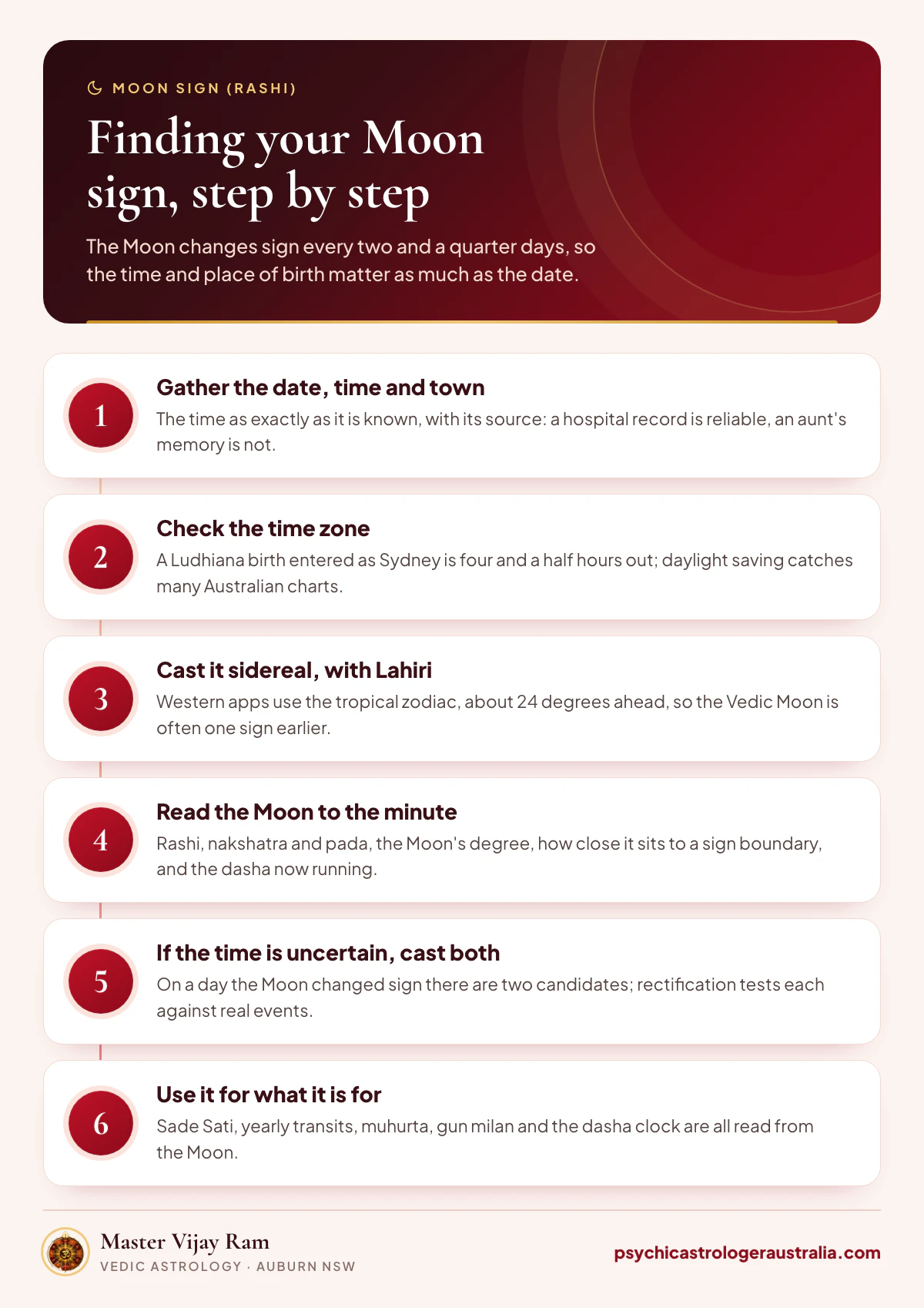
- The zodiac. A Western app gives the tropical Moon sign; a Vedic one gives the sidereal. Subtract about 24 degrees from the tropical position and the sign often changes.
- The ayanamsa. Vedic software can use several offsets. Lahiri is the standard, used by the Indian government's panchang, and it is what Vijay Ram ji uses. Other choices can shift the Moon by a degree or two, enough to change the sign at a boundary.
- The time zone. A birth in Ludhiana entered as if it happened in Sydney is out by four and a half hours, which moves the Moon by about two and a half degrees and can change the sign. Daylight saving, which India does not have, catches many Australian-born charts the same way.
- The birth time itself. Hospital records are reliable; a time remembered by an aunt is not.
How to find your Moon sign
Send three things: your date of birth, the time as exactly as it is known, with the source if you can (birth certificate, hospital record, family memory), and the town or city of birth. From these the chart is cast and the Moon's sidereal position is read off to the minute.
What a proper answer looks like is more than one word. It gives your rashi, your nakshatra and pada, the degree of the Moon, how close it is to a sign boundary, and the dasha you are running now. That last item is the one that makes the exercise worth doing, because the Moon sign on its own is a label and the dasha is a calendar. A kundli reading covers all of it.
Free calculators will give you a sign in seconds. They are fine if your birth time is exact and the site says it uses the Lahiri sidereal zodiac. They are not fine for the boundary cases below.
Born on a day the Moon changed sign?
The Moon changes sign on roughly four days in nine, so a birth with no recorded time has two candidate rashis almost half the time. A time that is wrong by an hour matters only for the one birth in twenty-seven that falls within an hour of a boundary, but for those charts it means a wrong Moon sign and a dasha that starts from the wrong star.
If your time is uncertain, say so. An honest astrologer will cast both charts, tell you how the two readings differ and, where the difference matters, suggest rectification: testing each chart against the dates of real events in your life, a marriage, a migration, a bereavement, until one fits and the other does not. Vijay Ram ji does this routinely for clients born in India decades ago with a time recorded to the hour, and he says plainly when the Moon sign cannot be settled.
What the Moon sign is used for
- Sade Sati and Saturn's other transits are counted from the Moon; who is affected in 2027 depends on nothing else.
- Gochar, the yearly transit reading, places Jupiter, Rahu and Ketu in houses from the Moon.
- Muhurta checks chandra bala, the Moon's strength on the chosen day relative to your rashi, before fixing a wedding or a griha pravesh.
- Compatibility in the gun milan system is scored from the two Moons and their nakshatras.
- Naming a child traditionally follows the first syllable of the janma nakshatra.
- Gemstones for the Moon, and for the Moon sign's ruler, are chosen only after the sign and the condition of its lord are known; gemstone guidance starts there.
What each Moon sign tends toward
These are the traditional keynotes, offered as a starting point and not a verdict; the nakshatra and the rest of the chart refine every one of them.
- Mesha (Aries): quick, direct, restless until there is something to lead.
- Vrishabha (Taurus): steady, loyal, slow to change and hard to move once settled.
- Mithuna (Gemini): curious, talkative, happiest with several things going at once.
- Karka (Cancer): protective, home-centred, moods that move with the tide.
- Simha (Leo): proud, warm, needs to be respected more than liked.
- Kanya (Virgo): precise, dutiful, worries in detail.
- Tula (Libra): fair-minded, sociable, uneasy with conflict.
- Vrishchika (Scorpio): intense, private, loyal to the few.
- Dhanu (Sagittarius): candid, principled, drawn to teaching and travel.
- Makara (Capricorn): patient, ambitious, carries responsibility early.
- Kumbha (Aquarius): independent, humane, thinks in systems.
- Meena (Pisces): gentle, imaginative, absorbs the feelings in a room.
What a Moon sign cannot tell you
A twelfth of humanity shares your Moon sign. On its own it cannot describe your personality, predict your year or say anything about your health, and a forecast written for “all Cancer Moons” is a weather report for a continent. The sign becomes useful only when it is placed in a chart: the Moon's degree, its nakshatra, the houses counted from it, the dasha running and the planets in aspect. That is the difference between a label and a reading, and it is the limitation Master Vijay Ram states first whenever someone asks him what their rashi “means”.
How Master Vijay Ram uses your Moon sign in a reading
He reads the Moon's sign, nakshatra and pada, then the Moon's strength: its phase at your birth, its distance from the Sun, who aspects it and whether it sits with Saturn, Rahu or Ketu. From that he describes the mind you were born with, and from the dasha he describes the time you are in. Everything else in the chart is read against those two. For a first pass at the chart yourself, the beginner's guide to reading a birth chart shows where the Moon sits and what to look at next, and a reading is available by phone, video or WhatsApp anywhere in the country, including Townsville and the north.
Where does your rashi come up for families in Canberra?
For many families in Canberra the first time anyone asks for a rashi is at a temple, whether at Mawson, Florey or Torrens. Priests performing an archana or sankalpa in a devotee's name often ask for the nakshatra and rashi, and a child born in the ACT whose Moon sign was never worked out may simply be given a parent's guess.
It comes up again at the house-warming. A griha pravesh in a new home in Gungahlin, Molonglo or across the border in Queanbeyan is timed with chandra bala, a check of where the Moon stands that day relative to each person's rashi, so a date that suits one adult may need checking against another's.
The Moon sign is also what the 2027 Sade Sati list is counted from. Aquarius, Pisces and Aries are inside it while Saturn is in Pisces, and Pisces, Aries and Taurus while it is in Aries from 3 June to 19 October, so a guessed rashi can put someone on the wrong side of that list for a whole year.
Canberra shares Sydney's clock, which leaves the Indian birth certificate as the usual source of time-zone mistakes for families here. Whether you are in Gungahlin or Tuggeranong, astrology readings for Canberra happen on the phone or over video and WhatsApp, and Auburn is about three hours away by road for those who would rather sit across the table. If the rashi turns out to be one of the four on the Sade Sati list, a Sade Sati and Shani reading looks at how the phase is likely to land in your own chart, and an online video consultation lets the whole household join from different rooms or cities.
Read next
- Sun Sign, Moon Sign or Rising Sign: Which One Is You?Sun sign, Moon sign or rising sign: what each is, why your Vedic signs differ from the Western ones, how to find all …
- Karka Rashi 2027: Ketu on the Moon and Jupiter’s Brief ReturnKarka rashi 2027 for the Cancer Moon: Ketu on the Moon and Rahu in the 7th all year, Jupiter back in Cancer from 25 J…
- Sihr Removal in Australia: Signs of Sihr and How Ruqyah HelpsSihr removal in Australia explained: the signs worth taking seriously, what to rule out first, how ruqyah actually wo…
Frequently asked questions
How do I find my Moon sign?
Give an astrologer, or a calculator set to the Lahiri sidereal zodiac, your date of birth, your time of birth as exactly as it is known and your place of birth. The chart is cast for that moment and the Moon's sign read off directly. A proper answer also gives the nakshatra and pada, the Moon's degree, how close it sits to a sign boundary and the dasha you are running, which is what makes the sign useful.
Is the Moon sign more important than the Sun sign?
In Vedic astrology, yes. The Moon signifies the mind, it changes sign every two and a quarter days so it is far more personal than the Sun, and the dasha system that times events begins from the Moon's nakshatra. Transits such as Sade Sati are counted from it. The Sun sign is read too, for the soul's direction and the father, but the chart does not begin there.
Why is my Vedic Moon sign different from my Western Moon sign?
Because the two systems use different zodiacs. Western astrology uses the tropical zodiac, anchored to the equinox; Vedic astrology uses the sidereal zodiac, anchored to the stars, which in 2027 sits about 24°14′ behind it. Subtract that from a Western Moon position and it often lands in the previous sign. Both describe the same Moon in the same sky; only the starting point of the zodiac differs.
What is the difference between rashi and nakshatra?
The rashi is the Moon's sign, one of twelve divisions of thirty degrees. The nakshatra is the Moon's lunar mansion, one of twenty-seven divisions of 13°20′, so each sign holds two and a quarter of them. The nakshatra is the finer layer: it starts the Vimshottari dasha, gives the traditional first syllable for a name and is matched star to star in marriage compatibility.
What is the difference between the Moon sign and the ascendant?
The ascendant, or lagna, is the sign rising on the eastern horizon at the moment of birth; it changes about every two hours and frames the twelve houses of the chart. The Moon sign is where the Moon stood, changing every two and a quarter days. Jyotish reads the body, the self and the houses from the ascendant, and the mind, transits and dasha from the Moon.
What if I do not know my exact birth time?
On most days the Moon stays in one sign all day, so the rashi is still certain; on roughly four days in nine the Moon changes sign and there are two candidates. An astrologer casts both charts and, where the difference matters, rectifies the time by testing each chart against the dates of real events in your life. Vijay Ram ji does this often for clients whose birth time was recorded only to the hour.
How often does the Moon change sign?
About every two and a quarter days. The Moon moves roughly thirteen degrees a day against the stars and a sign is thirty degrees wide, so it crosses all twelve signs in 27.3 days, the sidereal month. Its speed varies a little through the month, which is why the stay in a sign can be a few hours shorter or longer than average.
Which planet rules my Moon sign?
Mars rules Aries and Scorpio, Venus rules Taurus and Libra, Mercury rules Gemini and Virgo, the Moon rules Cancer, the Sun rules Leo, Jupiter rules Sagittarius and Pisces, and Saturn rules Capricorn and Aquarius. Rahu and Ketu rule no sign. The ruler's condition in your chart and its transits colour everything the Moon sign is used for, which is why a Capricorn or Aquarius Moon feels Saturn twice over.
Can two people with the same Moon sign be very different?
Yes, and they usually are. The sign is thirty degrees wide and holds two and a quarter nakshatras, so a Taurus Moon in Krittika and a Taurus Moon in Rohini begin different dashas and carry different natures. Add the Moon's degree, its phase, the planets aspecting it and the ascendant, and the shared sign becomes a small part of two quite different charts.
How is the Moon sign used in marriage matching?
The gun milan system scores compatibility from the two Moon signs and their nakshatras across eight tests, out of 36 points, and the deeper nakshatra comparison looks at temperament, health and the lords of the two signs. Because it is Moon-based, both birth times matter. Vijay Ram ji reads the full charts alongside the score rather than stopping at the number.
Does your Moon sign ever change?
No. The natal Moon sign is fixed at the moment of birth and stays the same for life. What changes is the transiting Moon, which passes through every sign each month, and the slower planets whose transits are counted from your natal Moon sign. When a reading says the Moon is in a different sign this week, it is describing the sky now, not your rashi.
Is a free Moon sign calculator reliable?
Reliable enough when three things hold: your birth time is exact, the time zone and daylight-saving setting for your birthplace are right, and the site states that it uses the Lahiri sidereal zodiac. If any of those is missing the sign can be wrong, especially for a birth within a few hours of the Moon changing sign. A calculator cannot tell you how close to a boundary you are; a reading can.
People also ask
How do I know my rashi by date of birth?
The date alone is not quite enough, because the Moon changes sign about every two and a quarter days. On a little more than half of all days the Moon stays in one sign, so the rashi is certain; on the rest it changes during the day and the time of birth decides between two candidates. Give the date, the time and the place, and the sign follows.
What is the difference between a Sun sign and a Moon sign?
The Sun sign is where the Sun stood at your birth, shared by everyone born in roughly the same month; the Moon sign is where the Moon stood, which changes every couple of days. Western horoscopes use the Sun sign in the tropical zodiac; Vedic astrology reads mainly from the Moon sign in the sidereal zodiac, which is usually a different sign altogether.
Which Moon sign is the strongest?
None by itself. In the classical rules the Moon is exalted in Taurus, in its own sign in Cancer and debilitated in Scorpio, but a Scorpio Moon with a strong lord and good aspects does better than an exalted Moon under Saturn's eye. Strength comes from the Moon's phase, its degree, the planets around it and the condition of the sign's ruler, not from the sign alone.
Which sign do Indian newspaper horoscopes use?
The Moon sign, in the sidereal zodiac. A daily rashifal in a Hindi or Punjabi paper is written for the twelve rashis counted from the Moon, which is why it reads nothing like the Sun-sign column in an Australian paper. If you read the rashifal by your Western Sun sign you are reading someone else's day, usually the sign after yours.
Can I find my Moon sign without a birth time?
Often, yes. The Moon stays in one sign for about two and a quarter days, so on a little more than half of all dates the sign is the same from midnight to midnight and the date and place are enough. On the other dates the Moon changes sign at some point, and without a time you have two candidates; an astrologer can usually settle it from the events of your life.
References & further reading
Serving clients across Australia
Confidential consultations by phone, video & WhatsApp — including: