
Quick answer
Upari badha and upar ki hawa are Hindi folk names for an unseen influence believed to have touched a person, usually after a sudden change in behaviour, fear, refusing food or strange speech. The same signs can be fever, psychosis, epilepsy, intoxication or grief, so a doctor comes first. Prayer, mantra and a reading follow, and nobody is ever beaten, starved or restrained.
What do families mean by upari badha?
Upari badha is a Hindi folk term for trouble believed to come from outside the ordinary world, an unseen influence that has settled on a person and changed them. Families reach for it when someone they love is suddenly not themselves: frightened, withdrawn, refusing food, speaking strangely, staring at nothing. The phrase carries generations of village experience, and it deserves to be heard with respect rather than laughed off.
It also deserves care, because the signs that make a grandmother say upari badha are the same signs a doctor needs to see that day. This page sets out what the words mean, why medicine comes first, what the Vedic tradition offers once the person is safe, and how spirit and ghost removal fits in only after those steps.
Upar ki hawa, hawa lagna, upari chakkar, pret badha: what is the difference?
The words overlap, and families use them loosely, but each carries its own picture.
- Upar ki hawa, literally the wind from above, is an unseen influence that brushes past a person, often said to happen at a lonely place, at dusk or near a cremation ground.
- Hawa lagna, being touched by the wind, is the everyday phrase for the moment it is believed to have happened: he came home from the field and was never the same.
- Upari chakkar, an outside affair, is vaguer and sometimes slides towards the idea that a person sent the trouble.
- Pret badha is the most specific: obstruction by a preta, the restless spirit of someone who died, in the tradition's account, without proper rites or before their time.
None of these words is a diagnosis. Each is a family's way of saying that something came from outside, which is exactly why the first question has to be about the body and the mind inside.
What do families describe?
The upari badha symptoms families report are remarkably consistent. A person changes suddenly, sometimes within hours: frightened of a room or of the dark, refusing food or water, sleeping too little or too much, speaking in a voice or a vocabulary that is not theirs, staring for long spells, saying they see or hear someone. Some become angry with relatives they love; some fall silent.
Often there is an event the family links to it: a visit to a cemetery or a hospital, a funeral, a night out, a long trip, a fall, a fever. That link is useful information for a doctor, and for the tradition too.
Why must a doctor see them first?
Because the same signs belong to illnesses that are urgent and treatable. A high fever or an infection can cause delirium, especially in elders and small children; epilepsy can cause staring spells, odd speech and lost minutes; alcohol, cannabis, stimulants and withdrawal can change a person overnight; and psychosis, which often first appears in young adults or after childbirth, brings voices, fear and beliefs nobody else shares. Grief can make the dead feel close enough to hear.
healthdirect's psychosis page lists the early signs, and its nurse line, 1800 022 222, is open around the clock. Sudden slurred or confused speech with a drooping face or a weak arm can be a stroke, and a stroke needs 000 at once, not tomorrow's appointment.
What families notice, and what to do first
The table pairs the signs families describe with the ordinary causes that look the same and the first step that keeps everyone safe. Prayer belongs in every row; it simply never belongs first.
| What the family notices | What it can also be | First step |
|---|---|---|
| Sudden change after a fever or illness | Delirium from infection or dehydration | A GP or emergency department today |
| Staring spells, odd words, lost minutes | Epilepsy or another neurological cause | Medical assessment; note the time and length of each spell |
| Hearing or seeing someone, fixed fears | Psychosis, including after childbirth | A doctor urgently; 000 if anyone is at risk |
| Change after a party, a night out or a new medicine | Intoxication, withdrawal or a side effect | Medical advice; tell the doctor everything taken |
| Talking to someone who has died | Grief, especially a death not attended | Time, company, a grief counsellor; remembrance rites |
| Slurred speech, drooping face, weak arm | Stroke | Call 000 immediately |
What should you never do?
Never beat, starve, restrain or lock up anyone to drive out an influence, never hold burning chillies or smoke to their face, never pour cold water over them and never force anything into their mouth. People have been badly hurt and some have died at the hands of relatives and healers who believed they were helping. If anyone at a gathering suggests any of this, stop it, and if someone is in danger, call 000.
The same applies to the person who frightened everyone. Shouting at them, crowding round them or filming them makes fear worse for everyone in the room, and it is the last thing a confused or frightened mind needs.
What helps in the first hours?
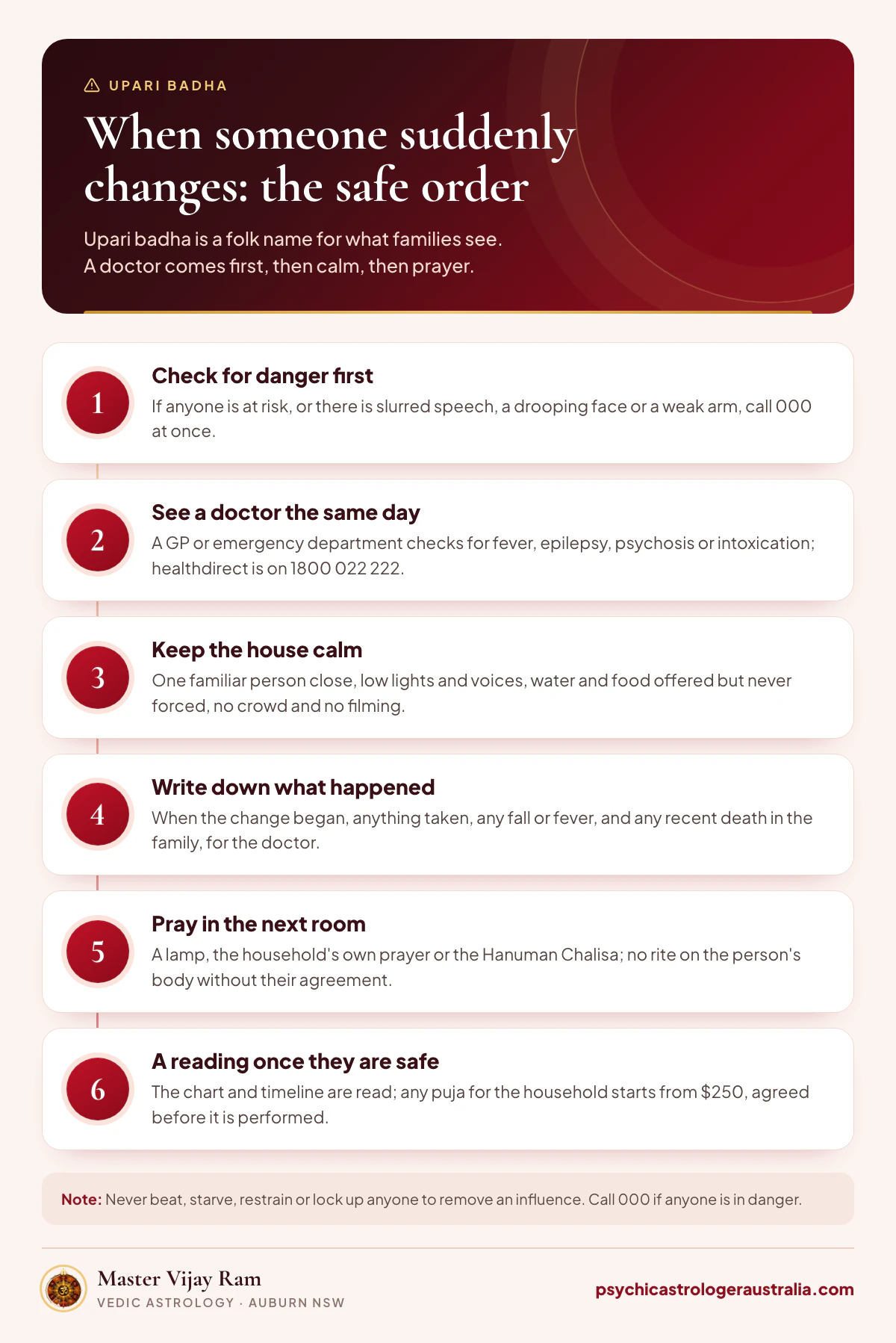
Calm, and a doctor. Keep one familiar person close, lower the lights and the voices, offer water and food without insisting, and keep the rest of the family out of the room. Write down when the change began, anything taken, any fall or fever, and any recent death in the family, and take that list to the GP or the emergency department.
Prayer can begin at the same time, in the next room: a lamp lit, the family's own prayer said quietly, no rite performed on the person's body without their agreement. For the people caring for someone who believes they are under an influence, helping someone who is sure they are cursed gives a carer's guide to staying close without arguing.
What if the person is a new mother?
Many families keep customs for the weeks after a birth, and some read a new mother's sudden change as a hawa that found her while she was weak. A mother who becomes confused, suspicious, sleepless or frightened in the days or weeks after the birth needs urgent medical care, because psychosis after childbirth is a recognised emergency. Her midwife, her GP or the emergency department comes first, and PANDA supports families through perinatal anxiety and depression.
Prayer for her and the baby can be kept at home in the family's usual way, quietly, with no smoke, camphor or strong incense near the baby.
What does the Vedic tradition offer?
Protection through devotion rather than force. The Hanuman Chalisa, Tulsidas's forty verses, has a line families have leaned on for centuries, bhoot pisach nikat nahi aavai, mahabir jab naam sunavai: no ghost or goblin comes near when the name of the great hero is recited. The Hanuman Chalisa for fear and protection explains how families keep it.
Beyond the household's own prayer, the tradition offers a reading, mantra jaap and, where it is warranted, a shanti puja or havan for the person and the home. Any such puja is performed by Master Vijay Ram in person at Auburn, and relatives can follow it on a video call; it is done for the person's peace, never on a person who is unwilling or unwell and untreated.
What does a reading look for once they are safe?
Once the person is safe and medical care has begun, the chart and the timeline are read. The Moon, which the tradition reads as the mind, is checked first, then Rahu and Ketu, the eighth and twelfth houses and the dasha running when the change began. A Rahu period over a weak Moon, or a recent death in the family, often explains the fear in the house better than any visitor from outside.
The reading never diagnoses an illness and never tells a family to stop a treatment. Possession symptoms: jinn, spirit or black magic sets out how the Vedic, Islamic and folk explanations are told apart, so that ground is not repeated here.
Is upari badha the same as kiya-karaya?
Not quite: upari badha pictures an influence that touched a person by chance or by place, such as the wind at dusk or a spirit near a cremation ground. Kiya-karaya pictures something done on purpose by someone, and it carries a suspicion of a person that upari badha does not. Kiya-karaya and how it is removed covers that idea, and when the family's story starts sliding towards a person, the careful answer is the same: no one is named.
What does upari badha removal cost?
The $50 consultation, by phone, video or WhatsApp, comes after the doctor, not before. Prayer work for the person and the household starts from $250 where the reading supports it, always agreed before it is performed, and puja and havan performed on request explains how it is arranged. What families call upari badha removal is, in this practice, prayer and protection with medical care running alongside.
What if elders insist on a folk healer?
It happens often when the elders are in India and the family is here. As an illustration, a family in Melbourne's west might have a grandmother on the phone from Punjab insisting that her grandson be taken to a healer who beats out the hawa, while his parents sit in an emergency department waiting room. The answer is to honour her worry, keep him with the doctors, and offer her a role: the family's prayer at home, a lamp, the Hanuman Chalisa said together on a video call.
Folk cures that hurt, delay treatment or frighten belong nowhere near a sick person, and black magic removal as practised here never includes them. Vedic readings for Melbourne families explains how consultations run from Victoria once the person is in care.
What prayer and a reading cannot replace
A reading cannot treat fever, psychosis, epilepsy, addiction or grief, and it cannot tell you that a doctor is unnecessary. This is faith-based guidance, not medical, legal or psychological advice, and no result is promised. What it can do, once the person is safe and in care, is give a frightened family a calm way to pray, a clearer picture of the period they are in, and protection for the household that harms no one.
Read next
- Kiya-Karaya: What Hindi and Punjabi Families Mean and How It Is RemovedKiya-karaya means something done against you, or caused to be done: how it differs from nazar and graha dosha, why no…
- Sihr Removal in Australia: Signs of Sihr and How Ruqyah HelpsSihr removal in Australia explained: the signs worth taking seriously, what to rule out first, how ruqyah actually wo…
- Seivinai and Suniyam: Black Magic Fears in Tamil FamiliesSeivinai and suniyam in Tamil families: what the words mean, what to rule out, temples for archanai, the Kanda Sashti…
Frequently asked questions
What is upari badha?
Upari badha is a Hindi folk term for trouble believed to come from outside the ordinary world, an unseen influence that has settled on a person and changed them. Families use it when someone suddenly becomes frightened, withdrawn, refuses food or speaks strangely. It is a way of describing what is seen, not a diagnosis, and the same signs need a doctor's assessment first.
What does upar ki hawa mean?
Literally the wind from above. It is the folk idea of an unseen influence brushing past a person, often said to happen at a lonely place, at dusk or near a cremation ground, after which they are not themselves. Hawa lagna, being touched by the wind, describes the moment it is believed to have happened. The words describe a fear, and a doctor checks the body first.
What are the symptoms of upari badha?
Families describe a sudden change: fear of a room or the dark, refusing food or water, broken or excessive sleep, a strange voice or vocabulary, staring spells, seeing or hearing someone, or anger towards loved ones. Every one of these can also be fever, delirium, epilepsy, psychosis, intoxication, withdrawal or grief, which is why medical care comes before any ritual.
Should we take them to a doctor or a healer first?
A doctor, the same day. A GP or emergency department can check for infection, epilepsy, psychosis, intoxication, a stroke and other urgent causes, and healthdirect's nurse line on 1800 022 222 can advise at any hour. Call 000 if anyone is at risk. Prayer can begin at home at the same time, and a reading can follow once the person is safe.
Is it ever right to restrain or beat someone to remove an influence?
Never. Beating, starving, restraining, locking up, holding smoke or burning chillies to the face, cold water and forced drinks have injured and killed people at the hands of relatives and healers who believed they were helping. Stop anyone who suggests it. If a person is a danger to themselves or others, call 000; that is a medical emergency, not a spiritual one.
What is pret badha?
Pret badha means obstruction by a preta, which in the tradition is the restless spirit of someone who died without proper rites or before their time. Families often connect it with a recent death or a visit to a cremation ground. Grief, especially after a death that could not be attended, produces many of the same experiences, so the family's own remembrance rites and support matter as much as anything else.
Which prayer helps with fear of bhoot-pret?
The Hanuman Chalisa is the prayer most families turn to, with its line that no ghost or goblin comes near when the great hero's name is recited. A lamp at dusk and the household's own prayer, said calmly and together, are the other traditional supports. They are said for the person's peace and the home's protection, alongside the doctor's care.
Can Master Vijay Ram remove upari badha?
He offers what the tradition offers, after medical care has begun: a reading of the chart and timeline, mantra jaap, and where it is warranted a shanti puja or havan for the person and household, performed himself at his place of practice in Auburn. He never works on a person who is unwilling, never tells a family to stop treatment, and promises no result.
What does it cost?
Once the person has seen a doctor, a $50 consultation by phone, video or WhatsApp, in English, Hindi or Punjabi, is the first step. Any puja, havan or jaap the reading supports starts from $250, with the amount agreed before it is performed and the family able to join by video. There are no emergency rates.
People also ask
How do you know if someone has upar ki hawa?
You cannot tell from the signs alone, because sudden fear, refusing food, odd speech and staring are also signs of fever, delirium, epilepsy, psychosis, intoxication and grief. The safe order is a doctor first, the same day, then calm at home, then prayer and a reading once the person is safe. Nobody should be frightened, restrained or tested to find out.
What is the remedy for upari badha?
In the tradition, prayer and protection: the Hanuman Chalisa, a lamp, mantra jaap, and where a reading warrants it a shanti puja or havan for the person and home. In practice the remedy always runs alongside medical care. Folk cures that hurt, starve, restrain or delay treatment are never acceptable, whoever recommends them.
Can grief look like a spirit problem?
Yes. After a death, especially one that could not be attended, many people sense the person nearby, hear their voice, dream of them vividly or talk to them, and families sometimes read this as pret badha. It is a common part of grief. Company, remembrance rites, time and a grief counsellor help; a doctor should check anyone who stops eating or sleeping.
Is upari badha a mental illness?
Upari badha is a folk explanation, not a medical term, and some people described this way do have a treatable illness such as psychosis or epilepsy, while others are feverish, intoxicated or grieving. A doctor can tell which. Faith and medicine are not rivals here: many families keep their prayer while the person receives treatment.
References & further reading
Serving clients across Australia
Confidential consultations by phone, video & WhatsApp — including: