
Quick answer
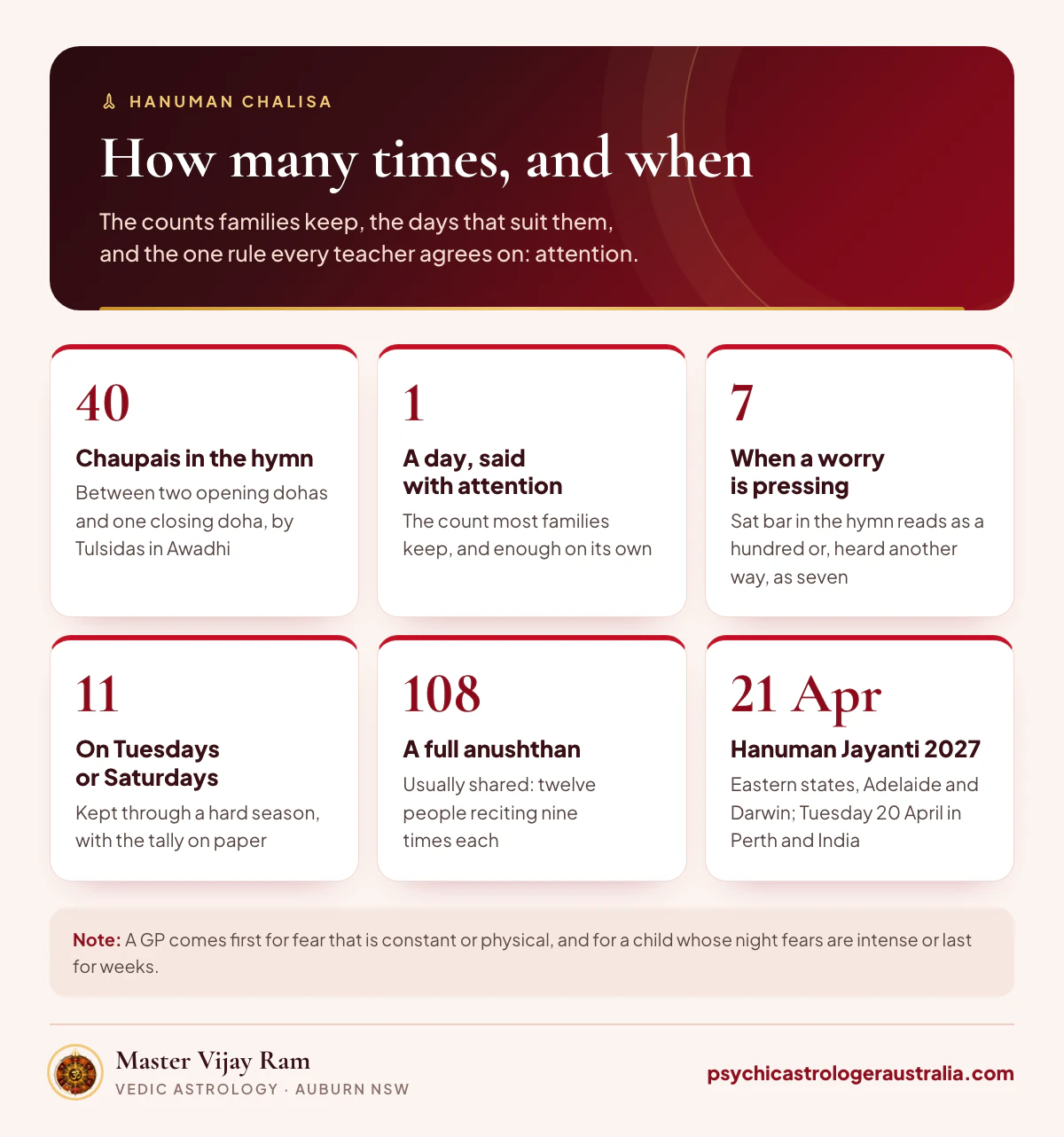
Most families recite the Hanuman Chalisa once a day, seven or eleven times when fear is pressing, and a hundred and eight times as a vow that is usually shared among a group. Tuesday and Saturday are its days, at dawn or at lamp-lighting. It steadies the person saying it; it never replaces a doctor or the police.
What is the Hanuman Chalisa, and why do frightened people reach for it?
The Hanuman Chalisa is a devotional hymn of forty chaupais that Tulsidas composed in Awadhi in the sixteenth century, and for many Hindu families it is the first prayer that surfaces in a frightening hour. Grandmothers teach it before the alphabet, students mutter it outside exam halls, and a driver caught in a storm on the Bruce Highway may find it coming back word for word. People who look up the Hanuman Chalisa for protection usually know it already; what they want to know is how many times, on which days, and whether they are doing it properly.
Master Vijay Ram hears those questions every week, often from someone who has also asked about negative energy removal and wonders whether the Chalisa might be enough on its own. Quite often his answer is yes. This guide covers the text, the counts and the days, a child who is afraid of the dark, and the things the hymn was never meant to do.
What do the forty verses actually say?
The hymn opens with two dohas, couplets in which the reciter bows to the guru, admits to being buddhi heen, short of understanding, and asks Hanuman for strength, wisdom and knowledge. Forty chaupais follow, and a single doha closes it, asking him to live in the heart together with Rama, Lakshmana and Sita. The name itself comes from chalis, the Hindi word for forty.
The first ten chaupais describe Hanuman himself: his strength, his learning, the thunderbolt and the banner in his hands. The next ten tell what he did for Rama, from carrying the herb that revived Lakshmana to leaping the ocean with Rama’s ring held in his mouth. The second half turns towards the person reciting, and that is where the lines about fear are found.
Which lines speak to fear and protection?
A handful of lines carry most of the weight for a frightened reader. “Tum rakshak kahu ko darna” says that with Hanuman as protector there is no one left to fear. “Bhoot pisach nikat nahi aavai, Mahabir jab naam sunavai” says that ghosts and troubling spirits keep their distance wherever his name is spoken.
“Nasai rog harai sab pira” asks for illness and pain to be taken away, and “Sankat te Hanuman chhudavai” gives him his best-loved title, Sankat Mochan, the one who frees people from trouble, on the condition that he is held in mind, deed and word. That condition is easy to skim past. The hymn ties its protection to attention, not to a number, and printed editions spell these lines in several slightly different ways.
How many times should you recite it?
Once, said with attention, is the count most families keep, and it is enough. The larger numbers belong to particular moments: three or seven when a worry is pressing, eleven on Tuesdays or Saturdays through a hard season, twenty-one as a short vow, and a hundred and eight as a full anushthan. Traditions differ on every one of these, and no teacher worth hearing will tell you that a smaller number does not count.
Near its end the hymn names a number of its own. “Jo sat bar path kar koi” promises release from bondage to whoever recites it sat bar: read as the Sanskrit shata it means a hundred times, and heard as the everyday Hindi saat it sounds like seven. Families who keep the Hanuman Chalisa 7 times, or a hundred and eight, tend to point to this line, and both readings have their followers.
| Count | When families use it | Roughly how long | A practical note |
|---|---|---|---|
| Once | Every day, at dawn or at lamp-lighting | Five to ten minutes | The count that lasts; daily and plain beats heroic and rare |
| Three or seven | A worrying week, the night before a hard appointment | Under an hour for seven | Seven in one sitting needs a quiet room and a glass of water nearby |
| Eleven | Tuesdays or Saturdays through a difficult stretch | An hour or more | Keep the tally on paper; a mala suits a mantra better than a whole hymn |
| Twenty-one | A short vow, or one long sitting on a festival | A few hours in one sitting | Once a day for twenty-one days is the gentler way to keep it |
| A hundred and eight (108) | An anushthan, Hanuman Jayanti, a family crisis | A full day for one person | Usually shared: twelve people reciting nine times each |
Which days and hours suit it?
Tuesday and Saturday are Hanuman’s days, and keeping the Hanuman Chalisa on Tuesday and Saturday is the oldest household rhythm attached to it. Tuesday, Mangalvar, has belonged to him for as long as anyone’s grandmother remembers; Saturday comes from a popular story in which Hanuman freed Shani from Ravana’s prison and Shani promised to go gently on those who remember him. Families in a hard Saturn period often keep the Saturday recitation for that reason, and the weekday fasts for each planet explains how a Tuesday or Saturday vrat fits beside it.
The hour matters less than the habit. Morning after a bath and before food is the classic time; lamp-lighting suits people who leave for work early; last thing at night suits anyone who lies awake. A night-shift worker can keep their own dawn, whatever the clock says.
Hanuman Jayanti, on Chaitra Purnima, is the great day of the year for the Chalisa. In 2027 it falls on Wednesday 21 April in the eastern states, Adelaide and Darwin, and on Tuesday 20 April in India and in Perth, where the Purnima meets no sunrise at all; some Tamil, Telugu and Kannada families keep his birthday in another month by their own calendars, so their temple’s date is the one to follow.
| City | Date | Chaitra Purnima (local time) | Rule applied |
|---|---|---|---|
| Sydney | Wed 21 Apr 2027 | Tue 20 Apr 2027, 9:22 AM AEST – Wed 21 Apr 2027, 8:27 AM AEST | tithi present at sunrise (udaya tithi) |
| Melbourne | Wed 21 Apr 2027 | Tue 20 Apr 2027, 9:22 AM AEST – Wed 21 Apr 2027, 8:27 AM AEST | tithi present at sunrise (udaya tithi) |
| Brisbane | Wed 21 Apr 2027 | Tue 20 Apr 2027, 9:22 AM AEST – Wed 21 Apr 2027, 8:27 AM AEST | tithi present at sunrise (udaya tithi) |
| Perth | Tue 20 Apr 2027 | Tue 20 Apr 2027, 7:22 AM AWST – Wed 21 Apr 2027, 6:27 AM AWST | the day the tithi covers most of the daylight — it meets no sunrise here (kshaya) |
| Adelaide | Wed 21 Apr 2027 | Tue 20 Apr 2027, 8:52 AM ACST – Wed 21 Apr 2027, 7:57 AM ACST | tithi present at sunrise (udaya tithi) |
| Canberra | Wed 21 Apr 2027 | Tue 20 Apr 2027, 9:22 AM AEST – Wed 21 Apr 2027, 8:27 AM AEST | tithi present at sunrise (udaya tithi) |
| Hobart | Wed 21 Apr 2027 | Tue 20 Apr 2027, 9:22 AM AEST – Wed 21 Apr 2027, 8:27 AM AEST | tithi present at sunrise (udaya tithi) |
| Darwin | Wed 21 Apr 2027 | Tue 20 Apr 2027, 8:52 AM ACST – Wed 21 Apr 2027, 7:57 AM ACST | tithi present at sunrise (udaya tithi) |
| New Delhi (reference) | Tue 20 Apr 2027 | Tue 20 Apr 2027, 4:52 AM IST – Wed 21 Apr 2027, 3:57 AM IST | tithi present at sunrise (udaya tithi) |
The tithi is one moment everywhere; only the clock and the sunrise differ, which is why a city can fall a day apart from India. Computed with the Swiss Ephemeris (Lahiri ayanamsa for Vedic positions) and checked against US Naval Observatory data. Times are rounded to the minute.
Do you need a lamp, red flowers and sindoor?
Strictly, nothing: the Chalisa is words, and words travel to a car park, a hospital corridor or a share-house bedroom. At home most families add a few things that set the time apart: a picture or small murti of Hanuman, a lamp of ghee or sesame oil, a red flower or two, and a pinch of sindoor. A red hibiscus from a Cairns or Darwin garden does the job as well as any temple garland.
Sindoor belongs to Hanuman through a well-loved story: seeing Sita put sindoor in her parting for Rama’s long life, he covered himself in it so that Rama would live for ever. Temples dress his murti in sindoor mixed with jasmine oil, the chola, and families offer a little on a Tuesday. Prasad is simple, jaggery and roasted chana, or boondi laddoos when someone has been past the sweet shop.
Keep the lamp on a metal plate, clear of curtains and well away from the smoke alarm, and never leave it burning in an empty room. That is the whole setup.
Are there Hanuman Chalisa rules, and which ones matter?
Families hand down plenty of Hanuman Chalisa rules: bathe first, wear clean clothes, face east, avoid meat and alcohol on the day, never stop halfway, never recite it lying down. Most are good habits of attention dressed up as rules. None of them appears in the hymn.
Two worries come up again and again. People fear that a mispronounced word will offend him, yet the hymn opens with the reciter confessing to little understanding and asking for help, and it is written in Awadhi, the everyday speech of its time, not temple Sanskrit. On whether women may recite it, or recite it during menstruation, traditions differ: some households ask for a pause from temple ritual, and many teachers say a prayer said from memory is never barred.
The rule that matters is attention. In the tradition’s own terms, one Chalisa said slowly with the mind on the words outweighs seven said while scrolling.
Can the Chalisa help a child who is frightened at night?
It can be part of the help, after the ordinary things. Night fears are common in young children, and the usual causes are plain ones: a scary video, an older cousin’s ghost story, a change at school, a new baby, too much screen time before bed. A child whose fear is intense or lasts for weeks, or comes with sleepwalking, night terrors, loud snoring or changes during the day, should see the GP or the child health nurse first.
Then the Chalisa becomes a bedtime ritual rather than a weapon. A parent can sit on the edge of the bed and say it softly while the child drifts off, or teach one line to hold on to: “Tum rakshak kahu ko darna”, with you as my protector, whom should I fear. Choose that gentle line rather than the one about ghosts, because a child who is afraid of ghosts does not need ghosts named at bedtime.
Keep talk of curses, nazar and black magic out of the child’s hearing altogether. Recurring nightmares and sleep paralysis covers the adult side of broken nights, where the medical questions come first in just the same way.
Does it help an adult’s fear, or anxiety that will not settle?
Many adults use the Hanuman Chalisa for fear the way their parents did: in the car before a court date, in a hospital waiting room, at three in the morning when the mind will not stop. Sung slowly, the chaupais set a steady rhythm, and many people find their breathing slows to follow it. That is a real comfort and worth having.
Fear that is constant, physical or out of proportion is a different matter. Panic, a racing heart, months of dread or broken sleep are reasons to see a GP, and Beyond Blue on 1300 22 4636 and Lifeline on 13 11 14 are there to talk to; in an emergency, ring 000. The Chalisa can sit beside that help, never in place of it.
If the counting itself starts to feel compulsive, if you fear that a missed recitation will bring disaster, tell the GP that too. Devotion should leave a person lighter, not chained to a tally.
Can the Chalisa settle a house that feels heavy?
In the tradition’s terms it is one of the gentlest ways to keep a house steady. Families recite it at dusk with the lamp lit, walk slowly through the rooms saying it, or say it at the front door after a difficult visitor has gone. Others leave a recording playing all day; a recording teaches the tune, but the tradition counts the words you say, not the speaker in the corner.
Before deciding a house is heavy, rule out the plain causes: damp and mould, a gas heater overdue for a service, a household running on too little sleep. The daily routine for protection sets out the threshold and evening-lamp habits, and the Chalisa slots into the evening lamp without any fuss.
What is the Chalisa not for?
It is not a spell. It cannot be aimed at a person, recited to make someone come back, or used to win a quarrel with a relative, and it was never meant to frighten anyone; the Hanuman of the hymn is a servant and a guardian, not a weapon. Anyone selling a “powerful Hanuman mantra” to harm a rival has misunderstood the deity and the text alike.
Nor is it a treatment. It does not replace medication, a psychologist, a lawyer or the police, and no number of recitations can promise that nothing bad will happen. It is a prayer, which steadies the person saying it and leaves the rest to Hanuman.
When is it worth asking for more than your own recitation?
When the fear has a shape: it began on a date you can name, it follows one person through several houses, or a whole family is caught in it at once. Then a $50 consultation by phone, video or WhatsApp reads the chart against those dates, and often the advice is simply to keep the Chalisa and fix the ordinary things. Where a protective item would genuinely help, a kavach prepared after a consultation is the traditional next step, never a purchase on its own.
The Sundarkand, the book of the Ramayana that follows Hanuman to Lanka, is the longer recitation families choose for bigger occasions, and holding a Sundarkand path at home explains how one runs. Some families instead ask for a hundred and eight recitations, or a Sundarkand, performed on their behalf: Vijay Ram ji carries these out himself in Auburn, the only place he practises, at a muhurat chosen for the purpose, and relatives may follow over video; a path or jaap performed for you starts from $250, agreed with the family beforehand.
Where can you recite with others, from Darwin to Geelong?
A Chalisa said together has its own pull, and Tuesday evening recitations are a fixture at many Hanuman temples in India. In Darwin the Sri Sithy Vinayakar Temple at Malak, home of the Hindu Society of the Northern Territory for more than four decades, is the place to ask; in Townsville a BAPS mandir meets in Railway Estate while the North Queensland Hindu community builds its Shree Durga Mahalakshmi Temple.
In Cairns, Geelong and on the Sunshine Coast, where the community still gathers in hired halls, a recitation is something a family can host in its own lounge room, with the neighbours warned about the singing. People there consult by phone or video like everyone outside Sydney; readings for Townsville families explains how that works, and the only in-person option is Auburn by appointment.
What can a Chalisa honestly promise?
Less than the internet says, and more than a sceptic expects. It cannot cure an illness, settle a court case, bring back a partner or stop every frightening thing from happening, and it is offered here as faith-based practice, not medical, legal or psychological advice. What it can do is give a frightened person something steady to hold, every day, in their own voice.
For most families that is the whole of the protection they need, and the number that matters is the one you will still be keeping next year. If something more is going on, one calm conversation will say so.
Read next
- How to Remove Negative Energy From Yourself: Vedic MethodsVedic ways to clear negative energy from yourself: what to rule out first, safe home practices, the four-gate reset, …
- Sundarkand Path at Home: When Families Hold One, and HowSundarkand path at home: what the fifth book of the Ramayana tells, when families hold a path, how it runs in a house…
- Vibhuti and Bhasma: Holy Ash in Protection and CleansingVibhuti and bhasma, the holy ash of Shiva: what it is made of, the tripundra, how to apply it with Om Namah Shivaya, …
Frequently asked questions
How many times should I recite the Hanuman Chalisa for protection?
Once a day, said with attention, is what most families keep and it is enough. Three or seven recitations suit a worrying week, eleven suits Tuesdays or Saturdays through a hard season, and a hundred and eight is a full anushthan usually shared among a group. Traditions differ on all of these, and the count you can sustain for a year matters more than a large one kept for a week.
Why do people recite the Hanuman Chalisa seven times?
Near its end the hymn promises release from bondage to whoever recites it sat bar. Read as the Sanskrit shata, that means a hundred times; heard as the everyday Hindi saat, it sounds like seven. Families who keep seven, or a hundred and eight, tend to point to this line. Seven recitations in one sitting take most people a little under an hour.
Is Tuesday or Saturday better for the Hanuman Chalisa?
Both are Hanuman’s days. Tuesday, Mangalvar, has always belonged to him, and Saturday comes from a popular story in which Hanuman freed Shani from Ravana’s prison and Shani promised to go gently on his devotees, so people in a hard Saturn period often keep Saturday. Many households keep both, and a daily recitation needs no particular day at all.
Can I recite the Hanuman Chalisa at night before sleeping?
Yes. Morning after a bath is the classic time, but evening at lamp-lighting and last thing at night are both common, and many people who lie awake find the steady rhythm of the chaupais settles them. Say it sitting up if you can, slowly, and let it be the last thing before the light goes off rather than something done while scrolling.
Can women recite the Hanuman Chalisa?
Yes, and women have recited it in Indian households for centuries. Some families keep older customs, such as not touching a Hanuman murti or pausing temple ritual during menstruation, and traditions differ on these. Many teachers say a prayer said from memory is never barred to anyone, and the hymn itself places no restriction on who may say it.
What if I mispronounce the words of the Hanuman Chalisa?
The hymn opens with the reciter admitting to little understanding and asking Hanuman for strength and wisdom, so imperfection is expected from the first line. It is written in Awadhi, the everyday speech of its time rather than temple Sanskrit, and printed editions spell several lines differently. Learn it slowly from a recording or a family member and keep going.
Does playing a Hanuman Chalisa recording count?
A recording is a good way to learn the tune and the words, and many families like it playing in the background. In the tradition, though, the practice is the recitation itself, the words said in your own voice with attention. Listening while you follow along silently is a reasonable middle step for someone who is still learning the text.
Can I recite the Hanuman Chalisa for someone else?
Yes. Parents say it at a frightened child’s bedside and families say it for a parent in hospital, and the tradition has always allowed prayer on another’s behalf. Keep it gentle and private, never use it to pressure the person, and make sure the practical help, the GP, the specialist or the counsellor, is already in place.
When is Hanuman Jayanti in 2027?
Hanuman Jayanti falls on Chaitra Purnima: Wednesday 21 April 2027 in Sydney, Melbourne, Brisbane, Adelaide, Darwin and the other eastern cities, and Tuesday 20 April 2027 in India and in Perth, where the Purnima meets no sunrise at all. Some Tamil, Telugu and Kannada families keep his birthday in a different month by their own calendars, so follow your temple.
Can Master Vijay Ram recite the Hanuman Chalisa or a path for me?
Yes, where it is warranted. He can recite a hundred and eight Chalisas, or a Sundarkand, himself in Auburn at a well-chosen hour, and the family may follow on a video call. The cost begins at $250 and is agreed in advance; a $50 consultation usually comes first, and it often concludes that your own daily recitation is enough.
People also ask
Which line of the Hanuman Chalisa is for protection?
Several. Tum rakshak kahu ko darna says there is no one to fear with Hanuman as protector; Bhoot pisach nikat nahi aavai says troubling spirits keep away when his name is spoken; and Sankat te Hanuman chhudavai calls him the one who frees people from trouble, provided he is held in mind, deed and word. Most families recite the whole hymn rather than single lines.
What happens if you read the Hanuman Chalisa daily?
In the tradition, daily recitation builds devotion and a steady protection around the person keeping it. In practical terms it gives the day a fixed point, a few quiet minutes, and a rhythm many people find calming. It cannot cure illness, settle a dispute or replace a doctor, and a fear that does not lift with it deserves proper help.
What are the rules for reading the Hanuman Chalisa?
Families keep many: bathe first, wear clean clothes, face east, avoid meat and alcohol on the day, finish what you start. Most are habits of attention rather than requirements, and none appears in the hymn itself. The rule every teacher agrees on is to say it slowly with your mind on the words, and to keep a lamp safely away from curtains and smoke alarms.
Can the Hanuman Chalisa remove fear?
It is one of the most loved prayers for fear, and many people find that saying it slowly calms them. Fear that is constant, physical or out of proportion is different: panic, months of dread or broken sleep are reasons to see a GP, and Beyond Blue and Lifeline are there to talk to. The Chalisa sits beside that help, never in place of it.
References & further reading
Serving clients across Australia
Confidential consultations by phone, video & WhatsApp — including: