
Quick answer
Most reported possession symptoms — sudden shifts in manner, sleep paralysis, a lost appetite for prayer — have ordinary medical or psychological causes to rule out first. Where something spiritual is genuinely involved, the pattern usually has a datable onset, is noticed by outsiders, and never fully lifts.
What people actually mean by possession
Possession is a heavy word, and it is rarely the right one. When a family rings and says someone is possessed, they usually mean something narrower and more frightening: a person they love has changed, and no explanation fits. The change might be a temper that arrives from nowhere, a face that looks unfamiliar for a few seconds, or a flat refusal to enter one room of the house.
Master Vijay Ram has spent forty years listening to those descriptions. The honest starting position is that most of them have an ordinary cause. A smaller number do not. The work of an assessment is to separate the two carefully, without theatre, and without deciding in advance which answer would be more interesting.
The symptoms families report most often
The same handful of reports come up again and again. Sudden shifts in voice or manner that last minutes and then pass. A strong aversion to prayer, scripture or a place of worship in someone who was devout. Waking at the same hour night after night, pinned and unable to move. Scratches with no remembered cause. Smells nobody else notices.
None of these, on its own, means anything. That is worth saying plainly, because lists of possession signs are written to frighten. A longer account of the individual markers sits in 15 Signs of Jinn Possession (and What to Do Next). What matters far more than any single symptom is the shape the symptoms make together: when they started, who else sees them, and whether they ever stop.
The Three-O Check: onset, others, offset
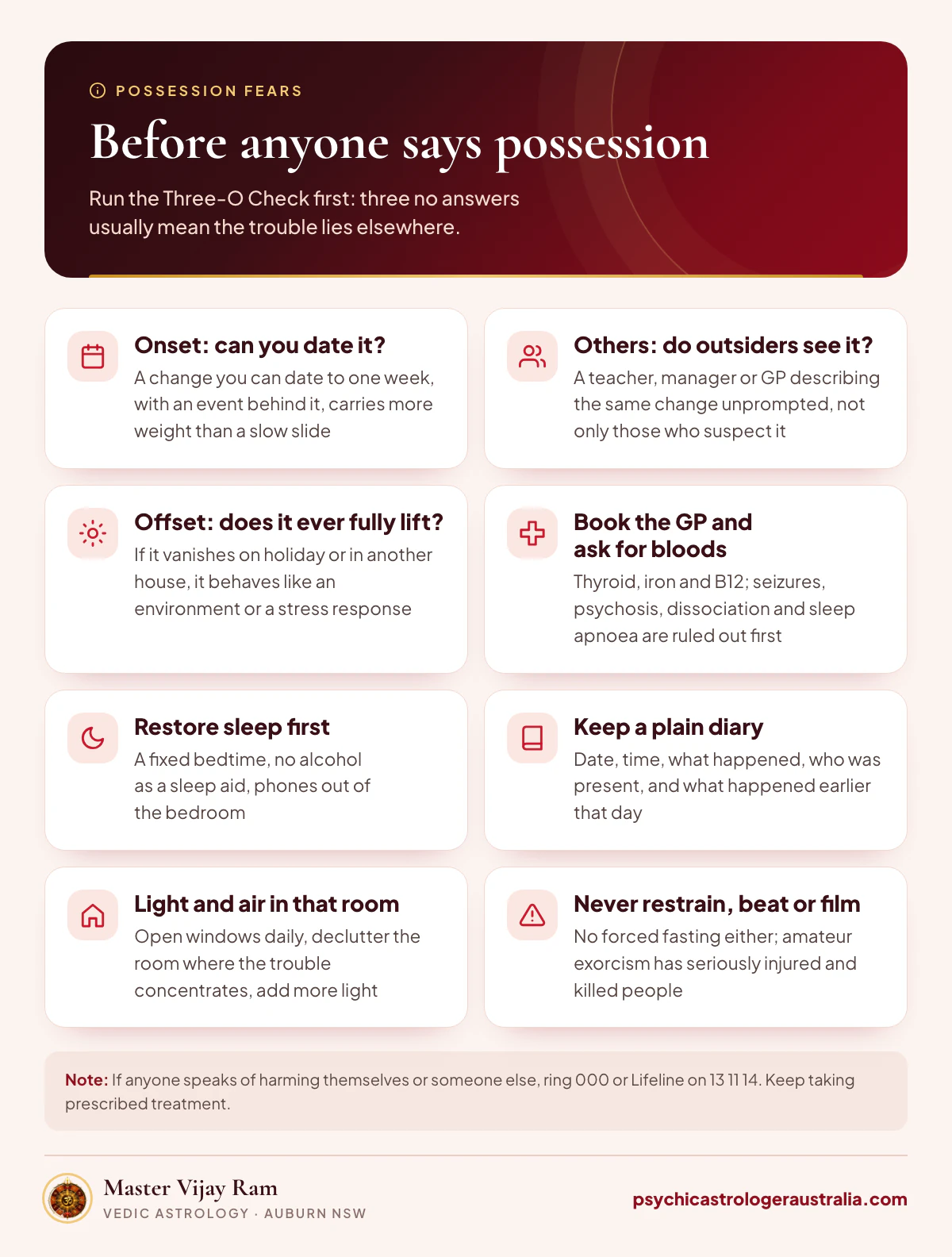
Vijay Ram ji applies a simple screen before anything else is considered, and you can run it yourself tonight. Call it the Three-O Check.
- Onset. Can you date the change to a single week, and name what happened then? A sharp onset with an event behind it carries more weight than a slow slide over two years.
- Others. Do people outside the household — a teacher, a manager, a GP — describe the same change unprompted? Or is it seen only by those who already suspect it?
- Offset. Does it ever fully lift? Something that disappears completely on holiday, or in another house, is behaving like an environment or a stress response, not an attachment.
Three yes answers prove nothing by themselves. Three no answers usually mean the trouble lies elsewhere, which is the far more common result.
A sign-by-sign checklist before you conclude anything
The table here is the one used in a first conversation. Read the middle column properly. Almost every case stops there, and it should.
| Sign observed | Ordinary explanation to rule out first | What would point to something spiritual |
|---|---|---|
| Voice, face or manner changes for minutes, then returns | Focal or temporal lobe seizures, dissociative episodes, intoxication or withdrawal, severe sleep debt | Unrelated people witness it, it ties to one place or hour, and the stretches in between are normal |
| Waking pinned, unable to move, sure someone is in the room | Sleep paralysis, shift work, sleep apnoea, alcohol, a new medication | Episodes continue on restored sleep, occur while fully awake, and follow the person to other houses |
| Sudden dread on entering one particular room | Trauma associated with that room, mould, poor ventilation, carbon monoxide, low light and noise | Several people with no shared history react in the same spot, starting after a datable event |
| A devout person now refuses prayer or scripture | Depression, burnout, grief, unresolved anger at a community or a leader | The aversion is physical and abrupt, lifts fully away from that setting, and pre-dates any loss of belief |
| Long unexplained illness with normal test results | Thyroid disease, low iron or B12, autoimmune conditions, sleep disorders, anxiety | The workup is complete and clear, symptoms track a calendar or a place, and the household dips together |
| Words, names or details the person could not know | Cryptomnesia, delirium, fever, psychosis, medication side effects | The content is specific, checkable by a third party who was absent, and repeats consistently |
Distance changes nothing about this reading. A family looking for Vedic help across Canberra works through the same three columns as anyone else, because an assessment is a conversation rather than an inspection.
What jinn disturbance tends to look like
In the Islamic tradition, jinn are created beings with their own lives, mostly indifferent to ours. Disturbance, where it genuinely occurs, tends to be episodic rather than constant. Families describe trouble that clusters at particular hours or in one part of a house and eases elsewhere. A person may become agitated during recitation, settle afterwards, and remember little of it.
What it does not look like is a permanent personality change with no gaps. That pattern points somewhere else almost every time. Where an assessment does suggest jinn involvement, the work on jinn disturbance proceeds quietly, without shouting, restraint or performance. Nobody is held down. Nobody is filmed. If a practitioner proposes otherwise, walk away and take the person to a doctor first.
What a spirit or pret-atma attachment tends to look like
In the Vedic understanding, a pret-atma is a departed soul that has not moved on, often after a sudden or unresolved death. Reports here carry a different texture. The affected person is described as sorrowful rather than aggressive, drawn to one spot, using turns of phrase that belonged to someone who has died, or grieving out of all proportion to their own loss.
Old grief explains most of this, and anniversary reactions are powerful and badly understood. Where an assessment does point further, releasing a spirit from a home is carried out gently and away from the household, so that no family member is put through a scene. The aim is release for both sides, not confrontation.
Why black magic behaves differently from both
Black magic, sihr, kala jadu — whichever word your household uses — is not ambient. It is described as targeted, and that shows in the pattern. The trouble follows a person rather than a place. It concentrates on one area of life: a marriage, a business, a visa, a court matter. It sharpens around dates that matter, and often begins after a specific falling-out.
Possession language attaches itself here because a targeted person becomes exhausted, irritable and unlike themselves. That is a consequence, not a mechanism. Anyone under sustained stress shows many of the same signs as the person who fears an attachment. Telling the two apart is the whole purpose of a careful first conversation, and it takes questions rather than a glance.
Nazar and heaviness at the lightest end of the scale
Most of what reaches this practice is not possession at all. It is heaviness: a home where arguments start over nothing, sleep that never restores, money that leaks away, a general sense of being worn down and watched. Nazar, buri nazar, drishti — the word differs by community, and the lived experience is much the same.
This end of the scale responds to simple work, and it is where most honest cases sit. Enquiries about the negative energy and evil eye removal work done for Blacktown households are very often exactly this: a Western Sydney household feeling flat and unlucky, not a person behaving strangely. Naming it accurately matters both ways. Heaviness treated as possession frightens a family for nothing, and possession treated as heaviness delays real help.
When this is not the answer
A great deal of what is brought here as possession has a medical, psychological or legal name. Those come first, always, and before any remedy is discussed.
- Temporal lobe and focal seizures, which produce fear, strange smells, altered awareness and lost minutes.
- Psychosis, bipolar mania and postpartum psychosis, all treatable and dangerous to leave alone.
- Dissociative episodes after trauma, where a person genuinely does not feel like themselves.
- Delirium from infection, thyroid disease, low iron or B12, sleep apnoea, or a new medication.
- Alcohol and drug intoxication or withdrawal, including from prescribed medicine.
- Coercive control and family violence, where fear and personality change are caused by another person. That belongs with police and lawyers.
If anyone is speaking about harming themselves or someone else, ring 000, or Lifeline on 13 11 14. Spiritual work sits alongside medical care. It never replaces it, and no honest practitioner will ask you to stop treatment.
Sleep, the single most misread symptom
More possession fears begin in bed than anywhere else. Sleep paralysis is the usual culprit: you wake with your mind alert and your body still locked, often with a crushing weight on the chest and a certainty that something is standing in the room. It is terrifying, it is common, and it is well described in sleep medicine. Shift work, alcohol, sleeping on your back and broken sleep all make it likelier.
So the first questions are about rosters, caffeine, screens and snoring, not about spirits. Where episodes persist on restored sleep, follow the person between houses and occur wide awake, that is a different picture. At that point faith-based ruqyah is one route considered, alongside — never instead of — a sleep study.
What households get wrong in the first week
The first week is where avoidable damage happens. Relatives gather, phones come out, and someone is challenged and provoked to see what happens. Amateur exorcism attempts begin: restraint, beating, forced fasting, cold water. People have been seriously injured, and some have died, during exorcisms attempted by untrained helpers. Do not do it, whatever anyone in the room claims to have seen.
The second error is deciding the answer before asking the question. Enquiries about how this is handled for families in South Western Sydney often open with a family insisting a spouse is not themselves and must have been interfered with, when the honest reading is an ordinary marriage in trouble.
Exorcism vs Spiritual Healing: A Safer Alternative sets out why the gentler route is safer, and it is worth reading before anybody acts.
What a careful assessment actually asks you
A first conversation is mostly questions, and they are ordinary ones. When did it start, and what else happened that month. Who else has noticed, and in what words. What a normal week looks like now compared with two years ago. What medication is being taken. Who has already been seen: GP, psychologist, imam, priest. What has been tried, and what changed afterwards.
Nothing is asked about your bank balance, and no verdict is reached from a photograph alone. Where you sit makes no difference: Hobart consultations are handled exactly as calls from a mainland suburb, because the conversation is spoken and any remedy is performed at Vijay Ram ji's own place of practice.
Where the conclusion is heaviness rather than attachment, work on heavy or negative energy is usually the lighter and more appropriate route.
Safe things to do while you are still deciding
You do not have to wait passively. None of the following carries risk, and all of it helps whichever way the assessment lands.
- Restore sleep first: a fixed bedtime, no alcohol as a sleep aid, phones out of the bedroom.
- Book the GP appointment now and ask for bloods, including thyroid, iron and B12.
- Open windows daily, declutter the room where the trouble concentrates, and get more light into it.
- Keep a plain diary: date, time, what happened, who was present, what happened earlier that day.
- Stop group discussions in front of the affected person. Fear spreads through a household faster than anything.
The page on spiritual protection and cleansing sets out daily practices that are safe to keep up in the meantime, whatever the cause turns out to be.
Aftercare, and why some things come back
Where work is done and something genuinely lifts, families usually describe the first change in sleep and in the atmosphere of the house rather than in dramatic behaviour. Nothing is promised here, and no timeframe is stated as certainty, because people and situations differ.
Things do sometimes return, and the reasons are usually mundane: the household stress that made everyone vulnerable was never addressed, contact with the original conflict resumed, or medical treatment was quietly stopped. Households who have been through negative energy and evil eye removal for Dandenong families hold their ground best when the simple habits continue — sleep, light, ventilation, and one weekly hour where the family talks about something other than the trouble. Fees here are fixed and agreed before anything is performed, and everything discussed stays confidential.
Read next
- 15 Signs of Jinn Possession (and What to Do Next)Fifteen signs people connect with jinn possession, the ordinary causes to rule out first, and a plain test for decidi…
- Psychic Attack: What the Term Means, and the Vedic ViewPsychic attack: where the term comes from, what people mean by it, the Vedic words for related ideas, the overlap wit…
- Signs of Negative Energy in Your Home & How to Clear ItSigns of negative energy in a home, the ordinary causes to rule out first, and how nazar, heavier interference and me…
Frequently asked questions
Can someone be affected without realising it themselves?
Often the person at the centre notices least. Family see the change first, while the person feels only tired, irritable or unlucky and explains it away. That settles nothing on its own, because depression and burnout look identical from the inside. It matters mainly as a reason to ask people outside the household what they have observed.
Does it matter whether my family calls it jinn, pret-atma or a curse?
The word usually tells you about the household's tradition rather than about the problem. Vijay Ram ji works with Hindu, Sikh, Muslim and Christian families, and the questions asked are the same every time: when it began, who else sees it, whether it ever lifts. The vocabulary changes from family to family. The assessment does not.
My teenager changed almost overnight. Is that a spiritual sign?
Rarely. Adolescence, a first episode of psychosis, cannabis, vaping, sleep deprivation, bullying and online harm all produce sudden change, and psychosis most often appears for the first time in the teenage and early adult years. Start with the GP and a frank conversation about school and the phone. Spiritual assessment comes after that, not before.
A devout relative now refuses to pray. Does that prove something?
No. Losing all appetite for prayer is one of the commonest features of depression, grief and burnout, and it is also common after a falling-out with a community or a leader. What would look different is aversion that is physical and abrupt, lifts completely away from that setting, and arrived before any loss of belief.
Should we film the episodes to show a practitioner?
Please do not. Filming turns a frightened person into a spectacle, hardens the family's conclusion before any questions are asked, and rarely shows what a careful account would miss. A written diary is far more useful: date, time, duration, who was present, and what happened in the hours before. Take that to the doctor as well.
Are unexplained scratches or bruises overnight meaningful?
Usually not. Fingernails, dry skin, eczema, scratching in sleep, low iron, blood-thinning medication and easy bruising account for most of what gets reported. Marks that appear consistently in places the person cannot reach deserve a doctor's opinion first. In any household where violence is possible, they deserve a far more serious conversation than a spiritual one.
Can more than one person in a house be affected at the same time?
It is reported, and it is also the pattern most easily explained by ordinary causes: carbon monoxide, mould, gas, poor ventilation, shared stress, or one frightened person setting the tone for everybody else. Check the house before you check anything else. Where several unrelated visitors react in the same room, that is worth examining further.
What must a practitioner never be allowed to do to my relative?
Nobody should be restrained, struck, starved, submerged, deprived of sleep, or taken off medication. Nobody should be told to stop psychiatric treatment. Nobody should be filmed for an audience. No genuine practitioner demands large sums in advance or names a date by which a person will be cured. Leave immediately if any of that appears.
My relative will see a healer but refuses a doctor. What should I do?
Say so on the first call. Vijay Ram ji will often use the consultation to encourage a medical assessment rather than to replace it, because a spiritual reading built on an unchecked body is worth very little. Framing the GP visit as ruling things out, rather than as disbelief, usually works better with a reluctant relative.
Do medication and spiritual work interfere with each other?
No. Prayer, recitation, cleansing and protective practice do not conflict with prescribed medicine, and none of them is a reason to change a dose. Any practitioner who says tablets block the remedy is putting your relative at risk. Keep the treating doctor informed, keep taking what is prescribed, and let the two run alongside each other.
Why does everything feel worse after dark?
Partly biology, partly attention. Cortisol falls in the evening, the house goes quiet, distraction disappears, and fear, pain and rumination all amplify. Something similar to sundowning is seen in anxiety and exhaustion, not only in dementia. So a pattern that appears only at night is weak evidence on its own. A pattern that also shows in daylight carries more weight.
Does the affected person have to take part in the consultation?
Not at the start. A family member can describe what is happening, and often has to, because the person at the centre is frightened or refuses outright. What is not acceptable is work carried out on someone who has actively refused it. Consent matters. Where the person is unwell, their treating doctor should know what is being considered.
How long does a first assessment conversation usually take?
Longer than most people expect, because the history matters more than anything else. Expect a proper conversation rather than a few minutes, covering onset, medication, sleep, who else has noticed, and what has already been tried. If a practitioner reaches a confident verdict inside two minutes without asking any of that, treat it as a warning.
What is charged if the conclusion is that nothing spiritual is involved?
Only the consultation, which is $50; if no remedy is called for, nothing further is charged. A large share of enquiries end exactly there, with a plain explanation, a suggestion to see a GP, and no remedy at all. Being sent away with a clear answer is a good outcome rather than a wasted call.
What should we watch for in the weeks after work is done?
Sleep and the atmosphere of the house usually shift before behaviour does. Keep the diary going for a month, keep medical appointments, and note honestly what changed and what did not. If old patterns return, the usual reasons are unaddressed household stress, renewed contact with the original conflict, or treatment that was quietly stopped.
People also ask
What are the first signs of spiritual possession?
Families most often report a change in manner that lasts minutes and then passes, waking pinned and unable to move, dread attached to one room, and a devout person losing all appetite for prayer. None of these means anything alone. What matters is the shape they make together: when it began, who else sees it, and whether it ever fully lifts.
Can possession symptoms be confused with mental illness?
Constantly, and in both directions. Psychosis, bipolar mania, dissociation after trauma, temporal lobe seizures and delirium from infection or thyroid disease all produce behaviour that looks otherworldly to a frightened family. Those conditions are treatable and dangerous to leave alone. A medical assessment comes first, always, and spiritual work sits alongside treatment rather than in place of it.
Is sleep paralysis a sign of jinn?
Not by itself. Sleep paralysis is common, well described in sleep medicine, and made likelier by shift work, alcohol, sleeping on your back and broken sleep. Pressure on the chest and a sense of a presence in the room are typical of the condition itself. What would look different is episodes that continue on restored sleep and happen while fully awake.
How do you tell black magic from possession?
Look at the shape rather than the drama. Black magic is described as targeted: the trouble follows one person, concentrates on a single area such as a marriage or a business, sharpens around important dates, and often begins after a specific falling-out. Attachment is described as episodic and tied to a place. Exhaustion and irritability appear in both, so they separate nothing.
What should a family do first if they suspect possession?
Book the GP and ask for bloods including thyroid, iron and B12. Restore sleep. Check the house for mould, gas and ventilation. Start a plain written diary of dates, times, and who was present each time. Stop discussing the person in front of them. Then, and only then, seek a spiritual assessment with that diary in hand.
References & further reading
Serving clients across Australia
Confidential consultations by phone, video & WhatsApp — including:
- Adelaide
- the Gold Coast
- Canberra
- Hobart
- Newcastle
- Wollongong