

Quick answer
Kiya-karaya is the Hindi and Punjabi phrase for something done, or caused to be done, against a person or a household. Unlike nazar, an unintended glance, or graha dosha, a planetary pattern in your own chart, it implies intent. A reading checks the chart and timeline first; removal is prayer, mantra and havan, the doer is never named, and Sikh families' Ardas is respected.
What does kiya-karaya mean?
Kiya-karaya is a Hindi and Punjabi phrase that means something done against a person, or caused to be done, and families use it when they believe a run of trouble was sent on purpose. In Punjabi it is often heard as kita-karaya, and online it appears as kiya kraya or kiya karaya. In everyday Hindi the same words simply mean all of one's work, as in the sigh that all one's kiya-karaya has gone to waste, which is a gentle reminder that the phrase began as ordinary speech.
When an elder says kiya-karaya about a household, though, they mean something specific and frightening. This page looks at what the phrase carries, how it differs from nazar and from a planetary pattern, why the doer is never named, and how black magic removal answers it when a reading finds it warranted.
Why does the phrase already point at a person?
Look at the grammar. Kiya is done; karaya is caused to be done, the causative form, which implies a second person: someone who wanted the harm and someone they paid or asked to carry it out. The phrase, in other words, contains an accusation before anyone has said a name.
That is why it is the most dangerous word in this vocabulary for a family. Nazar can be blamed on a glance and forgiven; a planetary period blames nobody. Kiya-karaya invites the question of who, and in a close family the answer is always someone near.
How is kiya-karaya different from nazar?
Nazar, the evil eye, is harm without a plan: an envious or admiring look that lands on a new baby, a new car or a good month, usually lifting quickly once the household keeps its customs. Nobody intends it, and nobody needs to be blamed for it. Kiya-karaya, by its very grammar, describes intent.
Many cases brought as kiya-karaya turn out to be nazar, or less, and the remedy for nazar is far lighter. Evil eye and nazar removal describes that lighter work, which most households can begin at home.
How is it different from graha dosha?
A graha dosha is a pattern in your own birth chart: a planet afflicted by sign, house or company, or a dasha period that presses on a part of life. Nothing was done to you; the chart describes a season that was always going to be demanding, and it has dates. The remedy is graha shanti, prayer and conduct aimed at the planet, not at any person.
This distinction settles a great many calls. A family sure that kiya-karaya has stalled a son's career may find him in a hard Saturn period that began the same month as his trouble, and black magic or a Rahu or Saturn period shows how the two are told apart.
Kiya-karaya, nazar and graha dosha side by side
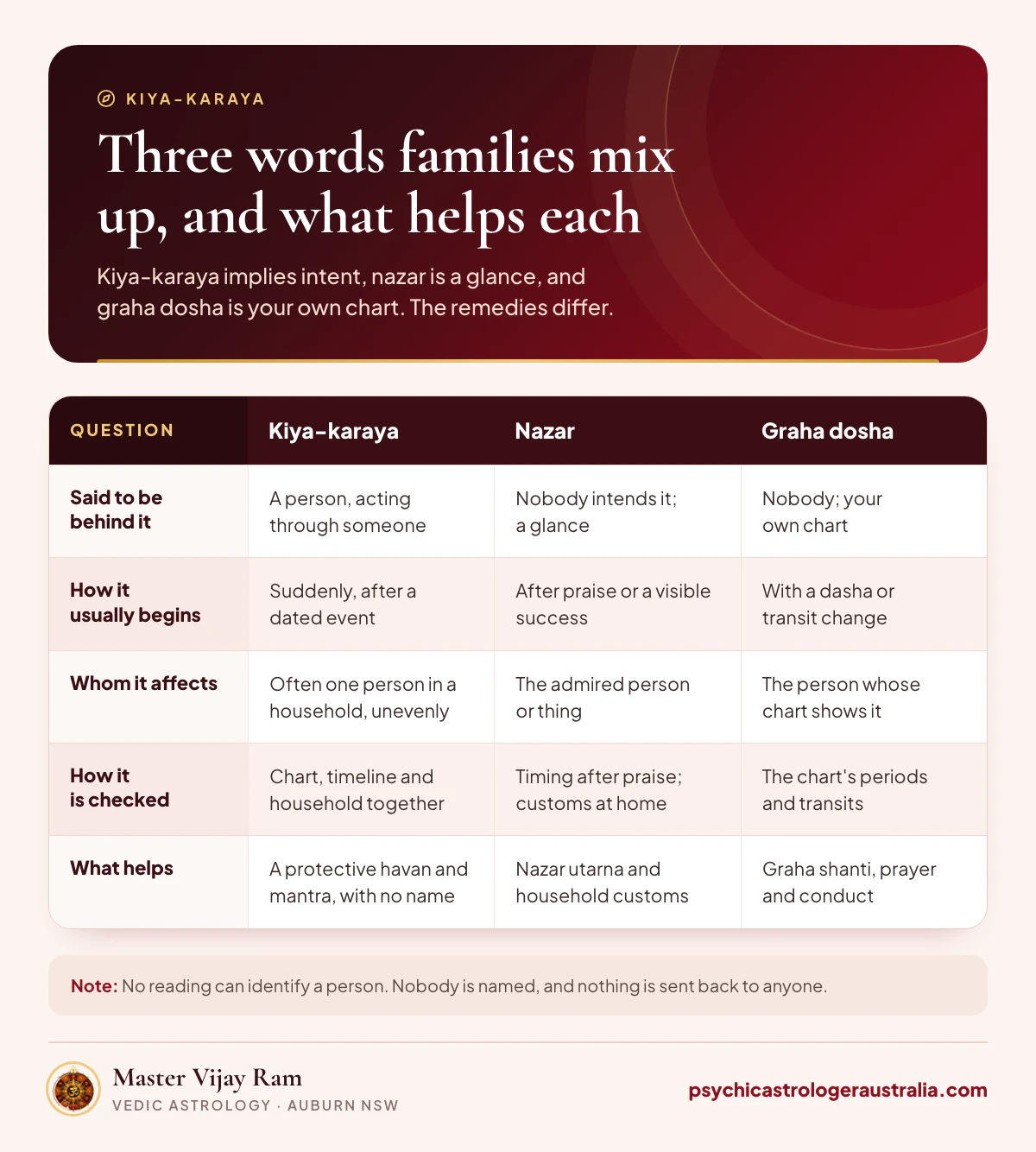
The table keeps the three ideas apart, because the remedy, the cost and the effect on the family are different for each.
| Question | Kiya-karaya | Nazar | Graha dosha |
|---|---|---|---|
| Who is said to be behind it | A person, acting through someone | Nobody intends it; a glance | Nobody; your own chart |
| How it usually begins | Suddenly, after a dated event | After praise or a visible success | With a dasha or transit change |
| Whom it affects | Often lopsided within a household | Usually the admired person or thing | The person whose chart shows it |
| How it is checked | Chart, timeline and household together | Timing after praise; customs at home | The chart's periods and transits |
| What helps | Protective havan and mantra, no name | Nazar utarna and household customs | Graha shanti, prayer and conduct |
What do families describe as kiya-karaya?
The kiya karaya symptoms families bring are rarely dramatic: a husband and wife who cannot bear each other's company after years of ease, a child who suddenly refuses school, money that comes in and will not stay, a house that has felt heavy since a particular visit, a small bundle found near the gate. Each has an ordinary explanation that comes first, from exhaustion and debt to bullying, a neighbour's own festival offering or a hard planetary season.
What makes an elder reach for the word is usually the timing: several things going wrong together, soon after a wedding, a property split or a quarrel. The timing is worth taking seriously as information; it is not proof. Kala jadu removal for Indian and Punjabi families sets out the full step-by-step assessment, so it is not repeated here.
Why is the doer never named?
Because the phrase is already halfway to a name, and the reading refuses to finish the sentence. In many households the suspicion settles on someone close: a brother's wife, a husband's sister, a cousin who lost out over land, a neighbour back in the village. A name spoken in a kitchen in Australia travels to Punjab within a day, and families have stopped attending each other's weddings for a generation over less.
A chart can show a pattern and its timing; it cannot show a face. Master Vijay Ram does not name, hint at or confirm anyone; the protection he offers is for the people who asked, and it works without knowing whom anyone suspects.
Which three questions does a reading ask?
With three questions, asked once the ordinary causes have been checked: does a period in the chart, a dasha or a transit over the Moon, already explain the trouble and its timing; did the trouble begin with a dated event rather than gradually; and does it fall unevenly across the household, hard on one person while others are untouched?
If the chart explains it, the answer is graha shanti and patience. If none of the three points towards anything sent, the answer is usually an ordinary cause with a plain next step. Only when the timeline, the household pattern and the chart together leave something unexplained is removal discussed.
What is tona hatana, and is it the same as removal?
Tona hatana means taking off a tona, a charm, and in many homes it is done by an elder: chillies, salt or a lemon circled over the head and then discarded or burnt, the way nazar is taken off. These customs are harmless when they are kept small and safe, and many families find them calming.
They are not removal of deliberate work, and they become harmful when they involve anything taken from another person, anything placed at someone else's door or anything put in food. Totke and tona: harmless habits and harmful ones draws that line carefully.
How is kiya-karaya removed?
Where a reading warrants it, kiya karaya removal is a protective havan with mantra jaap, chosen from the chart: prayer to Hanuman or Durga for protection, to Ganesha for the obstacles, and a shanti for whatever planet is pressing hard. Master Vijay Ram carries it out in person at Auburn on a chosen muhurat, and the family can join by video and light a lamp at home at the same hour.
Nothing is sent back to anyone, nothing is buried or burnt at another house, and no object needs to be bought. A havan performed on your behalf explains how the work is arranged.
What does aftercare look like?
A short daily practice for some weeks: a lamp at dusk, a mantra or the Hanuman Chalisa, the entrance kept clean, and the story retold to as few relatives as possible. Sleep, appetite and the mood of the house are the honest things to watch, and a GP stays involved for anything in the body or the mind. Aftercare for the first forty days sets out a week-by-week plan.
What about Sikh families who turn to Ardas?
Many Punjabi families are Sikh, and for them the answer to fear of kiya-karaya is often Ardas at the gurdwara, the standing prayer of petition, with Gurbani such as Sukhmani Sahib read at home. Sikh teaching places trust in Waheguru rather than in charms or counter-charms, and a family that finds its peace that way has found a complete answer within its own faith.
Master Vijay Ram respects that without reservation and does not argue anyone out of their path. Mixed families, where one side keeps jyotish and the other keeps the gurdwara, are welcome to do both, and nobody is told that a reading outranks a prayer.
What does a kiya-karaya consultation cost?
The consultation costs $50, by phone, video or WhatsApp, and consultations in Hindi or Punjabi can bring a grandparent into the conversation. Protective work begins at $250 when the reading supports it, is agreed before it is performed, and costs the same whoever the family suspects. Many calls end with an ordinary explanation and a plain next step.
What if the fear arrives from relatives in Punjab?
It often does. As an illustration, a couple on the Gold Coast might receive a call from a mother in Ludhiana who has consulted someone locally and been told the household's troubles are kiya-karaya by a relative. The useful response is to thank her for the worry, decline to discuss who, and have the couple's own charts read against their own dates.
Astrology readings for the Gold Coast covers how calls fit Queensland's clock, which never moves for daylight saving. A phone reading is the same reading, and a family that wants to meet face to face can book at Auburn.
What a reading cannot prove
A reading cannot prove that anything was done, cannot identify anyone and cannot promise that a household will feel settled by a certain date. It is faith-based guidance, not medical, legal, financial or psychological advice. What it can do is take a frightening phrase apart, separate it from nazar and from the chart's own seasons, and offer protection that blames nobody; if the fear itself has become too heavy, Lifeline on 13 11 14 is there at any hour.
Read next
- Upari Badha and Upar ki Hawa: What Families Mean and What HelpsUpari badha and upar ki hawa: what families mean by the words, the signs that overlap with fever, psychosis, epilepsy…
- Kala Jadu Removal for Indians & Punjabis in AustraliaKala jadu removal explained for Indian and Punjabi families in Australia: the stage-by-stage process, what you are as…
- Seivinai and Suniyam: Black Magic Fears in Tamil FamiliesSeivinai and suniyam in Tamil families: what the words mean, what to rule out, temples for archanai, the Kanda Sashti…
Frequently asked questions
What does kiya-karaya mean?
Kiya-karaya means something done against a person, or caused to be done, and families use it for trouble they believe was sent on purpose. In Punjabi it is often heard as kita-karaya, and it is spelled kiya kraya or kiya karaya online. In everyday Hindi the same words simply mean all of one's work, which shows how ordinary the phrase was before it became a fear.
What is the difference between kiya-karaya and nazar?
Nazar, the evil eye, is harm without a plan: an envious or admiring glance that lands on a person or a possession and usually lifts quickly with household customs. Kiya-karaya implies intent and a second person who carried it out. Many cases brought as kiya-karaya turn out to be nazar or an ordinary cause, and the remedy for nazar is much lighter.
Is kiya-karaya the same as a graha dosha?
No. A graha dosha is a pattern in your own birth chart, an afflicted planet or a demanding dasha, and nobody did anything to you. It has dates, and the remedy is graha shanti, prayer and conduct. A reading checks for it first, because a hard Saturn or Rahu period often explains exactly the trouble a family has blamed on someone.
Will Master Vijay Ram tell us who did the kiya-karaya?
No. A chart can show a pattern and its timing but never a person, and he does not name, hint at or confirm anyone. Suspicion usually falls on someone close, and a name spoken here travels to relatives in India within a day. The work does not need a name; it protects the people who asked, and nothing is sent back to anyone.
What is tona hatana?
Tona hatana means taking off a charm, usually by an elder at home with chillies, salt or a lemon circled over the head and then discarded, much as nazar is taken off. Kept small and safe, it is a harmless custom many families find calming. It is not the removal of deliberate work, and it must never involve anyone else's belongings, their door or their food.
How is kiya-karaya removed?
After a reading and the ordinary checks, and only where they warrant it, by a protective havan with mantra jaap chosen from the chart, often with prayer to Hanuman, Durga and Ganesha. He performs it at his Auburn place of practice, and the family may join by video. A short daily practice at home follows for some weeks.
We are Sikh. Should we do Ardas instead?
If your faith answers the fear through Ardas at the gurdwara and Gurbani at home, that is a complete answer within your tradition, and Master Vijay Ram respects it without reservation. Sikh teaching places trust in Waheguru rather than in charms. Mixed families where one side keeps jyotish are welcome to consult, and nobody is told a reading outranks a prayer.
What should we do if an elder in India says it is kiya-karaya?
Thank them for their concern, decline to discuss who might be responsible, and have your own charts read against your own dates. Check the ordinary causes too: health, money, work and the household's stress. Most such calls end with a plain explanation, and the elder can be given a role in the family's prayer rather than in the suspicion.
What does kiya-karaya removal cost?
Families pay $50 for a consultation, by phone, video or WhatsApp, in English, Hindi or Punjabi, and an elder is welcome on the call. Where the reading supports a havan, puja or jaap, it starts from $250 and is agreed before anything is performed. The figure does not change with whom the family suspects, and many calls end without any ritual.
People also ask
What are the signs of kiya-karaya?
Families describe sudden coldness between spouses, a child refusing school, money that will not stay, a heavy house after a visit or a bundle found near the gate. Each has ordinary explanations that come first, from exhaustion and debt to a planetary period. A reading weighs the timing and the household pattern before anything is suspected, and no one is ever named.
How do you remove kiya karaya at home?
At home, families keep protection rather than removal: a lamp at dusk, the Hanuman Chalisa or their own prayer, a clean entrance, and the small customs elders use to take off nazar, kept safe. Removal of deliberate work, where a reading warrants it, is a havan performed by a practitioner, never anything aimed at another household.
What is kita karaya in Punjabi?
Kita-karaya is the Punjabi form of kiya-karaya: something done, or caused to be done, against a person or household. The causative form implies a second person who carried it out, which is why the phrase so quickly turns into suspicion within a family. A careful reading separates it from nazar and from the chart's own periods.
Does Sikhism believe in kiya-karaya?
Sikh teaching places trust in Waheguru rather than in charms, spells or counter-charms, and many Sikh families answer the fear of something done through Ardas at the gurdwara and Gurbani at home. Folk beliefs about kiya-karaya still circulate in Punjabi households of every faith. Master Vijay Ram respects a family's own path and never argues anyone out of it.
References & further reading
Serving clients across Australia
Confidential consultations by phone, video & WhatsApp — including: