

Quick answer
A road aimed at the main door is a classical vastu concern, vedha, with a practical core: headlights, cars that miss the turn and noise. Cemeteries, crematoria and hospitals are mostly folk worries. A hedge, a solid fence, blockout curtains and a well-lit entrance answer most of it, and many families live happily in such homes.
Is it bad vastu to live near a cemetery, a hospital or a T-junction?
Vedha dosha is the name vastu gives to an obstruction or a line of force that strikes a house, most often a road running straight at the main door, or a pole, tree or building corner standing directly in front of it. Families meet the word when a relative looks at the listing photos and says the house is "on a T-junction", or when an aunt hears the backyard faces a cemetery and goes quiet on the phone.
The honest answer is that these worries come in two kinds. A road aimed at the door is a classical vastu concern with a sound practical core; cemeteries, crematoria and hospitals are mostly folk worries, and many families live happily, for decades, beside all three.
A vastu reading of your house and street separates the two, and says what, if anything, is worth doing about either.
What do the vastu texts and folk vastu actually say?
The vastu literature talks about the plot and its surroundings: a street that ends at a house, called veedhi shoola, and an obstruction before the door, dwara vedha. Some practitioners grade a street's direction, treating a road that runs in from the north-east as harmless or even helpful and one from the south-west as troublesome, while others count any road aimed at the door as a fault; traditions differ.
Folk vastu, the advice passed between relatives and printed in popular books, goes much further. It warns against homes near cremation grounds, burial grounds and hospitals, in the shadow of a temple, beside a large tree, and more; those warnings are customs and feelings, not rules from the classical texts, and they deserve to be weighed as such.
What genuinely matters at a T-junction?
Whatever its origin, the old rule describes something real on a modern street. Every pair of headlights coming down the stem of the T points straight into the front rooms at night, and a driver who misjudges the turn ends up in the front garden of exactly that house.
Noise matters too: cars braking to turn and accelerating away, all day and much of the night. A family with small children should watch how fast the traffic arrives, and a family that sleeps in the front bedroom should stand in it after dark before deciding anything; a house facing a T-junction is a vastu question, but it is first a question of glare, safety and sleep.
What does each worry mean in practice?
The table sets the common worries beside what folk vastu says, what genuinely matters, and what helps.
| Where the house is | What folk vastu says | What genuinely matters | What helps |
|---|---|---|---|
| At the top of a T-junction | The road strikes the door; a classical vedha | Headlights at night, cars that miss the turn, braking noise, resale | A solid fence or hedge, a raised garden bed, blockout curtains |
| A pole, tree or building corner before the door | Dwara vedha, an obstruction to what enters | A blocked path, roots in the pipes, a dark entrance | A clear, well-lit path; an arborist for the tree |
| Across from a cemetery | Sorrow nearby; unease after dark | Funeral traffic now and then, and usually very quiet neighbours | Nothing structural; a lamp at dusk if someone is uneasy |
| Near a crematorium | The cremation ground as an inauspicious place | Traffic on service days; personal comfort | Respect rather than fear; nothing needs fixing |
| Near a hospital | Suffering nearby, said to weigh on a home | Sirens, parking pressure, shift-work streets; also convenience | Double glazing or a bedroom on the quiet side |
None of the rows calls for demolition, and only the first two are classical vastu. The rest are about comfort, and comfort is fixed by ordinary means.
What about corner blocks and roads on two sides?
Vastu reads a corner block by which corner it is. Many practitioners welcome roads along the north and east and are warier of a block whose open corner faces the south-west, though traditions differ and a corner block is never a reason on its own to walk away.
In practice two street frontages mean more passing traffic, less privacy and two sets of headlights to think about. The same answers apply: planting, a solid fence on the busier side, and bedrooms placed away from the corner if the plan allows.
Living opposite a cemetery: what is the worry, and what is the reality?
The worry is sorrow: funerals passing the window, the thought of graves at the end of the garden, a child asking questions after dark. The reality, for most people who live beside one, is a green and unusually quiet outlook, land that nobody will ever build a block of flats on, and the occasional slow line of cars.
The tradition does not ask anyone to fear the dead. If a house near a cemetery leaves someone in the family uneasy, a lamp lit at dusk with a short prayer for those resting there is a kinder answer than a cleansing, and buying a house where someone died covers the closely related fear of a death in the home itself.
Is a crematorium nearby a different matter?
Folk belief treats the cremation ground as an inauspicious neighbour, and some older relatives will say so firmly. The tradition is more complicated: the cremation ground is also sacred, the place where Shiva is said to dwell and where every Hindu family eventually brings its own.
In Australia Hindu families use crematoria for their own rites, and many have stood in one. Living within sight of a place where families say goodbye is a matter of personal comfort, and nothing about it needs a remedy.
Is living near a hospital a vastu problem?
The classical texts say nothing about modern hospitals, and the folk worry that suffering nearby weighs on a home is a feeling, not a rule. What living near a hospital does bring is practical: sirens at odd hours, streets full of parked cars at shift change, sometimes a helicopter.
It also brings convenience. A nurse on night shifts in Townsville renting in Douglas to be near the hospital, or a family in Darwin choosing a street close to Royal Darwin Hospital for an elderly parent, has made a sensible choice, and a Townsville reading by phone or video would tell either of them so before it said anything about corners.
What remedies work without demolition?
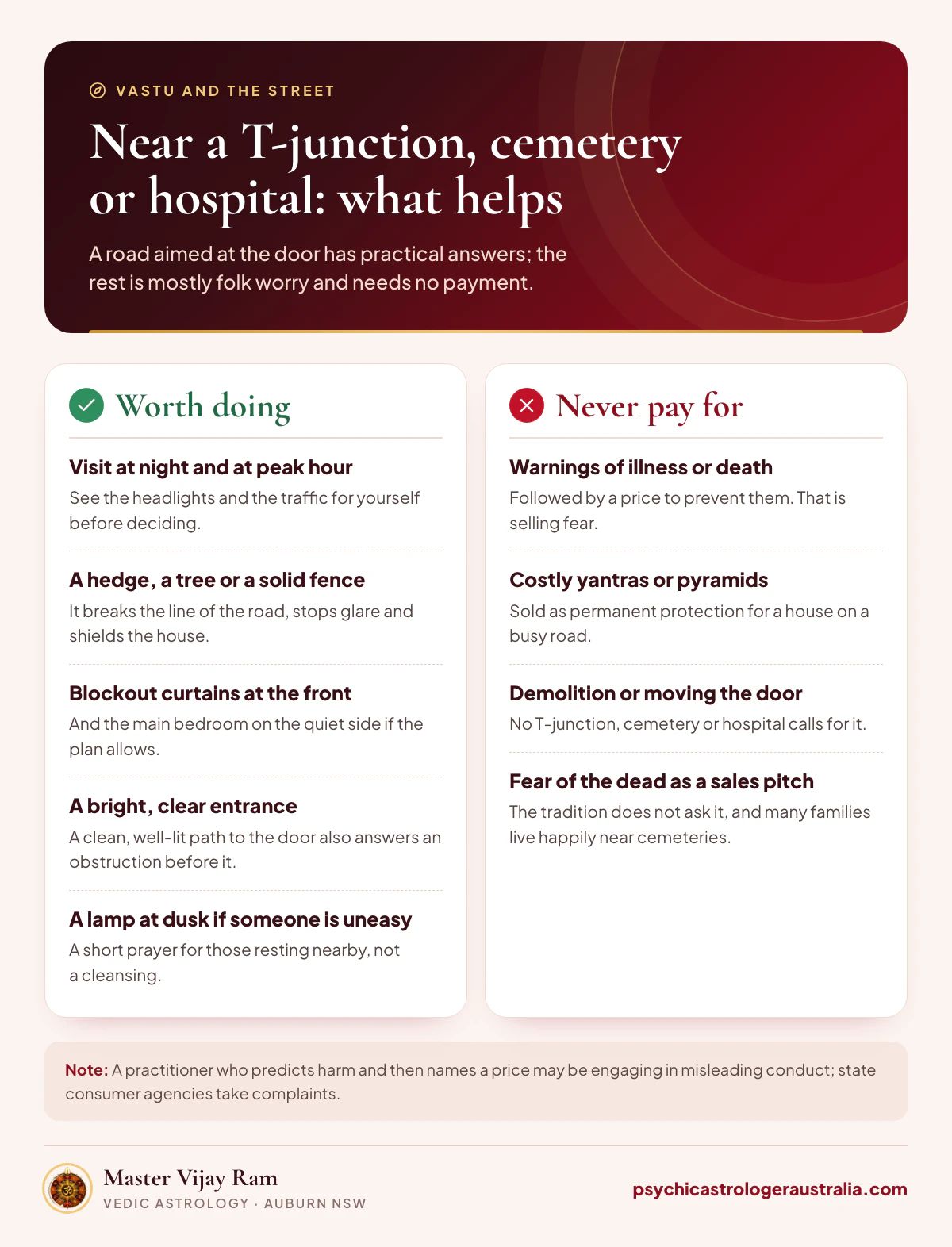
For a road aimed at the door, the folk remedies and the practical ones are often the same object. A dense hedge, a tree, a raised garden bed or a solid front fence breaks the line of the road in vastu terms, stops headlights reaching the front rooms, and gives a car that misses the turn something to hit before it reaches the house.
Inside, move the main bedroom to the quiet side if the plan allows, hang blockout curtains in the front rooms, keep the entrance clean and well lit, and, if the family wishes, place an image of Ganesh above the door facing outward, a folk custom many households like. The wider list of fixes is in vastu remedies that need no demolition.
Does feng shui say the same about a T-junction?
Broadly, yes. Feng shui practitioners also dislike a road aimed at the front door and describe it as sharp energy rushing at the house, and their remedies, plants, fences and screens, look much like vastu's.
The two systems agree here because the problem is visible to anyone standing at the door at night. Where they disagree, and why it is best to choose one system for structural decisions, is set out in an honest comparison of feng shui and vastu.
Should we avoid buying a house like this?
Not on vastu grounds alone. Visit at night to see the headlights, at peak hour to see the traffic and on a weekday to hear the sirens, ask a local agent or valuer how such houses sell in that suburb, and let the price reflect what you find.
If the family still loves the house after all that, buy it and make the practical fixes. A Central Coast family across the road from a cemetery or a Cairns family at the top of a quiet T-junction can live there contentedly for a lifetime, and many do.
Never pay for fear
Anyone who says a house near a hospital or a cemetery will bring illness or death to the family, and then names a price to prevent it, is selling fear. A practitioner who says "you are cursed, pay to remove it" may be engaging in misleading or unconscionable conduct, and NSW Fair Trading, Consumer Affairs Victoria, Queensland's Office of Fair Trading and WA Consumer Protection take complaints.
Be equally wary of an expensive yantra, a crate of pyramids or a "permanent protection package" sold for a road facing house. A hedge does more, and a reputable reader will tell you so.
When is a reading or a shanti worth having?
When the practical fixes are done and the household remains unsettled in a pattern that dates from the move itself, not from the first night of headlights. Before that conclusion, it is worth working through mould, damp, gas and the other real causes, because a heavy house usually has a physical reason.
Where a reading does find something, it may suggest a vastu shanti or negative energy removal for the household. A consultation is $50; a shanti, only where it is warranted, begins at $250, agreed before the day and performed by Master Vijay Ram himself in Auburn, as the online puja and havan service describes.
What vastu cannot change
It cannot slow the traffic, quieten a siren or alter how buyers see a street. Those belong to the council, to double glazing and to the market, and a family worried about speeding cars can ask the council about traffic calming before asking anyone about directions.
Vijay Ram ji's advice belongs to faith, not to engineering, law or finance, and it comes with no promised outcome. Most families who ring about a T-junction, a cemetery or a hospital leave with a hedge to plant and nothing to fear.
Read next
- Why Do Plants Keep Dying in My House? Light, Water, Vastu or NazarPlants keep dying in the house? Check light, water, pests and heating first, then what vastu says about cactus, money…
- Coming Home After a Hospital Stay: Gentle Cleansing for Patient and HouseComing home after a hospital stay: the discharge plan first, then a fresh smoke-free room, a recovery sankalp, prayer…
- Signs of Jinn Disturbance at Home and How Ruqyah HelpsJinn disturbance at home: which signs matter, which have ordinary causes, what ruqyah really is, and how a settled ho…
Frequently asked questions
Is a house facing a T-junction bad in vastu?
Vastu treats a road running straight at the main door as a fault, called veedhi shoola, and some practitioners grade it by direction. In practice the bigger issues are headlights in the front rooms, cars that miss the turn and braking noise. A dense hedge, a raised garden bed or a solid fence answers the vastu worry and the practical ones together.
What is vedha dosha?
Vedha dosha is the vastu name for an obstruction or line of force striking a house: a road aimed at the main door, or a pole, tree or building corner directly in front of it. The fix is to break the line or clear the path, with a hedge, fence, planting or better lighting, rather than to rebuild anything.
Is it unlucky to live opposite a cemetery?
The tradition does not ask anyone to fear the dead, and the worry is folk belief rather than a classical rule. Most people who live opposite a cemetery have a green, quiet outlook and the occasional funeral procession. If someone in the family is uneasy, a lamp at dusk with a short prayer for those resting there is the gentle answer.
Does living near a hospital bring illness into the home?
No such rule exists in the classical texts, which do not discuss modern hospitals. The real effects are practical: sirens, parked cars at shift change and sometimes a helicopter. Many nurses, doctors and families with elderly parents live near hospitals by choice. Double glazing or a bedroom on the quiet side deals with the noise.
What is the best vastu remedy for a road facing the house?
Break the line of the road before it reaches the door: a dense hedge, a tree, a raised garden bed or a solid front fence. Keep the entrance clean and well lit, hang blockout curtains in the front rooms and move the main bedroom to the quiet side if you can. Many families also place a Ganesh image above the door facing outward.
Someone says our house near a crematorium needs an expensive remedy. Should we pay?
No. Living within sight of a crematorium needs no remedy, and a practitioner who predicts illness or death and then names a price is selling fear. That may be misleading or unconscionable conduct, and NSW Fair Trading, Consumer Affairs Victoria, Queensland’s Office of Fair Trading and WA Consumer Protection take complaints. A hedge or a lamp costs little and helps more.
Should we buy a house at the top of a T-junction?
Decide on the evidence. Visit at night to see the headlights and at peak hour to see the traffic, ask a local agent or valuer how such houses sell, and let the price reflect what you find. If the family still loves the house, buy it and plant the hedge; many families live contentedly in exactly these homes.
Can Master Vijay Ram check our street layout?
Yes, by phone, video or WhatsApp. Send the floor plan, the compass bearing of the main door and a few photographs of the street from the doorway, by day and at night if you can. He makes no house visits and sees people in person only in Auburn. The $50 consultation usually ends with suggestions a nursery or a fencing contractor can carry out.
People also ask
Which houses should be avoided in vastu?
The classical concerns are about the plot and the door: a road running straight at the entrance, an obstruction directly before it, or a badly shaped block. Folk vastu adds homes near cemeteries, crematoria, hospitals and large trees, but those are customs rather than rules. Most such houses need practical fixes, not avoidance, and many families live in them happily.
Is a T-junction house good or bad?
It depends on the street. A busy T-junction brings headlights, braking noise and the risk of a car missing the turn; a quiet one in a slow suburban street brings very little. Vastu dislikes a road aimed at the door. A hedge, a solid fence and blockout curtains deal with most of it, and the price usually reflects the rest.
Is it okay to live near a crematorium as a Hindu?
Yes. Folk belief calls the cremation ground inauspicious, but the tradition also treats it as sacred, the place where Shiva is said to dwell and where every family eventually brings its own. Living within sight of one is a matter of personal comfort, and nothing about it needs a remedy or a payment.
How do you fix a house facing a road in vastu?
Break the line between the road and the main door with a hedge, tree, raised garden bed or solid fence; keep the entrance bright and clear; hang blockout curtains in the front rooms; and move the main bedroom to the quieter side if the plan allows. None of this needs demolition, and it also improves safety and sleep.
References & further reading
Serving clients across Australia
Confidential consultations by phone, video & WhatsApp — including: