
Quick answer
Sihr is deliberate harm worked through magic, and ruqyah is Quranic recitation used in response to it. Most people who suspect sihr turn out to have a medical, psychological or ordinary explanation, so a careful assessment rules those out first and says so plainly when no remedy is needed.
What the word sihr actually describes
Sihr is the Arabic word for magic or sorcery worked deliberately on another person: on their health, their mind, their marriage or their livelihood. It is named in the Quran, which is why the subject is taken seriously in Muslim households rather than laughed off. In Australia the word arrives in many accents. Families with roots in Lebanon, Somalia, Pakistan, Indonesia and Afghanistan may all use it, living beside neighbours who say kala jadu, jadoo, tona, or simply black magic.
Master Vijay Ram has spent more than forty years listening to those descriptions. The vocabulary changes; the reported experience rarely does. Someone feels blocked, drained, or estranged from their own family, and no ordinary explanation seems to hold. Naming that experience honestly is where an assessment begins, and it is only the beginning.
Why most of these enquiries are not sihr
This needs saying before anything else. Most people who write in describing sihr are not dealing with sihr. They are dealing with exhaustion, grief, a marriage neglected for years, an undiagnosed thyroid problem, a visa that has stalled, or a run of ordinary misfortune that happened to arrive all at once. Vijay Ram ji tells them so, plainly, and no remedy is arranged.
Some people start by searching for Vedic help across Brisbane and only later ask what the word actually means. That order is understandable, and it is backwards. The useful first question is not who can remove it. The useful first question is whether there is anything there to remove. A practitioner who never says no is not assessing anything; he is selling.
The signs people report most often
Across years of enquiries the same descriptions repeat themselves. None of them proves anything on its own.
- Sleep that breaks at the same hour night after night, with heaviness on waking
- A strong aversion to prayer, scripture or anything devotional, in a person who valued it before
- Coldness between husband and wife that arrived without an argument behind it
- Money that comes in and vanishes with no leak anyone can point to
- Recurring dreams of snakes, graveyards, black dogs, or of falling
- Physical symptoms that specialists investigate thoroughly and cannot place
The same list turns up in enquiries about black magic removal in Ipswich and in enquiries from towns hours away from any city. Location tells you nothing. A pattern tells you a little. How long it has run, and how many separate parts of a life it touches, tell you more.
Which signs carry more weight than others
Not every sign carries the same weight. A single hard month is noise. What raises the weight of a report is a combination of three things: an onset that can be dated to a particular week, several unrelated areas of life turning at the same time, and a pattern that continues after the ordinary explanations have been treated properly.
Aversion to worship is given particular attention in the Islamic tradition, because it removes the thing that would otherwise steady a person. So is a marriage that turns hostile with no subject to the fight; older sources call that the sihr of separation. Careful assessment of exactly that pattern is the ordinary work behind sihr and the healing for it, and most of it is listening rather than ritual. Nothing in that first hour requires anything to be burned, buried or bought.
Rule out the ordinary explanation first
Before any sign is treated as spiritual, the ordinary explanation has to be excluded, and excluded properly rather than assumed away.
| Sign observed | Ordinary explanation to rule out first | What would point to something spiritual |
|---|---|---|
| Waking at the same hour with dread | Sleep apnoea, alcohol, a rotating roster, an anxiety disorder | The same hour continues on holiday, in another house, and off roster |
| Sudden aversion to prayer or scripture | Burnout, grief, or faith lost after a bereavement | Headache, nausea or blanking in the moment, lifting as soon as the person walks away |
| A marriage that turns cold within weeks | Untreated depression, financial strain, an affair | No subject to the conflict, and both describe feeling switched off without knowing why |
| Pain or fatigue with normal test results | Thyroid disease, iron or vitamin D deficiency, fibromyalgia, post-viral fatigue | Symptoms move about the body and vanish for weeks, while every specialist finds a healthy person |
| Money never lasts | Undiagnosed spending, gambling, under-insurance, rising repayments | Income and outgoings are documented for months and still refuse to reconcile |
How that ruling-out is actually done, step by step, is described in How a Black Magic Specialist Diagnoses and Breaks a Spell.
The fourteen-night ledger
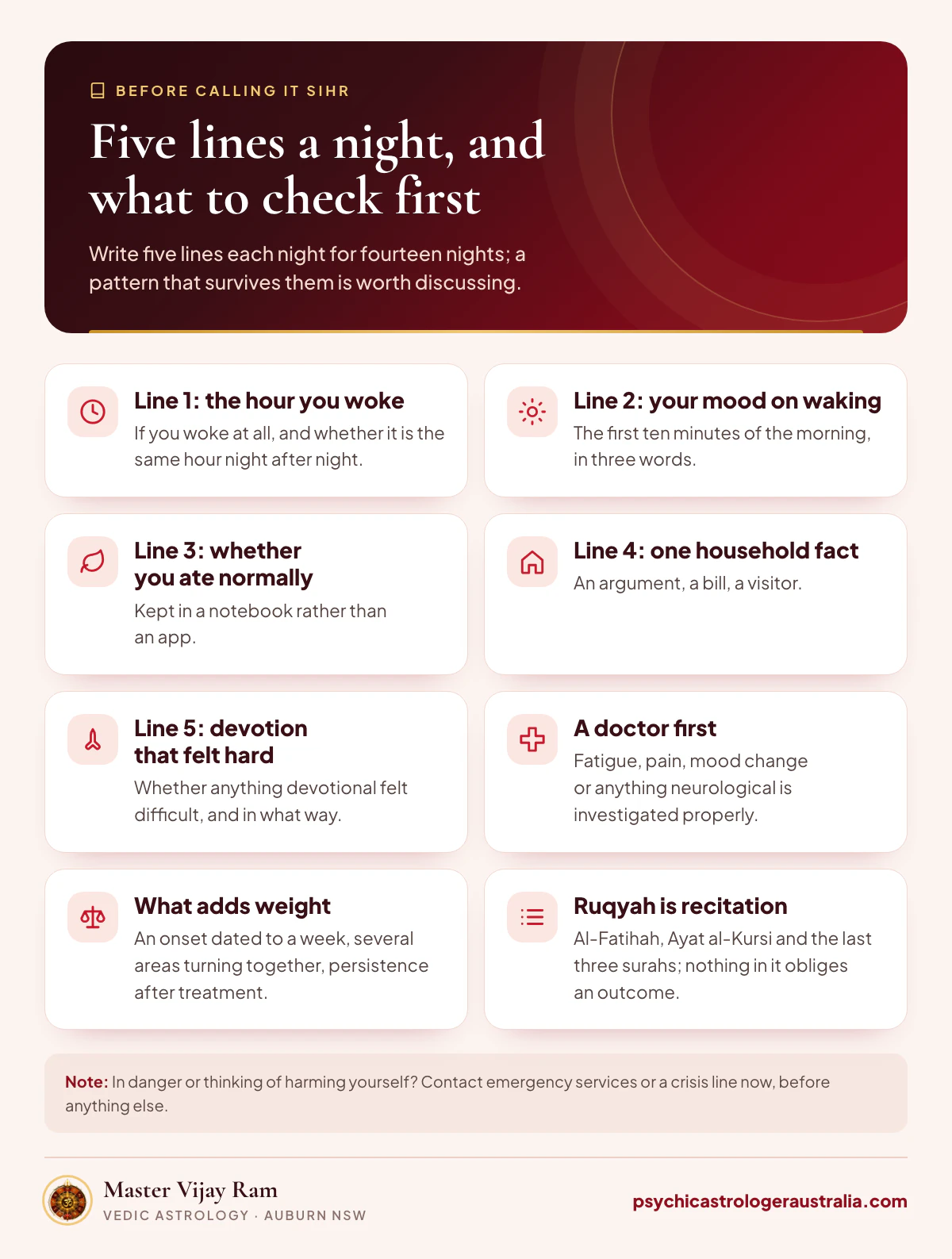
Memory is a poor witness when a person is frightened. So Vijay Ram ji often asks people to keep the fourteen-night ledger before anyone reaches a judgement. It is a notebook rather than an app, and it has five fixed lines written each night:
- The hour you woke, if you woke at all
- Your mood in the first ten minutes of the morning, in three words
- Whether you ate normally
- One plain fact about the household that day: an argument, a bill, a visitor
- Whether anything devotional felt difficult, and in what way
Fourteen nights is long enough to cross a work cycle and a weekend, and short enough that people actually finish it. Patterns that survive fourteen nights are worth discussing. Patterns that dissolve by the sixth night were usually a hard fortnight, and saying so saves a family a great deal of money and fear.
The types of sihr described in classical sources
Older Islamic texts separate sihr by its intended effect rather than by its method. Sihr al-tafriq is worked to divide: husband from wife, brother from brother. Sihr al-mahabbah is worked to bind someone's affection against their own judgement. Sihr al-marad is aimed at the body. Sihr al-takhyil works on perception, so that a person sees or believes what is not there. Some sources also describe material carried in food or drink, or knotted, or buried.
The labels are useful for describing a pattern to somebody else. They matter far less than people expect once a response is being planned, which is why the same careful process sits underneath work on curses carried down a family line whatever tradition supplies the name. Chasing the exact category is often a way of avoiding the harder and more ordinary questions.
Telling sihr apart from nazar and from a jinn problem
These three get collapsed into one another constantly, and the difference changes what is sensible to do next. Nazar, the evil eye, is usually unintentional. It follows admiration, arrives quickly, lands on whatever was praised, and often lifts quickly as well. Sihr is deliberate. It has a person behind it, and it tends to be stubborn and specific: this marriage, this business, this child.
A jinn problem is described differently again, as disturbance that seems to carry its own momentum rather than aim at a target. Because the symptom lists overlap so heavily, honest practitioners spend more time separating the three than treating any of them. The signs are set out at length in 15 Signs of Jinn Possession (and What to Do Next). Getting this distinction wrong sends people to the wrong help entirely.
What ruqyah is, and what it is not
Ruqyah is recitation. Verses of the Quran, most often al-Fatihah, Ayat al-Kursi and the last three surahs, are recited over a person, over water, or by the person for themselves. It is a supplication. Nothing in it obliges an outcome, and nobody performing it can promise one.
What ruqyah is not matters just as much. It is not a payment for a guaranteed result. It is not a reason to stop medical treatment. It does not require anyone to be touched, isolated, frightened, struck or restrained, and any practice that involves those things has left the tradition behind. Done properly it is calm and rather unremarkable to watch. Sessions, timing and what people actually experience are covered in Ruqyah Healing in Australia: Sessions, Cost & What Happens.
What a careful session actually involves
Assessment comes first, and it is mostly questions. When did this start, what changed that week, who else in the house is affected, what has already been investigated medically, what medication is being taken. Birth details may be taken if a Vedic reading is being run alongside the recitation. Then, if recitation is appropriate at all, it is done: sometimes with the person listening on a call, sometimes performed by Vijay Ram ji at his own place of practice, which is why a client's own address makes no difference to the work.
Enquiries from Joondalup follow that same order, as do enquiries from every other part of the country. Afterwards people are told plainly what to watch for over the coming weeks, and, just as importantly, what would mean nothing at all.
When this is not the answer
Some of what gets described as sihr already has a name in medicine. Thyroid disease, iron deficiency, sleep apnoea, perimenopause, diabetes, epilepsy and long-term infection all produce exhaustion, fog and collapsing mood. Psychosis, bipolar disorder, severe depression, PTSD and postnatal illness can produce voices, terror, personality change and the felt sense of being controlled by something outside yourself. Coercive control and family violence produce many of the same feelings, and they are a police and legal matter before they are anything else.
These come first. See the doctor. Take the medication. Ring the lawyer. Spiritual work sits alongside medical and legal help and never in place of it, and a practitioner who tells you otherwise is dangerous. If you are in danger, or thinking of harming yourself, contact emergency services or a crisis line now, before anything else on this page.
What you should be asked for, and what you should not
A reasonable assessment asks for your name, your date, time and place of birth if a chart is to be read, a clear account of the timeline, and what doctors have already excluded. It may ask who lives in the house. It should not require photographs of you undressed, the names of enemies you are expected to accuse, hair, nails or blood, or a large sum handed over before anything has been examined.
People who write in from Casula and Moorebank are asked the same short list as everybody else. If someone asks for more than that, or asks for it before explaining why it is needed, stop and put the question back to them. Nothing genuine depends on your embarrassment or on your silence.
Warning signs in whoever you approach
The people most easily exploited are the ones already frightened, which is most people who reach this subject. A few reliable warnings: a confident diagnosis offered within two minutes and before any real questions; money demanded up front that grows every time you call back; a relative named as the culprit with certainty; instructions to stop your medication; theatrics involving blood, animals or fire; and a promise that the problem will be gone by a fixed date.
A fixed fee removes much of that pressure, because the price cannot grow with your fear: here a consultation is $50, and spell or prayer work, where it is warranted, starts from $250 and is agreed before it is performed. Ask any practitioner what happens if they find nothing at all, and listen carefully to the shape of the answer. General guidance on keeping yourself steady while you decide is set out under spiritual protection and cleansing.
What steadies a household afterwards
Whatever the finding, the weeks afterwards matter more than the hour of recitation. Sleep at regular times. Keep the house aired and uncluttered. Return to prayer, or to whatever devotion belongs to your household, in small amounts rather than long strained sessions. Continue every medical treatment exactly as prescribed. Keep the fourteen-night ledger running for another fortnight, so that change is measured rather than merely hoped for. Resist retelling the story to the whole extended family, because repeated speculation keeps a household in exactly the state the work was meant to settle.
Readers in greater Perth who found this page often ask whether it can come back.
Honestly: circumstances recur, and so do old habits of interpretation, which is why the aftercare conversation belongs inside the work on black magic or a deliberate curse rather than being sold afterwards as an extra.
Read next
- Sihr of Separation: When a Marriage Is Targeted and How It Is LiftedSihr of separation explained: what sihr al-tafriq is said to do to a marriage, the ordinary causes that look identica…
- Upari Badha and Upar ki Hawa: What Families Mean and What HelpsUpari badha and upar ki hawa: what families mean by the words, the signs that overlap with fever, psychosis, epilepsy…
- Kala Jadu, Sihr and Voodoo: Which Tradition Is Your Family Describing?Kala jadu, sihr, voodoo, hooniyam and the evil eye: what each tradition means by harm, what undoes it, and how a Vedi…
Frequently asked questions
Do the different types of sihr need different treatment?
The classical categories describe intent: division, binding of affection, sickness, illusion. They help name a pattern for somebody else. In practice the response changes far less than the label suggests, because assessment, recitation and aftercare follow the same shape. Spending weeks trying to pin down the exact category is usually a way of postponing plainer questions about health, money and the household.
Why do some people feel worse while ruqyah is being recited?
Reactions during recitation are reported often: nausea, yawning, tears, heaviness, sometimes agitation. None of it proves anything by itself. Sitting still and listening intently makes an anxious person far more aware of their own body, and grief surfaces easily in quiet rooms. A reaction is noted rather than celebrated, and it is weighed against everything else known about the person.
Can I recite ruqyah for myself?
Yes. Self-recitation is the ordinary starting point in the tradition, and no permission or intermediary is required for it. Reciting al-Fatihah, Ayat al-Kursi and the last three surahs over yourself, morning and evening, harms nothing and settles many people. Ask for help when difficulty persists, when a child is involved, or when you cannot bring yourself to begin at all.
How is sihr different from a jinn problem when the symptoms overlap?
Sihr has a human being behind it and usually a target: a marriage, a business, one particular child. A jinn problem is described as disturbance carrying its own momentum rather than aiming at anything. The overlap in reported symptoms is genuine, which is why the distinction rests on the story around the symptoms rather than on the symptom list itself.
Someone told me to dig up the garden or search the roof. Is that sensible?
Be careful. Tearing a house apart on a hunch damages the home and frightens children, and people almost always find something eventually because houses contain objects. If a search is genuinely indicated it should be discussed first, kept limited, and never require you to destroy property. Never let anyone search your home unsupervised or handle what they claim to find.
Can sihr affect a whole household or only one person?
Reports describe both. More often one person carries the weight and the rest of the house absorbs the atmosphere around them. That distinction matters, because a household under ordinary strain generates symptoms in everybody, which looks identical from the inside. Asking who was affected first, and by how many weeks, separates the two pictures more reliably than anything else.
My dreams have changed. Is that enough to act on?
On its own, no. Dream content shifts with stress, medication, alcohol, pregnancy and broken sleep, and frightening dreams are very common in people who have been reading about magic late at night. Recurring dreams are worth recording alongside sleep and mood, and worth mentioning to whoever assesses you. They are one line in a longer account, never the whole case.
Are the signs different in children?
Children rarely describe heaviness or blocked luck. What gets reported instead is night waking, sudden fear of one particular room, appetite change, regression in a child who had settled, or a change in school reports. All of those have common paediatric and emotional causes that a doctor should see first. A child is never frightened, restrained or made the centre of a ritual.
Can something placed in food or drink carry sihr?
Classical sources describe material given in food or drink, and many enquiries mention it. It is also the claim hardest to examine and easiest to build a family feud on. Before anyone is accused, the ordinary causes of gut symptoms deserve proper exclusion: infection, intolerance, medication, ulcers, anxiety. Suspicion is not evidence, and an accusation inside a family cannot be withdrawn.
Is it acceptable to use Vedic remedies alongside Quranic recitation?
Many Australian households are mixed, or simply pragmatic, so the question comes up often. The honest answer is that it depends on your own conviction, and nobody should be pushed across a line they hold. Master Vijay Ram reads a chart when a chart is wanted and stays with recitation when that suits the family better. Nothing is imposed on anyone.
How do I raise this with a partner who thinks it is nonsense?
Lead with what you both observe rather than with the explanation. Sleep, money, arguments, health, dates. Ask them to look at fourteen nights of plain notes with you. Most sceptical partners object to the diagnosis rather than to the observations, and many will agree to a doctor's visit first. Agreement about the facts usually arrives well before agreement about the cause.
What should the weeks after a session look like?
Unremarkable, mostly. Regular sleep, an aired and uncluttered house, small consistent devotion rather than long strained sessions, and continued medical treatment exactly as prescribed. Keep noting what changes and what does not. Avoid retelling the story to every relative who rings, since repeated speculation holds a household in the very state the work was meant to settle.
How many sessions of recitation are usually needed?
There is no fixed number, and anyone quoting one is guessing. Some situations settle after a single assessment because nothing spiritual was found. Others involve recitation repeated across several weeks. What should happen at every point is a plain conversation about what has actually changed. If nothing has shifted after a reasonable stretch, that should be said aloud rather than sold around.
Why do some practitioners want a large payment before saying whether anything is wrong?
Because fear pays quickly. A large charge taken before any assessment rewards the diagnosis rather than the outcome, and it tends to grow each time you call back. A fixed fee removes that lever: here the consultation is $50, and spell or prayer work, where it is warranted, starts from $250 and is agreed before it is performed. Ask any practitioner what happens if they find nothing at all, and listen closely to whether the answer still ends in something to buy.
What should I write down before asking anyone to assess this?
Dates first. When did each problem start, and what else happened that week. Then medical history and what has already been tested or ruled out. Then who lives in the house and what changed for them. Then a fortnight of nightly notes on sleep, mood, appetite and household events. A page of plain facts is worth more than an hour of description.
People also ask
Is sihr the same as black magic?
Broadly, yes. Sihr is the Arabic term used in Islamic sources, while kala jadu, jadoo, tona, witchcraft and black magic are names other communities give to work of the same intent. The vocabulary reflects the tradition of the person speaking rather than a different phenomenon. What matters in an assessment is the description of what has actually been happening, not the word chosen for it.
What should I do first if I suspect sihr?
See a doctor and have the ordinary causes investigated properly, particularly where there is fatigue, pain, mood change or anything neurological. Then write down dates: when each problem began and what else happened that week. Keep a fortnight of plain nightly notes on sleep, appetite and household events. Only then ask someone to look at it. Rushing to a remedy first wastes money and settles nothing.
Does ruqyah work if the person does not believe in it?
Ruqyah is a supplication, not a mechanism that belief switches on or off. In practice, a person who resents being recited over will be tense, distressed and hard to read, which helps nobody involved. Nobody should be recited over without their consent, and a household that disagrees about this is usually better served by settling the disagreement first, calmly, before anything else is arranged.
Can medical tests rule out sihr?
Tests rule conditions in rather than out. Normal blood work and scans mean no disease was found by those particular tests, which is genuinely useful and often points to further investigation rather than to a spiritual answer. Many conditions take years to show on paper. Normal results are one input into an assessment, never a diagnosis of sihr arrived at by elimination.
Who is allowed to perform ruqyah?
In the tradition any Muslim may recite for themselves and for their own family, and a great deal of it never involves a practitioner at all. When outside help is sought, character matters far more than title: someone who asks questions before pronouncing, refuses to name culprits, tells people to keep seeing their doctor, and is willing to say plainly when nothing is wrong.
References & further reading
Serving clients across Australia
Confidential consultations by phone, video & WhatsApp — including: