
Quick answer
Seivinai is the Tamil word for harm believed to be worked on purpose through ritual; suniyam and pilli suniyam carry the same fear in Sri Lankan Tamil homes. Most cases prove to be ordinary trouble. Master Vijay Ram reads the chart against the timeline, keeps the family's Murugan worship at the centre, and performs a havan at Auburn only where warranted.
What do Tamil families mean by seivinai?
Seivinai is a Tamil word that means “a deed done”, and in a family's mouth it names harm believed to have been worked against a person or a household on purpose, through ritual. It is usually said quietly, often only once, by an elder who then waits to see whether the younger ones will laugh.
Master Vijay Ram hears it from Tamil households in Sydney, Melbourne, Brisbane, Perth, Canberra and Darwin, most often from a son or daughter ringing on a parent's behalf. This page sets out what the words mean as families use them, what usually sits behind the fear, where Tamil families here take it first, and what black magic removal in the Vedic frame does and does not involve.
Is suniyam the same fear in other words?
Very nearly. Suniyam is the word many Sri Lankan Tamil families use for sorcery worked against someone, and pilli suniyam, the paired phrase, is how the fear is often spoken of in full. The Sinhala hooniyam is a close cousin, and how kala jadu, sihr and hooniyam differ sets those vocabularies side by side.
Seivinai and suniyam both point at deliberate work. Drishti, or kan thirushti, does not: it is the evil eye, trouble that follows an admiring or envious look, with no ritual and often no intent, and drishti and the ash gourd rites covers it fully. Keeping the two apart is the first useful thing a family can do, because drishti is answered at home while seivinai talk can divide a family.
Which words will you hear at home, and what do they mean?
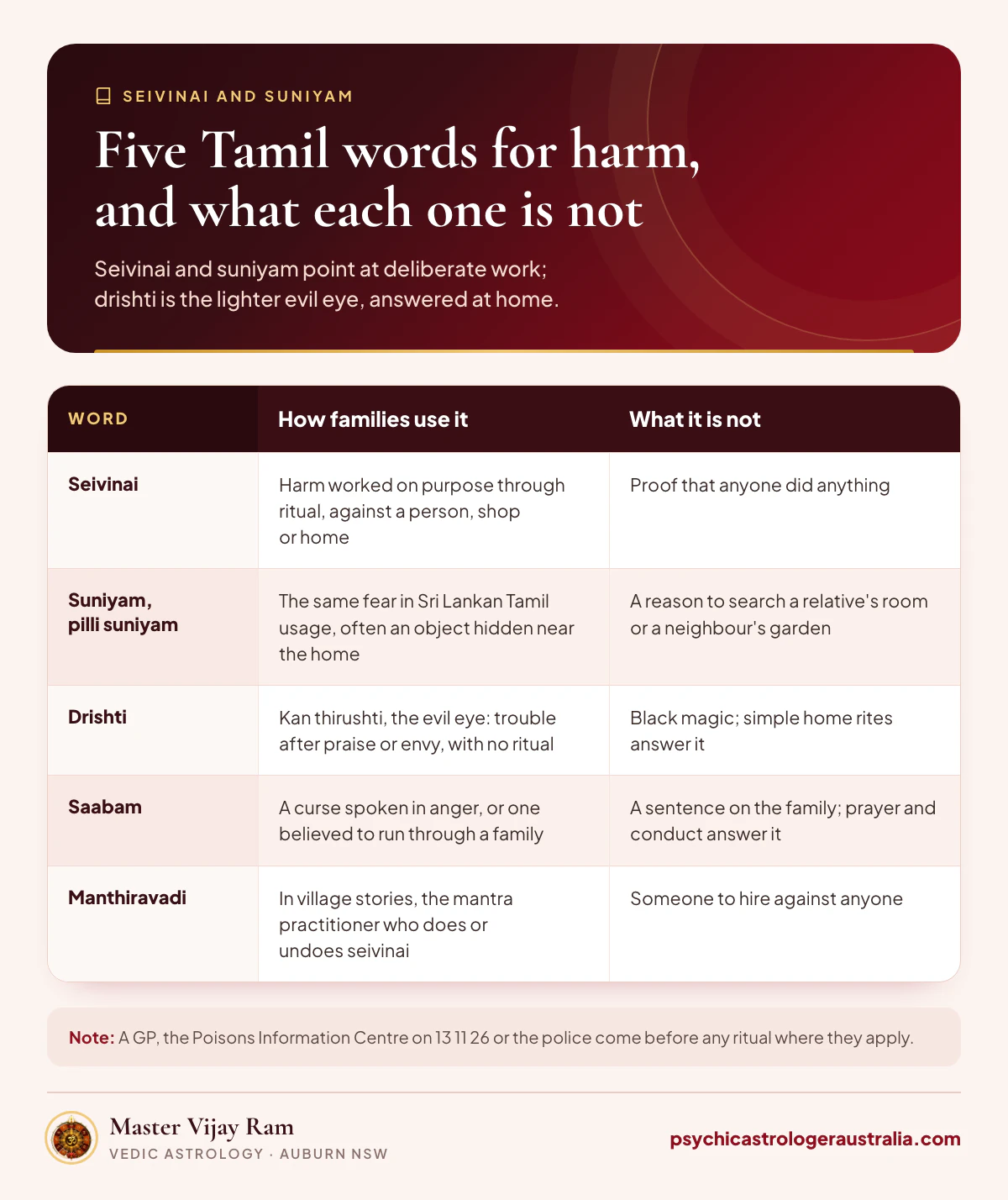
The table gives the words heard most often in Tamil households, how families use them, and the one thing each word should never be taken to mean.
| Word | How families use it | What it is not |
|---|---|---|
| Seivinai | Harm worked on purpose through ritual, against a person, a marriage, a shop or a house | Proof that anyone did anything |
| Suniyam, pilli suniyam | The same fear in Sri Lankan Tamil usage, often tied to an object hidden near the home | A reason to search a relative's room or dig in a neighbour's garden |
| Drishti, kan thirushti | The evil eye: trouble after praise or envy, with no ritual | Black magic; it is answered with simple home rites |
| Saabam | A curse spoken in anger, or one believed to run through a family | A sentence on the family; prayer and conduct answer it |
| Manthiravadi | The practitioner of mantras whom village stories and films cast as doing or undoing seivinai | Someone to hire against anyone; never part of the Vedic answer |
Telugu-speaking neighbours describe the same fear with their own words, and banamati and chetabadi in Telugu homes explains those.
What do families fear seivinai has done?
The seivinai symptoms families describe follow the milestones. A marriage alliance that collapses twice at the same stage, a shop that empties after its best year, a new marriage that turns cold within months, a child who stops eating after a relative's visit: these are the stories that bring the word out. Underneath most of them is a family's sense that its good fortune was seen, and resented.
Objects make the fear vivid. Families describe lemons pierced with pins, a small doll, hair knotted with thread, a square of copper scratched with lines, or kumkum and ash left near a gate, and most such finds have plain owners: a neighbour's own protective custom, an offering carried out of another house, children, or birds. Photograph the thing, lift it with gloves into the outside bin and wash your hands; if it carries a name, a photograph or a threat, keep it for the police, because that is intimidation.
The fear of being fed something deserves a sentence of its own, because it is common and has a practical answer. Anyone genuinely unwell after food needs a GP or the Poisons Information Centre on 13 11 26, and anyone in danger needs 000; no reading comes before either.
Why does the fear arrive when it does?
Seivinai talk tends to begin when a family is most visible: an engagement announced, a house bought, a first child, a business opened, a visa granted. Those are also the months of greatest strain, when sleep is short, money is tight and relatives have opinions about everything.
Distance sharpens it. A Tamil household in Perth or Darwin is a long way from the aunts who once absorbed small crises, and a phone call from Jaffna, Chennai or Kuala Lumpur can land a suspicion that nobody here is able to check.
What should be ruled out before anyone says seivinai?
The ordinary causes come first, and in most households they are the whole story. A GP for exhaustion, weight loss, broken sleep or a child who has changed; blood tests before any ritual; a psychologist for dread that will not lift. Lifeline on 13 11 14 answers at any hour for anyone in distress.
Then the practical side. An empty shop has a competitor, a lease or a season behind it; a property quarrel has a lawyer; a marriage under strain has Relationships Australia. Only a pattern that began on a date the family can name, touched several people at once and outlasted every ordinary fix is worth reading as anything more.
Where do Tamil families in Australia take it first?
Very often to the temple, which is the right instinct. In Sydney that may be the Sydney Murugan Temple at Mays Hill near Parramatta or the Sri Venkateswara Temple at Helensburgh; in Melbourne, the Murugan Temple in Sunshine North; in Perth, the Perth Hindu Temple at Canning Vale with its Shiva and Meenakshi shrines; in Brisbane, Sri Selva Vinayakar Koyil at South Maclean on the Mt Lindesay Highway.
Canberra families have the Sri Vishnu Shiva Mandir at Mawson, and in Darwin the Sri Sithy Vinayakar Temple at Malak has been the Hindu Society's home for more than four decades. An archanai in the family's names and nakshatras, a coconut broken, vibhuti carried home: none of it needs an astrologer's permission, and Master Vijay Ram encourages all of it.
Temple priests are also the right people for temple rites. Where a family wants a ceremony that belongs to its own Tamil or Sri Lankan tradition, he says so plainly and sends them back to the priests who perform it.
How does Murugan worship protect, in the family's own terms?
For many Tamil households Murugan is the protector closest to hand: the young god with the Vel, his spear, who defeats the demon Surapadman in the story told at Skanda Sashti. The Kanda Sashti Kavasam is a Tamil hymn whose name means armour, asking the god to guard the devotee limb by limb, and many families play or sing it morning and evening.
Skanda Sashti is a six-day observance ending on the sixth lunar day of the bright fortnight, usually in the Tamil month of Aippasi, and your temple's panchang gives the date in your own city. “Vel, Vel, Muruga” said at the door, vibhuti worn as three lines, a lamp lit before the picture: these protections already belong to the family, and none of them needs anything bought.
What does a Vedic reading add to what the temple gives?
It asks the question a temple does not: why now? Master Vijay Ram reads the birth chart of the person most affected, the dasha running and the year's transits, and sets them against the family's own timeline of when things changed and for whom. A Rahu or Saturn period, or a Sade Sati phase, often explains a hard season more plainly than any rival could.
Most readings end there, with a name for the season and a sense of when it eases. In the minority of cases where the chart and the timeline both point to something deliberate, the answer is protective work, never a counter-attack.
What happens when seivinai removal is warranted?
Seivinai removal, in the Vedic form he practises, is a shanti havan with Durga or Hanuman mantra, performed by him personally at his place of practice in Auburn on a muhurat chosen from the chart, with the names of those affected spoken in the sankalp. The family can join by video, and how a havan at Auburn is performed describes the day itself.
Afterwards the household keeps a short evening practice, and a family devoted to Murugan simply carries on with the Kavasam. Where the consultation finds it will help, a protective kavach is prepared, as kavach and taweez protection explains; he sells no threads, stones or kits.
Can amma or appa join the call in Tamil?
Yes, with a family member interpreting. Consultations run in English, Hindi or Punjabi, so a son or daughter usually sits beside the parent on a WhatsApp call, carries the questions across and brings the answers back, and consulting when Tamil is your first language explains how that call runs.
Let the elder tell the story in their own order, even if it starts years back. The question an amma asks halfway through, about a cousin's wedding or a land matter at home, is often the one the reading needs.
Why will he never say who did it?
Because no chart names a person, and because a name, once spoken, does more harm than the fear behind it. A suspicion pinned on a sister-in-law or a business partner can divide a family across two countries for a generation.
He will not test a relative, read a suspect's chart or study anyone's photograph, and families who press for a name are refused politely. Nothing is sent back, nothing is buried in anyone's garden, and no rite aimed at another person is ever performed.
What can a reading not do?
It cannot prove or disprove seivinai, find a hidden object, or tell a family who is to blame. It cannot replace the GP, the psychologist, the police or the lawyer, and no outcome can be guaranteed; this is faith-based guidance in the Vedic tradition, not medical, legal or financial advice.
What it can give is a calm second view: whether the timing carries anything, what kind of season this is, and which of the family's own protections to keep. Most families leave with less to do than they feared.
What does it cost, and how do Tamil families book?
A consultation is $50, by phone, video or WhatsApp, with as many relatives on the call as the family wants. Where a havan is warranted it starts from $250, agreed before it is performed, and the fee is the same whether the family's word was seivinai, suniyam or black magic.
Sydney families can also sit with him at Auburn by appointment, the only place he sees anyone in person, and readings for Sydney families sets out the options; black magic removal in Parramatta covers the households around Mays Hill. Everywhere else, from Sunshine North to Malak, the consultation reaches you by phone or video, and one calm message is enough to begin.
Read next
- Banamati and Chetabadi: Telugu Black Magic Beliefs and Safe RemovalBanamati and chetabadi for Telugu families in Australia: what the words mean, why accusations harm people, and what s…
- Black Magic Signs in the Family Home: A Household ChecklistA calm household checklist for black magic signs in the family home: what to rule out first, the shared-roof test, an…
- Black Magic Removal Near Me: What “Near” Actually Buys YouBlack magic removal near me: what a visit genuinely adds, what it does not, how the work reaches every suburb from Au…
Frequently asked questions
What does seivinai mean?
Seivinai is a Tamil word meaning a deed done, and families use it for harm believed to have been worked on purpose, through ritual, against a person, a marriage, a business or a home. It names a fear, not a fact: most households that use the word turn out to be living through an ordinary hard season, which a chart reading against the family's timeline can usually show.
Is pilli suniyam the same as seivinai?
Close to it. Suniyam, and the fuller phrase pilli suniyam, is how many Sri Lankan Tamil families speak of sorcery worked against someone, often tied to an object hidden near the home, while seivinai is the more common word in Tamil Nadu. The Sinhala word hooniyam is a close cousin. All of them point at deliberate harm, which sets them apart from drishti, the evil eye.
What are the symptoms of seivinai?
Families describe broken sleep, illness that tests have not explained, a business that empties, quarrels between spouses, marriage proposals that fail at the same stage, and objects found near the gate. Every one of these has ordinary causes that are checked first with a GP, a psychologist, an accountant or a lawyer. Only a pattern with a date the family can name, which outlasts every ordinary fix, is read as anything more.
We found a lemon with pins near our gate. Is it seivinai?
Usually not. Most finds belong to someone else's protective custom, an offering carried out of another house, children or birds. Photograph it, lift it into the outside bin with gloves, wash your hands and carry on with your evening lamp. Keep it and call the police if it carries a name, a photograph or a threat. If the household still feels wrong weeks later, have the timeline read, not the lemon.
Can the Kanda Sashti Kavasam protect a family from seivinai?
In the family's own tradition it is exactly that: a hymn to Murugan whose name means armour, asking him to guard the devotee limb by limb. Master Vijay Ram encourages Tamil families to keep it, morning and evening if they wish, alongside their temple worship. It is a protection of faith; it does not replace a doctor for illness or the police for a threat.
Does Master Vijay Ram speak Tamil?
No. Consultations are in English, Hindi or Punjabi, and Tamil-speaking elders join with a family member interpreting, usually a son or daughter beside them on a WhatsApp call. The chart is the same in every language, and Tamil words such as seivinai, drishti and saabam need no translation in the reading. Let the elder tell the story in their own order; the details they add often matter most.
Will he tell us who did seivinai on our family?
No. No chart names a person, and he will not test a relative, read a suspect's chart or study anyone's photograph. A name spoken in a frightened family can divide it for a generation, so families who press for one are refused politely. The work is protective only: it is done for the people affected, and nothing is ever sent back at anyone.
How much does seivinai removal cost?
The consultation is $50, and for most families that is the only charge, because most cases need no removal. Where the chart and the timeline do warrant it, a shanti havan performed personally at his place of practice in Auburn starts from $250, agreed before it is performed. The fee is the same whatever word the family uses, and it does not rise afterwards.
Should we still do archanai at our own temple?
Yes. An archanai in the family's names and nakshatras at the Sydney Murugan Temple at Mays Hill, the Murugan Temple in Sunshine North, the Perth Hindu Temple at Canning Vale or Sri Selva Vinayakar Koyil at South Maclean needs nobody's permission, and he encourages it. Temple rites belong to temple priests, and he sends families back to them for any ceremony of their own tradition.
People also ask
How do you remove seivinai?
First by ruling out the ordinary causes with a GP, a psychologist or a lawyer, because they explain most cases. Where a chart reading against the family's timeline still points to deliberate harm, a shanti havan with Durga or Hanuman mantra is performed on a muhurat, with the names of those affected in the sankalp, and the family keeps its own worship afterwards. Nothing is sent back at anyone.
What is suniyam in Tamil?
Suniyam is the word many Sri Lankan Tamil families use for sorcery worked against a person, often with an object believed to be hidden near the home, and pilli suniyam is the fuller phrase. It carries the same fear as seivinai. Families who find an object are best served by photographing it, binning it with gloves and keeping calm, not by searching anyone's house.
Which god protects from black magic in Tamil tradition?
Many Tamil families turn to Murugan, the young god with the Vel, and to his Kanda Sashti Kavasam, a hymn whose name means armour. Vinayakar, Durga and Hanuman are also called on, and temples such as Mays Hill, Sunshine North, Canning Vale and South Maclean are where families take the fear first. Traditions differ between households, and the family's own deity comes first.
How do I know if it is seivinai or drishti?
Drishti, the evil eye, follows praise or envy and needs no ritual; it is answered at home with simple rites such as circling salt or a lime and breaking an ash gourd. Seivinai is believed to be deliberate ritual work. A chart reading against the dates usually shows which, if either, fits, and most households turn out to have an ordinary hard season.
References & further reading
Serving clients across Australia
Confidential consultations by phone, video & WhatsApp — including: