

Quick answer
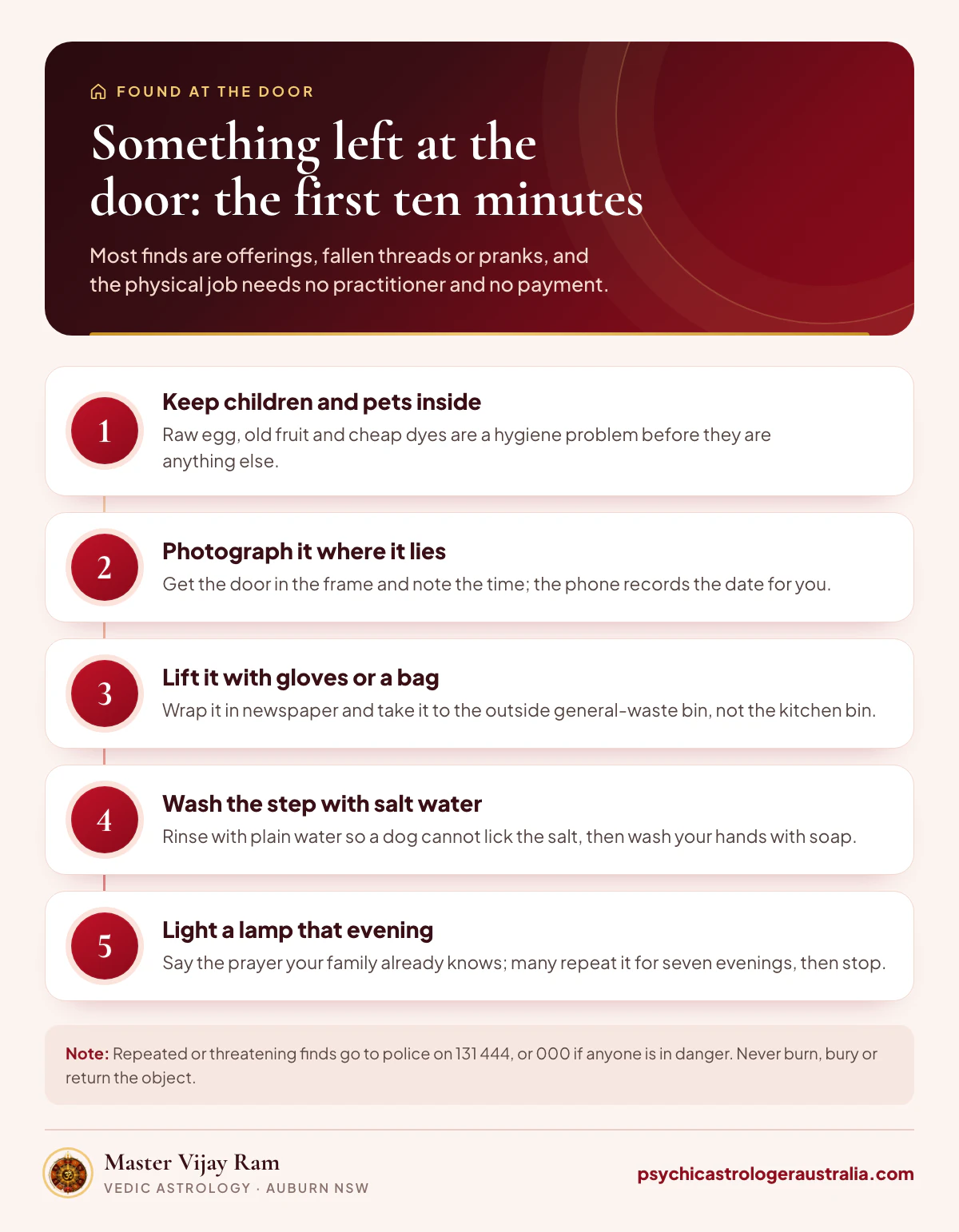
Most lemons, sindoor, threads, eggs or ash found at a front door are a festival offering, a discarded nazar bundle or a prank, not a curse. Photograph it, lift it with gloves or paper, wrap it for the outside bin, wash the step with salt water and light a lamp that evening. Repeated or threatening items go to police on 131 444.
What does it mean to find a lemon, sindoor or thread at your door?
A doorstep totka is a folk charm that is left at a threshold, a gate or a crossroads, usually a lemon, a smear of sindoor, a knotted thread, an egg or a little heap of ash, in the belief that whoever steps across it takes on what it carries. That is the belief. What Australian families actually find on the front step is, far more often, something with a dull explanation and no message in it at all.
This page is for the morning you open the door and see it. It covers what each object usually turns out to be, what to do in the first ten minutes, when the matter belongs with police, and the narrow case in which black magic removal, assessed honestly becomes a real question. Things discovered inside the house, in a pillow, a mattress or a garden bed, have their own page: a taweez or bundle found inside the home.
What turns up outside Australian homes?
The list is short and surprisingly consistent from Cairns to Geelong. Families ring about a lemon at the doorstep more than anything else, and the rest of the list rarely changes:
- a lemon, whole, cut in half, or pierced with pins or cloves;
- a red or orange smear of sindoor or kumkum on the step or the gatepost;
- a black or red thread knotted round the gate latch, the letterbox or a tap;
- an egg, whole or broken, or a coconut, sometimes smeared red;
- a small heap of ash, salt, mustard seed or dried chillies.
Less often there is something plainly meant to frighten: a doll, a photograph, a note with a name on it, nails driven into a lemon. Those are rare, they are a different matter, and they are dealt with further down.
What is each object usually, and what do you do with it?
The table sets the common finds beside the explanation that fits most of them and the plain way to deal with each. The last column is the point at which a find stops being a household chore.
| What you find | What it usually is | What to do | When it becomes more |
|---|---|---|---|
| Lemon with green chillies on a thread | A nimbu mirchi bundle that fell from a shop or a neighbour's door, or an old one thrown out | Gloves, wrap, outside bin | It is hung on your own door by someone else, more than once |
| Cut lemon, or lemons crushed on a driveway | Remains of a nazar ritual; lemons crushed under a new car's wheels | Sweep up, hose the spot, bin | It comes with pins, a name or a note |
| Sindoor or kumkum on the step | Spill from a neighbour's puja or a festival rangoli; an offering carried past your gate | Wash off with soapy water | A shape or writing is drawn in it on your door |
| Knotted black or red thread | A protection thread off a wrist or ankle; a thread tied by your own family's elder | Ask the household first, then bin it | Threads keep appearing after removal |
| Egg, whole or broken | A prank, a bird, or an egg circled for nazar and dropped | Paper towel, hot soapy water | Eggs keep arriving, or come with damage |
| Coconut, ash or chillies | A coconut broken for a new car or venture; incense or havan ash disposed of; nazar remains | Check ash is cold, wet it, bin it | Anything is burning or still warm |
What salt, lemon and chillies mean explains the household customs behind the first two rows, and why a bundle that belongs to someone else's routine ends up on a footpath.
What should you do in the first ten minutes?
Keep the children and the dog inside, and do not pick the object up with bare hands, mostly because raw egg, old fruit and cheap dyes are a hygiene problem before they are anything else. Take a photograph where it lies, with something in the frame that shows which door it is, and note the time. The phone records the date for you.
Then lift it with rubber gloves, or with a plastic bag turned inside out over your hand, and wrap it in newspaper or a second bag. Take it straight to the outside general-waste bin, not the kitchen bin and not the compost. Wash the step with a bucket of water and a handful of salt, rinse it afterwards with plain water so a dog cannot lick the salt, and wash your hands with soap.
That is the whole of the physical job. It takes less time than reading this page, and nothing about it needs a practitioner, a payment or a special day.
Why not burn it, bury it or throw it over the fence?
Burning turns a lemon into a fire risk and a cloud of smoke at the front of the house, and a burnt bundle sets off smoke alarms and a neighbour's asthma long before it settles anybody's mind. Burying it in your own garden keeps it on the property, which is the opposite of what a frightened household wants. Carrying it to the river, the beach or the bush is littering at best and illegal dumping at worst.
Throwing it back over a fence, or leaving it at the door of whoever you suspect, is the one response that genuinely makes things worse. It turns a find into a feud, and the tradition is plain that nothing is ever sent back.
Found something at a crossroads or on the footpath?
A crossroads totka, in the folk account, is a bundle left where roads meet so that whatever it carries scatters in four directions. In practice this means the thing you find at an intersection near home is usually somebody's own spent remedy: last week's lemon and chillies, the salt and chillies circled over a child, a coconut from a family's nazar rite. It was put there to be rid of, not to reach you.
The custom's own advice is to walk round it, not to step over it or take it home, and that happens to be good hygiene too. A footpath, a roundabout or a nature strip is council land; leave it alone, and if it sits there for days, report it to the council as dumped rubbish.
Could it be a festival offering or a prank?
Often it is exactly that. Around Navratri, Dussehra and Diwali, streets with several Indian families see rangoli, kumkum, flowers and coconuts carried from house to house, and some of it ends up on the wrong step. In many South Indian families lemons are placed under the wheels of a new car, or of the family car at Ayudha Puja, and crushed on the first drive, which leaves pulp on a driveway or a shared car park.
Eggs thrown at a door are a common prank, especially around Halloween and the end of the school year, and teenagers do not check which houses are Hindu. A household in Lara near Geelong or in Karama in Darwin might find an egg and a scattered bundle on the same morning and read them together, when they came from two different directions.
When does a doorstep find become a police matter?
When it repeats, when it threatens, or when someone has come onto your property to do it. A note, a name, a photograph of a family member, a doll with pins, writing on the door, damage to the car or the garden, or a figure caught on camera at night are not spiritual questions. Call the police assistance line on 131 444 to report it, and 000 if anyone is in danger or the person is still there.
Keep the photographs, the dates and any camera footage, and do not wash away writing until it has been photographed. Police can only act on what is recorded, and a log of three finds with dates carries more weight than a family's account of a frightening month.
Is a doorbell camera worth it?
For a household that has found the same thing twice, usually yes. A camera turns a fear into a fact: either nobody came, and the bundle blew in from the street, or somebody did, and the footage is what the police assistance line will ask for. Most families find the first answer, and the relief is immediate.
Point it at your own door, path and driveway, not into a neighbour's yard or windows. If you live in a unit block, check the strata rules first, and keep the footage for the police rather than posting it online.
Should you share the photo or ask around who did it?
No. A photograph of black magic items outside the house posted in a community WhatsApp group with the question "who would do this?" frightens a hundred families and points every eye at whoever the household already distrusts. That is how an accusation starts, and accusations do lasting harm to people who have usually done nothing.
Show it to one calm person if you need to, and to police if it is threatening. A practitioner who offers to identify the person from the object is selling something, which is why removal never starts with a name on this site.
What can you do at home that evening?
Something small and steady. Light a lamp at the threshold or the family altar at dusk, say the prayer your family already knows, whether that is the Hanuman Chalisa, the Gayatri mantra or a few lines of your own, and close the door. Many families repeat it for seven evenings and then stop, because the point is to finish the matter, not to keep it open.
If a thread was involved and the family wears protection threads of its own, what protection threads mean sets out the custom so a fallen kalava is not mistaken for something sinister. None of this needs to be bought, and none of it involves anyone outside the house.
When is a reading worth having?
When the household, not the object, shows a pattern: sleep, health, money or peace that changed on a date you can name, and stayed changed for weeks after the step was washed and the ordinary causes were checked. That is when Master Vijay Ram is worth calling: he sets the birth details of the people affected against those dates in a $50 consultation, held by phone, video or WhatsApp.
Most callers who start with a lemon and chillies at the door are told the find was ordinary and no remedy is needed. Where the chart does carry something, the removal is a puja or havan he performs himself in Auburn, from $250, with the figure settled before the day; a puja or havan performed for you describes how the family can watch by video. Nazar-related worries are covered on the evil eye and nazar page.
What will a reading never tell you about the lemon?
Who left it. No chart holds that, and he will not guess. No reading replaces a police report, a camera on the porch or a word with the strata committee either; nothing about it can be guaranteed, and what he offers is faith-based guidance, never legal, medical or financial advice.
A family in Townsville or on the Central Coast is read exactly as one in Sydney would be, and readings for Townsville families explains how a call is arranged.
What it can do is separate the find from the household. In most cases the lemon was just a lemon, the step is clean, and the most useful thing anyone can say is that the matter is finished.
Read next
- Found a Taweez or Bundle Inside Your Home? Pillow, Mattress or GardenFound a taweez in a pillow, a packet under the mattress or a bundle in the garden? Ask the family first, then how to …
- Tantrik, Ojha, Baba or Astrologer: Who Are You Actually Calling?Tantrik, ojha, baba, aghori, maulvi or astrologer: what each title really means, how advertisements misuse them, and …
- Black Magic vs Bad Luck: How to Tell the DifferenceBlack magic or a plain bad run? Use the three-S test of spread, start line and stall, and rule out the ordinary medic…
Frequently asked questions
What does a lemon at my doorstep mean?
Usually nothing aimed at you. Lemons turn up at doors as fallen or discarded nimbu mirchi bundles, as the remains of a family's nazar ritual, crushed under a new car's wheels, or carried there by children or birds. In folk belief a pierced or sindoor-smeared lemon is the classic totka, but even that is most often someone's own discarded remedy. Photograph it, bin it with gloves and wash the step.
Is sindoor at the door a sign of black magic?
Rarely. Sindoor and kumkum are everyday puja materials, offered at home altars and temples and used in festival rangoli, so spills and smears travel on shoes, trays and children's hands. Around Navratri and Diwali they are everywhere. Wash it off with soapy water. Writing, symbols or a name drawn in it on your door is different: photograph it and report it to police on 131 444.
I found a lemon and chillies at my door. Should I throw them away?
Yes, calmly and without ceremony. Lift the bundle with rubber gloves or an inside-out plastic bag, wrap it in newspaper and put it in the outside general-waste bin. Wash the step with salt water, rinse it so pets cannot lick the salt, and wash your hands. If a bundle keeps being hung on your own door by someone outside the household, keep a dated photo log and tell police.
What is a crossroads totka?
In folk custom, a crossroads totka is a bundle left where roads meet so that the trouble it carries scatters in four directions. Most such bundles are somebody's own spent remedy, such as last week's lemon and chillies or salt circled over a child, left there to be rid of it. The custom says walk round it rather than step over it or take it home, which is also sensible hygiene.
Is it dangerous to step over or touch what was left?
The physical risk is hygiene: raw egg, rotting fruit, dyes and ash. The folk belief says that stepping over a totka passes it on, and many families simply walk round it out of respect for the custom, which does no harm. Use gloves or a bag to lift it, keep children and pets away until the step is washed, and wash your hands afterwards.
Can I burn the things I found at my door?
It is better not to. Burning a lemon, thread or bundle makes smoke at the front of the house, sets off smoke alarms, can trigger a neighbour's asthma and is a fire risk on a dry day. If the ash you found is still warm, wet it thoroughly before binning it. Wrapping the object and putting it in the outside bin finishes the matter just as well.
When should I call the police about objects left at my door?
When items keep appearing, when they come with a note, a name, a photograph or a threat, when there is damage, or when someone is seen on your property to place them. Call the police assistance line on 131 444, and 000 if anyone is in danger or the person is still there. Keep every photo, date and piece of camera footage, because a dated record is what police can act on.
Will Master Vijay Ram tell me who left it?
No. He does not read objects to identify people, does not ask for the names of suspected neighbours or relatives, and will not confirm a suspicion. Naming someone on the strength of a lemon has broken more families than any lemon has. What he reads is the household's own birth details against the dates things changed, and the answer is about your household, never about anyone else's.
Do I need a removal after finding something at the door?
Usually not. If the step is washed, the object binned and the household is sleeping, working and eating as before, the matter is finished. A reading is worth having only when the household itself shows a pattern that began on a nameable date and has lasted weeks past the ordinary checks. The consultation is $50, and a removal, where one is warranted, starts from $250, agreed before anything is performed.
People also ask
What does it mean when someone leaves a lemon at your door?
Most often that a nimbu mirchi bundle fell or was thrown out, that a family disposed of a lemon used in a nazar ritual, or that children or a prank put it there. In folk belief a lemon pierced with pins or marked with sindoor is a totka meant to pass trouble to whoever steps over it. Even then, photographing it, binning it and washing the step is the complete response.
What should you do if you find black magic items outside your house?
Stay calm and keep children and pets inside. Photograph the items where they lie, lift them with gloves or an inside-out bag, wrap them and put them in the outside bin. Wash the spot with salt water, rinse it and wash your hands. Do not burn, bury or return the items, and do not post them online. If they repeat or threaten, report them to police on 131 444.
Is it bad luck to step on a lemon left at the door?
Folk belief says a totka passes to whoever steps across it, which is why many families walk round a lemon at a crossroads. There is no reason to panic if you already stepped on one: wash your shoes and the step, and say the prayer your family keeps. A lemon found at an Australian door is far more likely to be a discarded nazar bundle than a charm.
How do you clean a doorstep after finding something left there?
Remove the object with gloves and wrap it for the outside bin. Then wash the step with a bucket of water and a handful of salt, rinse it with plain water so a dog cannot lick the salt, and dry it. Many families light a lamp at the threshold that evening and say a short prayer. Sindoor and egg need hot soapy water first.
References & further reading
Serving clients across Australia
Confidential consultations by phone, video & WhatsApp — including: