
Quick answer
Narasimha, the man-lion, is the avatar of Vishnu who protected the boy Prahlada, and the Sudarshana Chakra is Vishnu’s spinning disc, worshipped in South Indian temples as a guardian in its own right. Families turn to them for protection through prayer, the Narasimha Kavacham and the Sudarshana homa, beside practical help, never in place of it.
Who are Narasimha and Sudarshana, and why are they Vishnu’s protective forms?
Narasimha is the fourth avatar of Vishnu, a being with a man’s body and a lion’s head and claws, who appeared to save a child named Prahlada from his own father. Sudarshana is the spinning disc that Vishnu holds in his right hand, which in South India became a deity in its own right, Chakrattalvar, the guardian who never misses. Together they are the forms of Vishnu that Vaishnava families turn to when they need protection rather than prosperity.
Master Vijay Ram is asked about them by Telugu, Tamil and Kannada families who grew up with a Lakshmi-Narasimha picture in the kitchen, and by others who have been told a Sudarshana homa will lift black magic. Both questions get a careful answer here, and black magic removal and what it involves describes his own work when the fear needs more than prayer.
What happened at the threshold at twilight?
Hiranyakashipu, a demon king, won a boon from Brahma that seemed to make him unkillable: no man or beast could kill him, indoors or outdoors, by day or by night, on the earth or in the sky, with any weapon. Secure in it, he persecuted everyone devoted to Vishnu, and worst of all his own small son Prahlada, who would not stop praying. Poison, fire, cliffs and elephants all failed to kill the boy.
At last the king struck a pillar and demanded to know whether Prahlada’s Vishnu was in that too. Narasimha burst from it, neither man nor beast, and at twilight, neither day nor night, on the threshold of the palace, neither inside nor outside, he laid the king across his lap, neither earth nor sky, and killed him with his claws, which are no weapon. Every condition of the boon was kept, and every one was answered.
It is hard not to notice that the moment he chose is the one a Hindu household marks each evening with a lamp at the door: dusk, at the threshold. The story places protection exactly in the in-between places where people feel least safe.
Why did Narasimha need to be calmed, and who calmed him?
When it was over his rage did not subside, and the gods themselves were afraid to approach him. They sent Prahlada, the child he had saved, and the boy’s prayer turned the fierce form, Ugra Narasimha, into the gentle one, Soumya Narasimha; in many tellings Lakshmi’s presence calmed him too, which is the image of Lakshmi Narasimha, the goddess seated on his lap, that hangs in so many homes.
That detail matters to anyone who worships fierce forms. The tradition does not ask devotees to stir Narasimha’s anger; it remembers him being soothed by a child’s trust, and the calm form is the one families keep.
What does the Prahlada story say to a frightened family today?
At its heart it is the story of a child harmed by the adult who should have protected him, and of a protection that took the child’s side. Read that way, it has a plain modern instruction: a child or a partner at risk in their own home needs real-world protection now, from the police on 000, from child protection services, from Kids Helpline for young people, and from 1800RESPECT for family violence.
The story never puts its power in the hands of the strong. Nobody should invoke Narasimha against a spouse, a parent or a relative, and nobody should be told that a family member is a demon. The protection in this story belongs to the vulnerable, and that is where it should stay.
What is the Sudarshana Chakra?
Sudarshana means auspicious sight, and the chakra is Vishnu’s spinning disc, held beside his conch, Panchajanya, his mace and his lotus. The Rigveda already pictures Vishnu’s wheel as the wheel of time, and in the later stories the disc is the guardian that acts on Vishnu’s behalf, the one that severed the head of the demon who became Rahu at the churning of the ocean.
South Indian temples personify it as Chakrattalvar or Chakraperumal, a many-armed figure standing in a ring of flame, with a shrine of his own inside larger Vishnu temples. Ordinary households meet him most often in a framed print or a small brass icon, and in the short Sudarshana Chakra mantra many families learn: om sudarshanaya vidmahe, maha jvalaya dhimahi, tanno chakra prachodayat.
How did Sudarshana protect King Ambarisha?
The Bhagavata Purana tells of King Ambarisha, a devotee of Vishnu, who was keeping a vow when the hot-tempered sage Durvasa arrived as his guest. Over a misunderstanding about breaking the fast, Durvasa conjured a fiery demon to destroy the king, and Ambarisha simply stood still and prayed. The Sudarshana destroyed the demon and then pursued Durvasa through the worlds, until Vishnu told the sage that only Ambarisha himself could release him.
So the sage came back and asked the king’s forgiveness, and Ambarisha gave it at once. That is the tradition’s model of protection from a curse: the devotee does not curse back, the protector deals with the harm, and the story ends in forgiveness rather than revenge, which is why no honest practitioner offers to send anything back.
Why do Sudarshana and Narasimha so often share a shrine?
Because in the Pancharatra temple tradition they are two faces of one protection. Many Chakrattalvar icons in South Indian temples are double-sided, with the many-armed Sudarshana on the front and Yoga Narasimha seated calmly on the back, and devotees walk around the shrine to see both. At Thuravoor in Kerala, Narasimha and Sudarshana have their own sanctums side by side within one temple.
The pairing suits the two forms. Sudarshana is protection that moves outward and acts; Narasimha in his yoga posture is protection that sits still and watches, and a household in fear usually needs a little of both.
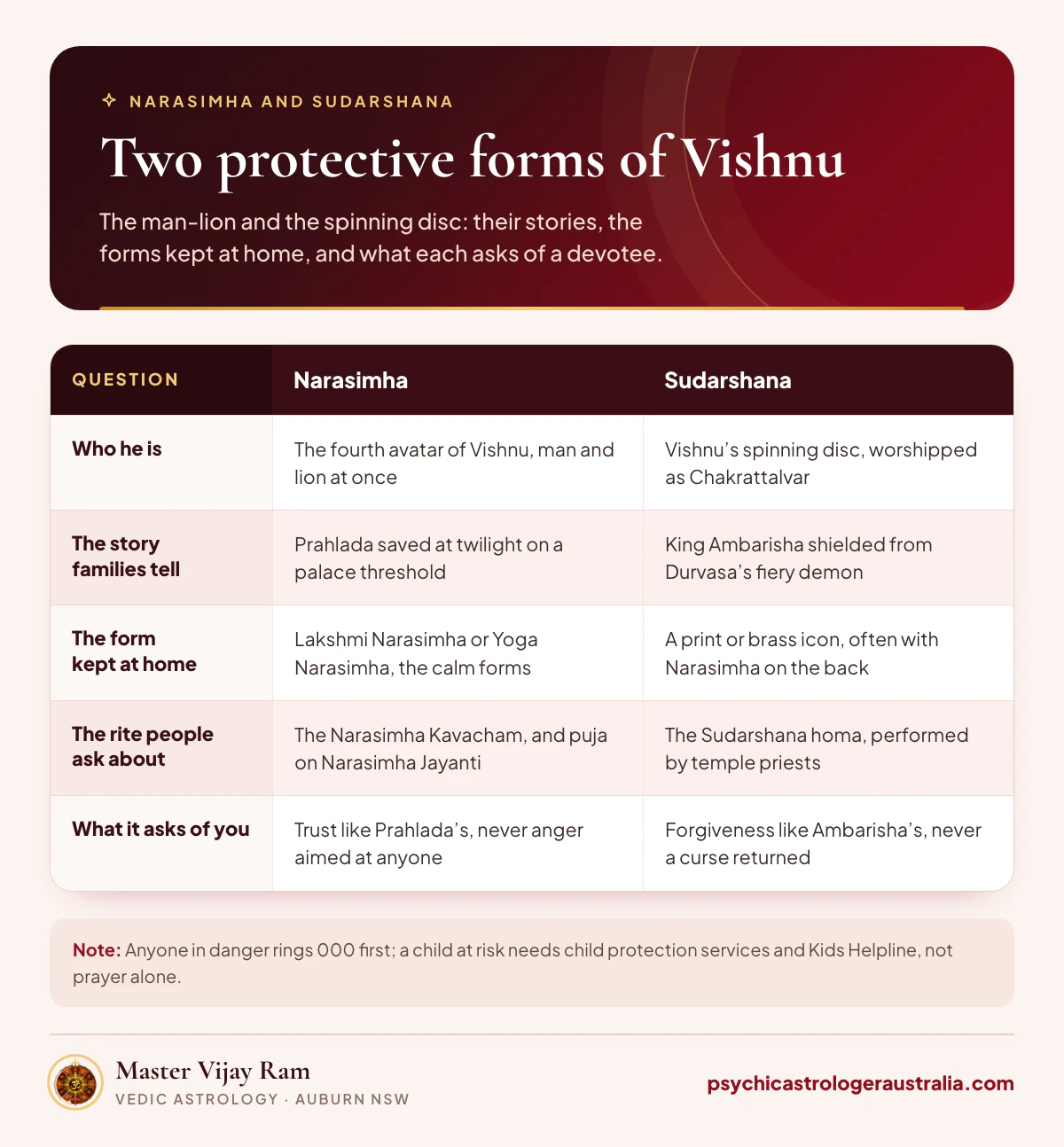
| Question | Narasimha | Sudarshana |
|---|---|---|
| Who he is | The fourth avatar of Vishnu, man and lion at once | Vishnu’s spinning disc, worshipped as Chakrattalvar |
| The story families tell | Prahlada saved at twilight on a threshold | King Ambarisha shielded from Durvasa’s fiery demon |
| The form kept at home | Lakshmi Narasimha or Yoga Narasimha, the calm forms | A print or brass icon, often with Narasimha on the back |
| The rite families ask about | The Narasimha Kavacham and puja on Narasimha Jayanti | The Sudarshana homa, performed by temple priests |
| What the tradition asks of you | Trust like Prahlada’s, never anger aimed at anyone | Forgiveness like Ambarisha’s, never a curse returned |
What is a Sudarshana homa, and who performs it?
A Sudarshana homa is a fire ritual in which Sudarshana is invoked, together with his consort Vijayavalli, into the sacred fire, with mantras and offerings of ghee and other materials. It is especially popular in South India, where families book it for a new house, a long illness, a run of obstacles or a fear of evil eye and black magic.
It is a priest’s rite, not a home experiment. A large fire in a suburban lounge room or an apartment is a fire risk and a smoke-alarm problem, so families either attend one at a temple or ask for it to be performed on their behalf; the Atharvaveda’s protective hymns shows how old the idea of answering harm with protective fire and verse really is.
What are the Narasimha Kavacham and the prayers families say?
The Narasimha Kavacham is a hymn of armour attributed in the tradition to Prahlada himself, asking Narasimha to guard each part of the body and each direction; Vaishnava families recite it on Narasimha Jayanti and in frightening times. Many Hare Krishna temples close their morning worship with short prayers to Narasimha, beginning namas te narasimhaya, prahladahlada dayine, I bow to Narasimha, who gives joy to Prahlada.
The Narasimha protection mantra most households use is no more than this: his name, a short Gayatri such as om vajranakhaya vidmahe, tikshna damshtraya dhimahi, tanno narasimhah prachodayat, or the Kavacham read slowly. Longer mantras and any sadhana of the fierce forms belong with a guru, and nothing here is a method for harming anyone.
When is Narasimha Jayanti?
Narasimha Jayanti falls on the Chaturdashi, the fourteenth lunar day, of the bright fortnight of Vaishakha, just before the Vaishakha full moon, which places it in an Australian late autumn. Devotees fast through the day and hold the puja at sunset, the hour of his appearance.
Its date is not given here, because the tithi depends on where you are; ask your temple, or use a panchang calculated for your own city. In Telugu and Sri Vaishnava communities the day is kept with particular devotion, and temples dedicated to Vishnu are the places to ask whether a special puja is held.
Which form suits a home altar?
The calm ones. Lakshmi Narasimha, with the goddess on his lap, and Yoga Narasimha, seated in meditation, are the forms most families keep, and the tradition is content with a lamp, tulsi leaves, a sweet such as panakam, the jaggery drink of the south, and a few minutes of the Kavacham or the name.
The ferocious images, Narasimha tearing at Hiranyakashipu, belong on temple walls and in dance-dramas, not above a child’s bed. The fierce forms ask for discipline, and at home that means steadiness and gentleness; the same restraint governs Shiva’s fierce guardian, as honouring Kaal Bhairav with restraint explains, and a family that keeps the calm form daily has kept Narasimha well.
When does a reading point to these forms?
Usually in a hard Rahu period, since the disc that severed the demon’s head is the tradition’s answer to Rahu, and sometimes when a household has lived with fear for a long time. What the Rahu mahadasha brings explains that period, and graha shanti for Rahu and the other planets describes when a fuller shanti is suggested.
A $50 consultation, held by phone, video or WhatsApp, reads the chart of the person most affected against the dates the trouble began. Quite often the advice is a daily prayer to the calm form and a practical plan; a homa is suggested only where the reading genuinely calls for one. Families in Perth and the rest of WA consult this way, and in-person appointments happen only at Auburn.
When is a homa or puja performed on your behalf?
When the family has no temple within reach that performs it, or cannot attend, and a reading has suggested it. Vijay Ram ji performs the Sudarshana homa or a Narasimha puja himself in Auburn, where he practises, on a chosen day or on Narasimha Jayanti, with the sankalp made in the family’s names and gotra, and relatives can watch by video.
A homa performed on your behalf begins at $250, a figure agreed with the family before the fire is lit. Nothing extra is added on the day, and nothing is ever performed against another person.
What can these protective forms not do?
They cannot replace a locked door, a restraining order, a doctor or a child-protection worker, and no priest can truthfully say in advance what a homa will achieve. Treat everything here as faith-based guidance rather than medical, legal or psychological advice, and anyone in danger rings 000 first.
What they offer is a way of being unafraid that is thousands of years old: a child who kept praying, a king who forgave, and a God who arrived at dusk, in the doorway, exactly when he was needed.
Read next
- Maa Kali and Protection: What the Fierce Goddess Is Invoked ForMaa Kali and protection: the first Mahavidya, her sword and tongue, Dakshina Kali at home, Kali Puja on the 2027 Amav…
- Black Magic in the Atharva Veda: Abhichara and the Protective HymnsWhat the Atharva Veda says about black magic: abhichara, kritya, the healing and protective hymns, the mani amulet, a…
- How to Break a Witchcraft Spell Safely: A Step-by-Step GuideA calm step-by-step guide to breaking a witchcraft spell safely: what to rule out first, the Standstill Week, the sta…
Frequently asked questions
What is the Narasimha protection mantra?
Most households use his name, the Narasimha Gayatri, om vajranakhaya vidmahe, tikshna damshtraya dhimahi, tanno narasimhah prachodayat, or the Narasimha Kavacham read slowly. Many Vaishnava temples also sing a short prayer beginning namas te narasimhaya. Longer mantras and any sadhana of the fierce forms belong with a guru, and none of it is ever used against another person.
What is a Sudarshana homa?
A Sudarshana homa is a fire ritual in which Sudarshana, Vishnu’s disc, is invoked with his consort Vijayavalli into the sacred fire, with mantras and offerings. It is popular in South India for a new house, illness, obstacles or fear of black magic. It is performed by priests at a temple or on a family’s behalf, never improvised in a lounge room.
What is the Sudarshana Chakra mantra?
The form most families learn is the Sudarshana Gayatri: om sudarshanaya vidmahe, maha jvalaya dhimahi, tanno chakra prachodayat. It is recited quietly, often with a lamp, by people who keep Vishnu as their family deity. Spellings vary, and your family’s or temple’s version is fine. It is a prayer for protection, not a weapon.
Who wrote the Narasimha Kavacham?
The tradition attributes it to Prahlada, the boy Narasimha saved, and it asks Narasimha to guard each part of the body and each direction, like armour. Vaishnava families recite it on Narasimha Jayanti and in frightening times. It is defensive from beginning to end and asks for protection of the reciter, never harm to anyone else.
Why was Hiranyakashipu killed at twilight on a threshold?
His boon from Brahma said he could not be killed by man or beast, indoors or outdoors, by day or night, on earth or in the sky, by any weapon. Narasimha, neither man nor beast, killed him at twilight on the palace threshold, across his lap, with his claws, so every condition was kept and answered at once.
Can I keep a Narasimha picture at home?
Yes, and many families do. The calm forms, Lakshmi Narasimha with the goddess on his lap and Yoga Narasimha in meditation, are the ones kept at home, with a lamp, tulsi and a simple sweet such as panakam. The ferocious images of the battle belong in temples and dance-dramas rather than above a child’s bed.
When is Narasimha Jayanti?
Narasimha Jayanti falls on the Chaturdashi of the bright fortnight of Vaishakha, just before the Vaishakha full moon, which is late autumn in Australia. Devotees fast and hold the puja at sunset, the hour he appeared. Because the tithi shifts with location, check your temple’s calendar or a panchang computed for your city.
Does a Sudarshana homa remove black magic?
In South Indian tradition it is one of the rites families choose when they fear black magic, evil eye or a long run of obstacles. Most such fears turn out to have everyday explanations, and the GP, a counsellor or the police come first. A homa is a prayer of protection; it cannot be guaranteed and it is never aimed at anyone.
How much is a Sudarshana homa done on our behalf?
Done by Master Vijay Ram himself in Auburn, with the sankalp made in the family’s names and gotra, a Sudarshana homa or Narasimha puja starts from $250, and the figure is agreed with the family before the fire is lit. Relatives can watch by video. A $50 consultation comes first and often finds that daily prayer is enough.
People also ask
Why is Narasimha worshipped for protection?
Because he appeared specifically to protect a devotee, the child Prahlada, from a father who tried again and again to kill him. Devotees pray to him when they feel cornered or afraid. The tradition remembers him being calmed by Prahlada’s trust, so households keep his gentle forms, and real danger still goes to the police on 000 first.
What is the difference between Narasimha and Lakshmi Narasimha?
Lakshmi Narasimha is Narasimha in his calm form, with the goddess Lakshmi seated on his lap after his rage at Hiranyakashipu had been soothed. It is the form most families keep at home and the presiding form at many temples in Andhra Pradesh and Telangana. Ugra Narasimha, the fierce form, is mostly seen in temples.
Is Sudarshana the same as Vishnu?
Sudarshana is Vishnu’s spinning disc, and in the Pancharatra tradition the disc personified, Chakrattalvar, is treated as Vishnu himself acting to protect. Many South Indian temples give him a shrine of his own, often with Yoga Narasimha on the back of the same icon. Devotees honour him as a guardian, not as a separate god competing with Vishnu.
Can anyone recite the Narasimha Kavacham?
Yes. It is a devotional hymn, attributed to Prahlada, and anyone can recite it slowly with attention, at a home altar or before a frightening day. Families with a Vaishnava teacher may follow a particular version. Intense sadhana of the fierce form is different: that is a matter for a guru, not for a website.
References & further reading
Serving clients across Australia
Confidential consultations by phone, video & WhatsApp — including: