

Quick answer
In Hindu folk belief a broken mirror means either bad luck or a mirror that took a nazar meant for the family, and vastu simply says not to keep cracked mirrors or broken things. Most breakage has a plain cause: children, pets, worn fittings, or summer heat on glass. Wrap the glass safely, replace what broke, and keep any cleansing small.
What does a broken mirror mean in Hindu belief?
In Hindu folk belief a broken mirror is a sign that can be read two ways. One reading treats it as bad luck, close to the European superstition of seven years’ misfortune that many Indian families absorbed along the way. The other, older in many households, says the mirror broke because it took a blow meant for the family, a nazar that landed on the glass instead of on a child.
Vastu adds a plainer instruction: do not keep cracked mirrors, broken clocks or damaged things in the house. Master Vijay Ram’s vastu consultations usually start a long way from omens, with the hook that gave way and the sun on the glass, because a home with things breaking in it needs a handyman before it needs a ritual.
Why do things seem to break in runs?
Because breakage has seasons in every household. A toddler who has just learned to climb, a new puppy, a cat that likes high shelves, a teenager’s ball games in the hallway: each produces a run of chips and cracks for a year or two and then stops. Fittings installed in the same year tend to wear out in the same year, so an older house can lose a hinge, a shelf bracket and a towel rail inside one month.
Tiredness plays its part too. A household going through a move, a new baby or a hard stretch at work drops more things, and once a family starts counting, every chipped cup joins the list. Seeing things breaking at home as a pattern is natural; most of the time the pattern belongs to the people and the house, not to anything unseen.
Can heat crack glass in an Australian summer?
Yes, and it catches many families by surprise. A window that is half in hot sun and half in shade, or one with a dark blind, a poster or tinting film pressed against it, heats unevenly and can crack from the edge without anything touching it. A hot dish set on a cold stone bench, or cold water poured into a hot glass, cracks for the same reason.
Toughened glass in shower screens and balcony panels occasionally shatters on its own, from a tiny flaw inside the glass or an old knock to the edge, which is frightening and still physical. A glazier or the builder can usually say which it was. A chip in a car windscreen that spreads overnight after a hot day is the same story on four wheels.
What about tired fittings and an ageing house?
Many breakages begin with a fixing rather than the object. Mirror adhesive softens in heat and humidity, plasterboard plugs work loose under a heavy frame, picture hooks bend, cupboard hinges sag until a door drops, and a shelf bracket that held for ten years gives way the week you add one more pot. Proper fixings into studs, and a level, prevent a surprising share of the omens families ring about.
Two things go straight to a professional. A crack in a wall or ceiling that grows, or doors that suddenly stick, is for a builder or a structural engineer; appliances failing one after another, or a safety switch that keeps tripping, is for a licensed electrician. Neither is a vastu question first.
Which breakages are most common, and who fixes them?
Here are the breakages families mention most, with the physical cause and the right tradesperson set beside what the custom says. The last column is there so the custom can be kept in proportion, not so it can be feared.
| What broke | The usual physical cause | Who can help | What the custom says |
|---|---|---|---|
| A mirror fell and broke | A worn hook, or adhesive failing in heat or humidity | A handyman; proper fixings into a stud | It took a blow meant for the family; do not keep it |
| A window cracked from the edge | Uneven heating from sun and shade, or a dark blind against the glass | A glazier | Replace cracked glass promptly |
| Glasses and dishes keep breaking | Small children, a crowded cupboard, hot and cold on the same glass | Rearranging; unbreakable cups for little hands | Some families read a run of breakage as nazar |
| A shower screen shattered | A flaw in toughened glass, or an old knock to the edge | A glazier or the builder; the agent if you rent | A fright, not an omen |
| Appliances failing one after another | Age, power surges, a wiring fault | A licensed electrician; the warranty | Broken things should not be kept in the house |
| A murti or framed deity picture chipped | A shelf at child height, a curious cat | A higher, steadier shelf | Retired respectfully with a prayer |
What does vastu say about keeping broken things?
Popular vastu advice is consistent on this. A cracked mirror, a stopped or broken clock, chipped crockery, a torn picture, a chair nobody can sit on and the appliance kept for parts are all said to hold stagnation in the house, and they are to be repaired or removed rather than stored. The practical sense underneath is obvious: broken glass cuts, cluttered cupboards cause more breakage, and a house that is cared for feels cared for.
The rest of vastu’s mirror advice concerns placement, especially in the bedroom, and vastu remedies without demolition covers where mirrors and light help most. Broken murtis and faded deity pictures have their own customs, set out in cleansing the puja room.
Did the mirror take the nazar?
Many families believe so, especially when a mirror or a glass breaks without obvious cause soon after a gathering or a burst of praise. The idea fits the protective logic of the whole tradition: in Gujarat and Rajasthan mirror-work embroidery is often said to turn the evil eye away, and a mirror that cracks is read as having done its job. Traditions differ, and nobody has to believe it.
If it is your family’s belief, it is a kind one. Thank the mirror, dispose of it safely, light a lamp and do not mourn it; there is nothing to fear in a protector that broke. Where the timing points at nazar on a person rather than a household object, evil eye and nazar removal describes how it is read and settled.
How do you clean up and dispose of broken glass safely?
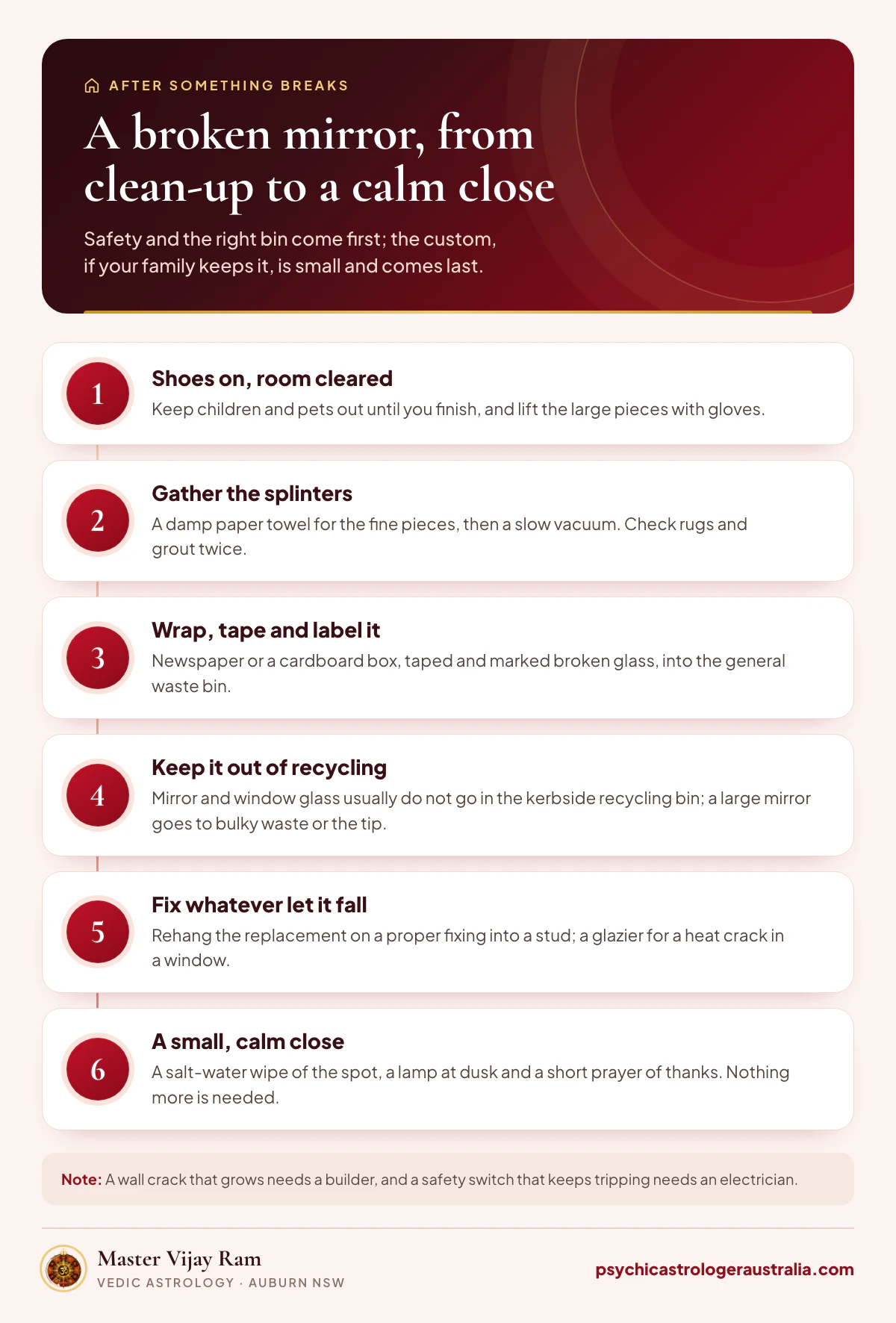
Put shoes on, and keep children and pets out of the room until you are finished. Lift the large pieces with gloves, gather the fine splinters with a damp paper towel, then vacuum the floor slowly and wipe the area again. Broken glass hides in rugs and grout for days, so check twice.
Wrap the pieces in several sheets of newspaper or a cardboard box, tape it closed and write “broken glass” on it before it goes in the general waste bin. Mirror glass, window glass, drinking glasses and ovenware usually do not go in the kerbside recycling bin, because they melt differently from bottles and jars; a large mirror goes to your council’s bulky waste collection or the tip. Your council’s website has the local rule.
Is a run of breakages a sign of negative energy?
Rarely on its own. Breakages cluster for ordinary reasons, and memory makes the cluster look bigger than it is, which is why black magic and bad luck are so easily confused. Some families do read breakage that began after one particular event, alongside poor sleep, quarrels and illness in the same weeks, as heaviness in the house, and that wider pattern is what deserves attention.
The order stays the same: fixings, glazier and electrician first, then a small cleansing, and only then a reading. A sibling post on why plants keep dying in the house works through the same question for the garden and the windowsill.
What is a simple cleansing after something breaks?
Once the glass is gone, wipe the spot with water and a pinch of salt, light a lamp in that room at dusk and say a short prayer of thanks for whatever the object protected. Hang the replacement mirror on a proper fixing, on a wall where it reflects light rather than clutter. That is the whole of it for a single breakage.
For a run of breakages, give the house a month: clear every broken or unused thing out, repair what can be repaired, keep the evening lamp, and notice whether the run stops once the fixings and the cupboards are sorted. Most runs do.
When do breakages deserve a closer look?
When the breakages are one thread in a wider household pattern with a clear beginning, and the practical causes have been dealt with: sleep breaking for everyone, quarrels, illness, a heaviness visitors notice. Master Vijay Ram reads the household’s charts against those dates by phone or video and says plainly when the answer is a loose hook and a hot summer.
Families who also want the layout looked at can send a floor plan and compass photos for a vastu reading within the same consultation.
Is there a charge for looking at breakages?
Yes: the consultation is $50, and most calls about breakages end there, with a list of fixes and perhaps a month of the evening lamp. If a vastu shanti or house cleansing is called for, the price begins at $250 and is agreed in advance, and he conducts it in person at Auburn; families who want to be present can join on video. What a performed puja or shanti involves is explained separately.
Nobody should be sold a remedy for a mirror that fell off a softened adhesive strip.
Heat, humidity and glass: Cairns, Townsville, Darwin and the south
Climate changes what breaks. In Cairns, Townsville and Darwin, strong sun on glass, cold air-conditioned rooms inside and wet-season humidity are hard on adhesive mirror tiles, hinges and window seals; on the Central Coast, salt air works on metal fixings near the beach. In Sydney and Melbourne a cool change after a hot day can stress glass that has been baking in the afternoon sun.
Consultations from Far North Queensland are by phone or video, as the page for Cairns clients describes, and anyone in Sydney who prefers to meet can book a time at Auburn.
What a cleansing cannot do
It cannot fix a cracked window, a failing shower screen, a tired hinge or a wiring fault; those are jobs for a glazier, a builder and a licensed electrician. It cannot be guaranteed, and vastu and the household customs are offered as faith-based guidance, not as building, electrical or legal advice.
What it can do is close the chapter calmly: the glass wrapped and gone, a lamp lit, a prayer said, and the family no longer bracing for the next crash.
Read next
- Coconut in Cleansing: Why a Nariyal Is Circled and BrokenWhy a coconut is circled over a person, broken at temples and set on a kalash, which coconut may be eaten afterwards,…
- The Main Door: Toran, Swastik and the Threshold, Your Home’s First ProtectionMain door protection in a Hindu home: threshold customs, the toran and swastik, rangoli at the step, and what changes…
- House Cleansing for Negative Energy: A Room-by-Room Vedic GuideA room-by-room Vedic guide to house cleansing for negative energy: what to rule out first, what is safe to do yoursel…
Frequently asked questions
What does a broken mirror mean in Hindu culture?
Families read it two ways. Some treat it as bad luck, close to the European superstition of seven years’ misfortune; many others say the mirror took a blow or a nazar meant for the family and has done its job. Traditions differ. Vastu’s instruction is simpler: do not keep a cracked mirror. Wrap the glass safely, replace the mirror on a proper fixing, and light a lamp if that steadies you.
Is it bad luck to keep a cracked mirror?
Popular vastu advice says not to keep cracked mirrors, broken clocks or damaged things in the house, because they are said to hold stagnation. The practical reason is just as strong: cracked glass can fall and cut someone. Replace the mirror, hang the new one on a proper fixing into a stud, and dispose of the old one safely rather than leaving it leaning in the garage.
Why do things keep breaking in my house?
Usually for ordinary reasons that happen to cluster: a toddler or a new pet, fittings installed in the same year wearing out together, summer heat on glass, a crowded cupboard, or a tired household dropping more things. Fix the fixings, rearrange the cupboards, and call a glazier, builder or electrician where it fits. If breakage is one part of a wider pattern from a nameable date, a reading can look at it.
How do I dispose of a broken mirror in Australia?
Wrap the pieces in several sheets of newspaper or a cardboard box, tape it, write broken glass on it and put it in the general waste bin. Mirror glass usually does not go in the kerbside recycling bin, because it melts differently from bottles and jars. A large mirror can go to your council’s bulky waste collection or the tip. Check your council’s website for the local rule.
Can heat really crack a window?
Yes. Glass that is half in hot sun and half in shade, or has a dark blind, poster or tinting film pressed against it, heats unevenly and can crack from the edge without being touched. Hot dishes on cold stone benches and cold water in hot glasses crack for the same reason. A glazier can usually tell a heat crack from an impact, and replace the pane properly.
Did my mirror break because it absorbed the evil eye?
That is a common family belief, especially when glass breaks soon after a gathering or a lot of praise, and it fits the protective logic of the tradition, which sees mirror-work as turning the eye away. Nobody has to believe it. If it is your family’s view, it is a gentle one: thank the mirror, dispose of it safely, light a lamp, and do not treat the breakage as a threat.
Our shower screen shattered by itself. Is that a bad sign?
It is frightening but physical. Toughened glass occasionally shatters on its own, from a tiny flaw inside the glass or an old knock to the edge, and a glazier or the builder can usually explain which. Keep everyone out of the bathroom until the glass is cleared, and if you rent, tell the agent in writing. There is no need to read it as an omen.
What should I do after something breaks at home?
Clean up safely first: shoes on, children and pets out, large pieces with gloves, fine splinters with a damp paper towel, then vacuum. Wrap and label the glass for the general waste bin. Then, if your family keeps the custom, wipe the spot with water and a pinch of salt, light a lamp at dusk and say a short prayer of thanks. That is enough for a single breakage.
Does Master Vijay Ram charge to look at a run of breakages?
A consultation is $50 by phone or video, and it usually ends with practical fixes and perhaps a month of the evening lamp. A vastu shanti or house cleansing, if the reading shows one is needed, begins at $250 with the amount agreed beforehand, and he performs it himself in Auburn. Nobody needs a remedy for a mirror that fell off a softened adhesive strip.
People also ask
Is a broken mirror a bad omen in Hinduism?
Some families treat it as one, but many read it the other way, as a mirror that absorbed a nazar meant for someone in the house. Traditions differ, and the scriptures say nothing that should frighten a family over a fallen mirror. Vastu simply advises not keeping cracked glass. Clean it up safely, replace it, and keep the evening lamp if that is your habit.
What does it mean when glass breaks on its own?
Usually heat or a hidden flaw. Window glass heated unevenly by sun and shade can crack from the edge, and toughened glass in shower screens and balconies occasionally shatters from a tiny internal flaw or an old knock. Folk belief sometimes reads it as a nazar being taken. Call a glazier first, keep the area clear, and treat the event as physical before anything else.
What does vastu say about broken things in the house?
Popular vastu advice is to repair or remove cracked mirrors, stopped clocks, chipped crockery, torn pictures and broken appliances promptly, because they are said to hold stagnation. Underneath is plain sense: broken things are hazards and clutter, and a cared-for house feels cared for. Chipped murtis and deity pictures are retired respectfully with a prayer rather than simply thrown out.
Can a run of bad luck at home be negative energy?
Occasionally families read it that way, when breakage, illness, quarrels and broken sleep all began after one event. Most runs, though, have plain causes that cluster, and memory makes them look larger. Deal with fixings, tradespeople and the household’s tiredness first. If a pattern remains, a reading of the family’s charts against the dates says whether a cleansing is worth considering.
Can broken glass go in the recycling bin?
Usually not. Mirror glass, window glass, drinking glasses and ovenware melt differently from bottles and jars and are generally kept out of kerbside recycling bins. Wrap them in newspaper or cardboard, tape and label the parcel, and put it in the general waste bin; large mirrors go to bulky waste collection or the tip. Councils differ, so check yours.
References & further reading
Serving clients across Australia
Confidential consultations by phone, video & WhatsApp — including: