
Quick answer
Caring for ageing parents is decided with doctors, the parents themselves and the whole sibling group, and the help of Carers Australia and Dementia Australia comes before any chart. A Vedic reading adds something narrower: which months suit a move or a hard conversation, what strain the caregiver’s own dasha shows, and where duty reasonably ends. It never predicts a lifespan.
What does a chart have to do with caring for a parent?
Less than the doctors and more than nothing. A caring for parents reading is a consultation that looks at the charts of the people who will carry the load, usually an adult child and sometimes the parent, and sets the coming months against the decisions the family already faces. It does not diagnose, it does not choose an aged care home, and it never says how long anyone will live.
What it can do is quieter. It can show that a son is entering a heavy Saturn stretch just as his mother’s needs rise, that a sister’s chart favours the practical role while his favours the money and the paperwork, and which months suit a move. Master Vijay Ram treats that as part of family problem guidance, and he says at the start that the medical team decides the medical questions.
Who should make the big decisions?
The parent first, for as long as they can. An older person who is still able to decide where to live has the right to decide it, even when the choice worries the children, and the conversations go better when that is said out loud.
Then the GP, the specialist and the aged care assessment. In Australia, government-funded care at home and residential care both begin with an assessment arranged through My Aged Care, and the GP is usually the person who knows the whole picture. A reading sits after those, not before.
Where a parent may lose capacity, the time to arrange an enduring power of attorney and an enduring guardian is while they can still sign. A solicitor or Legal Aid explains how it works in your state; the forms and names differ between states.
Where do Carers Australia and Dementia Australia come in?
Early, and before the carer is exhausted. Carers Australia and the carer organisations in each state offer information, counselling and respite planning for people looking after a family member, and many Indian families do not realise they count as carers at all. A daughter in Wollongong driving to her father’s flat every evening after work is a carer, whatever the family calls it, and caregiver stress is the usual result of not admitting it.
When memory is the worry, Dementia Australia offers information and support for families from the first doubts onward. A parent who repeats the same question, forgets the stove or gets lost on a familiar road needs a GP appointment and a proper assessment; none of those signs is a planetary effect, and none of them should wait for a reading.
Which houses describe the parents?
Tradition reads the mother from the fourth house and the Moon, and the father from the ninth house and the Sun. Those two houses also carry the home and the family’s faith, which is why questions about a parent moving in are so often fourth-house questions. The fourth house and the mother explains the house itself; this post only borrows it.
The caregiver’s own chart matters more than the parent’s. The sixth house is read for service and daily duty, the twelfth for hospitals, expenses and sleep, and Saturn for old age and patient work. When those are busy in the carer’s running dasha, the tradition expects the role to feel heavy, and that is useful to know.
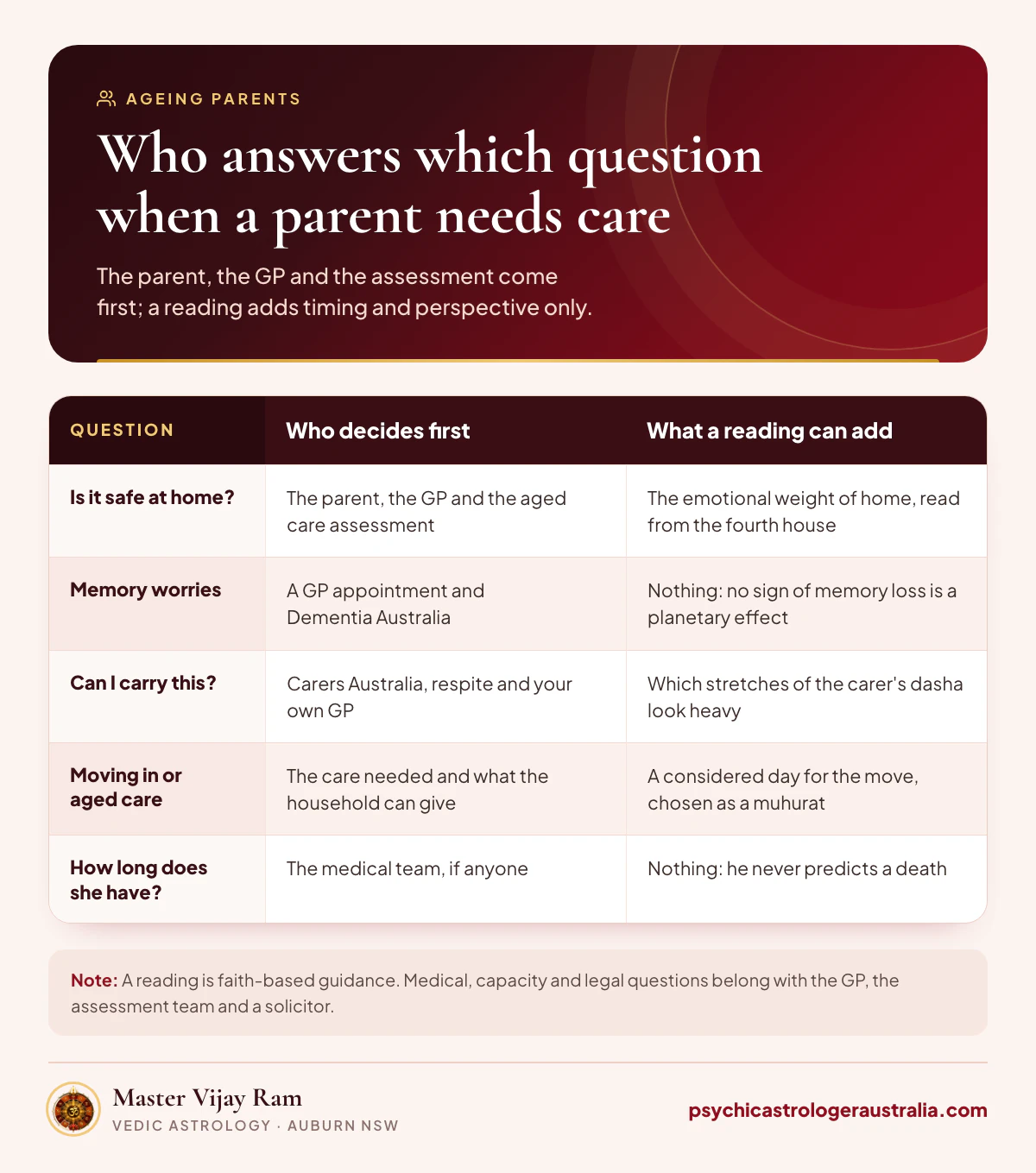
| Question in the family | Where the tradition looks | What it can add | What it cannot do |
|---|---|---|---|
| How is Mum likely to feel about moving? | Fourth house and the Moon in her chart | The emotional weight of home for her | Decide whether she is safe at home |
| Can I carry this for the next few years? | The carer’s sixth and twelfth houses, Saturn, the dasha | Which stretches look heavy and when relief tends to come | Replace respite, rest or a counsellor |
| When should we move Dad in with us? | Transits to both charts; a muhurat for the day | A considered month and day for the move | Make the house safe or the siblings agree |
| Is something wrong with his memory? | Nowhere useful | Nothing | Anything at all: the GP decides |
| How long does she have? | The tradition forbids answering | Nothing | He never predicts a death |
Why will he never say how long a parent will live?
Because the classical texts themselves warn against it, and because a wrong answer in either direction does real harm. A family told a parent has years left may delay the conversations that matter; a family told the opposite may grieve someone who is still in the room.
The eighth house is traditionally linked to longevity, and some astrologers still offer predictions from it. Master Vijay Ram does not. If a family asks, he turns the question to what can still be done well, which is almost always more than they expect.
What does the caregiver’s dasha show?
It shows the season the carer is in. A Saturn period, or Saturn crossing the Moon in Sade Sati, is traditionally read as responsibility without much applause, and many carers recognise themselves in that description. A Jupiter or Venus stretch is read as lighter, with more help arriving from others.
That reading is useful in a practical way. A carer who can see that the next eighteen months look heavy can arrange respite in advance, share the load with siblings before burning out, and stop blaming themselves for feeling tired. Saturn in each of the twelve houses shows how the planet of duty is read by position.
How do siblings share the load fairly?
Unevenly, almost always. With ageing parents, one child lives nearest, one earns most, one is the favourite, and one is in India or Perth. Fairness is not everyone doing the same thing; it is everyone doing something and the arrangement being said aloud.
Charts can help a family stop arguing about character. A brother whose chart leans towards money and organisation may handle the bills, the Centrelink forms and the solicitor, while a sister with a strong fourth house takes the daily visits, and neither is doing less. A family meeting with a written list does more than any reading, and a Relationships Australia family dispute service can help when it stalls.
When is a parent moving in, and when is aged care, the better choice?
That is a medical and household question first. The GP, an occupational therapist and the aged care assessment say what level of care a parent needs; the household says honestly whether it can give it, with shift work, young children and a two-storey house all counting.
A reading can then help with timing and with guilt. Many families from India carry a strong belief that a good son keeps his parents at home, and the decision to use residential care can feel like failure. The tradition is kinder than that: seva is care given well, and well-organised professional care that the family visits often is still seva.
Is choosing a home or a move date something a muhurat can help with?
For the move itself, yes. A day for a parent to move into your home or into residential care can be chosen in the same way as any household beginning, avoiding Rahu kaal and the weaker days in both charts. Choosing an auspicious date explains how the day and hour are picked.
The muhurat never overrides a discharge date, a bed that becomes available or a doctor’s advice. When a hospital says Thursday, Thursday it is, and a short prayer on arrival does as much as any chosen hour.
What about a parent who refuses help?
It is common, and it is usually fear: of losing the house, of being a burden, of strangers in the kitchen. Arguing from the chart does not help here, and nobody should be told that their stars require them to accept a carer.
What helps is time, a trusted outsider such as the GP or a community elder, and small steps, a cleaner before a carer and a carer before a move. If a parent is at real risk at home, the GP and the aged care assessment team are the people to tell, whatever the family tradition says about privacy.
How does a carer look after themselves?
By treating their own health as part of the job. Carers who skip their own GP visits, sleep badly and stop seeing friends are more likely to become unwell themselves, and that helps nobody. Respite, even a few hours a week, is not abandonment.
Low mood, constant anger or the feeling of being trapped deserve a GP appointment and, if they become heavy, Lifeline on 13 11 14. A mantra said each morning, a lamp lit for the parent, or a weekly visit to the temple can steady a carer; they are additions to rest and support, never replacements.
Is there a puja for a parent’s health?
Families often ask for one, especially before an operation or when a parent is in hospital. A Maha Mrityunjaya jaap or a graha shanti is traditionally offered for strength and peace, and it sits beside the treatment, never in place of it. Health and wellbeing guidance explains how he approaches these requests.
If a puja is wanted, Master Vijay Ram performs it personally at his place of practice in Auburn on a chosen muhurat, and the family can join by video, including a parent watching from a hospital bed. Puja and havan performed for you sets out the process. A consultation is $50; a puja or jaap starts from $250 and the figure is agreed before anything is performed.
What about parents who are still in India?
Distance changes the problem without removing it. A son in Townsville with ageing parents in Jalandhar faces visas, flights, a sibling who stayed behind and the guilt of being far away, and those deserve their own conversation. When parents come from India for long stays covers the visiting side; visa questions belong with Home Affairs or a registered migration agent.
Where does duty end?
Duty to a parent is real in every Indian tradition, and it has limits. It does not require a carer to wreck their marriage, their health or their children’s schooling, and it does not oblige anyone to accept abuse from a parent whose temper has worsened with illness. The texts speak of dharma as fitting the person and the time, not as one rule for everyone.
When a family is stuck on that question, a reading can name the season each person is in, which often loosens the blame. The father-and-son version of this argument has its own patterns, and father and son conflict and the ninth house looks at them.
What can a reading not do here?
It cannot assess capacity, diagnose dementia, choose a care home or settle a sibling dispute about money. It cannot tell you that a parent will recover, and it will not tell you that one will not. A parents health kundli reading is a way of understanding the season the family is in, nothing more.
Families in Newcastle, Geelong, Cairns and the Sunshine Coast consult by phone or video; readings for Newcastle families explains how. Consultations are in English, Hindi or Punjabi, and the only place he sees people in person is Auburn, by appointment.
Read next
- Father and Son Conflict: The Sun and the Ninth HouseFather and son conflict in migrant families: expectations, career, the family business, what the Sun, Saturn and the …
- Retirement Timing and the ChartRetirement timing and the chart: super and health first, then what the tenth, twelfth and ninth houses, Saturn and th…
- Kundli Reading Explained: What Your Birth Chart RevealsWhat a Kundli reading reveals about your life, personality, career and destiny. Master Vijay Ram explains Vedic astro…
Frequently asked questions
Can astrology tell me whether my parent should go into aged care?
No. The level of care a parent needs is decided by the parent where they are able, the GP and the aged care assessment arranged through My Aged Care. A reading can help a family understand the season each person is in, choose a day for a move once the decision is made, and ease the guilt many families from India feel about residential care, but it does not make the decision.
Which house in the chart shows the mother and the father?
In Vedic astrology the mother is traditionally read from the fourth house and the Moon, and the father from the ninth house and the Sun. Those houses describe the relationship and what the parent means to you. They are not a medical record, and they cannot tell you how a parent’s health will go. The caregiver’s own chart is usually more useful for the practical questions.
Will Master Vijay Ram tell me how long my parent has?
No. The classical texts warn against predicting death and he follows that warning without exception. A wrong answer either way harms the family, whether by delaying important conversations or by causing grief for someone still alive. If a family asks, he turns the reading to what can still be done well for the parent and for the people caring for them.
I feel guilty about considering a nursing home. What does the tradition say?
Many families from India believe a good child keeps parents at home, and the feeling is understandable. The tradition speaks of seva as care given well, and well-run professional care that the family visits often is still seva. Dharma is described as fitting the person and the time, so a household that cannot safely provide care is not failing its duty by choosing help.
Where can a carer get practical help in Australia?
Carers Australia and the carer organisations in each state offer information, counselling and help planning respite. Dementia Australia supports families worried about memory. The GP is the first stop for the parent’s health and for the carer’s own, and Lifeline on 13 11 14 is there if the strain becomes too heavy. A reading is an addition to these, not a substitute.
Can a muhurat be chosen for a parent moving in with us?
Yes. A day and hour for the move can be chosen from both charts and the local panchang, avoiding Rahu kaal and weaker days, and it is booked through a muhurat consultation. If a hospital discharge or an aged care bed sets the date, that date stands, and a short prayer on arrival is enough. The muhurat never overrides a medical or practical deadline.
Is there a puja for an elderly parent’s health?
Families often ask for a Maha Mrityunjaya jaap or a graha shanti for strength and peace. Master Vijay Ram performs it personally at his place of practice in Auburn on a chosen muhurat, and the family can watch by video. It starts from $250, agreed before it is performed. It sits beside medical treatment and never replaces it.
Can my parents join a reading from India or from a hospital bed?
Yes. Consultations run by phone, video or WhatsApp, in English, Hindi or Punjabi, so a parent in India or in hospital can listen or speak. A consultation is $50. Family members can join from different cities, and the time is arranged so that everyone is awake, which matters when one side of the family is several hours behind.
People also ask
What does the fourth house say about my mother?
The fourth house and the Moon are traditionally read for the mother, the home and peace of mind, so they describe what she means to you and the emotional weight of the family home. They are read alongside the rest of the chart and the running dasha. They do not describe her health in any medical sense, which belongs with her doctor.
Can Saturn make caring for a parent harder?
Tradition links Saturn with old age, patient work and responsibility, so a Saturn dasha or Sade Sati in the carer’s chart is often read as duty that feels heavy and unthanked. It is a tendency, not a sentence. Knowing it can help a carer arrange respite early and share the load before exhaustion sets in.
Does Dementia Australia help families from Indian backgrounds?
Dementia Australia offers information and support to families from the first worries about memory onward, and its resources are open to everyone in Australia. Families who prefer to speak in another language can ask about interpreter support. The first practical step for a parent showing memory changes is still a GP appointment and a proper assessment.
Is it wrong to put my parent in aged care?
No. The decision depends on what care your parent needs and what your household can safely give. The GP and the aged care assessment describe the first, and only the family can judge the second. Well-run care that the family visits often is still a form of seva in the Hindu tradition.
References & further reading
Serving clients across Australia
Confidential consultations by phone, video & WhatsApp — including: