
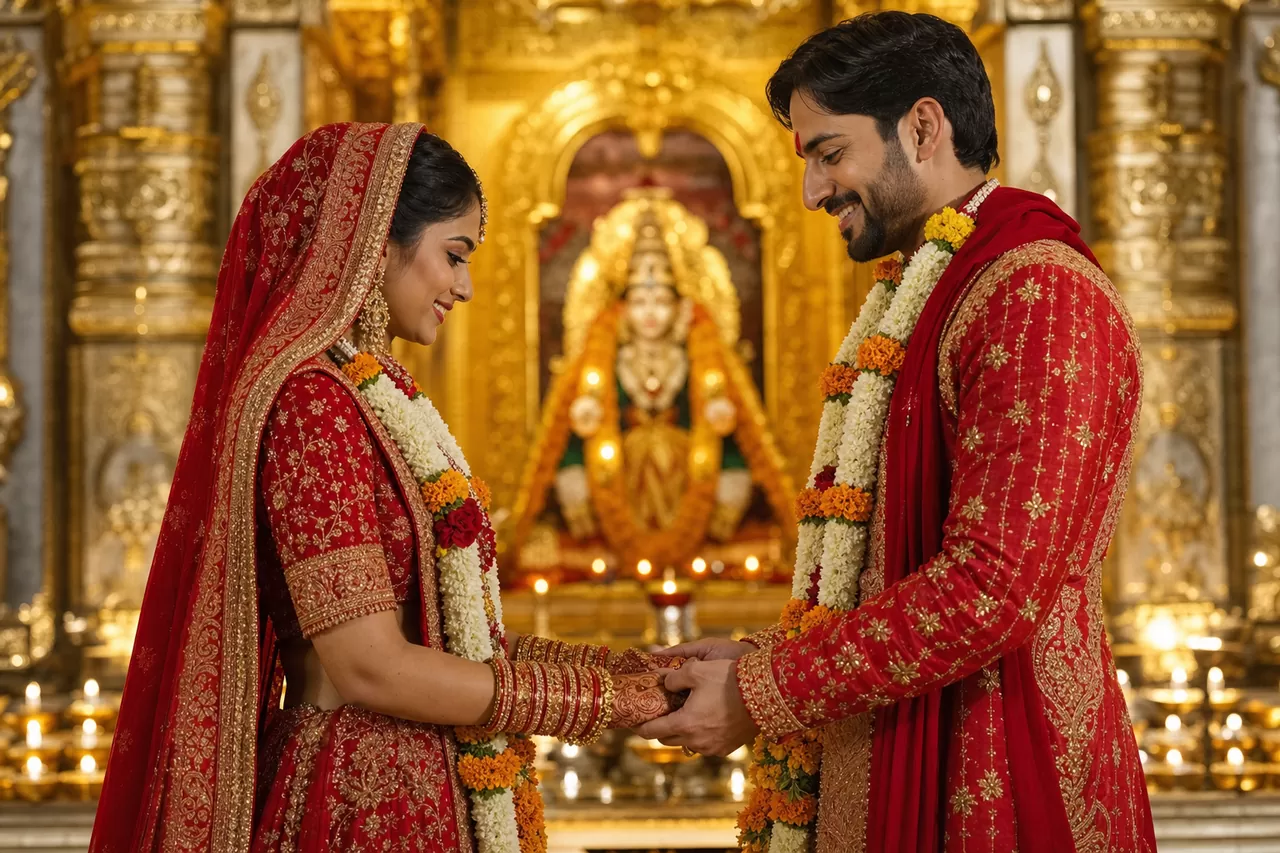
Quick answer
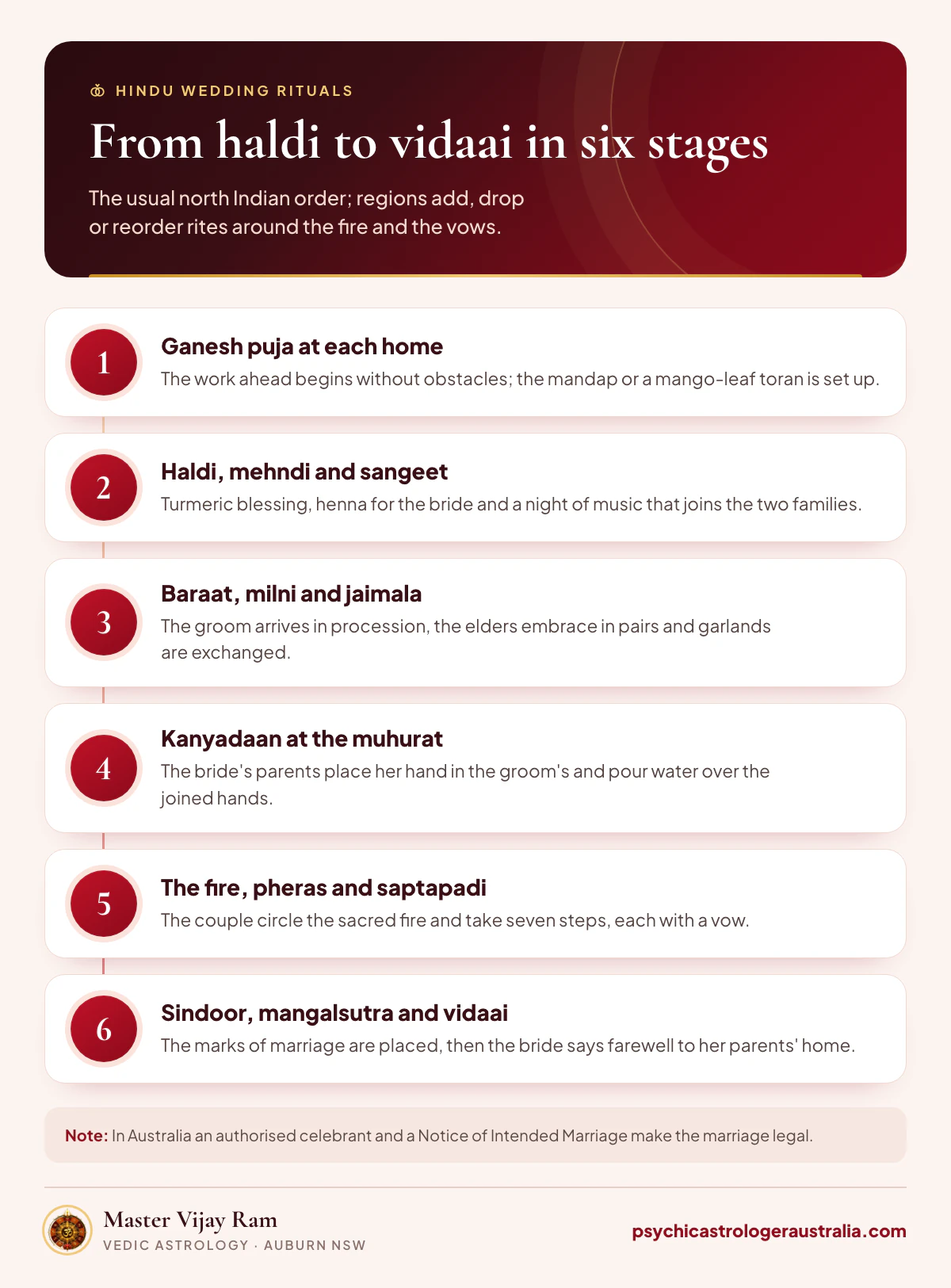
A Hindu wedding usually runs from haldi and mehndi through the sangeet, the baraat and jaimala, to kanyadaan, the sacred fire, the pheras and the seven steps of saptapadi, then sindoor, mangalsutra and the vidaai farewell. Regions change most of it; the fire and the vows are shared. In Australia an authorised celebrant makes it legal.
What are the main Hindu wedding rituals, in order?
Hindu wedding rituals are a sequence of rites, spread over several days, that move a couple from two households to one: blessing and preparation first, then the fire, the vows and the farewell. Vivaha is the fifteenth of the classical samskaras, and the core of it, the sacred fire and the seven steps, is shared across India even where almost everything around it differs. The rest is regional colour, and families argue happily about which version is correct.
This guide walks the usual north Indian order from haldi to vidaai, then shows where Punjabi, Gujarati, Bengali, Marathi and South Indian weddings change it. Picking the hour for the central rite is a separate job, the one a muhurat for the wedding ceremony answers, and the order of events here is planned around that hour.
What comes before the wedding day?
The formal steps usually begin with the families agreeing, the roka or sagai, sometimes months earlier; roka and sagai engagement rites covers those. Closer to the day, a Ganesh puja is held at each home so that the work ahead begins without obstacles, and many families set up the mandap or tie a mango-leaf toran at the door.
Then come the gatherings guests remember best. Each one has a purpose beneath the music, and knowing the purpose helps a couple decide what to keep when time, money or a small hall forces choices.
| Rite | When | What it does |
|---|---|---|
| Haldi | A day or two before, usually morning | Turmeric paste on the couple at their own homes: blessing, beauty and protection |
| Mehndi | The day or evening before | Henna patterns on the bride's hands and feet, songs from the women of the family |
| Sangeet | An evening before | Music and dance that bring the two families together |
| Baraat and milni | The wedding day | The groom's procession arrives; the elders of both sides embrace and exchange gifts |
| Jaimala | On arrival | Garlands exchanged as a sign of mutual acceptance |
| Kanyadaan | At the muhurat | The bride's parents place her hand in the groom's |
| Vivah homa, pheras and saptapadi | At the muhurat | The fire is witness; the couple circle it and take seven steps with seven vows |
| Sindoor and mangalsutra | After the steps | Marks of the married woman, placed by the groom |
| Vidaai | At the end | The bride's farewell to her parents' home |
What do haldi and mehndi actually mean?
Haldi is turmeric, and the paste of turmeric, gram flour and oil or milk is rubbed on by relatives who have each been asked to come. It is a beauty ritual with a blessing inside it: turmeric is auspicious, and in many families the couple stay home afterwards until the wedding. Bengali families call this gaye holud, and in some South Indian homes it is the nalangu.
Mehndi is the henna night, mostly for the women of the bride's family, with songs that tease the groom's side. The folklore that a deeper stain means a more loving mother-in-law is a joke every aunty tells and nobody needs to believe; the practical advice for the stains and the house is in preparing the family home for a wedding.
What happens when the baraat arrives?
The groom arrives in procession, traditionally on a white mare, now just as often in a hired car with a dhol player walking ahead. At the door the bride's family greets him with aarti, and in Punjabi weddings the milni follows: the uncles and fathers of both sides embrace in pairs and exchange gifts, an introduction made with the whole body.
The jaimala comes next, the exchange of garlands, often with the groom's friends lifting him out of reach for the laugh. It is the first public sign that the two have accepted each other.
What is kanyadaan, and why do some couples change it?
Kanyadaan is the rite in which the bride's parents place her right hand in the groom's and pour water over the joined hands, entrusting her to him. In the old reading it is the gift of a daughter, and for many parents it is the most emotional moment of the day.
Some modern couples ask that the rite be reworded as a joining of two families, or that the groom's parents take a matching part, and many priests are comfortable adapting it. Others keep it unchanged and read it as their parents' blessing rather than a transfer, and both choices sit within the tradition.
Why seven steps, and what are the saptapadi vows?
The saptapadi is the rite of seven steps taken together beside the sacred fire, and in many legal readings of Hindu custom it is the moment the marriage is complete. With each step a vow is said; the wording varies by text and family, but one common version runs as follows.
- For nourishment, that the household is never short of food.
- For strength, of body, mind and character.
- For prosperity, earned honestly and shared.
- For happiness and the knowledge that keeps it.
- For children, and for the care of those already in the family.
- For long life together, through every season.
- For friendship: that the two remain companions for life.
The pheras meaning overlaps with this. In many north Indian weddings the couple circle the fire seven times, the bride leading for some rounds and the groom for the rest; in others the circling is four or seven rounds and the seven steps are a separate rite.
Gujarati families, for one, often walk four pheras for the four aims of life. Traditions differ, and the family priest's practice decides.
How do regional weddings differ?
The fire and the vows are shared; nearly everything around them changes from one region to the next. A couple marrying across regions often keeps one rite from each side, and that is entirely ordinary.
- Punjabi Hindu weddings add the chooda, red and ivory bangles given by the maternal uncle, and the kaleere tied to them; the ghodi and the sehra for the groom; the milni at the door; and the doli at the end.
- Gujarati weddings have the mameru gifts from the maternal uncle, the groom welcomed by his mother-in-law at the door, and the hast milap, the joining of hands.
- Bengali weddings begin with gaye holud, include shubho drishti, the first look as the bride lowers the betel leaves from her face, and the sindoor daan.
- Marathi weddings hold a cloth, the antarpat, between the couple while the mangalashtak verses are sung, then drop it at the muhurat.
- Tamil and Telugu weddings include the mock pilgrimage of kashi yatra, the swing of the oonjal, and the tying of the thali or mangalsutra as the central moment; toe rings are placed during the seven steps, and the couple may be shown the star Arundhati.
What is the vidaai, and what follows it?
The vidaai ceremony is the farewell, when the bride leaves her parents' home with handfuls of rice thrown back over her shoulder as thanks for everything she received there. It is the rite where most families cry, and nobody should be embarrassed by that.
At the groom's home a griha pravesh of the bride follows: she tips a pot of rice over the threshold with her right foot and steps into the house, often on red-stained feet. In the days after, many families hold games, a reception and a first visit back to the bride's parents.
Is a Hindu ceremony legally binding in Australia?
Only if Australian requirements are met, and this is general information, not legal advice. The ceremony must be performed by an authorised celebrant, which may be a minister of religion registered under the Marriage Act or a civil celebrant; the couple give the celebrant a Notice of Intended Marriage at least one month before the wedding; two adult witnesses sign; and the marriage is then registered with the state's Registry of Births, Deaths and Marriages. A visiting priest from India is usually not authorised, so many couples hold a short civil ceremony on the same day or a few days before.
Consent is the one requirement no ritual can stand in for. Forced marriage is a crime in Australia, and 1800RESPECT and the Australian Federal Police help anyone being pressured into one.
How are the rituals fitted to an Australian wedding weekend?
Most couples here compress five days into two or three, around venue hire and leave. Haldi and mehndi are often held on the same day; the sangeet becomes a Friday night; the baraat walks a car park in Geelong or a hotel driveway in Darwin. What matters is that the central rites, the fire, the steps and the vows, happen in the chosen window, and that the hall allows a small, contained fire.
Couples marrying in India while living here face the opposite problem, of fitting Australian leave around a family's three-week programme, and planning a wedding in India from Australia goes through that.
Where does astrology come into the rituals?
In two places. Before any of this, the couple's charts are usually compared for temperament and timing in a kundli compatibility reading, and then the muhurat is chosen for the central rite, the kanyadaan, the pheras or the thali, depending on community. The method is set out in how a wedding date is chosen; a chart describes tendencies, and no muhurat can promise a happy marriage.
Master Vijay Ram chooses wedding muhurats in a $50 consultation, in English, Hindi or Punjabi, for families in Townsville, Cairns and the Central Coast as much as in Sydney. Where a family asks for a Ganesh puja or graha shanti before the wedding, he performs it personally at his place of practice in Auburn on the chosen muhurat; a puja performed before the wedding starts from $250, agreed before it is performed. Readers on the Bellarine and Surf Coast can see astrology for Geelong families.
What should a couple keep if they must cut the programme?
The fire, the seven steps and the vows; the blessing of both sets of parents; and whatever single rite each family would grieve to lose. Couples counselling before the wedding, through services such as Relationships Australia, does more for the marriage than an extra function, and the rest can be scaled to the hall, the budget and the guests who can travel.
Read next
- Guru Purnima in Australia: Honouring TeachersGuru Purnima in Australia: the Ashadha full moon, why it is Vyasa Purnima, how to find the day for your city and simp…
- Vivah Muhurat 2027: Wedding Season for Australian FamiliesVivah muhurat 2027 for Australian families: the two wedding seasons, the closed periods, nakshatras and tithis, the p…
- How to Reverse a Love Spell SafelyReversing a love spell safely means lifting a binding, not casting a second one. Learn the settling phases, the hones…
Frequently asked questions
What is the correct order of Hindu wedding rituals?
A common north Indian order is Ganesh puja, haldi, mehndi and sangeet before the day; then the baraat, milni and jaimala on arrival; kanyadaan, the vivah homa, the pheras and saptapadi at the muhurat; sindoor and mangalsutra; and finally the vidaai. Regional weddings add, drop or reorder rites, and the family priest’s practice decides the details.
What do the seven vows of saptapadi mean?
Each of the seven steps carries a vow, and wording varies by text and family. One common version asks for nourishment, strength, prosperity, happiness, children, long life together through every season, and lifelong friendship. Many couples now hear the vows explained in English as well as recited in Sanskrit, so both families understand what is being promised.
Are there seven pheras or four?
Both are found. Many north Indian weddings circle the fire seven times, often with the bride leading some rounds and the groom the rest. Gujarati and some other families walk four pheras, linked to the four aims of life, and take the seven steps as a separate rite. Neither is wrong; follow your family and your priest.
Is a temple wedding legal in Australia?
Only when Australian requirements are met. An authorised celebrant must perform it, either a registered minister of religion or a civil celebrant; a Notice of Intended Marriage must reach the celebrant at least one month before; two adult witnesses sign; and the marriage is registered with the state registry. A visiting priest is usually not authorised, so many couples add a short civil ceremony.
Can kanyadaan be changed or left out?
Many priests will adapt the wording so that the rite reads as a joining of families, or invite the groom’s parents to take a matching part. Some couples keep it exactly as it is and understand it as a blessing. It is a family decision, best discussed with the priest well before the day rather than on it.
Which part of the wedding needs the muhurat?
The central rite: in many north Indian weddings the kanyadaan or the pheras, in South Indian weddings the tying of the thali or mangalsutra. The haldi, mehndi and reception do not need the same precision, though many families still avoid the Rahu kaal for them. A consultation fixes the main window and plans the rest around it.
How long does a Hindu wedding ceremony take?
The central ceremony, from kanyadaan through the fire, the steps and the blessings, often runs about one to three hours depending on the priest and the community. The full programme with haldi, mehndi, sangeet and reception spreads across several days in India and is usually compressed into two or three days in Australia.
Does Master Vijay Ram conduct weddings?
No. He chooses the muhurat in a $50 consultation, compares charts where the family asks, and performs any Ganesh puja or graha shanti personally at his place of practice in Auburn, from $250 agreed beforehand. The wedding itself is conducted by your own priest, and an authorised celebrant must handle the legal side in Australia.
People also ask
What is the meaning of the pheras?
The pheras are the rounds the couple walk around the sacred fire, with Agni as witness to their promises. Depending on the community there are seven or four rounds, often with the bride and groom taking turns to lead. In many weddings they flow straight into the seven steps of saptapadi, which complete the marriage in Hindu custom.
What is the vidaai ceremony?
Vidaai is the bride’s farewell to her parents’ home at the end of the wedding. She throws handfuls of rice back over her shoulder as thanks for what that home gave her, and leaves with her husband’s family. It is often the most emotional moment of the whole wedding for both families.
Why is haldi applied before a wedding?
Turmeric is auspicious in Hindu custom, and the haldi rite combines a beauty treatment with a blessing from the relatives who apply it. Many families also read it as protection for the couple before the wedding, and in some homes the couple stay in after the haldi until the ceremony.
What is the difference between kanyadaan and saptapadi?
Kanyadaan is the parents’ rite, in which they place the bride’s hand in the groom’s and entrust her to him. Saptapadi is the couple’s rite, seven steps taken together beside the fire, each with a vow. In Hindu custom the saptapadi is usually treated as the moment the marriage is complete.
References & further reading
Serving clients across Australia
Confidential consultations by phone, video & WhatsApp — including: