
Quick answer
A long visit from parents in India goes best when practical things are settled first: visitor health insurance, who cooks and when, the grandchildren’s routines, and how long the stay will be. Visa questions go to Home Affairs or a registered migration agent. A Vedic reading adds timing and a calmer view of the friction, never a ruling on whose way is right.
Why do long visits from India feel so different?
Because a three-month stay is not a holiday; it is a second household moving into the first one. A long visit from parents visiting from India is a stretch of shared life that tests routines, kitchens, marriages and sleep, often in a three-bedroom house in Blacktown or a unit in Southbank built for one small family. Most families love having them, and most families also find week six harder than week one.
Master Vijay Ram hears both sides of these visits, sometimes from a daughter-in-law and her husband’s mother in the same month. He treats them as part of family problem consultations, and his first question is always a practical one: what has actually been agreed about the stay?
What should be settled before the flight?
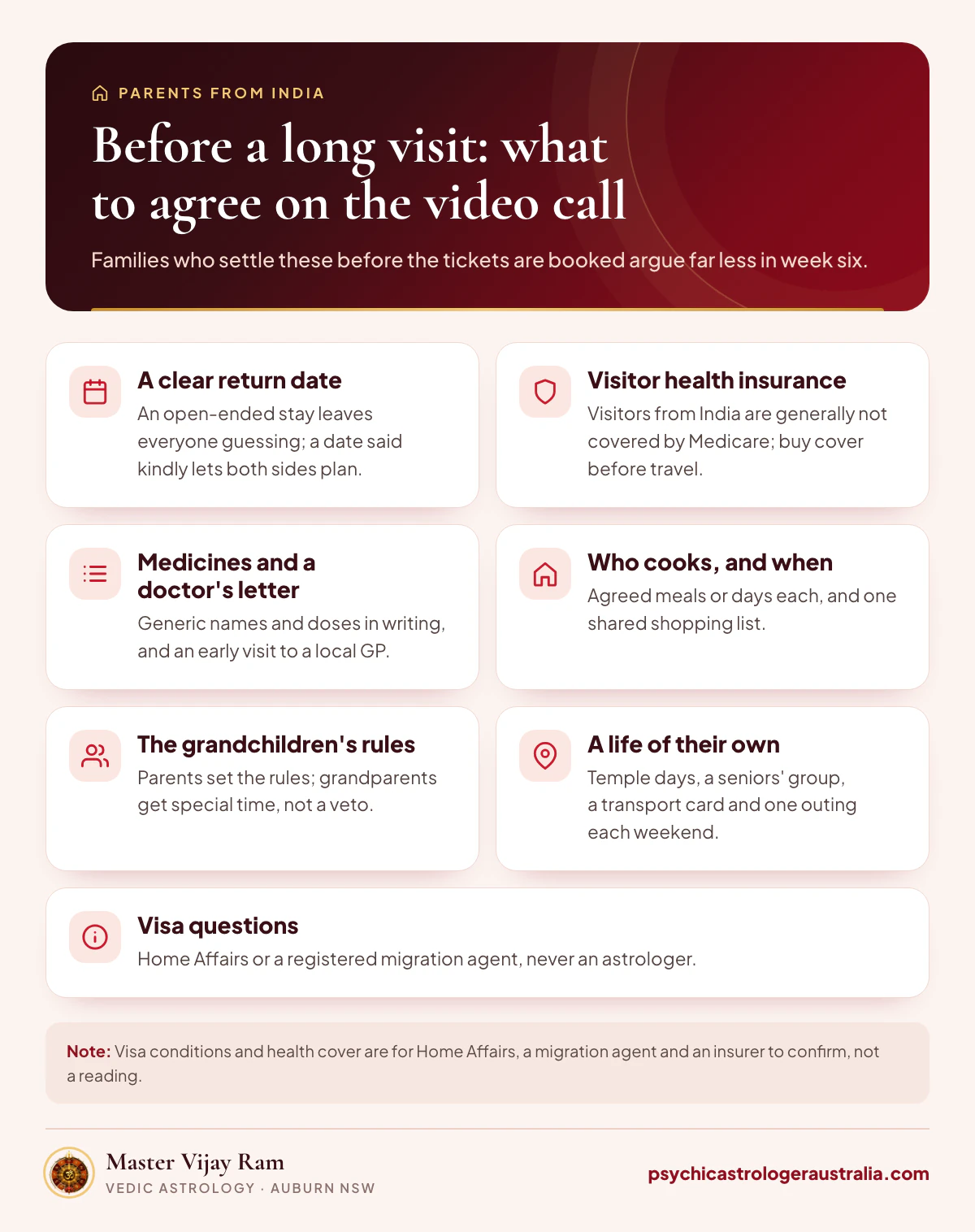
Five things: how long the stay will be, where everyone will sleep, who pays for what, how health care will work, and what the parents hope to do while they are here. Families who talk these through on a video call before the tickets are booked argue far less later.
The length matters most. An open-ended stay leaves everyone guessing, and guessing turns into resentment. A clear return date, said kindly, gives the parents something to plan around and the household something to look forward to as well as away from.
What about health insurance and medical costs?
This is the question families most often leave too late. Visitors from India are generally not covered by Medicare, so a fall, a hospital admission or a new heart problem during the stay can bring large bills. Private visitor health insurance, bought before travel, is the usual answer for a long stay in Australia, and some visas carry a condition requiring adequate cover.
Bring a written list of every medicine with its generic name and dose, and a letter from the parents’ doctor in India. Australian pharmacists cannot always fill an Indian prescription as written, so an early appointment with a local GP avoids a scramble. Which visa suits a long stay, and what conditions it carries, is a question for Home Affairs or a registered migration agent, not an astrologer.
What do families actually argue about?
Not the big things. The arguments are about onions in the dal, the grandchildren’s screen time, a mother-in-law reorganising the pantry, the heater running all night, and who gets up first for the bathroom. Each one is small; together they wear people down, and most in-law visit stress is built from exactly these.
| Friction point | What is usually underneath | What helps |
|---|---|---|
| The kitchen | Two people who each run a household, with different rules | Agreed days or meals each, and one shared shopping list |
| The grandchildren | Love expressed through food, gifts and fewer rules | Parents set the rules; grandparents get special time, not veto |
| The daughter-in-law | Expectations carried from India meeting a working Australian life | The son speaks to his own parents; the couple stays united |
| Boredom and isolation | No transport, no friends, no language for the shops | Temple days, seniors’ groups, a weekly outing booked in advance |
| Weather and sleep | Cold winters, early light, jet lag | Warm bedding, a heater safely placed, a slow first week |
Who should speak to whom?
Each partner speaks to their own parents. When a mother-in-law upsets her son’s wife, the conversation with the mother is the son’s to have, and the same applies the other way round. A spouse who is left to defend themselves against their partner’s family becomes lonely in their own house, and that loneliness outlasts the visit.
The tradition has its own version of this. In the joint households of the past an elder brother or uncle often mediated, and many families still find that a respected outsider, an aunt, a temple elder, or a counsellor from Relationships Australia, can say what neither spouse can.
How do you give the parents a life of their own here?
By remembering that they had full days in India. A father who ran a shop in Amritsar, or a mother who knew everyone in her colony, can find suburban Australia isolating: everyone at work, no footpath culture, buses they cannot read. Isolation turns into criticism of the household quickly.
A weekly temple or gurdwara visit, a seniors’ group with others from the same region, morning walks in the park, an Opal or myki card and a lesson in using it, and one family outing booked each weekend make a large difference. In Darwin the Hindu Society’s temple at Malak is a natural meeting place; in Sydney, Melbourne and Brisbane there are many.
What does the chart say about in-laws?
Vedic astrology has a technique called bhavat bhavam, reading a house counted from another house. One derived-house method reads the spouse’s mother from the tenth house (the fourth counted from the seventh) and the spouse’s father from the third (the ninth counted from the seventh). Traditions differ on how much weight to give this, and it describes the relationship’s texture rather than anyone’s character.
More useful is the timing. A Moon transit through the twelfth or eighth from the natal Moon, or a Saturn period for the person who carries the household, is traditionally read as a stretch when patience runs short. Knowing that a visit falls across such a stretch helps a couple plan more rest and fewer dinners. The fourth house, home and peace of mind explains why the household itself is read from the fourth.
Can the visit be timed?
Within reason. Flights, school holidays, a new baby’s arrival or a wedding usually set the dates, and they should. Where there is a genuine choice, a reading can suggest which months sit more easily on both charts, and some families like a short prayer on the day the parents arrive.
A family already in a difficult stretch, with a job change, a newborn or a strained marriage, may be wiser to shorten the visit or delay it a season. That is not disrespect; it is choosing a time when everyone can enjoy each other.
When a new baby is the reason for the visit
Many long stays begin with a birth. Grandmothers arrive to help in the first months, and their customs around food, oil massage, swaddling and visitors can clash with the advice of the hospital and the child health nurse. The nurse’s safe-sleep and feeding advice comes first; the rest can usually be blended with goodwill.
The grandmother’s experience is real and worth honouring. Asking her to take on the cooking and the older children, rather than the newborn’s sleep, often keeps everyone happy.
What should parents bring, and what should stay in India?
Many parents pack sweets, pickles, spices, dried fruit and puja items as gifts, and Australian biosecurity checks a good deal of it at the airport. Everything with food, plant material or animal products must be declared. What biosecurity lets through from India explains which items usually pass and which do not.
What helps when the visit has gone sour?
First, separate the person from the problem. A mother who criticises the cooking is usually frightened of being useless in a strange country, and a father who comments on money is usually worried about his son. Seeing that does not make the comments pleasant, but it makes them easier to answer gently.
Second, protect the marriage. A couple who agree on a few things in private, a quiet hour each evening, one night out alone each week, and a shared answer to the hardest topic, can ride out most visits. Where the strain has gone deeper than the visit, help for a strained marriage looks at the couple’s own charts. When the friction becomes abuse, threats or control of money, 1800RESPECT is the place to call, whoever the person is.
Families who feel that a heaviness came into the house with the visit sometimes ask about nazar or negative energy. Most often it is crowding, tiredness and old patterns; a lamp at dusk and a calmer routine help more than any suspicion of the visitors.
Is there a puja families do for a visit?
Some families hold a Satyanarayan katha or a small havan while the grandparents are here, which gives the elders a role and brings the community into the house. If a family wants Master Vijay Ram to perform one, it is done personally at his place of practice in Auburn on a chosen muhurat, with the family joining by video if they wish; puja and havan on a chosen day explains the process. A puja starts from $250 and the figure is agreed before it is performed.
How do grandparents in India join a reading?
Many families like the elders to hear a reading for themselves, especially when a grandchild’s naming, a marriage or a move is being discussed. Consultations run by phone, video or WhatsApp in English, Hindi or Punjabi, which suits most grandparents. Consultations in Hindi and Punjabi describes how that works, and family in India joining across time zones covers the practicalities when they are back home.
What can a reading not do for a visit?
It cannot extend a visa, choose a health insurer, or decide whether your mother is right about the onions. It cannot make a difficult relative easy. A joint family in Australia works through agreements, patience and goodwill, and the chart only shows the season those are tested in.
A consultation is $50. Families in Darwin, the Central Coast, Perth and the capital cities consult by phone or video; readings for families in Darwin explains how time zones are handled. In person, he sees people only at his place of practice in Auburn, by appointment. For the care of parents who are growing frail, caring for ageing parents and the chart looks at the harder decisions.
Read next
- Blended Families: Step-Parents and the ChartBlended families and step-parents: putting the children first, the slow pace that works, what the 5th, 7th and 11th h…
- Family in India Joining a Reading Across Time ZonesFamily in India joining a reading from Australia: the IST time difference by city, hours that suit both homes, Hindi …
- Vashikaran for Marriage Approval: Softening Family ResistanceHow family resistance to a marriage really softens: what vashikaran addresses, a stage-by-stage timeline, the honest …
Frequently asked questions
Can an astrologer tell me which visa my parents should apply for?
No. Visas for visiting parents, including how long they can stay and what conditions apply, are decided by Home Affairs, and a registered migration agent can advise on a particular case. A chart can describe the timing of travel and family changes in general terms, but it cannot predict a visa decision, and Master Vijay Ram does not give migration advice.
Do my parents need health insurance while visiting from India?
Visitors from India are generally not covered by Medicare, so a hospital stay or an emergency during a long visit can be expensive. Most families buy private visitor health insurance before travel, and some visas carry a condition requiring adequate cover. Home Affairs or a registered migration agent can confirm what your parents’ visa requires.
How long should a visit from parents in India be?
There is no right answer, but there should be an agreed answer. A clear return date, settled before the tickets are booked, lets parents plan their time and lets the household pace itself. Families with a newborn, a job change or a strained marriage often find a shorter visit, or one split into two trips, works better for everyone.
My mother-in-law and I keep clashing in the kitchen. What helps?
Two people who have each run a household will have different rules. Agreeing who cooks which meals or which days, keeping one shared shopping list, and having your spouse speak to their own mother about anything sensitive usually calms things. A chart can show whether either of you is in a strained stretch, but the agreement is what changes the kitchen.
What does Vedic astrology say about in-laws?
One derived-house method reads the spouse’s mother from the tenth house and the spouse’s father from the third, counting from the seventh house of marriage. Traditions differ on how much weight these carry. They describe the texture of the relationship and its harder seasons, never anyone’s character, and they never justify blaming a relative.
Is there a puja to bring harmony while parents are staying?
Some families hold a Satyanarayan katha or a small havan during the visit, which gives the elders a role and gathers the community. Master Vijay Ram performs such a puja personally at his place of practice in Auburn on a chosen muhurat, with the family joining by video if they wish. It starts from $250, agreed before it is performed.
Can my parents take part in a reading in Hindi or Punjabi?
Yes. Consultations run in English, Hindi or Punjabi by phone, video or WhatsApp, so parents can speak in the language they are most comfortable with, whether they are in Australia for the visit or back home in India. A consultation is $50, and the time is arranged so that every participant is awake.
My parents seem bored and unhappy here. Is something wrong?
Usually it is isolation. Parents who had busy days in India can find suburban Australia lonely when everyone is at work and they cannot drive or read the bus timetable. A weekly temple or gurdwara visit, a seniors’ group from the same region, a transport card with a lesson in using it, and a booked outing each weekend help a great deal.
People also ask
How do I handle a long stay from my in-laws?
Agree the length, sleeping arrangements, money and health insurance before the flight. Let each partner speak to their own parents about friction, keep some private time as a couple each week, and give the visitors a life of their own through temple, community groups and outings. Most tension comes from crowding and boredom rather than bad intentions.
Are visiting parents covered by Medicare?
Visitors from India are generally not covered by Medicare because Australia has no reciprocal health care arrangement with India. Families usually buy private visitor health insurance before travel. Home Affairs or a registered migration agent can say whether your parents’ particular visa requires a level of cover.
Can astrology tell when it is a good time for parents to visit?
A reading can show which months sit more easily on the household’s charts and which look strained, and some families choose the arrival day as a small muhurat. In practice flights, school holidays and family events usually fix the dates, and a reading works within them rather than against them.
What should parents not bring from India to Australia?
Food, plant material and animal products must be declared at the airport, and sweets, dairy, fresh and dried fruit, spices and raw seeds are among the items biosecurity officers check. Declared items that pose no risk are handed back. Packing fewer food gifts and declaring everything avoids most problems.
References & further reading
Serving clients across Australia
Confidential consultations by phone, video & WhatsApp — including: