
Quick answer
Keep Gangajal sealed in a copper or glass vessel at the altar, out of the sun. Sprinkle it with a mango or tulsi leaf from the altar to the main door, add a few drops to bath, mop or kalash water, and never drink it. With none at hand, clean water, a tulsi leaf and the seven-rivers verse stand in.
What is Gangajal, and why do families keep it at home?
Gangajal at home is usually a small sealed bottle on the altar shelf, and it is one of the few things almost every Hindu household keeps. Gangajal is the water of the Ganga, the river the tradition holds came down from heaven through Shiva’s hair, and it is used as a purifying water that makes a place, an object or a person fit for worship. A few drops are believed to carry the river’s blessing, which is why one bottle can last a family for years.
This page covers how families keep it, how it is sprinkled, what to do when there is none, and the one rule that matters most: it is for sprinkling, not drinking. Negative energy removal is the separate work for a home whose heaviness outlasts its own customs.
Where does Gangajal in Australian homes come from?
Most of it arrives in a suitcase. A relative returns from Haridwar, Rishikesh, Varanasi or Prayagraj with bottles filled at the ghats or bought sealed, and they are shared around the family like prasad. Indian grocers in most Australian cities also stock sealed bottles, and a temple priest can usually say where to find one.
Ganga jal in Australia is therefore often years old and a long way from its river, and that does not trouble the tradition at all. What matters is how it is kept and how it is used.
How should you store Gangajal at home?
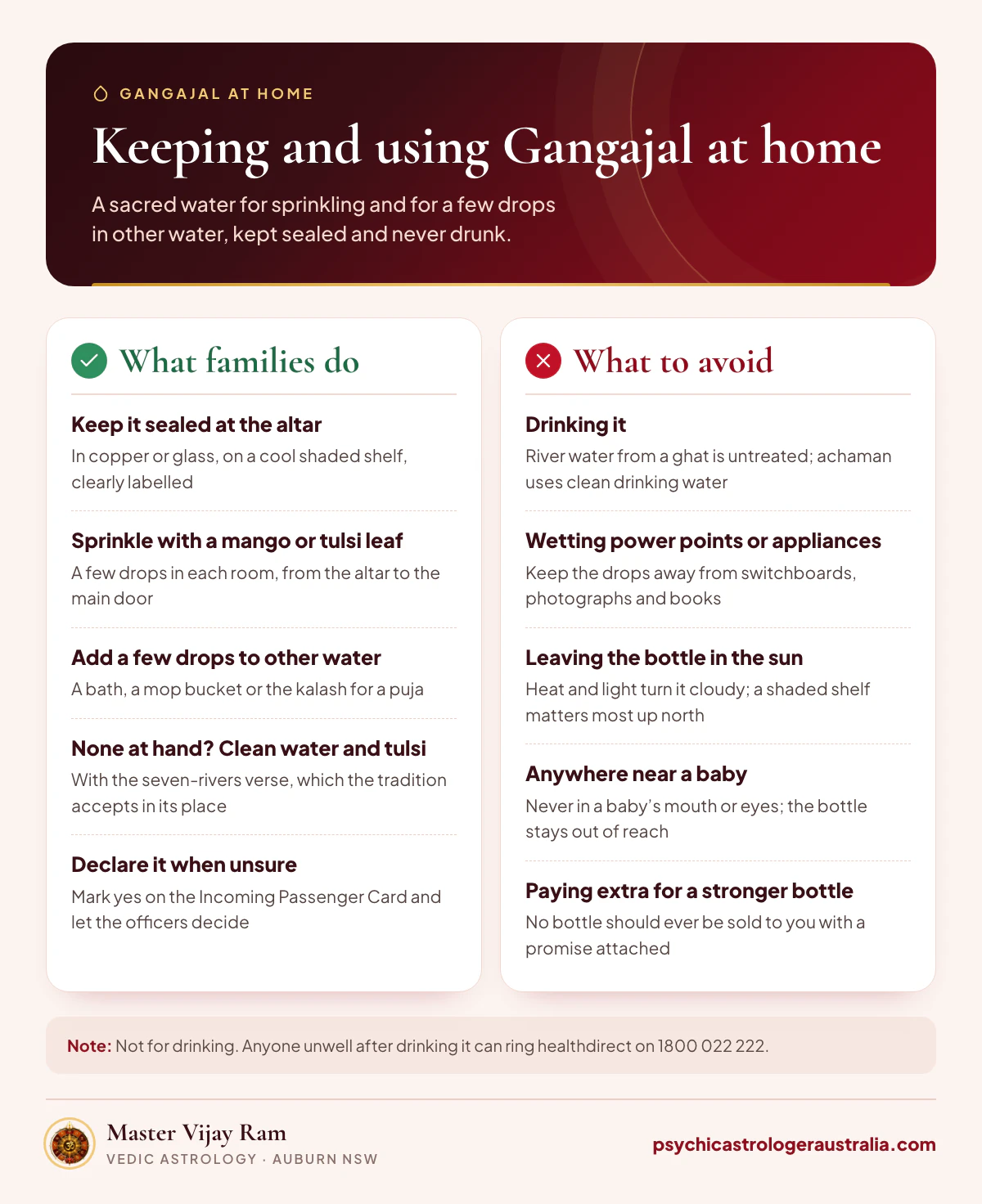
The short answer to how to store Gangajal is a sealed vessel at the altar. Copper is the traditional choice and glass serves just as well; plastic is common for travel, and many families pour the water into a small copper lota or a glass bottle once it is home. Keep the lid on, keep it off the floor, and touch it with clean hands.
Heat and light are the practical enemies. In a Darwin build-up or a Cairns wet season the altar shelf can be the warmest spot in the house, so choose a cool, shaded place out of direct sun. If the water turns cloudy, green or smells, it has met air, light or warmth; pour it on a garden plant and start a fresh bottle.
Copper darkens with time, and the old remedy still works: a rub with tamarind, or with lemon and a little salt, then a rinse. Label the bottle clearly so that nobody in the house mistakes it for drinking water.
What is prokshan, and how is Gangajal sprinkled?
Prokshan is ritual sprinkling. A little Gangajal is poured into a small bowl, a mango leaf, a tulsi leaf or a few blades of kusha grass are dipped in it, and the water is flicked lightly over the place or the object being purified. Without a leaf, the fingertips of the right hand do the same job.
Many families say a short purification verse while they sprinkle: Om apavitrah pavitro va sarvavastham gato’pi va, yah smaret pundarikaksham sa bahyabhyantarah shuchih. It asks that whoever remembers the lotus-eyed Lord be made clean within and without, whatever state they were in, and many priests say it at the start of a puja.
A light hand is the whole technique. A few drops land on each surface, nothing is soaked, and the floor should not need wiping afterwards.
How is Gangajal used to cleanse a home?
Sprinkling Gangajal in the house usually begins at the altar or the north-east corner, moves through each room with a few drops in the corners and at the doorways, and ends at the main door, where the threshold gets the last of the water. It takes about five minutes in a unit and perhaps fifteen in a large house, done in silence or with a mantra the family knows.
Families reach for it at set moments: before a puja, when a new home is entered, when the mourning period after a death ends, when a new car or a second-hand chest of drawers comes home, and after a long illness has left the house. At a griha pravesh every room is sprinkled before the family moves in, which is part of what a griha pravesh home blessing involves.
Keep the water away from power points, switchboards and electrical appliances, and away from photographs and books. A drop on timber or tiles does no harm.
Which uses need how much?
The table sets the common uses side by side. The quantities are customary rather than fixed, and every family has its own habits.
| Use | How it is done | How much | Care |
|---|---|---|---|
| The altar each morning | Sprinkled on the altar and the offerings before the lamp is lit | A few drops | Clean hands; lid straight back on |
| A room-by-room cleansing | Prokshan with a mango or tulsi leaf, ending at the main door | A small bowlful | Away from power points and photographs |
| Griha pravesh | Every room sprinkled before the family moves in | A small bowlful | Done by the priest or the head of the household |
| After a death | Rooms and thresholds sprinkled when the mourning period ends | A small bowlful | The family’s own community custom decides the day |
| A new car or second-hand furniture | Sprinkled with a short prayer | A few drops | Not on electrics, leather or a dashboard screen |
| Bath, mop or kalash water | Added to a bath, a bucket or the kalash for a puja | A few drops | Never as drinking water |
Why is a little Gangajal enough?
Because the custom holds that a drop of the Ganga makes all the water it touches Ganga. That is why families add a few drops to a mopping bucket, to a bath before a festival or to the kalash at a puja, and why one bottle from Haridwar can serve a household for years.
A few drops in bathwater are the most personal of these uses, and the Hindu ritual bath for cleansing covers what else belongs in it and what is best left out. For the bucket, the home cleansing calendar shows where the weekly and festival washes fall in the year.
What if there is no Gangajal in the house?
Then clean water does the work, and the tradition has always allowed for that. Fill a copper or glass vessel with fresh tap water, add a tulsi leaf, and say the verse that invites the seven sacred rivers into it: Gange cha Yamune chaiva Godavari Saraswati, Narmade Sindhu Kaveri jale’smin sannidhim kuru.
It calls on the Ganga, Yamuna, Godavari, Saraswati, Narmada, Sindhu and Kaveri to be present in the water, and many priests use it daily for exactly this purpose. A family that runs out before the next trip to India has lost nothing, and nobody should pay a premium for a bottle sold as more powerful than another.
Can you drink Gangajal?
No. Gangajal is for sprinkling and for adding a drop to water used outwardly, and it should not be drunk. River water bottled at a ghat is untreated, however sacred it is, and an old bottle that has sat on a warm shelf is not drinking water either.
Where a puja calls for achaman, the ritual sip at the start, use clean drinking water from the tap or a jug, with the verse said over it. Keep the Gangajal bottle out of children’s reach and never near a baby’s mouth or eyes, and anyone who feels unwell after drinking it can ring healthdirect on 1800 022 222.
Can you bring Gangajal back from India?
Many families do, and the honest rule at the airport is simple: if you are not sure whether something must be declared, mark yes on the Incoming Passenger Card and declare it. Officers decide, and declared items that pose no risk are handed back. Declaring takes a few minutes at the counter, and it is the safer habit with anything you are unsure about.
Pack the bottle sealed, wrapped and bagged in checked luggage, since liquids in cabin bags are limited on international flights. Bringing puja items from India goes through the rest of the suitcase item by item, and a sealed bottle from a local Indian grocer avoids the question altogether.
What can Gangajal do, and what can it not do?
In the tradition, Gangajal purifies. It readies the altar, the house and the person for worship, closes a period of mourning and welcomes a family into a new home, and many families say the house feels settled after a room-by-room prokshan.
It cannot disinfect a room, remove mould, heal an illness or settle a run of trouble that a chart shows. It belongs to faith and custom, what this page offers is religious guidance and not medical or legal advice, and no bottle of it should ever be sold to you with a promise attached.
When is more than Gangajal needed?
When a home stays heavy through a month of its own customs, with damp, mould and the gas heater already checked. Sprinkling more will not answer that, but a reading might: Master Vijay Ram looks at when the trouble started and what the household’s charts show for those weeks, in a $50 consultation by phone, video or WhatsApp.
Often the answer is to carry on with the customs, and nothing more is suggested. If a shanti is called for, its fee starts from $250 and is settled with the family before anything is done; Vijay Ram ji performs it himself in Auburn, his only place of practice, and a puja or havan performed on request explains how relatives can watch by video.
Darwin sits half an hour behind Sydney in winter and an hour and a half in summer, and an astrologer for Darwin families explains how calls are booked across that gap. When the heaviness follows a person rather than a house, removing negative energy from yourself is the better starting point.
Read next
- A Home Cleansing Kit in Australia: What to Keep and What to SkipA home cleansing kit for Australian homes: the short list of puja items worth keeping, how to store them, where they …
- Neem in Home and Body Cleansing: The Tradition and Safe UseNeem in Hindu home and body cleansing: Ugadi neem and jaggery, the neem bath, leaves at the door, why neem smoke stay…
- Signs of Negative Energy in Your Home & How to Clear ItSigns of negative energy in a home, the ordinary causes to rule out first, and how nazar, heavier interference and me…
Frequently asked questions
What is Gangajal used for at home?
Gangajal is used to purify: sprinkled on the altar before a puja, through the rooms in a home cleansing, at a griha pravesh, when a mourning period ends, and on a new car or a second-hand piece of furniture. A few drops are also added to bath, mop or kalash water. It is a sacred water for outward use, kept sealed at the altar, and it is not for drinking.
How do you sprinkle Gangajal in the house?
Pour a little into a small bowl, dip a mango leaf, a tulsi leaf or your fingertips, and flick a few drops into each room, starting at the altar or the north-east and finishing at the main door. Many families say the Om apavitrah verse as they go. Keep the drops away from power points, appliances and photographs; nothing should be soaked.
How long does Gangajal last?
Families say it never goes stale, and a sealed bottle kept cool, dark and closed can stay clear for a long time. If the water turns cloudy, green or smells, it has met heat, light or air; pour it on a garden plant and open a fresh bottle. In a hot northern summer a shaded shelf matters more than the vessel it sits in.
Which container is best for storing Gangajal?
Copper is the traditional choice and glass is just as good; both are kept sealed at the altar. Plastic bottles are fine for travel, and many families decant into copper or glass once they are home. Clean copper with tamarind, or with lemon and a little salt, rinse it well, and label the bottle so no one drinks it by mistake.
Can I drink Gangajal?
It is best not to. River water bottled at a ghat is untreated, however sacred, and an old bottle kept on a warm shelf is not drinking water either. Gangajal is for sprinkling and for adding to water used outwardly. Where a puja calls for achaman, the ritual sip, use clean drinking water with the verse said over it, and keep the bottle out of children’s reach.
What can I use if I do not have Gangajal?
Clean tap water in a copper or glass vessel with a tulsi leaf, and the verse that invites the seven sacred rivers into it, Gange cha Yamune chaiva Godavari Saraswati, Narmade Sindhu Kaveri jale’smin sannidhim kuru. The tradition has always allowed for this, and many priests use it daily. A family that runs out has lost nothing in blessing and needs no expensive substitute.
Can I bring Gangajal from India to Australia?
Many families do. If you are unsure whether it must be declared, mark yes on the Incoming Passenger Card and declare it; officers decide, and declared items that pose no risk are handed back. Pack it sealed and bagged in checked luggage, because cabin liquids are limited on international flights. A sealed bottle from a local Indian grocer avoids the question altogether.
Is Gangajal used after a death in the family?
Yes, in many families. When the mourning period ends, commonly after ten to thirteen days though communities differ, the house is cleaned and the rooms and thresholds are sprinkled with Gangajal to mark its close. The family’s own custom and priest decide the day and the details, and grief support such as Griefline is there alongside the rites for anyone who needs it.
Does Gangajal remove negative energy?
Families use it to purify a space and ready it for worship, and many say a room-by-room sprinkling leaves the house feeling settled. It is custom and faith rather than a treatment: it cannot remove mould, fix damp or end a run of trouble that has lasted months despite ordinary care. When that is the situation, a $50 reading is more useful than another bottle.
People also ask
Where should Gangajal be kept at home?
On the altar or in the puja cupboard, in a sealed copper or glass vessel, off the floor and out of direct sun. Many families avoid keeping it in the kitchen beside food or in a bathroom. Touch it with clean hands, keep the lid on, and label it so nobody mistakes it for drinking water, especially in a house with young children.
Is Gangajal available in Australia?
Yes. Indian grocers in most Australian cities stock sealed bottles, relatives bring it back from Haridwar, Rishikesh, Varanasi or Prayagraj, and a temple priest can usually suggest where to find it. A family without any can use clean water with a tulsi leaf and the seven-rivers verse, which the tradition accepts in its place.
Can Gangajal be mixed with normal water?
Yes, and that is one of its main uses. The custom holds that a drop of the Ganga makes the water it touches sacred, so families add a few drops to a mop bucket, a bath or the kalash for a puja, which is why one bottle can last years. The mixture is still for outward use and is never given as drinking water.
Which leaf is used to sprinkle Gangajal?
A mango leaf is the most common, with a tulsi leaf or a few blades of kusha grass in many homes; the fingertips of the right hand serve when there is no leaf. The leaf is dipped in a small bowl of Gangajal and flicked lightly so a few drops land on each surface, then placed in the garden or the green bin afterwards.
References & further reading
Serving clients across Australia
Confidential consultations by phone, video & WhatsApp — including: