
Quick answer
A rudraksha is the dried seed of an Elaeocarpus tree, sacred to Shiva and worn singly or in a japa mala. Its mukhis are the clefts running down the bead, and the meanings attached to each vary between texts and sellers. The five-mukhi bead is the commonest and suits almost anyone; expensive beads need a laboratory X-ray, and no bead promises a result.
What is a rudraksha bead?
A rudraksha is the dried seed of the fruit of certain Elaeocarpus trees, chiefly Elaeocarpus ganitrus, which grow from the Himalayan foothills to South-East Asia, and Hindu tradition treats it as sacred to Shiva. Once the blue outer fruit is removed, the stone inside is cleaned, dried and drilled, and it is worn as a single bead or strung into a mala for counting mantras. Every genuine bead is a natural object, so no two are quite alike.
It is also the most faked devotional object on the market, and the claims printed on sellers' cards run well ahead of anything the tradition promises. This guide covers what the faces mean, how the bead is worn and cared for, and how to avoid paying for a carved piece of wood. Master Vijay Ram sells no beads, which leaves him free to say so plainly.
A rudraksha is not the same thing as a kavach. A kavach is a protective locket, thread or yantra over which a mantra is recited for one named person, and a kavach or taweez prepared for one person explains how that differs from a bead bought off a shelf.
Why is the bead sacred to Shiva?
The name joins Rudra, an old name of Shiva, with aksha, read as eye or as tears. The best-known story says the first beads grew from tears Shiva shed after a long meditation, which is why Shaiva families have kept them for centuries and why sadhus are so often pictured wearing strings of them.
For most families today the bead's role is practical as well as devotional. A mala of rudraksha is the traditional counter for japa, and a single bead worn at the throat or over the heart is a reminder to pray, kept close to the skin through an ordinary working day.
What does mukhi mean?
A mukhi, literally a face or mouth, is one of the natural clefts that run down the bead from the top, where the stalk joined, to the bottom. Counting the clefts gives the bead its number: a five-mukhi bead has five lines running the full length of the seed. Inside, a genuine bead has a seed compartment for each face, which is what an X-ray shows.
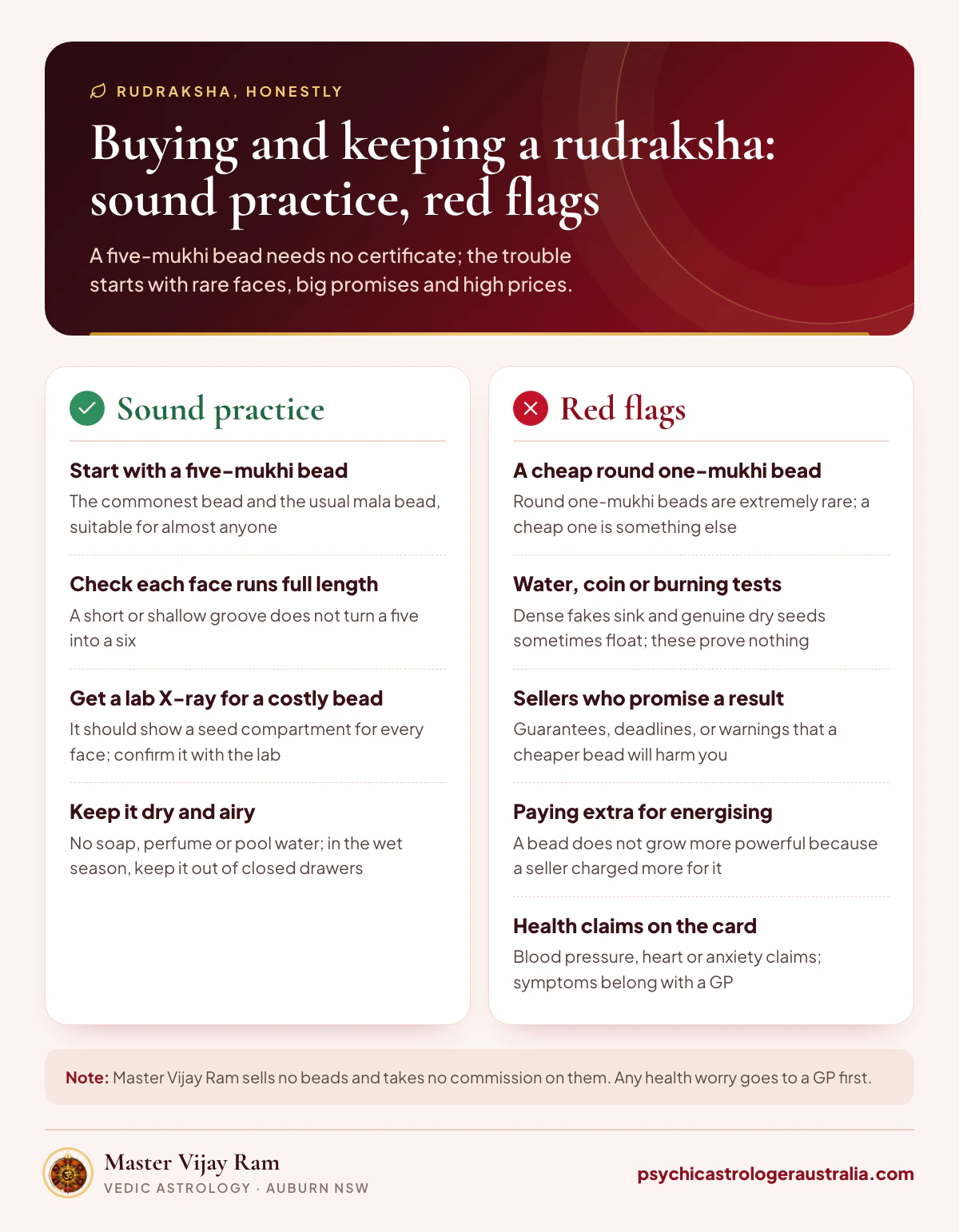
Sellers list beads from one mukhi to twenty-one and beyond, and the higher numbers are scarcer and dearer. A face only counts if it runs the full length of the bead; a short or shallow groove does not make a five into a six, however the card describes it.
What do the different rudraksha mukhi types stand for?
The traditional associations vary between texts, and the variation is worth knowing before anyone sells you certainty. The Shiva Purana and a short late text, the Rudraksha Jabala Upanishad, both describe the faces and their deities, and their lists do not always agree; the planetary links printed on most modern cards are a later astrological convention layered on top. The table shows the convention most rudraksha mukhi types are sold under, for the first nine.
| Mukhi | Planet most cards link it to | Deity most cards name |
|---|---|---|
| 1 | Sun | Shiva |
| 2 | Moon | Ardhanarishvara, Shiva and Parvati as one |
| 3 | Mars | Agni |
| 4 | Mercury | Brahma |
| 5 | Jupiter | Kalagni Rudra, a form of Shiva |
| 6 | Venus | Kartikeya |
| 7 | Saturn | Mahalakshmi, though some lists name others |
| 8 | Rahu | Ganesha |
| 9 | Ketu | Durga |
Treat the table as a description of how beads are marketed, not as scripture. One-mukhi round beads are extremely rare and widely faked, and anyone offering a cheap one is offering something else.
Why is the five-mukhi rudraksha the one most people wear?
Because it is the commonest bead by far, and because the tradition treats it as suitable for almost anyone. The five-mukhi rudraksha is linked with Kalagni Rudra and, on most cards, with Jupiter; it is the bead most malas are strung from, and it is the one families give to children, students and elders without a second thought.
Its ordinariness is a strength. A five-mukhi bead needs no certificate, is hard to fake profitably, and does everything the tradition asks a rudraksha to do: sit against the skin and bring the wearer back to prayer.
What benefits does the tradition actually claim?
The older texts praise the bead as purifying and pleasing to Shiva, and families describe it as steadying, protective and helpful to concentration in japa. Those are devotional claims, and for many wearers the steadiness is real in the way any faithful daily practice is real.
The rudraksha benefits listed online go much further: lower blood pressure, a stronger heart, an end to anxiety, a promotion at work. None of that is promised here, and none of it should replace care: symptoms belong with a GP, and anxiety or low mood deserves proper help rather than a bead. Healthdirect, listed below, is a sensible place to start.
How do you wear a rudraksha?
Most families string a single bead on red or black cotton or silk thread, or have it capped in silver or gold, and wear it so that it touches the skin at the throat or over the heart. Many first put it on on a Monday, Shiva's day, or on Maha Shivratri, after washing it and reciting Om Namah Shivaya; in 2027 that night falls on Saturday 6 March, and Maha Shivratri 2027 in Australia gives the night's timing.
The rules about taking it off differ from family to family. Some remove the bead to sleep, to bathe with soap, at a funeral or during intimacy; others never take it off; some ask the wearer to avoid meat and alcohol and others do not. Many teachers today welcome women wearing rudraksha, and the older restrictions some families keep are a matter of their own tradition.
Knowing how to wear a rudraksha also means knowing what a mala is for. A japa mala has 108 beads and a larger guru bead where the count turns back rather than crossing over, and the navagraha mantras and how to chant them explains how a mala is used day to day.
How do you look after a bead in an Australian climate?
Keep it dry, clean and away from chemicals. Sweat, soap, perfume, sunscreen and chlorinated pool water all dry and dull a seed, so wipe the bead after exercise, take it off before swimming, and clean the faces now and then with a soft brush. Many families rub in a little oil once in a while and let the bead rest in the shade before wearing it again.
Humidity is the other risk. In Cairns, where the wet season runs from November to April, a bead left in a closed drawer can grow mould, so store it in an open, airy place and check the thread, which frays and should be replaced before it snaps.
Bringing a bead home from India or Nepal has its own step. A rudraksha is a seed, so declare it as a plant product on the incoming passenger card; the biosecurity officer decides whether it needs inspection.
How can you tell real from fake rudraksha?
By looking for the common tricks first. Fakes include beads carved from wood or moulded in resin, low-mukhi beads with extra lines cut into them, two beads glued together and sold as a naturally joined Gauri Shankar, dyed or polished beads passed off as rare colours, and lookalike seeds such as bhadraksha sold under the better name.
The home tests are not reliable. Floating or sinking in water, spinning between two copper coins and burning a corner prove nothing about a bead, because dense fakes sink and genuine dry seeds sometimes float. For a cheap five-mukhi bead it hardly matters; for anything expensive, the only test worth paying for is a laboratory X-ray or CT scan that shows the internal seed compartments matching the faces.
The same logic applies to every devotional object sold with a promise, which telling a real taweez from a fake works through for amulets. Separating real and fake rudraksha is mostly separating a seller's claims from the seed.
What should you check before paying for an expensive bead?
Ask for a laboratory report that names the bead, shows the scan and can be checked with the lab directly, because certificates can be faked as easily as beads. Ask what happens if the report is wrong, get the answer in writing, and pay in a way that leaves you some protection.
Walk away from any seller who promises a result, sets a deadline or says the bead will harm you if you do not buy the costlier one. Under Australian Consumer Law a business may not make misleading claims about what it sells, and Consumer Affairs Victoria, listed below, explains your rights if a purchase goes wrong.
Does a rudraksha need to match your birth chart?
Some families choose a bead for the planet on its card, a seven-mukhi for a Saturn period, say, and that is a reasonable use of the convention. Where a reading is involved, the chart decides which planet is running and struggling, and a full kundli reading is where that is worked out; most people come away with a mantra and a habit rather than anything to buy.
A rudraksha is not a gemstone. The tradition treats it as gentle, and the warnings about the wrong stone backfiring do not carry over to a five-mukhi bead; if a seller says otherwise, ask which text says so.
What does Master Vijay Ram offer, and what does he not?
He sells no beads or gemstones, certifies no beads and takes no commission on either. He will tell you in a $50 consultation whether a bead, a mantra or nothing at all suits the period you are running, and where protection is genuinely warranted he prepares a kavach personally at his place of practice in Auburn, from $250, agreed before it is made. When a puja is wanted as well, a puja performed for you in Auburn explains how clients take part by video.
No bead, kavach or rite can promise an outcome, and he does not pretend otherwise. Clients who reach him through astrology readings for Cairns clients are on Queensland time all year, an hour behind Sydney in summer and level with it in winter.
Read next
- Sundarkand Path at Home: When Families Hold One, and HowSundarkand path at home: what the fifth book of the Ramayana tells, when families hold a path, how it runs in a house…
- Taweez & Kavach for Protection: Real Ones vs FakesHow to tell a genuine taweez or kavach from a fake: what belongs inside one, what never should, which option suits yo…
- Agnihotra: The Sunrise and Sunset Fire, and Whether It Suits Your HomeAgnihotra explained: the Vedic sunrise and sunset fire, the modern copper-pyramid practice and its mantra, local timi…
Frequently asked questions
What is a rudraksha made of?
It is the dried stone, or seed, of the fruit of certain Elaeocarpus trees, chiefly Elaeocarpus ganitrus, which grow from the Himalayan foothills to South-East Asia. The blue outer fruit is removed, and the seed inside is cleaned, dried and drilled to be worn as a single bead or strung into a mala. A genuine bead is a natural object, so its shape and faces vary from one seed to the next.
Which rudraksha mukhi is best?
No single mukhi is best for everyone. The five-mukhi bead is the commonest, the one most malas are made from and the one the tradition treats as suitable for almost anyone, which makes it the sensible default. Other mukhis are chosen by family custom or, where a reading is involved, by the planet that is running and struggling in the chart. Higher counts are scarcer, dearer and more often faked.
How do you wear a rudraksha for the first time?
Many families wash the bead, string it on red or black thread or have it capped in silver or gold, and first wear it on a Monday or on Maha Shivratri after reciting Om Namah Shivaya. It is usually worn touching the skin at the throat or over the heart. Rules about when to remove it, for sleep, bathing, funerals or intimacy, differ between families, and your own tradition's practice is fine.
Can women wear rudraksha?
Many teachers today say yes, and plenty of women wear a bead or use a rudraksha mala for japa. Some older family traditions keep restrictions, particularly during menstruation, and those are a matter of the family's own practice rather than a rule every Hindu follows. If your family has a custom, follow it; if it does not, a five-mukhi bead worn with respect is widely accepted.
How can I check if my rudraksha is real?
Look first for the common fakes: carved wood or resin, extra lines cut into a lower-mukhi bead, two beads glued together, dyed beads and lookalike seeds such as bhadraksha. Home tests like floating, sinking or spinning between coins are not reliable. For an expensive bead, ask for a laboratory X-ray or CT report showing internal seed compartments that match the faces, and confirm the report with the lab.
What are the benefits of wearing a rudraksha?
The tradition describes the bead as sacred to Shiva, purifying, steadying and a support for prayer, and many wearers find a bead kept against the skin a useful daily reminder to pray. Claims that it lowers blood pressure, cures illness or guarantees success are not part of an honest account. Health concerns belong with a GP, and no bead promises a result.
How do you clean and care for a rudraksha?
Keep it away from soap, perfume, sunscreen and chlorinated or salt water, wipe it after sweating, and clean the faces occasionally with a soft brush. Many families rub in a little oil now and then and let the bead rest in the shade. In humid places such as Cairns in the wet season, store it somewhere airy to avoid mould, and replace the thread before it frays through.
Does a rudraksha need to be energised?
Many families wash a new bead and recite Om Namah Shivaya before first wearing it, often on a Monday or Maha Shivratri, and some ask a priest to include it in a puja. Traditions differ on whether more is needed. A bead does not become more powerful because a seller charged extra for energising it, and that charge is one of the commonest upsells in the trade.
Does Master Vijay Ram sell rudraksha?
No. He sells no beads, certifies no beads and takes no commission from sellers. In a $50 consultation he will say whether a bead, a mantra or nothing at all suits the period you are running. Where protection is genuinely warranted he prepares a kavach for one named person at his place of practice in Auburn, from $250, agreed before it is made.
People also ask
Who should not wear rudraksha?
The tradition treats rudraksha, and the five-mukhi bead in particular, as suitable for almost anyone. Some families keep their own restrictions around meat, alcohol, funerals or menstruation, and those are matters of family custom. Anyone told a bead will harm them unless they buy a costlier one should treat that as a sales tactic, not a teaching.
How many mukhi rudraksha are there?
Sellers list beads from one mukhi to twenty-one and beyond, with higher counts scarcer and dearer. The texts that describe the faces, such as the Shiva Purana, do not always agree on their deities, and the planetary links printed on modern cards are a later convention. The five-mukhi bead is by far the commonest.
Is a 5 mukhi rudraksha good for everyone?
The tradition treats it as suitable for almost anyone, which is why it is the bead most malas are strung from and the one families give to children and elders. It is linked with Kalagni Rudra and, on most cards, Jupiter. It promises no particular result; its value lies in daily wearing and prayer.
What does a rudraksha X-ray show?
It shows the internal seed compartments of the bead. In a genuine rudraksha their number matches the faces visible on the outside, so a scan exposes carved extra lines, glued beads and wood or resin copies. A laboratory report is worth having for an expensive bead, provided you can confirm it with the lab directly.
References & further reading
Serving clients across Australia
Confidential consultations by phone, video & WhatsApp — including: