
Quick answer
Agnihotra is the Vedic fire offering made at sunrise and after sunset. Today it is usually the modern version: a small copper pyramid, dried cow dung, ghee and a few grains of rice, offered at the exact local moment with “Agnaye svaha, Agnaye idam na mama” at sunset. It is a devotion and a daily discipline, not an air purifier.
What is Agnihotra?
Agnihotra is a Vedic fire offering that a householder makes twice a day, at sunrise and after sunset, pouring an oblation into the sacred fire as the day opens and closes. It is one of the oldest rites in the Vedic tradition, and for centuries it defined the Agnihotri, the householder who kept the sacred fires and made the offering every day of his married life. Today the word usually means something simpler: a modern daily practice built on the same moments of the day.
This page explains both, the claims made for the modern version, and the practical question families in Australia ask, which is whether a daily fire suits their home at all. For families who would rather have a fire offering made on their behalf, Master Vijay Ram holds the havan himself in Auburn, as puja and havan performed on request describes.
What did the Vedic Agnihotra involve?
In its classical form it was a lifelong vow. The householder formally established the sacred fires, kept them alive, and offered milk and ghee into them each morning and each evening, with his wife as a partner in the rite. The offering was brief; the commitment was total, and it shaped the household’s day, its travel and even its meals around the two moments of the sun.
A small number of families in India still keep the classical rite. For nearly everyone else it survives as a reverence for sunrise and sunset, the two sandhyas, the joins of the day that the tradition treats as moments for prayer.
What is the modern Agnihotra, or Homa therapy?
The household version was popularised through the teaching of Gajanan Maharaj, and it is often taught under the name Homa therapy. It reduces the rite to something any household can do: a small copper vessel shaped like an inverted pyramid, a fire of dried cow-dung pieces with a little ghee, and two small pinches of unbroken rice smeared with ghee, offered into the flame at the exact moment of local sunrise and local sunset.
The fire is lit a few minutes before the moment, the mantra is said as the rice goes in, and the practitioner sits quietly until the flame dies down. Those few minutes of stillness are, for many who keep the practice, the reason they keep it.
How do the two forms compare?
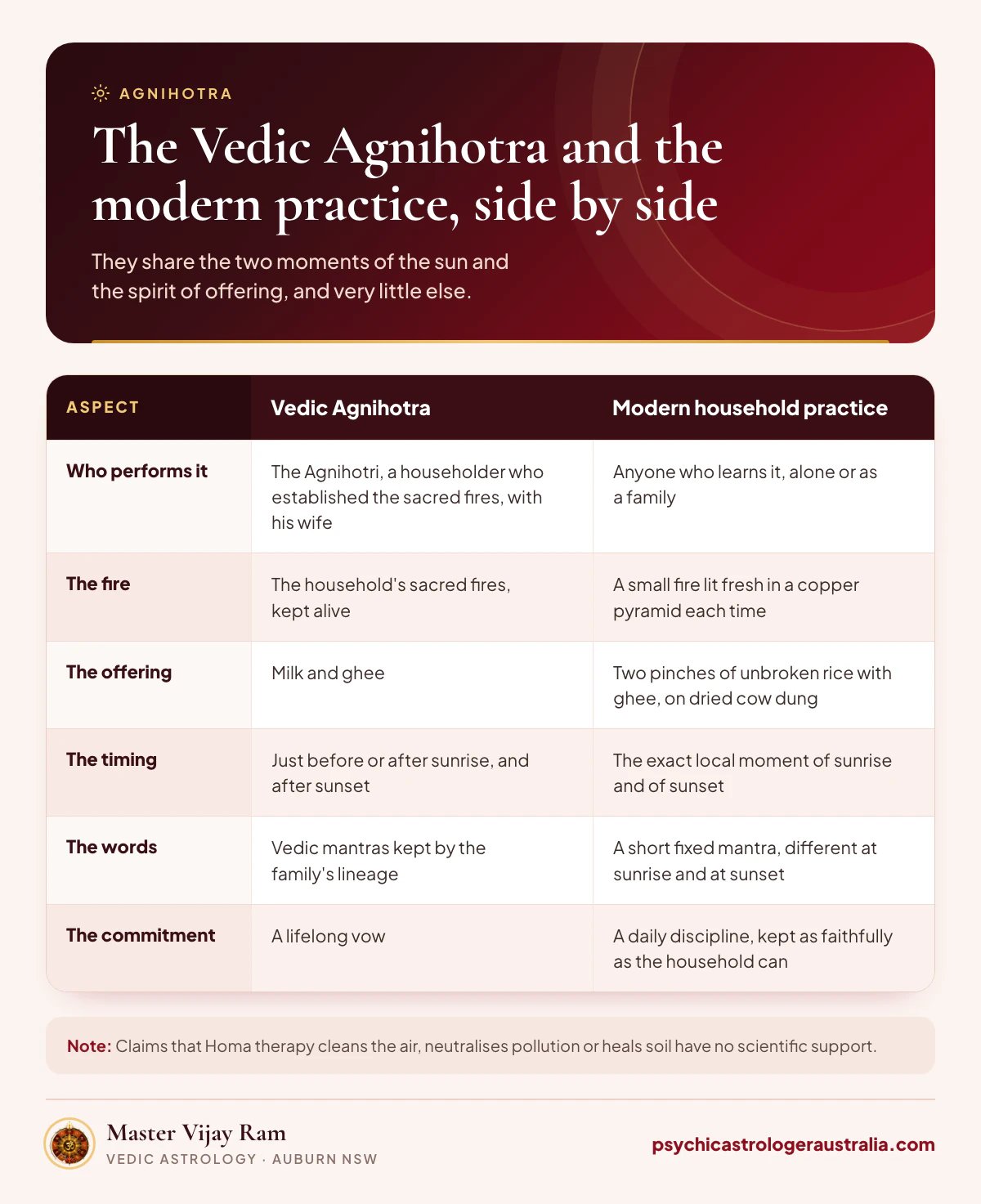
The table sets the classical rite beside the modern household practice. They share the hours of the day and the spirit of offering, and very little else.
| Aspect | Vedic Agnihotra | Modern household practice |
|---|---|---|
| Who performs it | The Agnihotri, a householder who has formally established the sacred fires, with his wife | Anyone who learns it, alone or as a family |
| The fire | The household’s sacred fires, kept alive | A small fire lit fresh in a copper pyramid each time |
| The offering | Milk and ghee | Two pinches of unbroken rice with ghee, on dried cow dung |
| The timing | Just before or after sunrise, and after sunset | The exact local moment of sunrise and of sunset |
| The words | Vedic mantras kept by the family’s lineage | A short fixed mantra, different at sunrise and at sunset |
| The commitment | A lifelong vow | A daily discipline, kept as faithfully as the household can |
What is the Agnihotra mantra?
The sunset Agnihotra mantra in the modern practice is “Agnaye svaha, Agnaye idam na mama”: an offering to Agni, the fire, followed by the words “this is for Agni, not for me”. The sunrise mantra has the same form and is addressed to Surya, the Sun. Learn both from a teacher or a printed guide of the tradition you follow, since spellings and pairings vary between groups.
The heart of it is the phrase idam na mama, “not mine”. It is said in many Vedic rites at the moment of offering, and it turns the act from a request into a release. People who keep the practice often say this is what changes them, far more than the fire.
How do you get the Agnihotra timing right in Australia?
From your own location, every day. Agnihotra timing follows the moment the sun’s upper edge crosses the horizon where you live, and that moment moves through the year and differs between cities. Geoscience Australia publishes a sunrise and sunset calculator for any place in the country, and that, not a timetable printed for an Indian city, is the source to use.
Three Australian quirks catch families out. Queensland keeps no daylight saving, so summer sunrises in Brisbane and on the Gold Coast come very early by the clock; Hobart’s long summer evenings push sunset late into the evening; and in the states that change their clocks, daylight saving shifts the clock while leaving the sun exactly where it was. Perth sits two hours behind Sydney in winter and three in summer, which is why a Sydney relative’s timetable is no use there.
The same logic runs through every Hindu calendar, because the day itself is counted from local sunrise; how a panchang is read explains why the city changes the day.
What are the claimed Agnihotra benefits, and what does the evidence say?
Promoters of Homa therapy claim far more than devotion: that the fire cleans the air, neutralises pollution, heals soil and helps crops grow, and some go further still. Those claims have no scientific support. A small fire of dung and ghee indoors adds smoke and fine particles to a room; it does not remove them.
The Agnihotra benefits the tradition itself can stand behind are of another kind: a fixed daily appointment with sunrise and sunset, a moment of offering without asking, and a household rhythm built around the sun rather than the phone. Those are real, and they need no exaggeration.
Does Agnihotra suit your home?
It suits a household where someone is at home at sunrise and sunset most days, where a small daily fire is allowed and safe, and where nobody’s lungs object. A retired couple in a Canberra house with a back patio, keeping it together each evening, is the kind of household it fits. A nurse on rotating night shifts in Hobart, or a family in a Brisbane high-rise, will find the timing or the building against them.
That is not a failure of devotion. The tradition offers the same moments without a fire: a lamp lit at sunrise and dusk, water offered to the rising sun, or a Gayatri mantra said facing east. Many families keep these and add the fire only on a festival morning.
What about smoke alarms, neighbours and children?
A pyramid fire is small, but it smokes most at the moment of offering, and a daily fire multiplies every risk of an occasional one. The rules on smoke alarms, strata by-laws and telling the neighbours are the same as for any fire indoors, and they are set out in full in holding a small havan in an apartment. Above all, a working alarm is never covered for the sake of a ritual.
Babies, toddlers and pets, birds most of all, are kept away from the smoke and the hot copper; pets, toddlers and home cleansing covers what is safe around them. A household with asthma is better served by the lamp than the fire.
Where do the cow-dung cakes come from?
Dried cow dung is the traditional fuel, and families often bring cakes back from India in a suitcase. To Australian biosecurity, dried cow dung is an animal product: it is declared on arrival, and officers decide whether it can come in. What Australian biosecurity lets through covers cow-dung cakes, rice, ghee and everything else a family might pack.
Whatever their source, store the cakes dry and sealed, especially through a sticky Queensland summer, because damp fuel smoulders and smokes rather than burning cleanly.
Is Agnihotra the same as a havan?
No. A havan is an occasional rite with many offerings and mantras, held for a house-warming, a festival or a shanti, and it can take an hour or more. Agnihotra is a daily rite of two brief offerings, fixed to the sun, and its power in the tradition lies in its repetition rather than its scale.
A family can keep either, both or neither. Doing Agnihotra at home for a month, then lapsing, is common and carries no penalty in the tradition; the sun rises again tomorrow, and the practice can start again with it.
Where does Master Vijay Ram fit in?
He does not teach Homa therapy or supervise a daily practice. What he offers is a $50 consultation by phone, video or WhatsApp in which a family can ask whether a daily fire, a lamp or a mantra suits their chart, their home and their working hours. Perth, Adelaide and Brisbane households consult him the same way, and readings for Brisbane families explains the Queensland clock.
Where a chart calls for a fire offering on the family’s behalf, such as a shanti in a hard period, it is performed by him in person at Auburn on a chosen muhurat, and family members may join the video call from wherever they are; the cost starts from $250 and is settled before the day. Negative energy removal covers the separate question of a home that feels heavy, which a daily fire is not meant to answer.
What can Agnihotra not do?
It cannot clean the air in your home, heal a garden, treat asthma or replace anything a doctor, a builder or an electrician would do. It cannot be kept safely in every building, and it cannot be made right by a timetable from another city. The practice belongs to faith, and nothing on this page is medical, legal or financial advice.
What it can do is give a household two still moments a day and a habit of offering without asking. For many families that is reason enough, and for many others a lamp at the same two moments does the same work.
Read next
- Sundarkand Path at Home: When Families Hold One, and HowSundarkand path at home: what the fifth book of the Ramayana tells, when families hold a path, how it runs in a house…
- Havan at Home in an Apartment: Smoke Alarms, Strata and a Small, Safe FireHavan at home in an apartment: how small a safe fire can be, smoke alarms that must never be covered, strata by-laws,…
- Signs of Jinn Disturbance at Home and How Ruqyah HelpsJinn disturbance at home: which signs matter, which have ordinary causes, what ruqyah really is, and how a settled ho…
Frequently asked questions
What is Agnihotra and how is it done?
Agnihotra is a Vedic fire offering made at sunrise and after sunset. In the modern household version, a small fire of dried cow dung and a little ghee is lit in a copper pyramid a few minutes before the moment, two pinches of unbroken rice smeared with ghee are offered with the mantra at the exact local sunrise or sunset, and the practitioner sits quietly until the flame dies down.
What is the Agnihotra mantra at sunset?
In the modern practice the sunset mantra is “Agnaye svaha, Agnaye idam na mama”, an offering to Agni followed by the words “this is for Agni, not for me”. The sunrise mantra has the same form and is addressed to Surya, the Sun. Groups differ in spelling and in the exact pairing of lines, so learn the version of the tradition you follow from its teacher or printed guide.
What time should Agnihotra be done in Australia?
At the exact local sunrise and sunset for where you are, which change every day and differ between cities. Geoscience Australia publishes a sunrise and sunset calculator for any location in Australia. Do not use a timetable printed for an Indian city, and remember that daylight saving moves the clock but not the sun, while Queensland, the Northern Territory and Western Australia keep the same clock all year.
Can Agnihotra be done in an apartment?
Sometimes: where the building’s by-laws permit a small flame, the ventilation is good and nobody in the home has asthma. A daily fire multiplies the risks of an occasional one, so the smoke alarm must stay working and uncovered, the copper pyramid sits on a heat-proof tray, and an adult stays with it until the flame dies. In many towers a lamp at sunrise and sunset is the wiser practice.
Does Agnihotra purify the air?
No. Claims that Agnihotra or Homa therapy cleans the air, neutralises pollution or heals soil have no scientific support. A small fire of dung and ghee indoors adds smoke and fine particles to a room rather than removing them. The benefits the tradition can honestly offer are spiritual and personal: a daily rhythm, a moment of stillness, and the habit of offering without asking.
What is Homa therapy?
Homa therapy is the name under which the modern Agnihotra practice is often taught, popularised through the teaching of Gajanan Maharaj. It keeps the sunrise and sunset fire in a simplified household form. Its promoters make health, pollution and farming claims that have no scientific support, so it is best understood as a devotional discipline rather than a treatment.
Can I bring cow-dung cakes from India for Agnihotra?
Dried cow dung is an animal product for Australian biosecurity purposes. Mark yes on the Incoming Passenger Card, declare the cakes, and let the officers decide; declared items that pose no risk are handed back. Because the outcome is not yours to predict, it is often simpler to source fuel in Australia, and whatever you use should be kept dry and sealed so it burns cleanly.
Is Agnihotra the same as a havan?
No. A havan is an occasional rite with many offerings and mantras, held for a house-warming, a festival or a shanti, and it can last an hour or more. Agnihotra is a brief daily offering fixed to sunrise and sunset, and its value in the tradition lies in repetition. A family can keep a daily Agnihotra, an occasional havan, both, or neither.
What if I miss the exact moment of sunrise or sunset?
The modern practice puts great weight on the exact moment, while the classical rite allowed just before or after sunrise and after sunset. Either way, a missed day carries no penalty in the tradition. Light a lamp or say a short prayer facing east or west instead, and begin again at the next sunrise; a practice kept most days is worth more than one abandoned for imperfection.
People also ask
What are the benefits of Agnihotra?
The honest benefits are personal and devotional: two fixed moments of stillness each day, a practice of offering without asking, and a household rhythm set by the sun. Claims that it purifies the air, heals soil or treats illness have no scientific support, and an indoor fire adds smoke to a room. Anyone with asthma is better served by a lamp than a fire.
What do you need for Agnihotra at home?
A small copper pyramid-shaped vessel on a heat-proof tray, a few pieces of dried cow dung, a little ghee, unbroken rice, matches or camphor to light the fire, and the local sunrise and sunset times for your exact location. A working smoke alarm stays uncovered, and someone stays with the fire until the flame has died down.
Who started Agnihotra?
Agnihotra itself is ancient, one of the oldest rites of the Vedic tradition, kept by the householders called Agnihotris. The modern simplified practice with a copper pyramid and a short fixed mantra was popularised through the teaching of Gajanan Maharaj, and it is often taught today under the name Homa therapy.
Can Agnihotra be done after sunset?
In the classical rite the evening offering was made after sunset. The modern household practice makes it at the exact moment of local sunset, with the fire lit a few minutes earlier. If the moment is missed, a lamp or a short prayer keeps the evening join of the day, and the practice resumes at the next sunrise without any sense of penalty.
References & further reading
Serving clients across Australia
Confidential consultations by phone, video & WhatsApp — including: