
Quick answer
Maha Shivratri 2027 is Saturday 6 March in every Australian city and in India. The Chaturdashi runs from 5:34 pm on the Saturday to 7:17 pm on Sunday 7 March in Sydney time, so Saturday's midnight is inside it everywhere: nishita kaal is 12:43 to 1:31 am in Sydney, 1:08 to 1:56 am in Melbourne, 11:35 pm to 12:23 am in Brisbane and 12:04 to 12:52 am in Perth, with the fast broken on Sunday.
Maha Shivratri 2027 in Australia at a glance
Maha Shivratri is the great night of Shiva, kept on the Chaturdashi of Magha's dark fortnight, Phalguna in the purnimanta reckoning, with a vigil through the night and the main puja at nishita, the dead of night. In 2027 it falls on Saturday 6 March in every Australian city and in India, one of the handful of festivals this year on which no city and no country is a day apart.
The Chaturdashi runs from 5:34 pm on Saturday 6 March to 7:17 pm on Sunday 7 March in Sydney time, which puts the midnight of Saturday night inside it from Brisbane to Perth and in Delhi as well. A Saturday is also the kindest night the calendar could have chosen for a vigil, because the fast ends on a Sunday.
| City | Date | Magha Krishna Chaturdashi (local time) | Rule applied |
|---|---|---|---|
| Sydney | Sat 6 Mar 2027 | Sat 06 Mar 2027, 5:34 PM AEDT – Sun 07 Mar 2027, 7:17 PM AEDT | tithi present at midnight (nishita) |
| Melbourne | Sat 6 Mar 2027 | Sat 06 Mar 2027, 5:34 PM AEDT – Sun 07 Mar 2027, 7:17 PM AEDT | tithi present at midnight (nishita) |
| Brisbane | Sat 6 Mar 2027 | Sat 06 Mar 2027, 4:34 PM AEST – Sun 07 Mar 2027, 6:17 PM AEST | tithi present at midnight (nishita) |
| Perth | Sat 6 Mar 2027 | Sat 06 Mar 2027, 2:34 PM AWST – Sun 07 Mar 2027, 4:17 PM AWST | tithi present at midnight (nishita) |
| Adelaide | Sat 6 Mar 2027 | Sat 06 Mar 2027, 5:04 PM ACDT – Sun 07 Mar 2027, 6:47 PM ACDT | tithi present at midnight (nishita) |
| Canberra | Sat 6 Mar 2027 | Sat 06 Mar 2027, 5:34 PM AEDT – Sun 07 Mar 2027, 7:17 PM AEDT | tithi present at midnight (nishita) |
| Hobart | Sat 6 Mar 2027 | Sat 06 Mar 2027, 5:34 PM AEDT – Sun 07 Mar 2027, 7:17 PM AEDT | tithi present at midnight (nishita) |
| Darwin | Sat 6 Mar 2027 | Sat 06 Mar 2027, 4:04 PM ACST – Sun 07 Mar 2027, 5:47 PM ACST | tithi present at midnight (nishita) |
| New Delhi (reference) | Sat 6 Mar 2027 | Sat 06 Mar 2027, 12:04 PM IST – Sun 07 Mar 2027, 1:47 PM IST | tithi present at midnight (nishita) |
The tithi is one moment everywhere; only the clock and the sunrise differ, which is why a city can fall a day apart from India. Computed with the Swiss Ephemeris (Lahiri ayanamsa for Vedic positions) and checked against US Naval Observatory data. Times are rounded to the minute.
Every time on this page was computed for the city centre with the Swiss Ephemeris and the Lahiri ayanamsa. The south-eastern states are still on daylight saving on 6 March, which ends four weeks later, so Maha Shivratri 2027 in Australia is timed in AEDT and ACDT in those cities and in standard time in Brisbane, Darwin and Perth.
The nishita rule and why one date worldwide
Shivratri belongs to the night whose nishita, the middle of the night, falls inside the Chaturdashi. Because the tithi lasts a little over twenty-five hours this year and begins in the late afternoon, it covers Saturday's midnight on every clock in the world: 5:34 pm Saturday to 7:17 pm Sunday in Sydney, 2:34 pm Saturday to 4:17 pm Sunday in Perth, and 12:04 pm Saturday to 1:47 pm Sunday in Delhi.
That is why there is no Australian-versus-Indian argument about the Mahashivratri 2027 date, unlike Holi a fortnight later. The only thing that changes from city to city is the clock time of the night's divisions, which depend on local sunset and sunrise, and those are set out below.
Nishita kaal by city
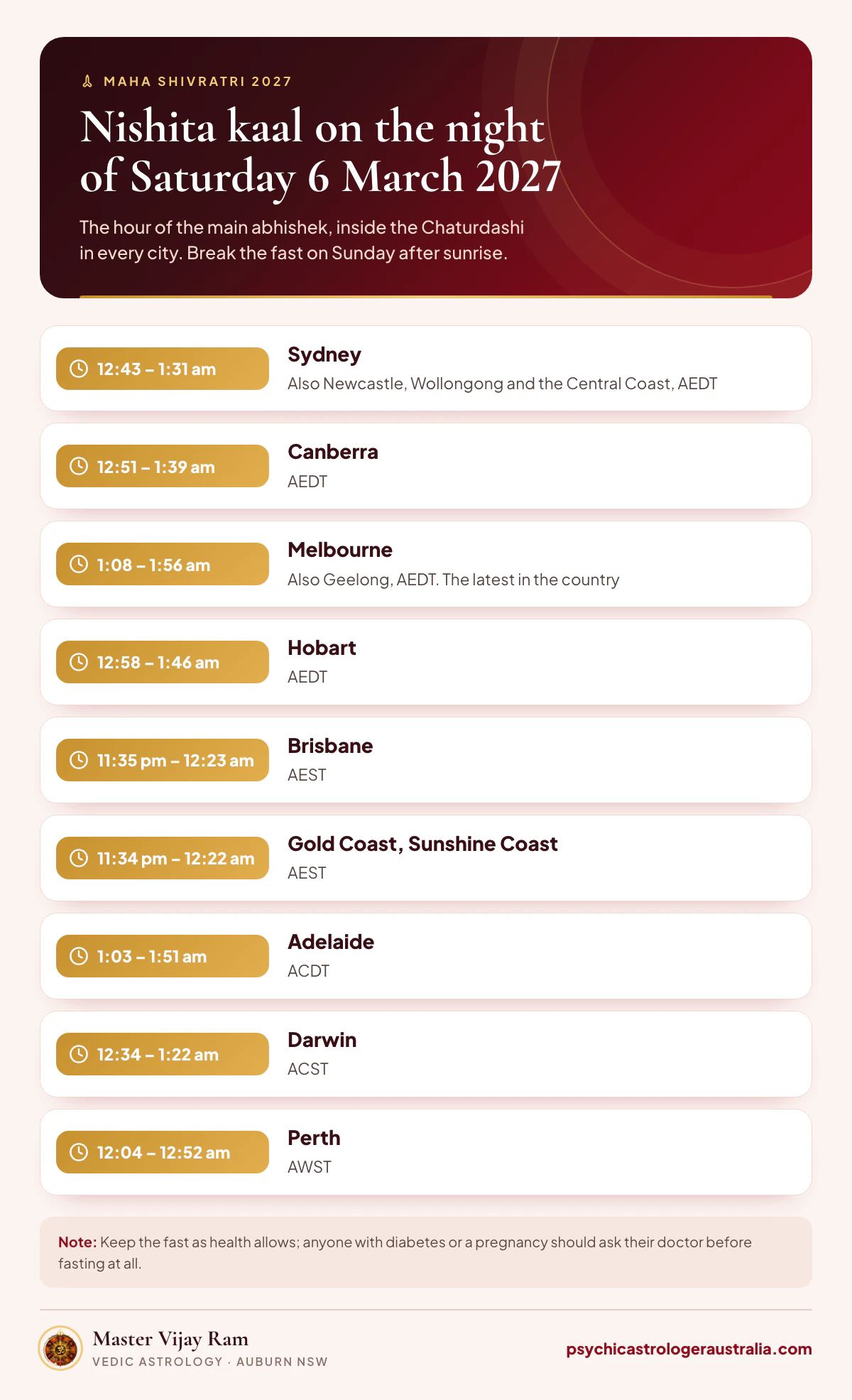
Nishita is the middle of the night, from sunset to the next sunrise, with a ghati of twenty-four minutes on either side. It is the hour of the main abhishek, and in early March it falls well after midnight in the daylight-saving cities and before midnight in Brisbane.
| City | Sunset, Saturday 6 March 2027 | Nishita kaal | Sunrise, Sunday 7 March |
|---|---|---|---|
| Sydney, Newcastle, Wollongong, Central Coast | 7:26 pm AEDT | 12:43 am – 1:31 am | 6:47 am |
| Canberra | 7:35 pm AEDT | 12:51 am – 1:39 am | 6:55 am |
| Melbourne, Geelong | 7:53 pm AEDT | 1:08 am – 1:56 am | 7:10 am |
| Hobart | 7:48 pm AEDT | 12:58 am – 1:46 am | 6:57 am |
| Brisbane | 6:15 pm AEST | 11:35 pm – 12:23 am | 5:44 am |
| Gold Coast, Sunshine Coast | 6:14 pm AEST | 11:34 pm – 12:22 am | 5:42 am |
| Adelaide | 7:47 pm ACDT | 1:03 am – 1:51 am | 7:07 am |
| Darwin | 7:06 pm ACST | 12:34 am – 1:22 am | 6:50 am |
| Perth | 6:46 pm AWST | 12:04 am – 12:52 am | 6:10 am |
| New Delhi (reference) | 6:24 pm IST | 12:08 am – 12:56 am | 6:40 am |
Every one of these windows lies inside the Chaturdashi, so there is no city where the abhishek has to be hurried. Melbourne's is the latest in the country, nearly two in the morning, which is what summer time and a western longitude do to a midnight.
The four prahar pujas
Families and temples that keep the full vigil divide the night into four prahars from sunset to sunrise and perform an abhishek in each: milk in the first, curd in the second, ghee in the third and honey in the fourth, by the most common custom. The prahars are equal quarters of the local night, so they too shift with the city.
| City | First prahar | Second prahar | Third prahar | Fourth prahar |
|---|---|---|---|---|
| Sydney | 7:26 – 10:16 pm | 10:16 pm – 1:07 am | 1:07 – 3:57 am | 3:57 – 6:47 am |
| Melbourne | 7:53 – 10:43 pm | 10:43 pm – 1:32 am | 1:32 – 4:21 am | 4:21 – 7:10 am |
| Brisbane | 6:15 – 9:07 pm | 9:07 – 11:59 pm | 11:59 pm – 2:52 am | 2:52 – 5:44 am |
| Adelaide | 7:47 – 10:37 pm | 10:37 pm – 1:27 am | 1:27 – 4:17 am | 4:17 – 7:07 am |
| Darwin | 7:06 – 10:02 pm | 10:02 pm – 12:58 am | 12:58 – 3:54 am | 3:54 – 6:50 am |
| Perth | 6:46 – 9:37 pm | 9:37 pm – 12:28 am | 12:28 – 3:19 am | 3:19 – 6:10 am |
| Hobart | 7:48 – 10:35 pm | 10:35 pm – 1:22 am | 1:22 – 4:10 am | 4:10 – 6:57 am |
Canberra's prahars begin at 7:35 pm and run about ten minutes behind Sydney's; the Gold Coast and the Sunshine Coast are within a minute of Brisbane. A family that cannot keep all four performs the nishita abhishek alone, which the tradition treats as the heart of the night.
The fast and the parana on Sunday 7 March
The Shivratri fast runs from the Saturday morning through the night, kept on water, fruit or a single light meal according to custom and health, and it is broken, the parana, on Sunday 7 March after sunrise and before the Chaturdashi ends at 7:17 pm AEDT. In practice that is any time on Sunday in Australia, after a sunrise of 6:47 am in Sydney, 7:10 am in Melbourne, 5:44 am in Brisbane and 6:10 am in Perth.
A nurse coming off a Saturday night shift, a student with Monday's exam or a parent with a baby keeps the fast as health allows; the tradition has always bent to duty, and anyone with diabetes or a pregnancy should ask their doctor before fasting at all.
Shivratri on a Saturday night
Saturday is Shani's day, and a Shivratri that falls on it is an old favourite of the remedy books, since Shiva is the lord of Saturn and the night is the one most often prescribed for a Saturn under strain. It is also, more plainly, a night most Australians can keep: the vigil ends on a Sunday morning, the temples can stay open until dawn without a working day behind them, and the family can sleep.
The Melbourne and Sydney temples will hold aratis through all four prahars, the Shiva temples among them certainly, and a family that wants the midnight abhishek at home and the dawn arati at the temple can have both. Melbourne's nishita is the latest on the mainland, at 1:08 am, and Hobart's is 12:58 am; a family in Geelong follows Melbourne's clock within a minute.
A Rudrabhishek at home
The home puja needs a Shivling or an image, water, milk, bilva leaves and a lamp, and the family awake. It fits inside the nishita window, with the fuller vigil for those who keep it.
- Bathe in the evening, set the Shivling on a tray that can drain, and light the lamp at sunset to open the first prahar.
- At nishita, pour water, then milk, curd, honey and ghee over the Shivling, then water again, reciting Om Namah Shivaya or the Rudram if the family knows it.
- Offer bilva leaves in threes, white flowers, bhasma and a little fruit, and sing the Shiva arati with everyone awake.
- Keep the lamp through the night if you can, and break the fast after Sunday's sunrise.
Nothing here needs a priest, and a child asleep on the sofa by the second prahar has still kept Shivratri.
Shiva, Saturn and Sade Sati in 2027
On 6 March 2027 Saturn stands in sidereal Pisces, where it remains until 3 June, which places the Aquarius moon sign in the last phase of Sade Sati, Pisces in the peak and Aries in the first phase, with the Dhaiya on Sagittarius and Leo. For those six signs the Shivratri night has always been the traditional opening of a Saturn remedy, a Rudrabhishek or a Shani shanti, and it is why Master Vijay Ram's diary fills in the week before.
Whether a particular chart needs that is a question for a reading and not for the calendar. The Sade Sati and Shani remedies page explains what is looked at first, the Sade Sati 2027 guide sets out the phases for the year, and the comparison with the Saturn return is for readers who have heard both terms and are not sure which is theirs.
The sky of Shivratri 2027
The Sun has been in sidereal Aquarius, Kumbha, since 13 February, and the Moon on the night of the vigil is in Capricorn, in the nakshatra Dhanishta, thin and rising only before dawn, which is why the night is dark and why the tradition gave it to Shiva. Mercury turned direct on Wednesday 3 March after a retrograde that began on 10 February, so the festival falls three days into the post-retrograde shadow, which ends on 24 March.
None of this changes the puja, and the shadow is of interest only to anyone signing something in the Shivratri week. Daylight saving in the south-eastern states ends on Sunday 4 April, so the times above are the last of the summer's late midnights.
What Shivratri means in a reading
Shivratri is the night the tradition gives to dissolving what is stuck, and astrologers use it for the remedies of Saturn above all, then of Ketu and the Moon. The Shivratri puja time is the same for a whole city; what differs is whether a given chart needs a remedy at all, and the honest answer is that many do not.
Where a reading finds one is warranted and the family cannot keep the vigil themselves, a Rudrabhishek or a Shani shanti is performed personally on request at his own place of practice in Auburn during the nishita window, with the family joining by video. A consultation is $50; a puja performed on request starts from $250, and the figure is agreed before anything is performed. This is faith-based guidance, not medical, legal or financial advice.
What this page cannot do
It cannot tell your temple which prahar to open its doors for, and it cannot keep the vigil for you. The full 2027 festival calendar places Shivratri in the year, and the Holi 2027 page explains why the festival a fortnight later does split Australia from India when this one does not.
It also cannot choose a muhurat for a wedding or a griha pravesh in the Phalguna fortnight, which depends on the particular chart; that is the work of a muhurat consultation. What it can do is tell a family in Townsville or Tarneit that Saturday 6 March is the night, that their own midnight is the hour, and that Sunday is for breakfast.
Read next
- Janmashtami 2027 in Australia: Date and Nishita TimingJanmashtami 2027 is Wednesday 25 August in eastern Australia and Tuesday 24 August in Perth and India. Nishita puja t…
- Diwali 2026 and 2027 in Australia: Dates and Lakshmi Puja Times by CityDiwali falls on Sun 8 Nov 2026 and Fri 29 Oct 2027 across Australia. Lakshmi Puja sunset, Pradosh Kaal and Vrishabha …
- Diwali 2026 House & Aura Cleansing: Clear the Year's Heavy EnergyDiwali 2026 house and aura cleansing done honestly: clean first, use the Five-Lamp Check, and learn when heaviness is…
Frequently asked questions
What is the date of Maha Shivratri 2027 in Australia?
Saturday 6 March 2027 in every Australian city, with the vigil running through Saturday night into Sunday morning, and the same Saturday in India. The Magha Krishna Chaturdashi runs from 5:34 pm on the Saturday to 7:17 pm on Sunday 7 March in Sydney time, so the midnight of Saturday night falls inside it everywhere, which is the nishita test the festival uses. No city or country is a day apart this year.
What time is the Shivratri puja in Sydney and Melbourne?
The main abhishek belongs to nishita kaal, the middle of the night: 12:43 to 1:31 am in Sydney and 1:08 to 1:56 am in Melbourne, both AEDT, on the night of Saturday 6 March 2027. The four prahars begin at sunset, 7:26 pm in Sydney and 7:53 pm in Melbourne, and run in equal quarters to sunrise at 6:47 am and 7:10 am. Canberra's nishita is 12:51 to 1:39 am and Hobart's 12:58 to 1:46 am.
What time is the Shivratri puja in Brisbane, Adelaide and Darwin?
Brisbane, on standard time, has the earliest nishita in the country, 11:35 pm to 12:23 am AEST, with the prahars from sunset at 6:15 pm to sunrise at 5:44 am; the Gold Coast is a minute earlier. Adelaide's nishita is 1:03 to 1:51 am ACDT, with sunset at 7:47 pm, and Darwin's is 12:34 to 1:22 am ACST, with sunset at 7:06 pm. All three windows are inside the Chaturdashi.
What time is the Shivratri puja in Perth?
Nishita kaal in Perth is 12:04 to 12:52 am AWST on the night of Saturday 6 March 2027, with the Chaturdashi present on Perth's clock from 2:34 pm on the Saturday to 4:17 pm on the Sunday. The four prahars run from sunset at 6:46 pm in quarters of about two hours and fifty minutes to sunrise at 6:10 am, and the fast is broken after that sunrise on the Sunday.
When is the Shivratri fast broken in 2027?
On Sunday 7 March 2027, after sunrise and before the Chaturdashi ends, which is 7:17 pm AEDT in the eastern cities, 6:47 pm ACDT in Adelaide, 5:47 pm ACST in Darwin and 4:17 pm AWST in Perth. In practice the parana can be any time on the Sunday morning or early afternoon. Those who cannot fast for medical reasons keep the vigil without the fast, which the tradition accepts.
What are the four prahar pujas?
The night from sunset to sunrise is divided into four equal prahars, and an abhishek is performed in each, most commonly with milk in the first, curd in the second, ghee in the third and honey in the fourth. In Sydney on 6 March 2027 the prahars run 7:26 to 10:16 pm, 10:16 pm to 1:07 am, 1:07 to 3:57 am and 3:57 to 6:47 am. A family that keeps only one performs the nishita abhishek, which is the heart of the night.
Is Maha Shivratri 2027 on the same day in India?
Yes, Saturday 6 March 2027. In India the Chaturdashi runs from 12:04 pm on the Saturday to 1:47 pm on the Sunday, so Saturday's midnight is inside it, with nishita kaal in Delhi at 12:08 to 12:56 am. Because the tithi lasts over twenty-five hours and begins in the afternoon, it covers Saturday's midnight on every clock in the world, which is why Shivratri does not split Australia from India the way Holi does a fortnight later.
Why is Shivratri linked with Saturn and Sade Sati?
Shiva is the lord of Saturn, and the remedy books give Shivratri, above all a Shivratri on a Saturday, as the night to begin a Rudrabhishek or Shani shanti for a Saturn under strain. On 6 March 2027 Saturn is in sidereal Pisces, which puts Aquarius in the last phase of Sade Sati, Pisces in the peak and Aries in the first, with Dhaiya on Sagittarius and Leo. Whether a chart needs the remedy is a question for a reading.
Does Mercury retrograde affect Shivratri 2027?
No. Mercury turned direct on Wednesday 3 March 2027, three days before the festival, and only its post-retrograde shadow remains, until 24 March. The puja, the fast and the vigil are acts of devotion and are untouched by any planet's motion; the shadow is of interest only to someone signing a contract in the Shivratri week, who should read it twice.
People also ask
When is Maha Shivratri 2027?
Saturday 6 March 2027, in Australia and in India, with the vigil through Saturday night and the fast broken on Sunday 7 March. The festival is kept on the night whose middle falls inside the Magha Krishna Chaturdashi, and in 2027 that tithi covers Saturday's midnight everywhere, from 5:34 pm Saturday to 7:17 pm Sunday in Sydney time.
What is nishita kaal on Shivratri?
The middle of the night, from sunset to the next sunrise, with a ghati of twenty-four minutes on either side, about forty-eight minutes in all. It is the hour of the main abhishek. On 6 March 2027 it falls at 12:43 to 1:31 am in Sydney, 11:35 pm to 12:23 am in Brisbane and 12:04 to 12:52 am in Perth, later in the daylight-saving cities because their clocks run an hour ahead of the Sun.
What should be offered to Shiva on Shivratri?
Water first, then milk, curd, honey and ghee poured over the Shivling, then water again, with bilva leaves in threes, white flowers, bhasma, a little fruit and a lamp, and the mantra Om Namah Shivaya or the Rudram for those who know it. The abhishek is performed at nishita, or in each of the four prahars for those keeping the full vigil, and the fast is broken after Sunday's sunrise.
Can I keep the Shivratri vigil if I work on Sunday?
Yes. The heart of the night is the nishita abhishek, about forty-eight minutes after midnight in most Australian cities, and a family that performs it and sleeps afterwards has kept Shivratri. The fast is kept as health and duty allow, broken after Sunday's sunrise, and a nurse coming off nights or a parent with a baby keeps a lighter version with a clear conscience; the tradition has always bent to duty.
Is Shivratri a good night to start a Saturn remedy?
It is the night the remedy books give for it, and a Saturday Shivratri, as in 2027, doubly so, since Saturday is Saturn's own day. Saturn in Pisces on 6 March 2027 places Aquarius, Pisces and Aries in Sade Sati and Sagittarius and Leo in Dhaiya. Whether a particular chart needs a Rudrabhishek or a Shani shanti, or nothing at all, is what a reading decides; the night is the same for everyone.
References & further reading
Serving clients across Australia
Confidential consultations by phone, video & WhatsApp — including: