
Quick answer
A Sundarkand path is a sung recitation of the Sundar Kand, the Ramayana’s fifth book, in which Hanuman crosses to Lanka and finds Sita. Families hold one at home on a Tuesday or Saturday for a new house, an illness, a stalled plan or a hard year: a lamp, a group, a few hours of singing, then prasad.
What is a Sundarkand path, and why do families hold one at home?
A Sundarkand path is a recitation of the Sundar Kand, the fifth book of the Ramayana, in which Hanuman crosses the ocean to Lanka, finds Sita and carries back word that she is alive. Most families who hold a Sundarkand path at home use the Awadhi version in Tulsidas’s Ramcharitmanas, sung together over an afternoon or an evening with a harmonium, a dholak and a lamp. It is a household’s way of asking for courage when a task looks too big, and of giving thanks when one has been done.
Master Vijay Ram is often asked whether a path suits a new house, an illness or a long run of obstacles, and whether it can be done properly in a flat. This guide answers those questions, and a path or puja performed on request describes the version he performs himself for families who cannot host one.
What happens in the Sundar Kand?
The book belongs to Hanuman from start to finish. In Tulsidas’s telling it opens with Hanuman stirred by Jambavan’s encouragement, and the third of its opening Sanskrit verses, Atulita baladhamam, is the praise of Hanuman that many families know by heart without knowing where it comes from. Then he leaps.
Over the ocean he is tested three times: a mountain rises to offer him rest, Surasa, the mother of serpents, blocks his way, and a demoness who catches flying creatures by their shadows tries to drag him down. In Lanka he searches the city at night in a tiny form, meets Vibhishana, and finds Sita in the Ashoka grove, grieving and close to despair, where he lets Rama’s ring fall for her to see.
Then the story turns. Hanuman wrecks the grove, is bound and brought before Ravana, warns him to return Sita, has his tail set alight and burns the city with it, and carries Sita’s hair jewel back to Rama. Tulsidas closes the book with Vibhishana taking refuge with Rama and the ocean yielding, so that the bridge can be built.
Why this book, of all the Ramayana?
Because it is the part of the epic where things start to go right. The army is stuck on the wrong side of the sea, Sita has nearly given up, and one devoted servant does what everyone believed could not be done; families read it when they feel stuck on the wrong side of something themselves. The tradition explains the name in more than one way, as the beauty of the story itself or as a pet name Hanuman’s mother is said to have used.
The Sundarkand path benefits people speak of are the ones the story models: courage, obstacles cleared, hope coming back after bad news, and a household gathered around something other than its worry. In the tradition Hanuman is present wherever Rama’s story is told, so many families lay an empty seat for him before they begin.
When do families hold a path?
Tuesday and Saturday are the usual days, and a Sundarkand on Tuesday evening, straight after work, is a common pattern in Australian homes. The occasions are the big turns of family life: moving into a house, a wedding coming up, a parent in hospital, a son or daughter leaving for study, a court date, a business that keeps stalling, or the end of a year the family wants to close properly.
Some families tie it to the calendar instead. Chaitra Navratri begins on Thursday 8 April 2027 in Australia and ends at Ram Navami, Thursday 15 April 2027 in every city; households that read the whole Ramcharitmanas over those nine days, the navahna path, pass through the Sundar Kand along the way, and others hold a single Sundarkand evening on Ram Navami itself or on Hanuman Jayanti.
| City | Date | Chaitra Shukla Navami (local time) | Rule applied |
|---|---|---|---|
| Sydney | Thu 15 Apr 2027 | Wed 14 Apr 2027, 7:54 PM AEST – Thu 15 Apr 2027, 5:51 PM AEST | tithi present at midday (madhyahna) |
| Melbourne | Thu 15 Apr 2027 | Wed 14 Apr 2027, 7:54 PM AEST – Thu 15 Apr 2027, 5:51 PM AEST | tithi present at midday (madhyahna) |
| Brisbane | Thu 15 Apr 2027 | Wed 14 Apr 2027, 7:54 PM AEST – Thu 15 Apr 2027, 5:51 PM AEST | tithi present at midday (madhyahna) |
| Perth | Thu 15 Apr 2027 | Wed 14 Apr 2027, 5:54 PM AWST – Thu 15 Apr 2027, 3:51 PM AWST | tithi present at midday (madhyahna) |
| Adelaide | Thu 15 Apr 2027 | Wed 14 Apr 2027, 7:24 PM ACST – Thu 15 Apr 2027, 5:21 PM ACST | tithi present at midday (madhyahna) |
| Canberra | Thu 15 Apr 2027 | Wed 14 Apr 2027, 7:54 PM AEST – Thu 15 Apr 2027, 5:51 PM AEST | tithi present at midday (madhyahna) |
| Hobart | Thu 15 Apr 2027 | Wed 14 Apr 2027, 7:54 PM AEST – Thu 15 Apr 2027, 5:51 PM AEST | tithi present at midday (madhyahna) |
| Darwin | Thu 15 Apr 2027 | Wed 14 Apr 2027, 7:24 PM ACST – Thu 15 Apr 2027, 5:21 PM ACST | tithi present at midday (madhyahna) |
| New Delhi (reference) | Thu 15 Apr 2027 | Wed 14 Apr 2027, 3:24 PM IST – Thu 15 Apr 2027, 1:21 PM IST | tithi present at midday (madhyahna) |
The tithi is one moment everywhere; only the clock and the sunrise differ, which is why a city can fall a day apart from India. Computed with the Swiss Ephemeris (Lahiri ayanamsa for Vedic positions) and checked against US Naval Observatory data. Times are rounded to the minute.
How does a path run at home?
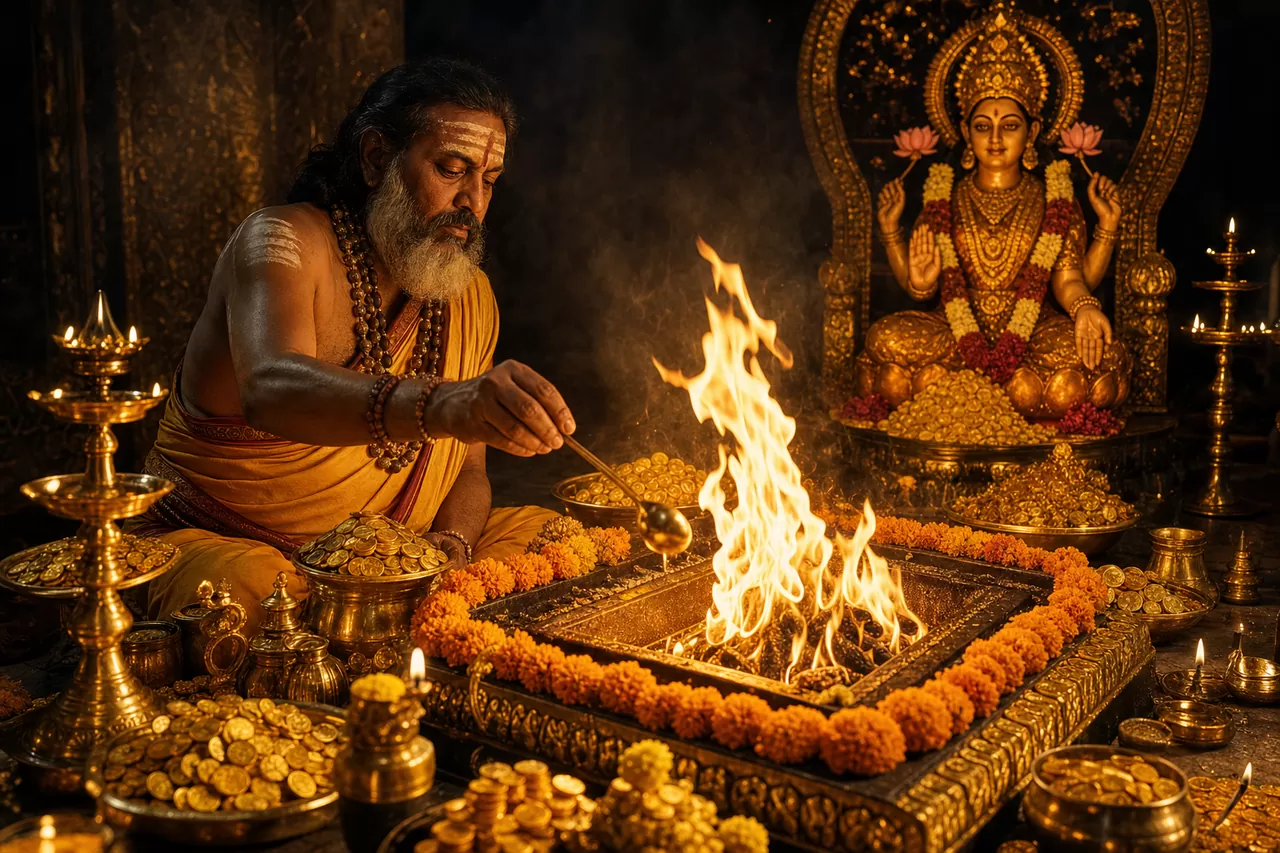
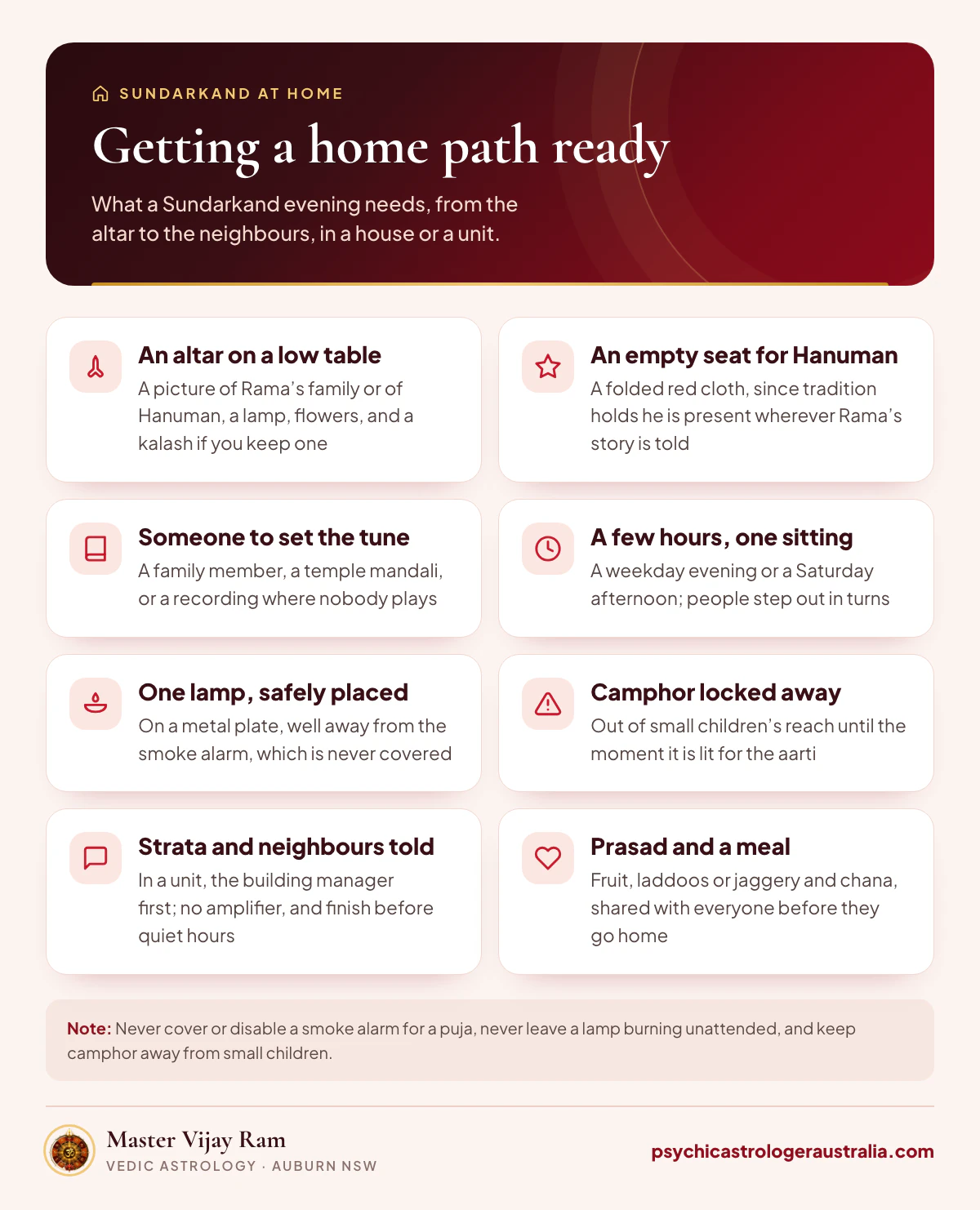
The lounge room is cleared and a low table becomes the altar: a picture of Rama with Sita, Lakshmana and Hanuman, or of Hanuman alone, a lamp, flowers, a kalash of water if the family keeps one, and a folded red cloth for the empty seat. Everyone sits on the floor except the elders and anyone who cannot, who are given chairs without any fuss. The path begins with an invocation to Ganesha, often the Hanuman Chalisa as well, and then the Sundar Kand itself.
One person sets the tune for each passage and the room sings with them, slowing a little for the doha that closes it. A harmonium, a dholak and a pair of manjira keep the music; a recording can stand in where nobody plays. The path ends with the aarti of Rama and of Hanuman, the prasad is shared, and in most homes a meal follows.
Who leads it, and what if nobody reads Hindi?
Any family member who can follow the text can lead, and many groups pass the book around so that everyone takes a passage. Editions that print the Awadhi beside a Roman transliteration and an English or Hindi meaning are easy to find, and many younger readers in Australia lead a path from a transliterated copy. A temple mandali, a group of singers who do this often, can be invited where the family would rather join in than lead.
What matters is that someone keeps the pace steady and the room together. A path sung too fast to follow becomes a performance rather than a prayer.
How long does it take, and can it stop halfway?
A sung path usually takes a few hours, which is why families start on a weekday evening or a Saturday afternoon. Read aloud by one practised reader rather than sung, it is shorter. The custom is to finish in one sitting, with people taking turns to step out for a child or a phone call rather than the path pausing for everyone.
If an emergency interrupts it, the tradition is not cruel: pick up where you stopped when you can, or begin again on another day. Nobody is punished for a dash to the hospital.
Can a Sundarkand be held in a unit or an apartment?
Yes, with a little planning, and the table shows how the three usual settings differ. Smoke alarms are required in every home and must never be covered or switched off for a puja; one ghee lamp on a metal plate is enough, and the camphor for the aarti stays locked away from small children until the moment it is lit. A small, safe havan in an apartment covers the fire rules for families who want to add one.
| Setting | Space and seating | Sound | Lamp and aarti | Who to tell first |
|---|---|---|---|---|
| A house | The lounge room cleared; chairs for the elders | Harmonium and dholak at normal volume; windows shut as it gets late | A ghee lamp on a metal plate; camphor lit only for the aarti | The next-door neighbours, with an invitation and some prasad |
| A unit or apartment | Fewer guests; cushions rather than a full carpet | Voices and manjira, the dholak soft, no amplifier; finish well before quiet hours | One small lamp well away from the alarm; an electric diya where by-laws forbid a flame | The strata or building manager, then the neighbours on the shared wall |
| A hired hall or temple | Room for a large group and a meal | Amplified singing is often allowed; ask | The venue’s own rules on flame and incense | The booking officer, about flame, food and finishing time |
Parking is the other courtesy. A dozen cars in a quiet court in Point Cook or Kellyville will be remembered long after the prasad has gone, so ask guests to share rides or park around the corner.
What should guests know before they come?
Shoes come off at the door, phones go on silent, and children are welcome as long as someone watches them near the lamp. Guests usually bring fruit or sweets for the prasad rather than a gift for the house, and the meal afterwards is often vegetarian and sattvic, cooked without onion or garlic, though families differ. Anyone with asthma is better seated well away from the lamp and any incense.
Nobody has to know the words. A guest who simply sits and listens has taken part as fully as anyone, in the tradition’s view, and the host’s one real job is to see that everyone is fed before they go home.
What are the Sundarkand rules, and which are only custom?
The Sundarkand rules families mention most are a bath and clean clothes before beginning, a seat laid for Hanuman, the book on a stand or a cloth rather than the floor, no meat or alcohol in the house that day, and the path finished in one sitting. All of them are customs of respect, and households keep them more or less strictly.
Questions about who may read have gentler answers than many people fear. Women lead paths in homes and temples everywhere, children join in, and guests of other faiths are welcome to sit with the family; traditions differ on menstruation, and many households no longer ask anyone to stay away.
Can a path help a family through illness or into a new home?
As prayer, yes, and that is how families have always used it. The Sundarkand for protection of a household going through illness sits beside the doctors, never ahead of them: the treatment plan, the specialist and the hospital social worker come first, and the path gathers the family around the person rather than around the fear. Health and wellbeing readings look at the timing in a chart when a family wants that as well, and never replace a diagnosis.
For a new home, a path is often held on the first Tuesday or Saturday after moving in, or folded into the house-warming itself. A griha pravesh house-warming puja is the fuller rite for entering a house, and the home blessing he performs is carried out at his place of practice in Auburn, with the family joining by video.
Where in Australia can you join a group path?
Ask your nearest mandir first, because north Indian temples and Ramayan mandalis often hold group recitations on a Tuesday or Saturday evening. In Brisbane the Shree Laxmi Narayan Mandir at Burbank also serves Gold Coast families, and Melbourne families have the Shri Shiva Vishnu Temple at Carrum Downs; in Sydney, with temples and community halls spread across the west, the quickest guide is usually a family friend who already hosts paths.
In Perth the Perth Hindu Temple at Canning Vale, and in Adelaide the Shri Ganesha Temple at Oaklands Park, are long-established community homes and good places to ask. Families anywhere can consult by phone or video as well; phone and video readings in Brisbane explains how that works; for anyone who wants to sit across the table, Auburn is the only place, by appointment.
What if you cannot host a path yourself?
Many families cannot: the unit is too small, the family is scattered between Australia and India, or the person who always led the path has died. Vijay Ram ji performs a Sundarkand path personally at his place of practice in Auburn on a chosen muhurat, with the family joining by video if they wish and the prasad offered on their behalf. A path performed this way starts from $250, agreed before anything is done, and a $50 consultation comes first where the family wants the timing or the reason read.
For the daily practice between paths, the Hanuman Chalisa for fear and protection is the shorter companion most households keep.
What can a Sundarkand path not do?
It cannot cure an illness, sell a house, win a court case or change another person’s mind, and nobody can promise that it will. It is offered here as devotion and faith-based guidance, not medical, legal or financial advice, and a family in crisis needs its doctors, lawyers and counsellors working at the same time.
What a path does is quieter and real: a room full of people singing one story for a few hours, a household that stops talking about its trouble long enough to remember its strength, and a tradition that has carried families across wider oceans than this one.
Read next
- Hanuman Chalisa for Fear and Protection: How Many Times, and WhenHanuman Chalisa for protection and fear: what the forty verses say, how many times to recite it, which days suit it, …
- How to Remove Negative Energy From Yourself: Vedic MethodsVedic ways to clear negative energy from yourself: what to rule out first, safe home practices, the four-gate reset, …
- Rudraksha Beads: Mukhi Types and an Honest Guide to Wearing OneRudraksha explained honestly: what the bead is, mukhi types and why lists differ, the five-mukhi bead, how to wear an…
Frequently asked questions
How long does a Sundarkand path take?
Sung by a group with a harmonium and dholak, a Sundarkand path usually takes a few hours, so families start on a weekday evening or a Saturday afternoon. One practised reader reading rather than singing takes less time. The custom is to finish in one sitting, with people stepping out in turns, and a meal usually follows the aarti and prasad.
Which day is best for a Sundarkand path?
Tuesday and Saturday are the traditional days, because both belong to Hanuman. Families also hold a path on Ram Navami or Hanuman Jayanti, on the first Tuesday or Saturday in a new home, before a wedding or a court date, or when a parent is in hospital. A muhurat can be chosen for a big occasion, but an ordinary Tuesday evening is perfectly proper.
Can we do a Sundarkand path at home without a pandit?
Yes. A Sundarkand path is a recitation, and any family member who can follow the text can lead it, with the others singing along. Editions with Roman transliteration and meanings make it possible for those who do not read Devanagari. Some families invite a temple mandali to lead the music, and some ask for a path to be performed on their behalf instead.
Can women lead or read the Sundarkand?
Yes. Women lead Sundarkand paths in homes and temples everywhere, and nothing in the text bars them. Traditions differ on menstruation: some families step back from ritual for those days, while many no longer ask anyone to stay away from a recitation. Children and guests of other faiths are welcome to sit with the family and listen.
What prasad is offered at a Sundarkand path?
Families commonly offer boondi or besan laddoos, jaggery with roasted chana, fruit, or a sweet made at home, and guests often bring fruit or sweets to add to it. The meal that follows is usually vegetarian and often sattvic, cooked without onion or garlic, though families differ. Prasad is shared with everyone present before they leave.
Can a Sundarkand path be held in an apartment?
Yes, with planning. Tell the strata or building manager and the neighbours on the shared wall, keep the guest list small, sing without an amplifier, keep the dholak soft and finish well before quiet hours. Never cover or disable the smoke alarm: use one small lamp on a metal plate well away from it, or an electric diya where by-laws forbid a flame.
Is the Sundarkand the same as the Hanuman Chalisa?
No. The Hanuman Chalisa is a single hymn of forty chaupais in praise of Hanuman that takes minutes to recite. The Sundar Kand is a whole book of the Ramayana telling his journey to Lanka, and a sung path takes a few hours. Many families recite the Chalisa at the start of a Sundarkand path and keep it daily in between.
Can a Sundarkand path be held for someone in hospital?
Yes, families often hold one when a parent or child is seriously ill, and the person can join by video if they are well enough. The path is prayer and comfort for the household; it sits beside the treatment plan and the doctors, never ahead of them. Keep it gentle, and let the patient decide whether they want to be part of it.
What does it cost to have a Sundarkand path performed for us?
The path is recited by Master Vijay Ram himself in Auburn, where he practises, at a muhurat chosen for the family, who can take part over video. Fees start at $250 and are agreed before the day, and a $50 phone, video or WhatsApp consultation comes first if the family wants the timing or the reason looked at.
What happens if a Sundarkand path is interrupted?
The custom is to finish in one sitting, with people stepping out in turns, but an emergency comes first. If the path has to stop, pick up where you left off when you can, or begin again on another Tuesday or Saturday. The tradition does not punish a family for a hospital dash or a sick child.
People also ask
What are the benefits of reading the Sundarkand?
In the tradition, courage, obstacles removed and hope restored, because the Sundar Kand is the part of the Ramayana where an impossible task is done and Sita learns she has not been forgotten. In practical terms a path gathers a household around something other than its worry for a few hours. It does not cure illness or settle disputes, and no one can promise outcomes.
Why is the Sundar Kand called Sundar?
Sundar means beautiful, and the tradition explains the name in more than one way: as the beauty of the story itself, in which despair turns to hope, or as a pet name that Hanuman’s mother is said to have used for him. The book is the fifth of the Ramayana in both Valmiki’s Sanskrit epic and Tulsidas’s Awadhi Ramcharitmanas.
What should not be done during a Sundarkand path?
By custom, no meat or alcohol in the house that day, no book on the bare floor, no leaving the path unfinished if it can be helped, and no loud talk or phones during the singing. Practically, never cover or disable a smoke alarm, never leave the lamp unattended, and keep camphor locked away from small children until it is lit.
Is a Sundarkand path good for a new house?
Many families hold one on the first Tuesday or Saturday after moving in, or as part of the house-warming, so that the first large gathering in the house is a prayer. It complements a griha pravesh rather than replacing it. In an apartment, tell the strata manager and the neighbours first and keep the music soft.
References & further reading
Serving clients across Australia
Confidential consultations by phone, video & WhatsApp — including: